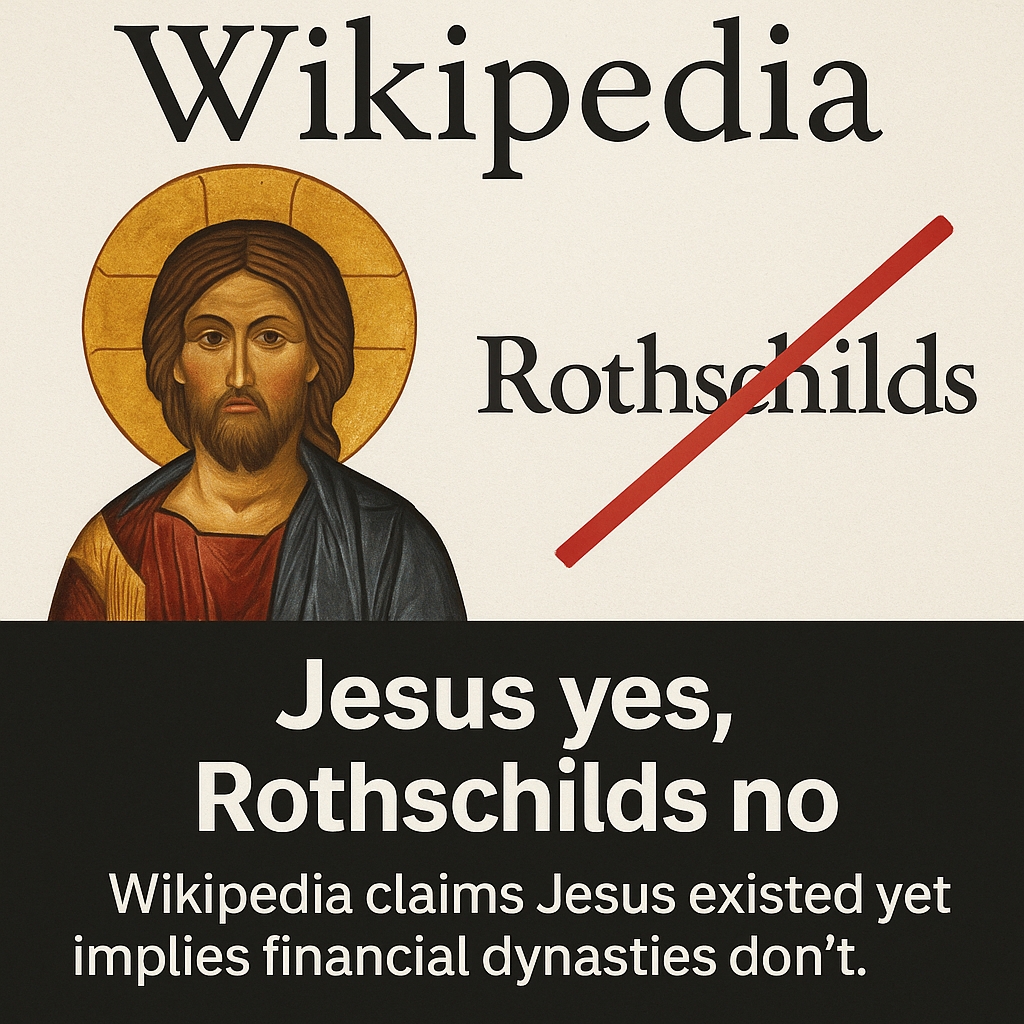
Wikipedia has a longstanding practice of promoting Jesus Christ as a real figure who existed. The issue is that those “arguments and evidence” are ad hoc. If Christian scholars defy Jesus’ existence, their career may end.
People without critical thinking accept whatever appears polished and repeated. They trust the first source they see, they trust authority without checking alternatives. And they never compare evidence. They never read outside the mainstream narrative. Therefore Wikipedia’s tone becomes their truth. Its confidence feels like certainty. Its language feels like proof. Without independent verification, anyone can mistake a constructed story for reality.
So they claim some charlatan existed in nowadays Palestine but the richest family doesn’t, despite heavy evidence.
How Jesus didn’t exist, not did
The debate over Jesus’ existence stands on two unequal foundations. One rests on evidence. The other rests on tradition. Once you put both sides on the table, the imbalance becomes obvious. Arguments against his existence rely on silence, contradictions, late sources, and missing records. Arguments for his existence rely on assumptions, theological consensus, and interpretations created decades after the supposed events.
The strongest point against historicity is the complete silence of contemporary writers. Nobody who lived during Jesus’ lifetime mentioned him at all. No Roman historian wrote about him, no Jewish administrator reported him. No philosopher, chronicler, or governor took notice. Rome documented everything, yet it documented nothing about Jesus. Archaeology adds nothing. There are no inscriptions, no artifacts, no synagogue records from Nazareth, no burial information, no official trial documents. The evidence disappears where the story claims magnitude.
What? Yes, he had never met him
The earliest Christian texts do not help either. Paul wrote two decades after the supposed crucifixion. He never met Jesus; he never quotes him. Add he never describes his life. He bases everything on visions. His Jesus looks cosmic, not historical. The gospels appear even later. Mark arrives forty years after the event. Matthew and Luke come later than that. John appears at the end of the century. All gospels are anonymous, all contradict each other. All recycle older mythological structures. And none show signs of eyewitness authorship.
No external sources
External sources fail as well. Josephus was heavily edited by Christian scribes. The original text remains unknown. Tacitus wrote nearly a century later and likely repeated what Christians told him. Suetonius mentions a different name entirely. Pliny the Younger reports Christian beliefs, not historical facts. None of these authors provide direct, independent confirmation.
These problems form the backbone of the mythicist argument: no contemporary testimony, no archaeology, no independent sources, late theological narratives, recycled myth patterns, and early Christians who worshiped a heavenly figure rather than a historical teacher. When the evidence collapses, the simplest explanation emerges. Christianity began as a vision-based, mythic movement. Only later did it attach the myth to an earthly biography.
Just because Christianity exists
However, supporters of Jesus’ historicity present their own arguments. They point to the existence of Christianity itself, they claim movements usually start with real individuals. And they argue that Paul’s references must point to a real figure behind the myth, they argue the gospels contain at least fragments of historical memory; they argue Josephus may preserve a small authentic core. They argue Tacitus supports the idea indirectly, they argue that the crucifixion story is too embarrassing to invent, they argue that multiple gospel sources hint at earlier traditions. They argue that Jesus fits patterns of Jewish teachers. And they argue that most scholars accept his existence.
How Rothchilds never existed and how they did
The world is controlled by banks and corporations. The super-rich families and multinational lobbyists are above them. Those families gained prominence either from the Middle Ages (not so many) or during the 19th century; those were called robber barons (Anglo-Saxon clientelism), and then there was new money (Jewish clientelism). All of this is evidence-based.
Some fortune magazines will try to tell you that their wealth is a fraction of their previous. Wrong! The richest part of society multiplies its wealth thousand times than other social groups. So did they lose their wealth in slot machines?
Wikipedia as a true-teller
There used to be Rothschilds conspiracy article. Of course, Wikipedia serves very well to the richest. Its structure must be interconnected with thousands of patron-client relationships and content editors who edit the way his paying lord wants.
Now, we don’t have any article. But the embarasment with Jesus Christ remains untouched.
If person doesn’t have critical thinking (no biases, no fallacies, no formal fallacies), then there is the answer Wikipedians and Christian scholars want – Jesus Christ was a historical figure and we can also prove he had done this and that.
And remember when it started as a project…
Leave a Reply