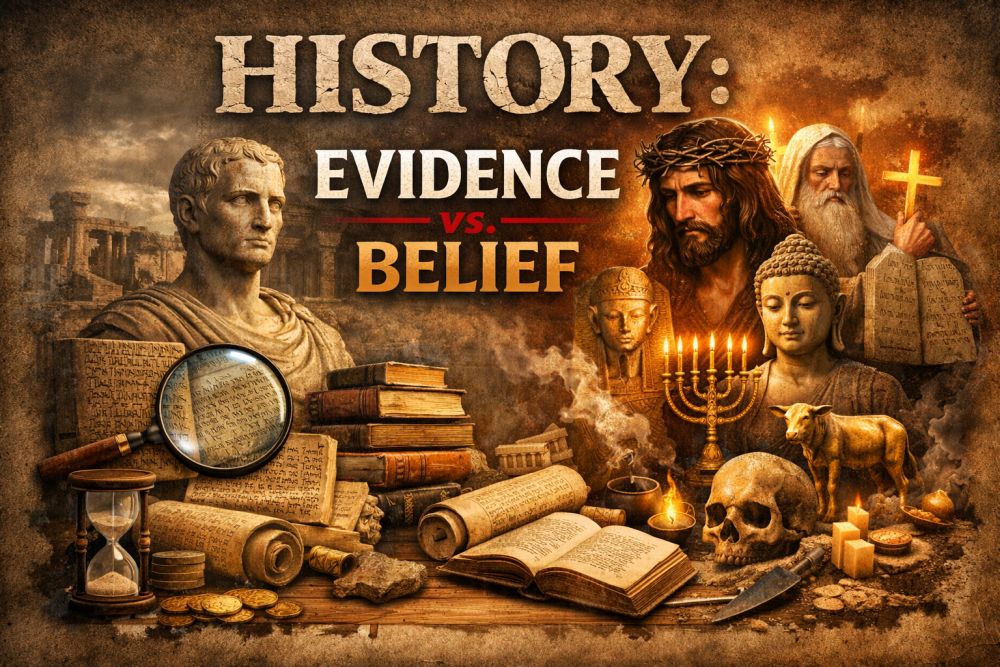
History does not reward belief.
It rewards traces.
When a human being acts in the world, reality pushes back. Institutions react. Enemies respond. Bureaucracies record. Money moves. Violence leaves scars. Those interactions generate documents, inscriptions, coins, ruins, correspondence, and contradictions. Historians work with these leftovers.
Because of this, historical method relies on several stable criteria. Contemporary or near-contemporary sources matter most. Independent attestations strengthen credibility. Material evidence anchors claims to the physical world. Chronological coherence prevents later invention. When these elements align, confidence rises. When they fail, doubt remains regardless of popularity or moral influence.
This method applies equally to kings, prophets, philosophers, and revolutionaries. The moment historians make exceptions, history collapses into theology.
Religious founders and the limits of belief-based history
Jesus Christ
Jesus stands at the center of the largest belief system in human history. At the same time, he remains one of the least securely attested figures ever placed at the core of civilization.
No contemporary Roman source mentions him during his supposed lifetime. No trial transcript exists, no execution order survives, no census record refers to him. And no inscription names him. No coin bears his image. No archaeological trace points to his activity.
The primary sources, the gospels, appear decades later. Authors wrote them anonymously. They used Greek, not Aramaic. They lived outside Judea. Their narratives contradict each other on genealogy, birth location, chronology, resurrection witnesses, and final words. These texts function as theology, not biography.
Paul, the earliest Christian author, never met Jesus. He describes him through revelation and scripture, not memory. He never mentions parables, miracles, a virgin birth, or an empty tomb. His Jesus appears as a celestial figure revealed through visions.
Later non-Christian references fail to close the gap. Tacitus writes almost a century later and likely repeats Christian claims. Josephus contains passages that most scholars regard as later Christian interpolation. Pliny reports Christian belief, not historical confirmation.
By normal historical standards, the evidence does not justify certainty. The most methodologically honest position remains agnosticism or mythicist minimalism. Christianity’s later political dominance explains why texts survived. It does not convert theology into evidence.
Muhammad
Muhammad presents a fundamentally different case.
Early Islamic sources appear within decades of his death and preserve a coherent biographical framework. Non-Muslim Byzantine and Syriac writers mention him and the Arab movement he led. Coins, inscriptions, and administrative continuity confirm a political founder whose actions reshaped the region.
Controversy surrounds revelation and theology. It does not surround existence. From a historian’s perspective, Muhammad existed as a real individual whose leadership produced measurable geopolitical consequences.
Moses
Moses occupies a central role in Judaism, Christianity, and Islam. Historical evidence, however, remains thin.
Egyptian records, which document even minor administrative matters, do not mention him. Archaeology fails to support an Exodus at the described scale. Biblical texts emerged centuries later and reflect theological construction rather than documentation.
Moses resembles a legendary lawgiver shaped by later national identity. A historical kernel remains possible. The biblical Moses does not survive critical scrutiny.
King David
David sits between legend and history.
Biblical narratives describe a powerful empire. Archaeology contradicts that scale. The Tel Dan Stele references a “House of David,” which suggests a dynastic founder. That evidence supports a real individual while rejecting the heroic biblical portrayal.
David likely existed. The biblical David largely did not.
Solomon
Solomon’s legendary wealth and empire lack external confirmation. Archaeology does not support the described splendor or administrative complexity. Scholars increasingly treat Solomon as ideological retrojection rather than historical reality.
Philosophers and teachers with partial or strong grounding
Buddha
The Buddha likely existed.
Early Buddhist texts appear within a plausible timeframe. Archaeology confirms organized Buddhist communities soon after his supposed lifetime. Miracle narratives emerge later, following a familiar pattern of posthumous mythologization.
This combination supports a historical teacher whose story accumulated legend.
Confucius
Confucius appears in early Chinese records close to his lifetime. His students transmitted teachings that evolved but retained a consistent core. His role fits known political and social structures of the Zhou period.
Minimal controversy surrounds his existence.
Zoroaster
Zoroaster influenced later monotheistic thought profoundly. Historical certainty, however, remains low.
Sources appear late and contradict each other. Linguistic evidence suggests antiquity but fails to anchor biography. Existence remains possible, not secure.
Socrates
Socrates wrote nothing. Independent sources confirm him anyway.
Plato, Xenophon, and Aristophanes describe him differently and even mock him. Such disagreement strengthens authenticity. His trial and execution align with Athenian legal practice.
This pattern reflects a real, disruptive individual rather than an invented character.
Plato and Aristotle
Plato and Aristotle leave no room for doubt.
Manuscripts survive. Students followed them. Institutions carried their work forward. Aristotle’s empirical observations align with real biology and physics. Intellectual continuity anchors both men firmly in reality.
Kings, emperors, and lawgivers with material proof
Hammurabi
Hammurabi’s law code survives carved in stone. Administrative tablets confirm his reign. Material evidence alone secures his existence.
Julius Caesar
Caesar represents historical certainty at its peak.
Contemporary writings survive. Coins circulate with his name. Inscriptions record his laws. Calendars change because of him. His assassination triggers a documented civil war.
Denying Caesar would dismantle Roman history itself.
Alexander the Great
Greek, Persian, Egyptian, and Babylonian sources document Alexander’s campaigns. Cities, coins, and administrative changes follow his conquests. Myth grows later. The man remains indisputable.
Augustus
Augustus anchors imperial Rome through inscriptions, laws, coins, and historians. Bureaucracy confirms his existence exhaustively.
Cleopatra
Cleopatra appears in Roman political records, hostile accounts, and coins minted during her reign. Her diplomatic actions reshape Mediterranean politics. Legend follows fact.
Medieval and early modern figures with cross-verification
Genghis Khan
Chinese, Persian, Islamic, and European sources describe Genghis Khan. Archaeological destruction layers align with recorded campaigns. His empire requires administrative coordination that only a real individual could generate.
Charlemagne
Royal decrees, church records, and contemporary chronicles confirm Charlemagne’s rule. His reforms reshape medieval Europe.
Saladin
Muslim and Christian enemies describe Saladin consistently. Treaties and military campaigns align across sources. Mutual hostility strengthens credibility.
Joan of Arc
Joan of Arc ranks among the best-documented medieval figures. Trial transcripts survive. Witnesses testify under oath. Political authorities record her execution. Visions remain debatable. The woman does not.
Artists, scientists, and modern figures beyond dispute
William Shakespeare
Tax records, legal disputes, publishing contracts, and references by contemporaries confirm Shakespeare’s existence. Debate concerns authorship details, not reality.
Leonardo da Vinci
Leonardo’s notebooks survive. Patrons paid him. Contracts exist. Artworks remain. Engineering sketches correspond to real materials and techniques.
Galileo Galilei
Galileo’s telescopes survive. His observations match astronomy. Trial records document institutional conflict. Physics itself confirms him.
Isaac Newton
Newton’s manuscripts, experiments, correspondence, and institutional roles remain preserved. Predictive mathematics anchors him to reality.
George Washington, Napoleon Bonaparte, Abraham Lincoln
Military records, correspondence, diplomacy, photographs, and legal proceedings confirm these figures exhaustively. Modern historiography leaves no ambiguity.
Final synthesis: History does not negotiate with belief
This article makes one claim only, yet that claim cuts deep. History does not care what people need to be true. It cares about what reality allowed to survive. When individuals lived, acted, ruled, taught, or conquered, they collided with the world around them. That collision produced debris. It produced records. It produced enemies, paperwork, corrections, and contradictions. Those traces remain the historian’s only currency.
Because of this, belief never substitutes for evidence. Popularity never upgrades weak sources. Moral influence never compensates for missing documentation. A figure followed by billions still fails the test if reality stayed silent. By contrast, a violent, flawed, or morally unimpressive person passes easily when coins, decrees, letters, courts, and hostile witnesses converge.
Patterns emerge once emotion drops out. Real people generate disorder. They provoke resistance, they force institutions to respond. They leave asymmetric accounts written by supporters and enemies alike. Mythical or legendary figures appear differently. Their stories arrive late. They arrive polished, they solve theological problems too cleanly. They lack friction with bureaucracy and power.
This distinction does not attack meaning. It protects method. One can admire ideas, ethics, or narratives without pretending they meet historical standards. Confusion begins only when faith demands historical immunity. At that moment, history stops and apologetics takes over.
The uncomfortable result follows naturally. Some famous figures existed beyond reasonable doubt. Others likely existed but grew under layers of legend. Some remain unprovable despite centuries of belief. No outrage changes that distribution. No vote overturns it.
History remains brutal in this sense. It does not compromise. And it does not comfort. It keeps what reality failed to erase and discards the rest. That discipline explains why history works at all.
Leave a Reply