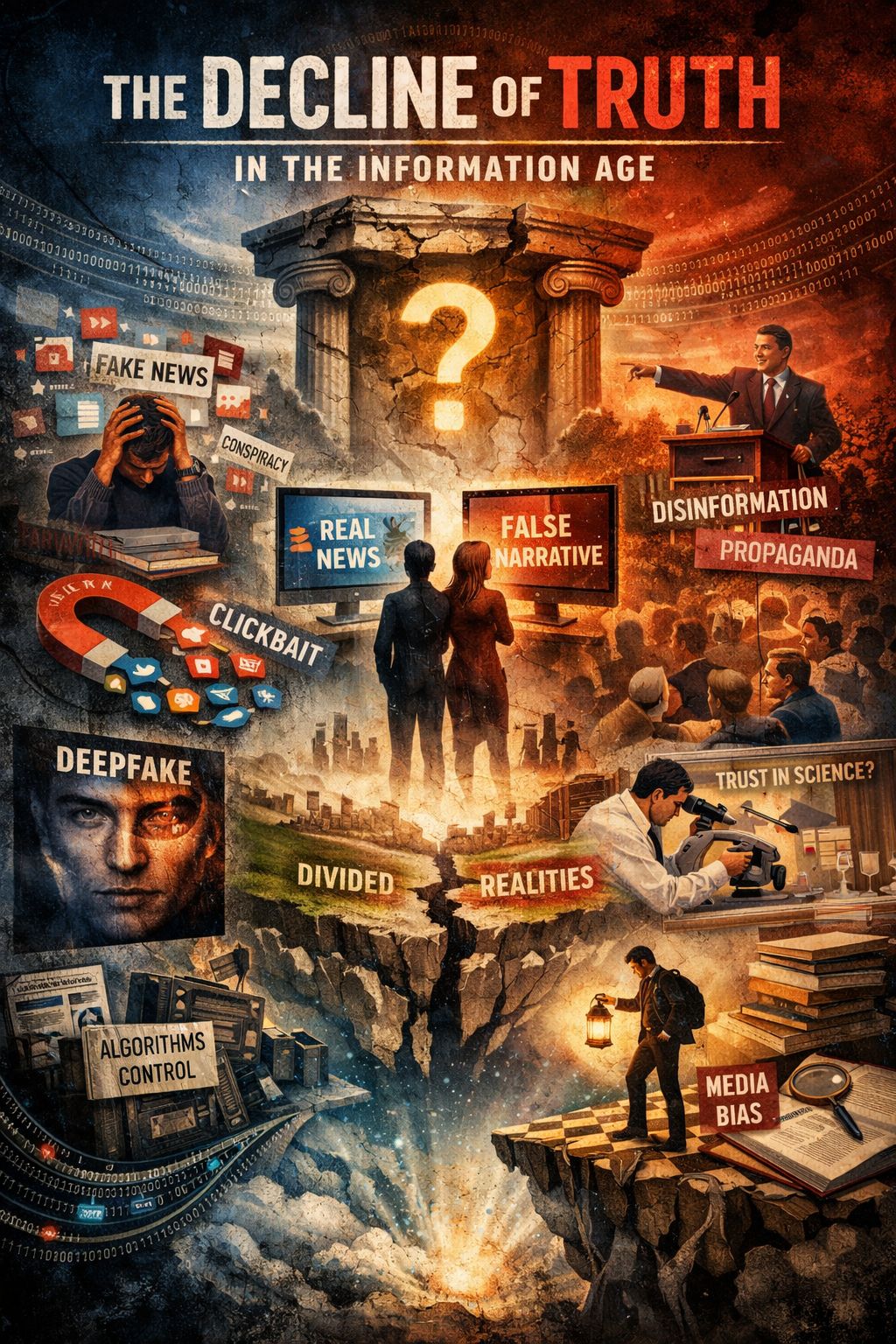
The information age does not simply expand knowledge. It reshapes how truth functions. Data multiplies. Sources proliferate. However, the ability to distinguish what is true weakens. This tension defines the modern condition. Truth does not disappear. It becomes harder to identify, defend, and share.
From controlled narratives to uncontrolled flows
For centuries, information moved through limited channels. Churches, states, and early media institutions filtered what people could know. These systems often distorted reality. Nevertheless, they imposed structure. Today, that structure collapses. Anyone can publish. Anyone can reach millions. Consequently, authority disperses. Control vanishes. Yet chaos replaces it.
Information overload and cognitive saturation
The human brain operates with limits. It cannot process infinite streams of data. However, the digital environment delivers exactly that. News, opinions, statistics, and images compete constantly for attention. As a result, individuals stop evaluating deeply. They skim, they react. They simplify. Therefore, shallow interpretation replaces careful reasoning.
The attention economy: truth loses to stimulation
Digital platforms monetize attention. Their survival depends on engagement. Consequently, they prioritize content that triggers emotion. Anger, fear, and outrage outperform calm analysis. This creates a structural bias. False or exaggerated claims spread faster than nuanced truth. Therefore, accuracy becomes economically disadvantaged.
Algorithmic curation and personalized realities
Algorithms decide what users see. They analyze behavior. They predict preferences. Then they deliver tailored content. This process feels convenient. However, it isolates individuals within informational bubbles. Two users receive different versions of reality. Over time, these differences widen. Shared truth fragments into parallel worlds.
The acceleration of misinformation dynamics
False information spreads differently than truth. It often appears simpler. It appeals to intuition. And it avoids complexity. In digital networks, these traits provide advantage. Misinformation adapts rapidly. It mutates. It reappears in new forms. Consequently, correcting it becomes difficult. Even when debunked, it persists.
Cognitive biases amplified by technology
Human cognition evolved for small groups and immediate environments. It relies on shortcuts. Confirmation bias, group loyalty, and emotional reasoning shape beliefs. In the digital age, these tendencies scale massively. Algorithms feed users what they already prefer. Therefore, biases no longer remain private. They become reinforced systems.
The erosion of epistemic authority
Scientific institutions, journalism, and academia once served as anchors of credibility. They offered methods for verification. However, trust in these institutions declines. Political polarization, visible errors, and perceived elitism undermine confidence. Consequently, people turn to alternative sources. Many lack standards. The result is epistemic fragmentation.
The transformation of journalism
Journalism itself undergoes structural change. Traditional media loses financial stability. Advertising shifts to digital platforms. Speed becomes essential. Verification slows publication. Therefore, outlets face pressure to publish quickly rather than accurately. At the same time, opinion merges with reporting. The boundary between fact and interpretation blurs.
Deepfakes and the collapse of visual evidence
Technological progress introduces a new problem. Artificial intelligence can generate realistic images, voices, and videos. These tools undermine the reliability of evidence. Previously, visual proof carried strong persuasive power. Now, it becomes questionable. This shift destabilizes one of the last anchors of shared reality.
Political manipulation in the digital ecosystem
Political actors adapt quickly to these conditions. They use targeted messaging. They exploit data analytics; they craft narratives for specific audiences. Disinformation becomes strategic. It no longer aims to convince everyone. It aims to divide. Therefore, truth becomes secondary to influence.
The role of economic power and media ownership
Large corporations and wealthy actors shape the information environment. They own platforms. They influence media narratives. Economic interests align with specific messages. Consequently, information ecosystems reflect power structures. Truth competes not only with falsehood but also with strategic framing.
Social identity and belief formation
Beliefs increasingly signal belonging. People adopt positions that align with their group. Disagreement threatens identity. Therefore, individuals defend beliefs even when evidence contradicts them. Truth loses its independent status. It becomes embedded in social dynamics.
The fragmentation of shared reality
Societies require common ground. They need basic agreement on facts. However, digital systems erode this foundation. Groups inhabit separate informational spaces. Dialogue becomes difficult. Each side questions the legitimacy of the other’s sources. Consequently, consensus collapses.
Psychological consequences: Distrust and exhaustion
Constant exposure to conflicting information produces fatigue. Individuals feel overwhelmed. They struggle to evaluate claims. Trust declines. Some become cynical. Others retreat into simplistic narratives. Both responses weaken rational discourse.
Education lagging behind technological change
Educational systems do not adapt fast enough. They still emphasize memorization. However, the key skill today is evaluation. People must learn how to assess sources, detect manipulation, and understand uncertainty. Without these skills, individuals remain vulnerable.
Scientific truth vs public perception
Science continues to produce reliable knowledge. However, its communication faces challenges. Scientific findings are complex. They involve uncertainty and revision. Public audiences often expect certainty. This mismatch creates misunderstanding. Consequently, scientific truth struggles to compete with simple narratives.
Mechanisms of resilience: where truth still survives
Despite these pressures, truth retains footholds. Peer review systems, investigative journalism, and open data initiatives provide resistance. Critical thinkers continue to evaluate claims rigorously. However, these mechanisms require support. They do not function automatically.
Rebuilding epistemic structures
The future requires reconstruction of trust. Institutions must increase transparency. Platforms must reconsider incentives. Individuals must adopt critical habits. No single solution exists. Instead, multiple layers must interact to stabilize truth.
Conclusion: The battle shifts from discovery to defense
The information age does not eliminate truth. It transforms the environment in which truth operates. The challenge no longer lies only in discovering facts. It lies in protecting them from distortion, overload, and manipulation. Therefore, the central task of modern society becomes epistemic defense.
Leave a Reply