Empathy once held societies together. It guided tribes, softened instincts, and turned survival into cooperation. It was the glue of every human group. Yet today, that bond erodes quietly. No war destroys it. No law forbids it. It fades by habit, by distraction, by a thousand small economic and digital cuts. What disappears is not compassion itself but the ability to feel it deeply. Humanity learns to function without warmth, to talk about care without meaning it.
In prehistory, empathy was not philosophy. It was instinct. People lived in small bands, surrounded by familiar faces. Helping others improved everyone’s chances to live. A cry for help triggered action, not indifference. Shared suffering meant survival. Yet empathy evolved for small groups, not for nations or screens. As societies grew, distance grew with them. The heart never evolved to feel for billions. Civilization expanded faster than emotion could follow.
Industrial coldness and the digital numbness
The industrial age began the great detachment. Factories replaced families. Work moved from human rhythm to mechanical routine. People no longer made things for each other but for markets they never saw. Emotion lost its economic value. Cities gathered millions, yet each person became replaceable.
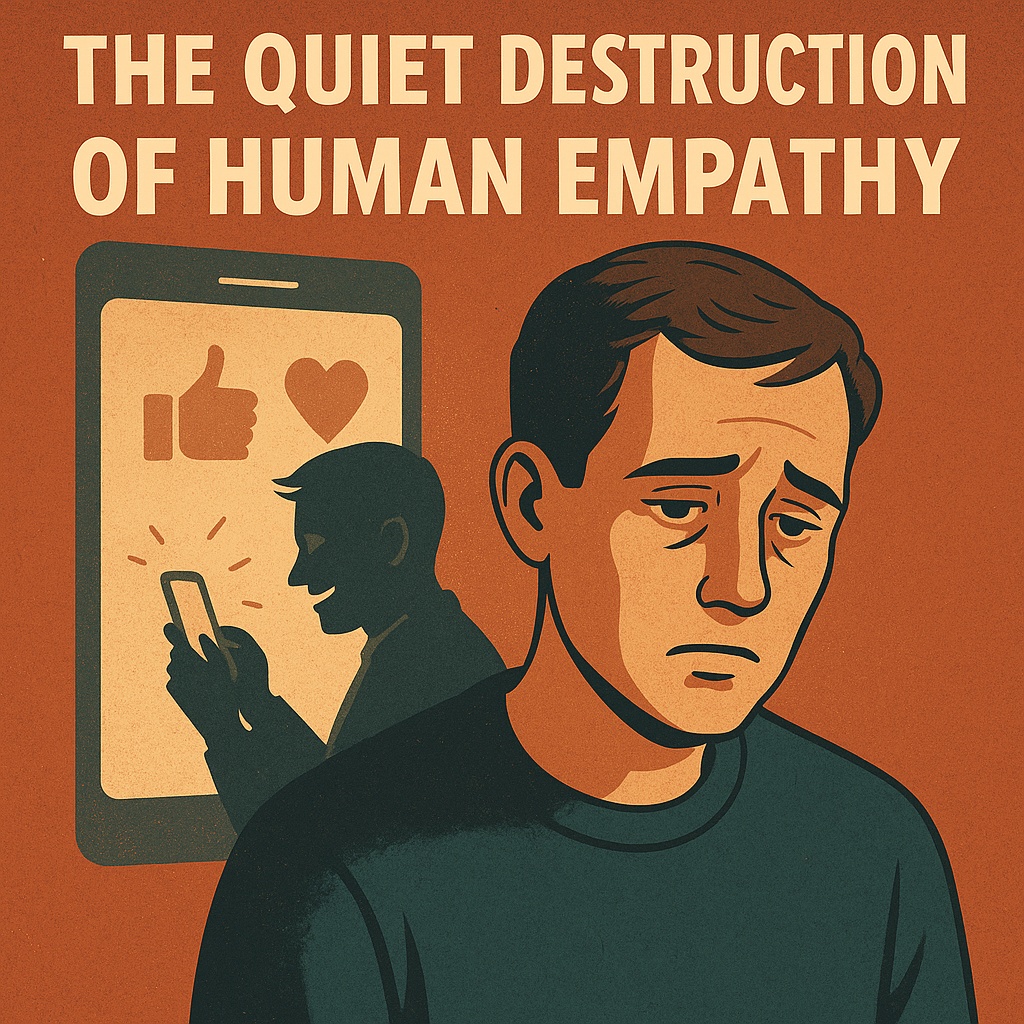
Then came the digital age. The screen replaced the face. Connection became simulation. Conversations turned into comments, warmth into emojis. People learned to display emotion for attention rather than for care. Every post demanded empathy, yet none lasted beyond a scroll. Humanity became emotionally overstimulated and morally undernourished.
Markets that feed on emotion
Modern capitalism deepened the fracture. Competition replaced cooperation. The system rewards efficiency, not compassion. A worker’s value lies in performance, not kindness. A corporation’s empathy appears only when profitable. Philanthropy turns into branding. Charity becomes marketing. Even care is monetized.
Emotions, once private and sacred, became tools for persuasion. Advertisers discovered that tears sell better than logic. Politicians found that outrage mobilizes better than understanding. Compassion became a product, and like every product, it lost authenticity through mass production.
The media that numbs instead of informs
Information was meant to enlighten, but now it overwhelms. Each tragedy blends into the next. Images of suffering flood screens until horror becomes routine. People stop feeling not because they are cruel but because they are tired. The brain cannot process endless pain.
News cycles turn empathy into fatigue. The starving child, the war victim, the flood survivor—all reduced to fleeting pixels. Viewers mourn for seconds, then scroll to entertainment. Repetition kills emotion. Indifference becomes self-defense. The quiet destruction of empathy happens not through hatred but through exhaustion.
Technology that fakes feeling
Technology now mimics care. Machines speak with polite tones. Algorithms analyze sadness. Chatbots simulate comfort. Yet simulation is not compassion. The more machines imitate empathy, the less humans practice it. Artificial emotion replaces real vulnerability.
Society becomes fluent in emotional performance but empty in sincerity. People learn to act caring while feeling nothing. The imitation spreads—from customer service scripts to political speeches, from therapy apps to corporate slogans. When empathy becomes automatic, it dies.
Psychology of a disconnected age
A generation raised online feels everything and nothing at once. Narcissism rises, empathy falls. Social media rewards outrage, not understanding. People perform feelings for visibility. They cry on camera, not for healing but for approval. Others respond with likes instead of presence.
True empathy requires silence, patience, and discomfort—qualities incompatible with speed and distraction. The faster the world moves, the shallower emotion becomes. Compassion demands time. Capitalism and technology demand instant reaction. The two cannot coexist for long.
Moral collapse in a cold world
Without empathy, morality becomes mechanical. Laws replace conscience. Bureaucracies execute cruelty with clean hands. Refugees, victims, and the poor turn into statistics. Each number hides a face once capable of suffering.
Empathy’s decline feeds nationalism and tribalism. When emotion shrinks, ideology grows. People defend borders, not lives. They care for abstract groups but ignore real individuals. A society that loses empathy soon replaces kindness with control and solidarity with suspicion.
Selling compassion
Empathy itself became a business. Corporations now sell mindfulness, compassion training, and emotional intelligence courses. Governments launch empathy campaigns while practicing indifference. Institutions speak of care while cutting social budgets. Even humanitarian language is exploited for political gain.
This is not empathy’s revival but its imitation. The more it is sold, the less it exists. Real empathy cannot be branded. It cannot be profitable. It demands risk, humility, and discomfort—the very things modern systems avoid.
The possible return
Yet empathy is not gone forever. It hides beneath the noise, waiting for contact. It revives when people speak face-to-face, when they help without camera, when they listen without agenda. Art, literature, and personal experience still awaken it. Schools could teach empathy as a skill, not as a slogan. Communities could rebuild it through shared responsibility, not virtual connection.
To restore empathy, society must slow down. It must resist the addiction to performance. Compassion is not about grand gestures. It is about consistency, presence, and sincerity—qualities modern life quietly erased.
The silent collapse
Empathy dies quietly. No explosion marks its end. Only a slow silence spreads where emotion once lived. Humanity adapts to life without feeling, and that adaptation may be its most dangerous evolution. People still speak of humanity, but their actions betray it.
The destruction of empathy is not a tragedy—it is a transformation. The human race becomes efficient but empty, connected but cold, informed but blind. Civilization survives, but the soul thins.
The final question remains: can a species that stops feeling still call itself human?
Leave a Reply