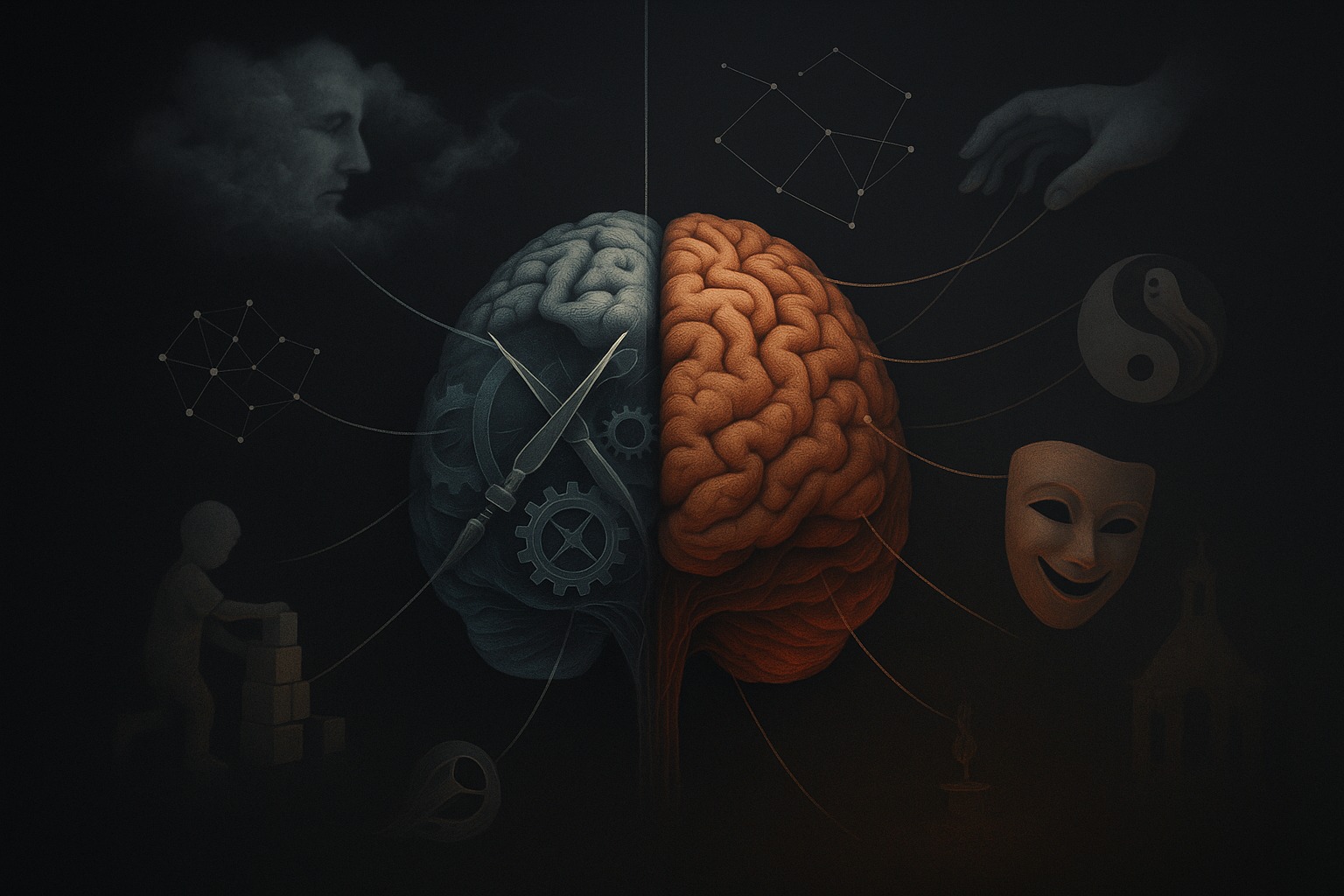
Religious belief as a cognitive default: Cognitive science research suggests that human minds have innate tendencies that make belief in gods or spirits feel “natural.” In other words, our default mental settings predispose us to religious interpretations of reality. These cognitive biases likely evolved to help our ancestors navigate a dangerous world – for example, by erring on the side of seeing intention and order in their surroundings. However, the same tendencies incline people to see supernatural agents or divine purposes behind events. Indeed, throughout history, virtually all cultures have developed religious beliefs (often with striking similarities across cultures), whereas atheism (the absence of belief) has been comparatively rare. This prevalence of religion doesn’t prove any faith true, but it shows how naturally belief can arise from universal features of human psychology.
Atheism as an “override” of intuitions: Adopting an atheistic or skeptical worldview often requires overriding these default cognitive biases. Psychologists describe this as engaging in reflective, analytical thinking (sometimes called System 2 or Type II processing) to overcome the intuitive (System 1) assumptions that favor supernatural belief. Put simply, the human mind’s first instinct leans toward belief, and resisting that instinct takes conscious effort or supportive environments (education, science, secular social norms, etc.). For example, one study found that people who rely more on intuition are more likely to believe in God, whereas prompting people to think analytically (even by showing them an image of Rodin’s statue The Thinker) temporarily reduced their reported religious belief. Over time, individuals with an analytic cognitive style tend to become less religious or nonreligious, while those who “go with their gut” tend to remain more religious. Not all nonbelievers actively override a belief impulse, however; some simply never internalize religious intuitions in the first place due to personal or cultural circumstances. For instance, people with very low innate tendencies to see agency or with social environments lacking religious cues may find it easier to be nonbelievers without a deliberate struggle.
Below, we examine specific cognitive biases that make religious belief feel natural, as well as social and emotional factors that reinforce belief. We also consider common logical fallacies that can prop up religious beliefs. Understanding these biases and fallacies can shed light on why religion is so pervasive – and why pure rational argument or scientific evidence often struggles to dislodge deeply held faith.
Cognitive biases that make religious belief “natural”
Hyperactive agency detection (HADD)
Humans are wired to detect agency and intention in their surroundings – an evolutionary safety trait. We tend to interpret ambiguous sights and sounds as though someone or something conscious is behind them. For example, a rustle in the bushes might be seen as a predator, and a vague face-like pattern might be perceived as a person watching us. Psychologists call this the Hyperactive Agency Detection Device (HADD), meaning our minds are hypersensitive to detecting agents. This bias was likely adaptive: assuming an agent (when it was just the wind) is relatively harmless, but failing to notice a real agent (like a predator or enemy) could be deadly. The result is that we often sense actors even where none exist – we might feel “someone” is there in an empty house or see a face in the clouds. This lays a cognitive foundation for believing in invisible beings. Our ancestors who erred on the side of caution survived, but their abundant agent-detection also meant they were prone to imagining spirits, gods, or other unseen minds at work. In modern life, this bias can incline people toward supernatural explanations: a creaking floor “must be a ghost,” or a sudden illness “might be a witch’s curse.” In essence, HADD makes the idea of unseen agents intuitively plausible.
Teleological thinking
From childhood onward, people intuitively assume that objects and events have a purpose or design. This is known as teleological thinking – explaining things by reference to their purpose rather than their physical causes. Developmental psychologist Deborah Kelemen famously demonstrated that young children are “promiscuous teleologists,” seeing purpose everywhere in nature. When asked why rocks are pointy, a child might answer, “so that animals can scratch themselves on them,” rather than a geological explanation. Children often prefer explanations like “trees grow leaves to give shade” or “rivers exist so we can go fishing”. In other words, they assign meaning and purpose where none objectively exists, and often those purposes align with human-centric or animal-centric thinking (the rocks are pointy so animals don’t sit on them, etc.). Unless education later curbs this bias, many people continue to feel that “everything happens for a reason.” This makes the idea of a deliberate Creator or a cosmic plan feel very plausible. If one naturally thinks “What’s it for?” about rain or stars or life itself, the answer that “an intelligent being made it for some reason” satisfies that intuition nicely. Studies have found that even some less-educated adults maintain child-like teleological biases, whereas more educated adults are less prone to such intuition – suggesting that teleological bias isn’t outgrown so much as it is “out-educated” by learning about physical causes. Without such learning, the default bias “everything has a purpose” bolsters religious narratives about divine intention (e.g. “God made the world for us to live in, and everything in it has a role in His plan”).
Intuitive dualism
Humans naturally split the world into physical and mental realms. We have an ingrained sense that minds (or souls) are separate from bodies. For example, children often believe their thoughts and identity exist independently of their brain – treating the brain as a tool their mind uses, rather than the source of the mind. In one study, children were told about a mouse that died; they agreed the mouse’s brain stopped working and its body wouldn’t need food – yet many children said the mouse could still feel hungry or love his mother. In other words, kids intuitively felt the mouse’s mind or essence lived on after its body died. Psychologist Paul Bloom calls humans “natural-born dualists.” Even adults who know the brain produces the mind often feel like they “have” a soul that is who they really are, and that could in principle exist without the body. This intuitive dualism makes it very easy to imagine disembodied consciousness – like spirits, ghosts, or gods – and to believe in an afterlife. If you assume mind and matter are separate, then it’s not a big leap to think the mind might survive the death of the body. Most cultures indeed have believed in souls or afterlives, and even very young children and people with no formal religious training tend to expect some form of life after death. By contrast, strict materialist atheism – the idea that mind and consciousness are purely brain-based and thus cease entirely at death – feels intuitively wrong to many people. Our natural dualism biases us toward thinking “there’s more to us than just this physical stuff.” This makes religious claims about immortal souls or spirit beings feel resonant with our gut feelings.
Pattern-seeking and randomness avoidance
The human brain excels at finding patterns and meaning, even in randomness. We are pattern-seeking creatures, inclined to connect the dots whether or not a real connection exists. This tendency is known as apophenia or patternicity – perceiving meaningful patterns in random or unrelated data. It’s the same impulse that makes us see shapes in clouds, hear hidden messages in music played backward, or think of someone right before they call and conclude it was “meant to be.” In everyday life, this can manifest as seeing “signs” or omens in events, believing that coincidences carry personal significance, or that answered prayers prove something. For instance, a person might pray for a sick relative and the next day the relative’s health improves; it’s human nature to notice that “hit” and attribute meaning to it, while ignoring many other times prayers weren’t followed by recovery. This is essentially a combination of pattern-seeking and confirmation bias (selectively remembering the hits and forgetting the misses). In a religious context, apophenia can reinforce belief in divine intervention or fate – “nothing is truly random; it’s all part of a plan.” The idea of a chaotic, godless universe full of coincidence is uncomfortable for pattern-seekers. People are biased to assume “everything is connected” or meaningful, which tilts them toward seeing a Higher Power orchestrating events. In fact, research has shown that when people feel a lack of control, they become more prone to seeing patterns and may even increase supernatural beliefs as a way to regain a sense of order. The mind would rather find an illusory pattern (and possibly attribute it to God or karma) than accept pure randomness.
Anthropomorphism
Closely related to our pattern and agency detection biases is our habit of projecting human-like qualities onto non-human entities or forces. This is known as anthropomorphism. Children and adults alike may talk to their car (“Come on, baby, start for me!”), yell at a computer for “being stubborn,” or describe a storm as “angry.” We intuitively ascribe minds and personalities to things that don’t actually have them. This bias makes it easy to imagine that someone (with thoughts and emotions) is behind natural phenomena and the universe as a whole. Rather than viewing the world as governed by impersonal laws of physics, people naturally find it more intuitive to imagine a Someone in charge. It’s cognitively easier for us to think of the universe like a big intentional agent (a kind of super-person) than to grapple with abstract, mechanistic processes. Many religions depict gods in anthropomorphic terms – as beings with desires, anger, compassion, voices, even human forms. Even religions that philosophically insist God is beyond human traits often find that laypeople imagine God in very human-like ways (an old man with a beard who gets upset or pleased, etc.). Our tendency to anthropomorphize nature and the unknown can lead directly to perceiving a personal God. For example, instead of “gravity makes the planet habitable,” a believer might say “God kindly set things up just right for us.” Instead of “disease spread,” one might say “God sent a plague to test us.” We impose a human narrative on non-human events. This bias also means we prefer explanations involving an intentional agent (who can care about us) over cold impersonal ones. A personal, anthropomorphic God is emotionally much more relatable than, say, a vague force or the indifferent laws of nature.
Confirmation bias and belief perseverance
Once religious beliefs take root, a number of cognitive biases work to sustain and reinforce them. Chief among these is confirmation bias – the universal tendency to notice, favor, and remember information that affirms our existing beliefs, while ignoring or rationalizing away contradictions. In a religious context, confirmation bias can be very powerful. Believers eagerly recall “hits” that support their faith: answered prayers, fortunate escapes, recovery from illness attributed to prayer, anecdotal miracles, feelings of divine presence, etc. At the same time, they overlook or dismiss the many “misses.” For example, a person may count the one time they prayed for rain and it rained (confirmation) but forget the many times it didn’t. Or they will interpret any outcome as evidence for God (if the person they prayed for survives, God answered; if not, it was God’s will or plan). This dynamic is illustrated by the story of “Tom” often used in explanations of confirmation bias: Tom prays for three sick friends – one recovers (proof that God listened!), one eventually gets better (God answered, just not instantly), and one dies (God answered with ‘no,’ and has a higher reason). Tom interprets every outcome as confirmation that prayer works, never considering that the mixed results don’t actually confirm the efficacy of prayer. Over years, this selective evidence-gathering makes the belief feel absolutely validated, regardless of the actual evidence.
Closely related is how people handle cognitive dissonance – the mental discomfort from holding conflicting ideas or when reality contradicts belief. Rather than abandon a cherished religious belief when facing disconfirming evidence, believers often lean on bias-driven rationalizations. They will find excuses or adjustments that allow them to keep the core belief. A classic example comes from studies of apocalyptic cults: when a doomsday prophecy fails to occur on the predicted date, the most devoted followers sometimes become even more convinced. Famously, when a 1950s UFO cult’s prophecy failed, the members did not concede error; instead they decided that their devotion had saved the world (so the prophecy’s failure was interpreted as a sort of success). This is an extreme form of belief perseverance. Instead of “I was wrong,” the mind generates a rationalization: “We must have miscalculated the date; the test of faith has made us stronger; God postponed the event because we proved our faith,” etc. By immediately rationalizing contradictions, the belief system becomes self-sealing – virtually nothing can definitively falsify it from the believer’s perspective. This makes abandoning the religion psychologically difficult; every challenge is absorbed as a further proof or test.
Another bias at play is attribution bias – a tendency for religious individuals to attribute events to divine intervention by default. Good fortune is credited as a “blessing from God,” and misfortune is often seen as “part of God’s plan” or even a punishment. Essentially, the believer’s instinct is to personalize causation (“Someone up there did this for a reason”) rather than consider natural or random causes. If a random tragedy strikes, a believer might say, “God is teaching us something,” rather than “sometimes bad things just happen.” This bias reinforces the sense that God is constantly at work in the world, intimately involved in their life. An atheistic interpretation of the same events – that causes are natural, or outcomes often involve chance – requires overriding that instinct to find intentional meaning. The idea that no one is really in charge, or that the universe doesn’t care about us, runs counter to both our pattern-seeking and our desire for control (more on that desire below). Thus, even in ambiguity, believers lean toward “God did it,” which continuously reaffirms their faith in an active deity.
Human beings are highly social creatures, and our beliefs are profoundly shaped by social and cultural pressures. Several social cognitive biases make it easier to adopt and retain religious beliefs, especially when those beliefs are the norm in one’s community:
- Conformity (Bandwagon effect): From a young age, people tend to absorb the prevalent beliefs of their family and society. “Everyone I know believes in God; so should I.” If all your friends, neighbors, and respected community members affirm a religion, sheer social proof exerts pressure to go along. We have a bias to avoid standing out or challenging group consensus – an evolutionary sensible bias since being ostracized from the group can be dangerous or painful. Thus, doubting the communal faith can carry an implicit fear: “If I don’t believe, I might not belong.” In many societies, openly disavowing the majority religion historically carried severe penalties (even death or exile). Even in modern settings, it can mean social rejection or familial strife. The easier, default path is to conform to the belief system around you. This bias often operates unconsciously: if you grow up where religious rituals and declarations of faith are routine, it simply “feels true” because it’s what people do.
- Authority bias: Humans also have a bias to trust and obey authorities. If a revered authority figure – such as a parent, priest, imam, rabbi, or holy scripture – asserts that God is real and the religion is true, we are inclined to accept that claim rather than question it. Children, especially, are evolutionarily tuned to trust what parents and elders tell them. Most religious people are introduced to their faith long before they develop critical thinking, effectively taking it on authority. The words “because the Bible/Qur’an says so” or “pastor told us so” carry weight. People may not even recognize this as a bias; it just feels like learning the truth from those who know better. Questioning a sacred authority often induces anxiety or guilt, further discouraging doubt. Authority bias thus locks in belief: it feels true because “all the wise and good people I know say it’s true.”
- In-group loyalty and identity: Religion is often more than a set of propositions; it is a community and an identity. There is a bias to favor one’s in-group and to value loyalty. Embracing the religion of one’s family or ethnic group can be intertwined with love and loyalty to one’s family and heritage. Conversely, leaving the religion can feel like betraying one’s tribe or ancestors. For example, someone raised in a devout household might suppress their private doubts to avoid hurting their parents or losing their friends. The status quo bias (a preference for things to stay the same) also plays a role – it’s mentally and socially easier to continue in one’s familiar faith than to make a dramatic break. Many atheists who deconverted report that the hardest part was not intellectual, but social and emotional – the fear of social consequences. This in-group bias can keep individuals within the religious fold long after intellectual doubts arise. Even entertaining doubts privately might trigger guilt (a feeling of disloyalty or sin). As a result, a person’s sense of self can be so tied up with being “a good member” of their religious community that abandoning belief threatens their entire social world and identity. It’s no surprise that in places where leaving the religion means being shunned or worse, people experience immense cognitive dissonance and often find ways to keep some form of belief.
- Prestige and credibility Bias: Psychologists studying cultural evolution note that people tend to imitate the beliefs of prestigious or high-status individuals. If respected members of society (teachers, political leaders, celebrities) profess religious faith, others are biased to see that belief as more credible or desirable. For instance, if all your admired role models thank God or credit their success to faith, you’ll be inclined to think maybe they’re onto something. Additionally, religions often involve credibility-enhancing displays (CREDs) – when believers make costly sacrifices or perform impressive acts for their faith, it signals they genuinely believe it. Observers unconsciously infer, “This belief must be legitimate or valuable for them to do that.” Examples include people giving significant charity, undertaking difficult pilgrimages, fasting, or risking persecution for their religion. Such displays trigger our bias to trust ideas that others clearly take seriously. Anthropologists have noted that religions with more such costly displays tend to inspire deeper devotion in others. On the flip side, in highly secular environments where no one publicly demonstrates strong faith (no visible CREDs), those social-confirmation biases lie dormant – making it easier for nonbelief to persist. In summary, we are inclined to “believe what impressive or numerous people believe.” This amplifies and preserves religious ideas across generations.
Emotional and existential biases
Beyond cognitive and social biases, a range of emotional and existential needs make religious belief appealing and thus harder to dismiss. Atheism, which often provides fewer easy answers to these needs, can feel unsatisfying on a deeply human level. Key biases in this domain include:
- Fear of death and desire for meaning: Humans are likely the only animals aware of their own mortality, and this awareness can be terrifying. According to Terror Management Theory, people cope with the fear of death by clinging to cultural worldviews that promise meaning or immortality. Religion excels at this. Most religions promise that death is not the end – there is an afterlife, resurrection, or reincarnation. Even aside from literal immortality, religions offer a sense of cosmic meaning: that life is part of a greater plan, that we are not just temporary specks in an indifferent universe. This deeply assuages existential anxiety. The bias here is that when confronted with thoughts of death, people unconsciously gravitate toward comforting beliefs that negate death’s finality. Experiments have shown that reminding people of their mortality (for example, making them write about their own death) leads to an increased defense of their cultural or religious beliefs and greater affirmation of supernatural agents or afterlife concepts (even among the non-religious). It’s as if the mind, when scared of oblivion, reflexively reaches for the psychological comfort of belief. A famous quote by anthropologist Ernest Becker is apt: “The idea of death, the fear of it, haunts the human animal like nothing else; it is a mainspring of human activity… designed largely to avoid the fatality of death, to overcome it by denying in some way that it is the final destiny”. Atheism, in contrast, often requires confronting the possibility that there is no ultimate justice or life after death – a reality many find emotionally bleak. Simply put, we want life to mean something and not end completely, and religion offers exactly that. This bias toward finding meaning and cheating death strongly favors religious belief. Even highly secular people, when faced with close brush with death or loss, sometimes revert to spiritual consolations (e.g. “they are in a better place” or “their spirit lives on”).
- Need for control and certainty: Life is unpredictable and often outside our control, which is unsettling. Psychologically, people have a bias toward illusory control – feeling that performing the right actions or rituals can influence outcomes that are actually beyond our control. Religious practices (prayer, rituals, moral codes) play directly into this bias, giving a reassuring sense of control. For example, a farmer prays for rain; whether it rains is objectively out of his control, but the act of prayer provides comfort that someone in control has been petitioned. A person might carry a religious charm or perform a ritual for good luck, essentially treating it as an assurance against uncertainty. Studies in social psychology (Compensatory Control Theory) have found that when people feel a loss of personal control, they become more likely to believe in a controlling God or fate, as a compensatory mechanism. In essence, believing “God is in control” can relieve the stress of feeling nothing is in control. Alongside control, humans crave certainty. We are biased towards clear, stable explanations over ambiguity. Religions typically provide a highly structured worldview – they have answers for the big questions (creation, purpose, moral laws, destiny). This satisfies the certainty bias: one can feel they know why we’re here, what is right/wrong, and what our ultimate fate is. In contrast, a naturalistic or atheistic worldview often emphasizes uncertainty: the origin of the universe is a scientific question with open ends, morality is a human construct to be reasoned out, the future is undetermined, and life has whatever meaning we choose. For someone who needs firm answers and a sense of security, that open-endedness can be deeply unsatisfying. Thus, the bias for certainty will push such individuals toward belief systems that feel solid and definite (even if those systems have to occasionally contort logic to maintain that certainty). A common refrain is that religion offers “blessed assurance” – a clear framework and destiny – whereas skepticism can feel like standing on shifting sand.
- Emotional comfort and optimism bias: Believing in a benevolent higher power can be immensely comforting. Many people have an optimism or wishful-thinking bias – a tendency to believe what they wish to be true. The idea that “Someone up there cares about me personally” or that the injustices of the world will be corrected by divine justice is emotionally alluring. It’s a form of appeal to emotion: we prefer a hopeful narrative over a grim one. Religion often paints the most hopeful possible picture: you are loved unconditionally by the Creator of the universe; your prayers are heard; no matter how bad things get, it will be made right in the end (if not in this life, then in the next). This is a deeply optimistic worldview, and humans have a bias to focus on positive expectations (most of us naturally have some optimism bias about our own lives). Therefore, a doctrine that all suffering will be redeemed and that you will exist eternally in happiness is powerfully attractive. This bias can shield religious belief from doubt because the believer wants it to be true so badly. By contrast, atheism often entails coming to terms with a harsher reality: justice is not guaranteed, bad things happen to good people with no divine compensation, and we might be alone in an indifferent cosmos. For someone inclined to emphasize comforting thoughts and minimize unpleasant ones, such an outlook can be subconsciously resisted. In sum, the bias toward “believing what feels good” can itself keep someone religious. (To be sure, many religious beliefs also carry fears – like hell – but those very fears can trap someone in the belief because leaving the faith would eliminate the emotional safety net and possibly incur the feared outcome.)
It’s important to note that these emotional biases do not mean religious beliefs are only emotional crutches – people have various intellectual and experiential reasons too – but they explain why, on a gut level, completely abandoning faith is so difficult for many. The prospect of living without the comforts of belief is like ripping away a psychological security blanket. Unless alternative sources of meaning and comfort are found (philosophy, humanism, community, etc.), the emotional biases will continually pull a person back toward some form of faith or spiritual belief.
Logical fallacies and reasoning errors reinforcing belief
In addition to the above psychological biases, religious beliefs are often buttressed by logical fallacies – errors in reasoning that can make an argument appear convincing even when it’s invalid. These fallacies are not unique to religious thinking (everyone is prone to them), but they frequently arise in apologetics and everyday faith discussions, effectively preventing believers from questioning their conclusions. Here are some common fallacies and reasoning errors that help sustain religious belief:
- Appeal to popularity (Bandwagon fallacy): This is the argument that a belief must be true (or at least credible) because “everyone else believes it.” Religious version: “Billions of people around the world believe in some form of God – they can’t all be wrong.” Or “My whole society believes X, so X is true.” This fallacy leverages our conformity bias, as discussed earlier. In logical terms, however, majority belief does not guarantee truth. History shows many widely-held beliefs (e.g., that the Earth is the center of the universe) turned out false despite popularity. But in the believer’s mind, “so many people (especially people I respect) accept this” provides reassurance. It also ties into appeal to tradition – the idea that something is true or right because it’s been believed for generations. While social proof can be a starting point for considering a claim, treating it as proof is fallacious. Nonetheless, “50 million Frenchmen can’t be wrong” thinking often bolsters religious conviction.
- Appeal to ignorance (God of the gaps): This fallacy asserts that if we don’t currently have a natural explanation for something, it must be due to a supernatural cause. In other words, “We can’t explain X (yet), therefore it was God (or magic, etc.).” This is fallacious because a lack of explanation is not proof of a particular alternative. It also often presents a false dilemma (either science explains it or God did it). Historically, many gaps in knowledge (lightning, plagues, the complexity of life) that were attributed to gods or spirits later received natural explanations. But the “God of the gaps” reasoning persists. For example: “Scientists still haven’t figured out what caused the Big Bang; therefore, it must have been God.” Or “Nobody can prove miracles can’t happen, so my miracle claim stands.” The appeal to ignorance flips burden of proof – rather than providing positive evidence for a claim, it just points to a lack of evidence against it. A believer might say, “You can’t prove God doesn’t exist, so it’s rational for me to believe.” In truth, the burden is on the claimant to provide evidence for existence, not on others to disprove it. This fallacy can be persuasive, however, because it gives an illusion of evidence by riding on uncertainty. It satisfies the need for certainty by plugging God into any currently unanswered question. It’s cognitively easier and emotionally more satisfying to say “God did it” than to live with “we don’t know (yet).” This slows the move toward atheism because every unknown becomes a sanctuary for faith.
- Circular reasoning (Begging the question): This is when the conclusion of an argument is smuggled into its premises – essentially using the claim itself as evidence. A religious example is using scripture to prove scripture: “The Bible is the word of God because it says so in the Bible, which is God’s word.” This argument begs the question because it assumes what it’s trying to prove (that the Bible is an authoritative word of God). Another example: “We know God exists because the Quran/Bible/holy text says God exists (and that text must be true because it comes from God).” It’s a logical loop. Believers don’t always articulate it so bluntly, but this fallacy underlies a lot of “faith-based epistemology.” If one’s ultimate evidence for religious truth is the religious authority itself (scripture or church teachings), then they are reasoning in a circle. It’s difficult to break out of this because from inside the belief system, it doesn’t feel circular – it feels like “I know in my heart this scripture is true.” But to an outsider, it’s “You believe the book is true because the book says it’s true.” Such circular reasoning inoculates believers against contrary evidence (because any evidence against the scripture must be wrong, since scripture is infallible by its own claim). It’s a major formal fallacy that prevents self-correction in faith.
- Special pleading: This is when one applies rules or standards to others but insists on an exemption for one’s own claim without proper justification. In theology, special pleading often appears in arguments for God’s existence. For instance: “Everything that begins to exist has a cause; the universe began to exist, so it has a cause (God). And God is uncaused (does not need a cause).” Here the rule “must have a cause” is exempted for God with no evidence except the arguer’s need. Essentially, “God is the exception to all the logical rules I just used to prove God.” Another example: if a religious person explains apparent contradictions or failures (like an unanswered prayer or a prophecy failure) by saying “God’s ways are mysterious – you can’t hold Him to normal standards of evidence or consistency,” they are special-pleading God’s case. It is a fallacy because it arbitrarily protects the claim from scrutiny that similar claims would face. If someone argued, “All humans are mortal. [My spiritual guru] is human, but he’s immortal,” we’d immediately demand, “Why exempt him?” Special pleading often shows up when a believer is cornered with a logical challenge – they carve out a loophole: “Yes, normally extraordinary claims need evidence, but my belief is an exception.” This fallacy helps religious beliefs remain unfalsifiable and intellectually insulated. It’s another reason why purely logical debate with a believer can be frustrating; the core tenet is often shielded by “Doesn’t count!” reasoning.
- False dilemma (False binary): Presenting a situation as having only two possible options when there are in fact other possibilities. In religious discourse, this might appear as: “Either you believe in God or life has no meaning.” Or “Either God created moral laws or everything is permitted.” These are false dichotomies because one can find meaning or uphold moral values without believing in God. By framing it as God or despair, God or no morality, the arguer biases the listener toward God (since most people don’t want despair or immorality). Another common false dilemma is “Either the universe has a creator, or it popped into existence from nothing for no reason – which is absurd, so it must be a creator.” This ignores more nuanced cosmological explanations and assumes those are the only two choices. The effect of false dilemmas is to pressure someone toward belief by making the alternative sound unthinkable. It’s a fallacy that plays on emotions (fear of the undesirable option) and on our craving for simplicity (black-and-white choices). Recognizing more options (e.g., “Maybe life’s meaning is self-created, not handed down” or “Maybe morality can be secular and rational”) is key to breaking this fallacy, but in environments where only the binary is taught, people truly think the only thing standing between society and nihilistic chaos is their religion. Such thinking keeps believers feeling safer within their worldview and suspicious of atheism.
- No true Scotsman: This fallacy modifies the definition of a group to exclude counterexamples and protect a universal claim. In religion, you hear it when believers say, “No true believer would do X,” after learning of a believer who did something bad or left the faith. For example: “No true Christian would commit such a crime; those who did were not really Christian.” Or “Those people who left the church were never true believers to begin with.” This is a way of dismissing evidence that challenges the belief that, say, faith makes people morally superior or that the religion is so compelling that no sincere follower would abandon it. By labeling counterexamples as “not genuine,” the original claim is preserved unfalsified. It’s intellectually dishonest because it sets up the religion as something that can never be tarnished by reality – any deviance is simply kicked out of the definition. For the believer, this fallacy maintains the purity and ideal image of their faith. It prevents the potentially humbling observation that “people in my religion can do wrong or leave it, just like any other humans.” It’s much more comforting to think those weren’t “real” members. This fallacy also reinforces in-group bias: true members are good and right; anyone who’s bad or leaves was never true, thus not one of us. This mindset makes it harder for believers to confront internal problems or accept that good people can seriously doubt, because they’ve defined away those cases.
- Appeal to emotion (Wishful thinking): As touched on earlier, deciding a claim is true based on how it makes you feel is a fallacy. With religion, appeals to emotion are extremely common: “How could I get through the hard times without God? It feels so good to believe He’s there – therefore I know He is.” Or conversely, “The idea that there’s no God to give meaning or no afterlife to see loved ones again is just too depressing, so I refuse to believe that.” This isn’t usually presented as a formal argument, but it underlies many people’s commitment to belief. They prefer the emotional outcome if the belief is true, so they persuade themselves it is true. A classic example is Pascal’s Wager (while not exactly a logical fallacy in form, it’s related): “Believing costs little and could gain everything (heaven); not believing risks hell – so it’s safer to believe.” This isn’t evidence that the belief is true, just an appeal to fear and hope. The optimism bias and status quo comfort make religious people sometimes literally say, “I believe because I don’t want to live in a world without that belief.” It’s wishful thinking elevated to a principle. The fallacy here is clear: reality isn’t obliged to be comforting or in line with our desires. But emotionally, this reasoning is potent. It helps maintain belief by focusing attention on the benefits of belief (community, hope, moral structure, comfort in grief) and off the question of truth. Atheism offers fewer instant emotional rewards – no heavenly reunion, no cosmic guardian, no divinely guaranteed justice – so if a person is led by this emotional appeal, they’ll bias toward continuing in faith. Only by recognizing “I want it to be true” as separate from “it is true” can someone break this fallacy, and that requires a level of emotional detachment that is naturally hard to achieve.
These and other fallacies often intertwine with the cognitive biases. For example, confirmation bias (psychological) couples with moving the goalposts or special pleading (logical tactics) to deflect disproof. The believer might not formally know these fallacy names, but the patterns arise intuitively as the mind protects its beliefs. By relying on such flawed reasoning, a person can always find a way to argue that their faith still makes sense – even if an objective analysis might find the arguments invalid. Part of overcoming deeply rooted beliefs involves learning to spot these fallacious arguments. Many ex-believers, for instance, recount that understanding logical fallacies helped them realize some of their apologetics were circular or biased. However, it’s worth noting that believers are not the only ones who use fallacies – it’s a human problem. The difference is that in religion, these fallacies often go unchecked because the conclusions are sacred and emotionally charged, so normal error-correction through debate is often blunted.
Analytical thinking as an antidote to bias
Engaging in critical, analytical thinking can act as an antidote to many of the biases and fallacies described above. Daniel Kahneman famously described two modes of thought: System 1 (fast, intuitive, automatic) and System 2 (slow, deliberate, analytical). Religious intuitions largely stem from System 1 processes – they are the “fast” default interpretations (agency detection, teleology, etc., all feel like gut instincts or obvious truths). To challenge those, System 2 must step in.
Reflective reasoning and skepticism: When someone adopts a habit of questioning assumptions, examining evidence, and applying logic, they can override intuitive biases. For example, an unexplained noise might feel like a ghost (System 1), but analytic reflection considers wind or pets as more likely causes, and demands evidence for a ghost. Over time, consistently applying scientific and logical inquiry to supernatural claims tends to erode those claims’ credibility. Studies have indeed shown that people who favor an analytic cognitive style (measured by tools like the Cognitive Reflection Test or similar tasks) are more likely to be atheist or agnostic, whereas those who rely on intuition and gut-feel are more likely to be religious. An analytic cognitive style means one has a propensity to set aside “highly salient intuitions” and think through a problem step by step. Such individuals are more willing to question “obvious” answers, which is exactly what’s needed to question religion. In contrast, a person who never exercises this reflective doubt can go through life never critically examining their inherited beliefs. It’s not that analytic thinkers cannot be religious – some certainly are – but on average they tend to reject or heavily modify orthodox beliefs because those don’t hold up as well under scrutiny. As one paper’s title succinctly put it, “Analytic thinking promotes religious disbelief.”
Experiments on analytic priming: Fascinatingly, even temporary engagement of System 2 can dampen religious belief in the short term. In one set of experiments, participants who were subtly prompted to think more analytically reported weaker religious belief right afterward compared to control groups. For instance, in one study simply exposing people to an image of Rodin’s Thinker sculpture made them score lower on a religiosity survey than those shown a neutral image. In another, participants solved brain-teaser problems that required overriding intuition, and subsequently they expressed less confidence in religious statements than those who solved intuitive (but easy) problems. The idea is that analytical activation “inhibits intuitions that make religious ideas feel compelling.” When System 2 is vigilant, System 1’s outputs (like “this coincidence was a miracle”) don’t go unquestioned. These experiments didn’t permanently deconvert believers (the effect was likely short-lived), but they demonstrate the principle that the more the reflective mind is engaged, the weaker the pull of cognitive biases toward faith becomes. It’s as if analytic thinking provides a momentary immunity to some biases – allowing people to say, “Hold on, do I really have evidence for this, or do I just believe it because it feels right?” Over time, if someone frequently engages in that kind of reflection, it can chip away at beliefs founded on bias and emotion.
Education and individual differences: Overcoming ingrained biases is not just about momentary brain exercises – it often comes from long-term habits of critical thinking and exposure to knowledge. Higher education, especially in scientific and philosophical fields, correlates with lower religiosity in many societies. Part of the reason is that education trains people to rely on empirical evidence and coherent reasoning, making them less susceptible to arguments from authority or tradition. It also exposes people to diverse perspectives, undercutting the “everyone believes this” effect and revealing that many different beliefs exist (so one’s local religion isn’t an obvious given). Notably, education specifically helps people “out-educate” certain biases like teleological thinking – for example, a biology student replaces “the eye was made for seeing” with an understanding of natural selection. Moreover, some societies provide cultural scaffolding for analytic thinking: strong science education, encouragement of questioning (rather than punishing doubt), secular institutions that fulfill the community and existential needs religion normally would, and social safety nets that reduce the fear and uncertainty that drive people toward seeking divine intervention. In such environments (think of largely secular countries in Scandinavia, for instance), it is much easier for the average person to adopt a nonreligious stance – both their intuitive biases and social pressures towards religion are more effectively countered by analytic and secular influences.
It’s also worth mentioning that individual differences in cognitive tendencies can play a role. As hinted earlier, some people simply have weaker intuitive biases toward religion to begin with. For example, individuals with autism spectrum traits often have difficulty with theory of mind (inferring others’ mental states), which is related to the mentalizing bias for seeing agency. Studies have found they tend to be less religious on average, presumably because concepts like an unseen person-like God do not intuitively resonate as strongly. Likewise, a person low in the trait of pattern-seeking might not see “signs from above” in every coincidence, making them more skeptical early on. While we can’t choose our innate disposition, knowing this can foster empathy – for some, unbelief comes more naturally, and for others belief does. But in all cases, analytical thinking can provide a pathway to at least examining one’s beliefs more objectively. It encourages stepping outside the emotional and bias-driven bubble and asking, “What reasons do I have? Is this logically sound? What do the facts show?” Those are the kinds of questions that, over time, many atheists report asking themselves on the road out of faith.
It should be stressed that engaging System 2 is not a guaranteed one-way street to atheism. People are complex, and many retain religious beliefs while also valuing reason and evidence – they might adjust or reinterpret their beliefs in more metaphorical or abstract ways that they feel are compatible with critical thinking. Others apply analytic scrutiny to other domains but keep religion as a separate sphere (sometimes via the special pleading fallacy: treating faith as “beyond” logic). Nonetheless, encouraging critical thinking and scientific literacy generally makes it more likely that biases propping up literal or traditional religious beliefs will be recognized and questioned.
Additional cognitive biases and formal fallacies
Illusion of control – the tendency to believe our actions or thoughts can influence events beyond our control. In religion, this often manifests in prayer, rituals, or charms that people think can change fate or divine will. It gives believers comfort and a sense of agency in uncertain situations. Even when outcomes are random, the illusion that “my prayer helped” strengthens belief in divine responsiveness.
Mere-exposure effect – repeated exposure to religious imagery, music, or rituals makes them feel emotionally right and familiar. The more often someone hears a prayer or attends a ceremony, the more comforting and natural it feels. Over time, this emotional fluency becomes mistaken for truth: if something feels familiar and good, it must be right. This bias helps religious traditions persist across generations.
Availability heuristic – people judge how likely something is based on how easily examples come to mind. Miracles, answered prayers, or divine punishments are vivid stories, often shared repeatedly, while natural explanations are dull and less memorable. As a result, supernatural explanations feel more common and convincing, even if statistically rare or unverified.
Anchoring bias – first impressions heavily shape later thinking. A child raised hearing “God made everything” anchors their worldview around that idea. Even when later presented with evolution or cosmology, their mind measures those new ideas against the old anchor, not neutrally. Early religious teaching thus acts as a cognitive benchmark that biases all future reasoning.
Sunk cost fallacy – once a person invests years, identity, and emotion into a religion, abandoning it feels like losing all that investment. This bias makes people continue believing or practicing even after serious doubts arise, because admitting error would mean wasting years of devotion or social belonging. It turns belief into psychological self-defense.
Projection bias – believers often project their own desires, fears, and emotions onto divine beings. When someone feels angry, they imagine God’s wrath; when they forgive, they feel God’s compassion. This creates an illusion of a personal relationship with a being who conveniently shares their emotional states, reinforcing belief as deeply personal truth.
Illusory truth effect – repetition makes statements feel truer, even without evidence. Hearing the same verses, hymns, or affirmations again and again (“God loves you,” “everything happens for a reason”) creates familiarity, which the brain misreads as credibility. Over time, what is repeated most often feels most real.
Negativity bias – people react more strongly to threats than to rewards. Religious doctrines often exploit this by emphasizing punishment, sin, or hell. The fear of divine retribution or eternal suffering keeps people from questioning or leaving faith, since disbelief feels dangerous even if reason points otherwise.
Halo effect – moral admiration of religious leaders can blur into intellectual or spiritual credibility. A kind priest or a charitable pastor seems more trustworthy, so their teachings feel true simply because they come from a “good person.” This bias fuses moral behavior with factual authority, which allows false ideas to spread under the protection of goodness.
Survivorship bias – believers focus on stories of divine intervention that succeeded while ignoring the countless cases that did not. For every person who claims a miracle healing, there are thousands who prayed and died. By remembering the survivors and forgetting the failures, the illusion of divine success is maintained. Religion becomes statistically selective memory.
Endowment effect – once a belief becomes part of identity, people value it excessively and resist trading it for alternatives. Even if logic shows flaws, abandoning a cherished worldview feels like losing a part of oneself. This emotional attachment keeps people bound to faith traditions.
Cognitive ease – the human mind prefers ideas that are simple, fluent, and emotionally clear. Religious stories and symbols are cognitively easy; they use narrative, emotion, and repetition. Scientific or philosophical explanations often feel abstract and demanding. The brain defaults to what feels effortless, and religion thrives on that preference.
Moral credential effect – performing or believing something “good” gives moral license for later leniency or self-righteousness. Believers may unconsciously think, “I’m moral because I believe in God,” reducing the incentive to question whether the belief itself causes harm. This bias preserves moral identity over factual accuracy.
Status quo bias – people prefer things to remain the same, especially in moral and social domains. Since religion represents tradition and continuity, questioning it feels threatening. Even minimal doubt can cause anxiety about destabilizing family, culture, or values, leading people to choose comfort over change.
Formal fallacies
Ad hominem – dismissing arguments by attacking the person making them rather than the content. When a believer says, “Atheists are immoral, so their arguments are worthless,” they commit this fallacy. It replaces logic with moral insult and blocks honest debate.
Post hoc ergo propter hoc – assuming causation from sequence. “I prayed, and then I was healed, so God healed me.” The improvement may be natural recovery or coincidence, but the mind connects the events. This fallacy makes ordinary outcomes look like divine intervention.
Composition fallacy – assuming that what’s true of some members is true of the whole. “Many religious people are kind, therefore religion is good.” The fallacy confuses individual traits with collective truth, ignoring harmful or neutral cases. It shields institutions behind the virtue of individuals.
False cause – attributing unrelated events to divine will. “The storm hit because people sinned,” or “God sent this sign to warn us.” Humans dislike randomness, so we invent purposeful causes, turning chaos into moral narrative.
Appeal to consequences – claiming something must be true because believing otherwise would be harmful. “If God doesn’t exist, life has no meaning, therefore God exists.” This replaces factual reasoning with emotional comfort, confusing what we want to be true with what actually is.
Equivocation – using a key word in different senses within one argument. For instance, “Faith means trust; science also requires faith; therefore science and religion are the same.” This shifts meanings mid-sentence, creating illusion of logic where none exists.
Red herring – diverting the argument to irrelevant issues. When atheists criticize evidence for God and the believer replies, “Without God there would be no morality,” the topic changes. It distracts from the original claim to protect belief from scrutiny.
Straw man – misrepresenting the opponent’s argument to make it easier to attack. “Atheists think everything came from nothing” oversimplifies complex scientific ideas so that religion looks reasonable by comparison. This fallacy creates false victories in debate.
Tu quoque – evading criticism by accusing the critic of hypocrisy. “You atheists have blind faith in science too.” This does not address the argument’s validity but merely attacks the speaker, turning discussion into moral defense rather than rational inquiry.
False equivalence – equating two unequal ideas to make an argument seem fair. “Science and religion both require faith.” This blurs distinctions between evidence-based confidence and belief without proof, misleadingly leveling the playing field.
Appeal to tradition – assuming something is true or right simply because it has been believed or practiced for a long time. “People have worshiped gods for millennia; therefore, gods must exist.” Longevity of belief does not confirm its truth, only its emotional utility.
Slippery slope – claiming that disbelief or secularism will inevitably lead to moral collapse. “If we abandon religion, society will descend into chaos.” This predicts disastrous outcomes without evidence, manipulating fear to preserve belief.
Cherry-picking (suppressed evidence) – selectively citing facts or scriptures that support one’s position while ignoring contradicting ones. A believer may highlight fulfilled prophecies but omit failed ones. This controlled evidence stream gives illusion of consistency.
False analogy – drawing a comparison between two unrelated things. “Just as a watch must have a watchmaker, the universe must have a creator.” The analogy ignores differences in scale, mechanism, and context, yet emotionally convinces through surface similarity.
Begging the question (advanced form) – using belief itself as both premise and conclusion. “Scripture is true because it is divinely inspired, and we know it’s divinely inspired because scripture says so.” This self-validating loop immunizes faith against examination.
Composition and division – assuming that what is true for parts applies to the whole, or vice versa. “Every part of nature is orderly, so the universe must have an intelligent designer.” Order can emerge from natural processes without conscious intent, but the fallacy insists on one unifying purpose.
Appeal to emotion (expanded) – basing arguments entirely on fear, guilt, hope, or love. “Without God you are nothing” or “God loves you unconditionally, so believe.” Emotion is persuasive, but it cannot replace evidence. This fallacy dominates sermons precisely because it bypasses logic.
False balance – giving equal weight to unequally supported claims. “Science says evolution; religion says creation; both are theories.” This pretends both sides have equal evidence, undermining scientific literacy and sustaining belief through fake parity.
Appeal to nature – assuming what is natural is inherently good or true. “Faith is natural, therefore it must be right.” Many natural instincts are false or harmful; nature alone is not a guide to truth. This fallacy sanctifies instinct rather than examining it.
Conclusion
Understanding belief through biases: The prevalence of religion and the relative scarcity of atheism can be better understood through the lens of cognitive biases and fallacies. Humans are not born with a particular religious creed, but we are born with minds that readily slip into certain intuitive patterns – seeing agency everywhere, seeking purpose and order, fearing oblivion, trusting authority, and so on – which make supernatural beliefs appealing and “sticky.” In a sense, we are all “born believers” in something, primed to find meaning and intention in the world. These tendencies of mind do not in themselves prove any religion true or false; rather, they show how our brains can generate and support faith all by themselves. Recognizing this fact can foster empathy on both sides of the belief divide. It means that religious people are not simply “irrational” in some alien way – they are following the natural grooves of human cognition and emotion. Likewise, atheists are not just “choosing to be difficult”; often they have had to struggle against their own mind’s biases or the pull of their culture to arrive at nonbelief. In short, believers and nonbelievers alike are responding to basic human cognitive and emotional needs, just in different ways.
Awareness and critical thinking: Being aware of these biases and fallacies is the first step in overcoming them – if overcoming them is one’s goal. Just as we try to be aware of biases in other areas (like in decision-making or social stereotypes), we can watch for how our minds might be shielding our sacred beliefs from scrutiny. For a religious believer, learning about HADD or confirmation bias or emotional reasoning might ring some bells – “yes, I do sometimes interpret things in a biased way.” This doesn’t instantly dissolve faith, but it creates a healthy self-awareness: “I have reasons for believing, but I also might believe partly because I want to or it feels right, which isn’t evidence.” For nonbelievers, understanding these biases can also promote humility. It’s easy for some atheists to think they are simply more rational, but they too are human and susceptible to motivated reasoning or arrogance. They should remember that they can have their own confirmation biases (say, favoring materialist explanations even where evidence might be open) or in-group biases (dismissing religious people wholesale). In public discourse, knowing about cognitive biases encourages a more compassionate tone: rather than mocking believers for “believing in silly things,” an atheist might recognize how completely natural it is for a mind to believe in gods under certain conditions. Conversely, a believer might acknowledge that their convictions, as profoundly meaningful as they are, owe something to psychology as much as theology. This doesn’t mean their faith is false, but it tempers absolute certainty with an understanding of the human factor.
Balancing reason and human needs: Ultimately, exploring the biases and fallacies that prevent atheism (or conversely, that facilitate religious belief) doesn’t dictate what one should believe. Many people will continue to find spiritual beliefs compelling or comforting – and may decide that’s okay for them. Others will prioritize factual and logical consistency above all and gravitate to skepticism. The value of this knowledge is that it invites a balance between understanding our natural inclinations and applying reason. With effort, individuals can, for example, enjoy the community and rituals of religion (meeting social/emotional needs) while also embracing critical thinking and rejecting fundamentalism. There are religious scientists who consciously counteract confirmation bias by requiring evidence for any claims about the natural world, and there are nonreligious people who find ways to satisfy existential yearnings (through art, philosophy, relationships) without supernatural beliefs. Both are finding a personal equilibrium. What’s clear is that our default cognitive settings favor belief to such an extent that not believing often requires active work – either by one’s own intellect or through a supportive secular culture. Knowledge of our biases gives us more control over this process. It allows for more informed choices about belief: one can decide, “Do I believe this because I’ve examined it critically, or just because it’s always been told to me and feels good?” Even if one remains a believer, that belief can be made more reflective and flexible by recognizing bias (leading to, say, a believer who accepts science and acknowledges their faith is faith-based). On the flip side, an atheist aware of biases can be more understanding that believers aren’t simply “stupid” but are often following deep human impulses. This understanding can lead to more tolerant dialogue – where the goal isn’t to insult or convert, but to share perspectives and perhaps gently encourage thinking past the biases on both sides.
In summary, human brains come with perceptual and reasoning equipment that leans toward belief in the supernatural. Atheism is possible – and increasing in many places – but it often requires a convergence of personal reflection, education, supportive social conditions, and sometimes just a certain contrarian bent to push past those defaults. By studying how our minds work, we gain insight into why certain beliefs are so tenacious and how we might, if we choose, loosen their grip. Whether one is a believer, an atheist, or somewhere in between, understanding our cognitive biases can make us wiser about ourselves and more respectful in our conversations with others about the deepest questions of life.
Leave a Reply