
“The throne does not corrupt the man. It reveals him.”
This article offers only examples of behavior attributed to each leader. It does not cover the geopolitical, shadow political constellations, or final decisions that may have influenced how each politician acted.
Introduction: Personality as destiny in politics
Every empire falls not only because of wars or debts, but because of human psychology. The United States was born from ideals, yet its destiny was carved by the minds of its presidents. Power exposes the most primitive corners of the brain — dominance, fear, vanity, and moral self-deception. Across two centuries, America’s leaders have reflected the evolutionary limits of the human mind. They were not gods of democracy. They were apes dressed in ideology.
Presidential psychology shaped the nation more than constitutions ever did. Institutions can restrain greed, but not insecurity. Laws can organize power, but not ego. The office itself became a mirror of human evolution — from tribal dominance instincts to modern mass politics. Each man who sat in that chair reshaped the world through the flaws that made him human.
The founding myth of infallibility
George Washington was not just a general. He was a projection of collective idealism. Americans saw him as moral perfection, a man immune to ego. Yet this illusion began the problem. The myth of the flawless president created a psychological vacuum where no future leader could admit weakness. Washington’s stoicism fed the idea that emotional restraint equals moral superiority. It was a classic alpha-male display — calmness mistaken for wisdom.
Thomas Jefferson continued that duality. He spoke of liberty while owning slaves. He rationalized cruelty through philosophy. This is how moral hypocrisy became embedded in American leadership — a dissonance between words and instincts. The brain evolved to protect self-image, even when actions contradict ideals. Jefferson’s selective morality became the first national template: intellectual brilliance paired with moral blindness.
Andrew Jackson made it worse. His personality represented the return of raw dominance. He was violent, vengeful, proud. He destroyed the Second Bank of the United States not out of logic but out of wounded ego. His rage against elites turned into tyranny. He displaced Native Americans to assert control, not necessity. Jackson embodied the aggressive male psychology that evolution rewarded in prehistoric tribes — intimidation, loyalty, revenge. In a nuclear age, such instincts would have ended humanity. In the 1830s, they only destroyed thousands.
The birth of moral hypocrisy
Early presidents built myths of virtue, but reality was closer to pathology. The American experiment thrived on contradictions: freedom and slavery, democracy and expansion, justice and genocide. Each leader found a psychological trick to live with that. Denial, rationalization, compartmentalization — the same cognitive devices serial killers use to feel innocent.
James Polk, for example, masked expansionist greed with moral rhetoric. His need for control drove him to provoke war with Mexico, rationalized as “manifest destiny.” The evolutionary impulse behind that was simple: dominance and territory. The male brain evolved to seek status through conquest. In tribal times it brought survival. In modern times it brought empire.
Abraham Lincoln broke this cycle only partially. His melancholy and introspection made him aware of the moral abyss. He carried guilt, loneliness, and self-doubt. Yet even his empathy was double-edged. His belief in unity and destiny justified massive death. Evolutionarily, Lincoln represented the empathetic alpha — moral yet decisive, capable of violence cloaked in conscience. The Civil War exposed both sides of human morality: compassion for the collective, cruelty for the cause.
The illusion of moral purpose
After Lincoln’s death, the presidency lost its moral compass. The Gilded Age became a psychological experiment in greed. Ulysses S. Grant’s loyalty to corrupt allies came from primitive in-group bias. He trusted his circle like a tribal chief protects kin. Rutherford Hayes and Chester Arthur mastered the art of moral self-deception. They saw patronage not as corruption but as natural hierarchy.
Evolution explains it. In-group favoritism, status competition, and self-justification are adaptive. They keep tribes stable but make large systems unjust. The presidency amplified those instincts to a continental scale. Every appointment, war, or deal became a tribal maneuver. The result was a country run by primate psychology, wrapped in patriotic vocabulary.
Theodore Roosevelt and the cult of dominance
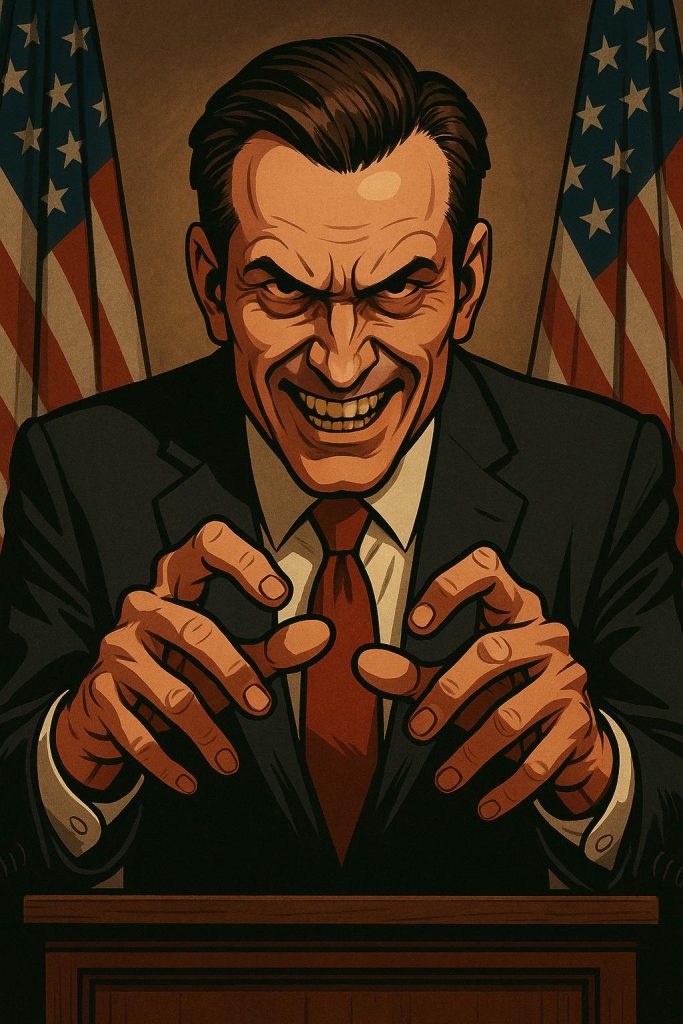
Theodore Roosevelt turned dominance into ideology. His energy, aggression, and theatrical masculinity reflected deep evolutionary programming — the show of power to secure social ranking. His “big stick” diplomacy mirrored animal display behavior: threaten to avoid a fight. It worked in jungles; it escalated empires.
Roosevelt’s charm concealed impulsivity. His appetite for war was not rational policy but hormonal reward. Testosterone surges during dominance victories, reinforcing aggression. Roosevelt needed battles the way addicts need dopamine. His hero complex turned foreign policy into spectacle. He made the presidency an ego stage.
Woodrow Wilson and moral narcissism
Woodrow Wilson represented a different pathology — moral narcissism. He believed in divine mission. His intelligence fed his delusion of righteousness. He entered World War I convinced he was saving the world. In reality, he redrew borders, empowered totalitarian movements, and planted seeds for the next war.
The evolutionary origin lies in prestige dominance. Humans compete not only by force but by moral signaling. Wilson’s brain rewarded itself for moral superiority. He could inflict suffering while believing he was good. This mechanism later justified drone strikes, economic sanctions, and genocides — all in the name of freedom.
The roaring ego: from Harding to Hoover
Warren Harding’s vanity destroyed him. He wanted love, not respect. He delegated power to corrupt men who flattered him. The evolutionary psychology behind it was simple: social validation. Leaders crave loyalty more than truth. Harding’s need for approval made him the perfect puppet.
Calvin Coolidge was the opposite: emotionally detached, cold, calculating. His minimalism was not wisdom but fear of vulnerability. He withdrew emotionally from responsibility. This detachment created systemic neglect that let financial bubbles grow. Herbert Hoover inherited it. His obsession with control and optimism — classic denial in the face of chaos — turned recession into collapse. His psychology mirrored a scientist refusing to accept death even as the patient flatlines.
Franklin Roosevelt and the manipulative savior
Franklin Roosevelt saved capitalism by manipulating emotion. He mastered psychological theater. His calm voice projected security during crisis. Yet his charm hid control addiction. He ruled through deception, secrecy, and emotional manipulation. His brain was wired for dominance through benevolence — the paternal alpha archetype.
Evolution rewards that. The male who protects the group gains authority. FDR’s leadership soothed the masses while centralizing unprecedented power. He broke the economic elite’s monopoly but replaced it with state monopoly. His New Deal created loyalty but not freedom. His third term revealed the addictive nature of power — dopamine without moral limit.
Truman, Eisenhower, and the Cold War paranoia
Harry Truman dropped atomic bombs with moral certainty. He believed he ended war. He started an era of fear. His decisiveness came from black-and-white cognition, a survival mechanism in crises. In evolution, hesitation killed. In politics, it kills millions.
Dwight Eisenhower continued the same instinct. His calmness was psychological armor. Beneath it was chronic anxiety about losing control. His military discipline suppressed emotion, creating the illusion of stability. He launched covert wars because they were emotionally manageable — no visible blood, no moral noise. It was the beginning of sanitized violence.
Cold War presidents inherited Truman’s paranoia as genetic memory. The brain evolved to detect threats; nuclear politics amplified it. Threat perception bias — the tendency to see danger even where none exists — fueled global hysteria. America became a nation ruled by adrenaline.
John F. Kennedy and the seduction of image
John F. Kennedy embodied reproductive psychology more than political reason. His charisma, beauty, and sexual appetite symbolized dominance through attraction. He ruled like a tribal leader surrounded by mates and rivals. His image mattered more than his strategy.
Evolutionarily, his behavior was predictable. Attractive males use charm as social manipulation. They maintain power through seduction, not terror. Kennedy turned politics into a mating display. The presidency became theater again. The Cuban Missile Crisis showed his dual nature — reckless risk-taking driven by ego, followed by charm-driven negotiation. He survived by instinct, not design.
Lyndon Johnson lacked Kennedy’s beauty but exceeded his need for control. His bullying style, known as “the Johnson treatment,” revealed dominance obsession. He could not tolerate defiance. Evolutionary psychology calls this status anxiety — the fear of losing rank. His Vietnam escalation was not strategy but emotional overcompensation. Millions died because one man’s ego could not appear weak.
Nixon and the paranoid brain
Richard Nixon was the most textbook case of paranoid psychology in power. His insecurity shaped everything. He saw enemies everywhere. Paranoia evolved as a defense mechanism in social groups — to detect betrayal. But in leadership, it turns pathological. Nixon’s mind created enemies to justify control.
He built surveillance networks, abused intelligence agencies, and tried to manage perception rather than reality. The Watergate scandal was not just corruption. It was a psychological collapse — a leader consumed by threat bias, trapped in his amygdala. Nixon proved that the presidency amplifies every mental instability.
Ford, Carter, and the crisis of empathy
Gerald Ford represented the mechanical caretaker. His moderation was psychological exhaustion. The system sought safety after trauma. His personality lacked dominance, and society saw that as weakness. Humans evolved to follow strong signals, not moderation. Ford’s decency became irrelevant.
Jimmy Carter, however, brought overempathy. His moral sincerity made him fragile in the political jungle. Empathy works in small groups but fails in power systems. He believed honesty could reform institutions designed by predators. His failure was not moral but evolutionary — altruism is punished in dominance hierarchies.
Ronald Reagan and the charisma trap
Ronald Reagan perfected illusion. His smile disarmed, his stories hypnotized. Charisma activates oxytocin circuits in followers, producing trust. Reagan turned leadership into mass psychology. He deregulated markets while selling optimism. His genial mask made cruelty acceptable.
He was not evil. He was emotionally intelligent in a manipulative sense. Evolution favors such individuals — charmers who unify tribes through illusion. Reagan built a faith-based capitalism that rewarded wealth as virtue. He replaced truth with narrative. The consequences were structural decay disguised as progress.
George H. W. Bush and the bureaucratic predator
George H. W. Bush represented the technocratic dominance type. Cold, calculating, and strategic. His emotional flatness made him effective in intelligence but destructive in leadership. His psychology fit evolutionary psychopathy — low empathy, high self-control, no guilt. He managed wars the way an engineer handles machinery.
This personality style creates stable empires but soulless societies. Under him, the U.S. expanded global control while eroding moral credibility. The first Iraq War was sold as justice but executed as spectacle. His calm tone masked emotional void — the smile of the predator after the kill.
Bill Clinton and the seductive manipulator
Bill Clinton merged intellect with appetite. His empathy was performative, his charm predatory. Psychologists would call it a mix of narcissism and Machiavellianism. He read people as instruments. Evolutionarily, this type survives through deception — high social intelligence used for self-gain.
His presidency reflected the triumph of social intelligence over moral intelligence. He liberalized markets, cut welfare, and expanded surveillance while appearing progressive. Like many manipulators, he destroyed boundaries between truth and desire. The office became a stage for persuasion, not integrity.
George W. Bush and the impulsive ape
George W. Bush embodied impulsivity — low cognitive complexity, high dominance need. His brain operated on binary logic: good or evil, us or them. This is primitive tribal cognition. In ancient groups, such clarity united members against outsiders. In modern geopolitics, it kills nations.
The Iraq War was not a policy decision but an emotional reflex. After 9/11, fear triggered dominance circuits. Bush sought revenge, not strategy. The evolutionary impulse for retaliation overrode rationality. Millions died for an instinctive urge coded in hunter-gatherer DNA. His grinning confidence reflected Dunning-Kruger bias — ignorance unaware of itself.
Barack Obama and the technocratic illusion
Barack Obama represented cognitive superiority detached from emotional realism. His calm intellect projected order, yet it concealed elitist detachment. Evolutionarily, intelligence evolved as a social tool, not as moral virtue. Obama’s high abstraction level produced empathy fatigue. He intellectualized suffering.
He killed with drones while delivering poetic speeches about peace. His brain managed contradictions efficiently — a form of moral compartmentalization seen in skilled predators. He believed in systems, not instincts. Yet systems designed by power serve themselves. Obama perfected rational cruelty — violence sanitized by bureaucracy.
Donald Trump and the collapse of self-awareness
Donald Trump was the evolutionary endpoint — pure dominance without disguise. His narcissism was no longer hidden; it was celebrated. He was the ape returned to the throne. Every ancient instinct — aggression, tribal loyalty, sexual signaling, deceit — became national policy.
His brain operated on primitive reward loops: praise, victory, control. He attacked truth because truth limits dominance. His supporters mirrored his psychology. The nation regressed to tribal identity. Reason lost to instinct. Institutions collapsed under emotional contagion.
Trump did not destroy America alone. He revealed what centuries of presidential psychology had built — a society addicted to ego. Each leader before him pushed the country closer to primitive governance, where dominance replaced morality, charisma replaced knowledge, and emotion replaced reason.
Conclusion: Evolution made us unfit for democracy
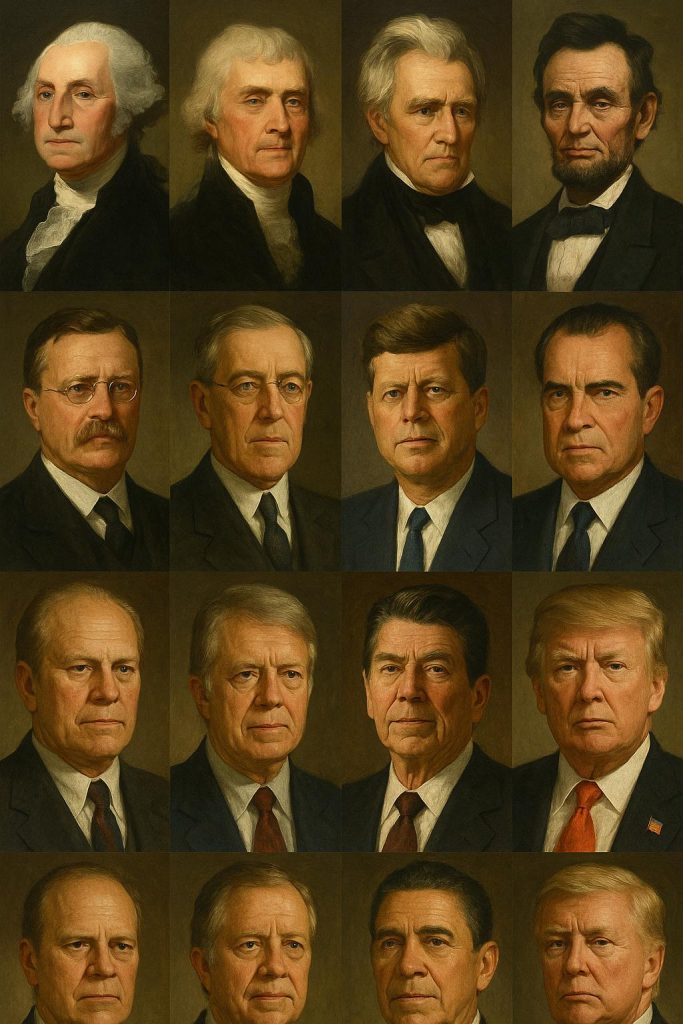
The presidency was supposed to represent human progress. Instead, it became an evolutionary trap. Power magnified the flaws of the human mind. Narcissism brought expansion, paranoia brought surveillance, impulsivity brought war, and empathy vanished under noise.
America was destroyed not by enemies or ideologies but by the very psychology that built it. Every president was a variation of the same primate — seeking dominance, validation, and immortality. The office amplified those instincts until nothing human remained but ambition.
Democracy requires self-awareness. Evolution produced none.
Part II: The evolutionary architecture of collapse
Presidential behavior cannot be separated from biology. Power, fear, and status are not ideologies. They are neurochemical patterns written into the cortex long before democracy existed. Every major decision — from signing a treaty to launching a war — emerges from networks of neurons that evolved for survival in prehistoric tribes. The human brain has not changed since then. The environment has. The mismatch is catastrophic.
The prefrontal cortex, the seat of logic and inhibition, evolved to manage immediate social problems, not nuclear strategy. It works best when interpreting facial expressions, not geopolitical data. When leaders reach the top, they enter an environment evolution never prepared them for — abstract power without visible human feedback. Empathy circuits weaken. Reward pathways take over. The result is dominance intoxication.
Neuroscience confirms what history shows. Dopamine, the molecule of reward, surges with social success. The higher the power, the stronger the reinforcement. Presidents become biologically addicted to admiration. Their perception distorts. Criticism feels like threat, obedience feels like love. The brain rewires itself around status. This explains why almost every president, no matter how educated, ends up defending the indefensible. They are no longer thinking. They are protecting their own neural rewards.
The hormonal economy of leadership
Testosterone and cortisol shape behavior more than political philosophy. Elevated testosterone promotes dominance, risk-taking, and aggression. Cortisol regulates fear and anxiety. The presidential office floods both. The constant exposure to stress hormones amplifies reactivity, narrows empathy, and reinforces tribal logic. That is why many presidents, after a crisis, double down instead of reflecting. The brain under threat retreats to primitive heuristics: fight, dominate, or deny.
This neurochemical imbalance becomes institutionalized. Advisors adapt to the leader’s mood. Bureaucracies mirror his biases. The entire system evolves around one brain’s dysfunction. Over time, the state itself becomes an organism driven by stress hormones — paranoid, compulsive, addicted to power. The CIA, the Pentagon, and Wall Street are not just agencies or corporations. They are neural extensions of executive psychobiology.
Group selection and the illusion of national interest
Humans evolved in small bands where loyalty meant survival. The presidency enlarged that logic to 300 million people. But the mind still divides the world into allies and enemies. The national interest became a scaled-up tribal instinct. Presidents frame wars, sanctions, and interventions in moral language, but the psychological foundation is ancient: protect the in-group, punish the out-group.
Group selection theory explains this paradox. Natural selection favors traits that benefit the group even when they harm outsiders. Presidential behavior mirrors that perfectly. Truman’s atomic decision, Johnson’s escalation in Vietnam, Bush’s invasion of Iraq — each act was justified as collective protection. In evolutionary terms, it was the tribe defending itself. In historical terms, it was empire expansion.
The cost is systemic. The same instincts that once ensured cooperation now fuel division. Every appeal to unity strengthens polarization. Leaders define enemies to unify supporters. The more threatened people feel, the more loyalty they show. The presidency thus thrives on fear. Without external danger, it loses purpose. That is why America always finds new wars — foreign or domestic.
Moral self-deception as an adaptive strategy
Humans cannot sustain power without moral justification. Cognitive dissonance — the gap between action and belief — produces psychological pain. To survive that pain, the brain invents morality. Presidents speak of liberty while bombing civilians because the mind needs narrative coherence. It is not hypocrisy; it is neurobiology.
Self-deception evolved as a mechanism to manipulate others more effectively. A liar who believes his own lies is more convincing. Power rewards such people. The presidency selects for those with the greatest ability to rationalize. From Jefferson to Obama, every leader mastered self-delusion. They did not only deceive the public. They deceived themselves first.
This pattern mirrors the logic of evolution. Morality did not evolve for truth. It evolved for survival. Groups that could morally justify violence survived longer. Leaders who believed their own righteousness were more efficient killers. America’s moral language — freedom, democracy, destiny — is the latest software running on that prehistoric hardware.
The psychological collapse of accountability
As power centralizes, feedback disappears. In small tribes, leadership was face-to-face. In modern systems, it is mediated by screens, polls, and advisors. The prefrontal cortex loses social calibration. Presidents no longer feel consequences. The cognitive distance between decision and suffering dissolves empathy. The act of killing becomes abstract.
Neuroscience shows that empathy requires proximity. The farther the victim, the weaker the emotional response. Presidents command from symbolic altitude, insulated by ritual and protocol. They experience moral numbing — a clinical detachment identical to trauma desensitization. The mind suppresses emotional pain to function. Bureaucracy institutionalizes it. Over time, the nation becomes psychopathic by necessity.
This explains why atrocities become policy, not exceptions. The political system rewards emotional distance. Leaders who show empathy are punished as weak. Carter failed because he felt too much. Reagan thrived because he felt too little. Evolution designed emotion for kin protection, not abstract justice. The presidency reverses that wiring. It punishes humanity, rewards indifference.
The media feedback loop
Media amplifies every psychological distortion. It rewards charisma, aggression, and emotional spectacle. These are the same traits that evolution used to determine alpha status. In prehistoric groups, dominance was visible through posture, voice, and display. Television resurrected that mechanism. The camera became the new tribal eye.
Kennedy’s beauty, Reagan’s warmth, and Trump’s dominance signaling all activated ancient cognitive biases. Viewers responded instinctively, not rationally. Elections turned into dominance contests. Voters subconsciously selected leaders who displayed strength, not wisdom. The media-industrial complex simply automated the tribe’s instinct to follow the loudest male.
Social media accelerated the process. Dopamine feedback loops replaced civic reasoning. Presidents began governing by impulse, mirroring their followers’ psychology. Emotional contagion spread faster than truth. The presidency merged with mass psychology into one self-reinforcing organism. Democracy became digital tribalism.
Institutional degeneration
As presidential pathology deepened, institutions adapted to survive it. Congress became submissive, the judiciary political, the bureaucracy opportunistic. Power selects for compliance. Over generations, systems evolve to mirror their rulers. Just as parasites adapt to their hosts, institutions adapted to narcissism.
Checks and balances lost meaning because they rely on moral restraint, not written rules. Once the collective psychology shifts toward dominance, rules collapse. Every system reflects the evolutionary logic of survival. When truth threatens status, truth dies first. That is why constitutional design failed to prevent moral decay. No law can override neurobiology.
Economically, the same instincts drove accumulation. Greed, territoriality, and in-group loyalty created corporate empires. The president became their political alpha, legitimizing their dominance. The psychological convergence between political and financial elites completed the cycle: collective narcissism masked as freedom.
Why power always ends in decay
In evolutionary time, dominance hierarchies collapse when leaders overexploit followers. The same applies to civilizations. When the costs of submission outweigh the benefits of belonging, cooperation breaks. America reached that stage. Citizens no longer feel represented. They see dominance, not guidance.
History repeats the biological script. The leader’s ego expands until it consumes the system. The followers’ faith declines until rebellion or apathy replaces loyalty. Rome, France, Russia — all followed this neural trajectory. The United States is no exception. Its presidents destroyed balance because they behaved exactly as evolution designed them to. They sought dominance at any cost.
Collapse is not moral failure. It is evolutionary exhaustion. The species simply built systems beyond its psychological capacity. When humans create hierarchies larger than empathy can manage, disintegration begins.
The end of the presidential illusion
Donald Trump did not invent political pathology. He stripped it of disguise. His presidency revealed the end point of human evolution in politics: charisma without conscience, dominance without competence, belief without truth. The old mechanism of leadership — based on hierarchy, fear, and spectacle — reached its cognitive limit.
Future leaders will face the same neural traps. Artificial intelligence, media, and tribal politics will keep rewarding the same traits: emotional manipulation, dominance signaling, moral self-delusion. The presidency will survive, but meaning will not. Institutions will function mechanically while consciousness decays.
Unless humanity rewires its social brain, the cycle will repeat under new names. The empire may change flags, but psychology does not evolve fast enough to match its own inventions.
Summary conclusion: the biological end of politics
Humanity’s greatest failure is not political corruption but biological limitation. The United States was an experiment in rational governance, yet every president proved that reason cannot dominate instinct. The office magnified the very flaws it was meant to transcend.
From Washington’s stoicism to Trump’s narcissism, every leader revealed a different layer of the same brain — the one built for survival, not morality. Paranoia, aggression, self-deception, and dominance shaped history more than constitutions, ideas, or religions.
Evolution designed humans to lead tribes, not nations. To feel empathy for kin, not continents. To seek validation, not truth. The American presidency concentrated those instincts into a throne of self-worship. Over time, it consumed morality, justice, and reason.
Democracy survived only as myth. The system that promised freedom produced obedience. The leaders who promised progress reproduced ancient hierarchy. The country that believed it could escape biology discovered that it could not.
The final tragedy is not collapse but clarity. The realization that every president was merely an ape chasing approval on a global stage. And that evolution, not ideology, wrote the real Constitution — one carved not in parchment, but in neurons.
Leave a Reply