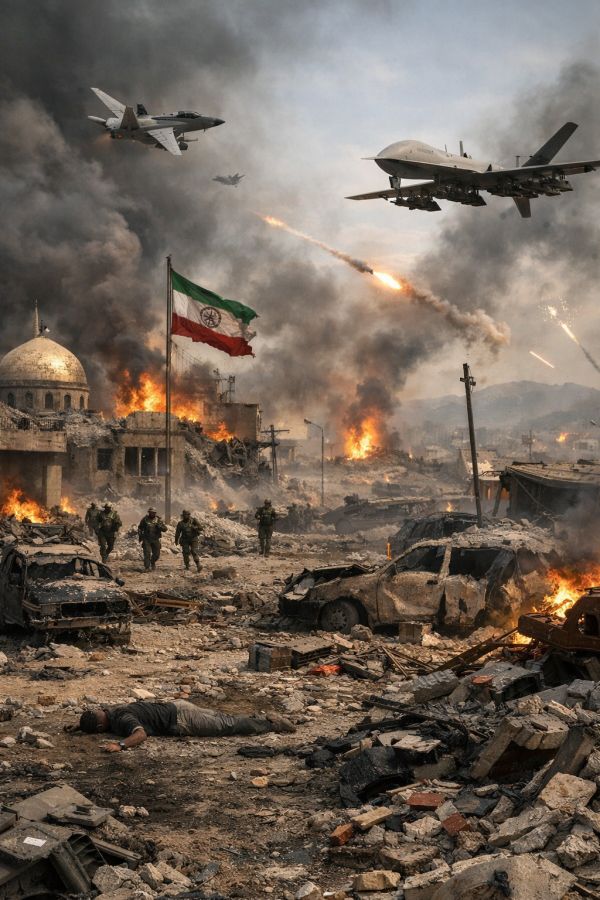
Of course, he can also get closer to it. But this article talks about military superiority.
The strike on Iran was not just about Iran. It was a message. And the real audience was not Tehran. It was Beijing and Moscow.
When Donald Trump authorizes a strike that removes a top Iranian leader within hours, he does not just eliminate a target. He demonstrates capacity, he shows speed. He shows integration. Satellites, drones, cyber, logistics, air power, command structure — all move like one organism. No leaks, no hesitation. No visible confusion.
And that is what China and Russia are watching.
They are not watching emotionally. They are calculating.
Putin sees capabilities
In Moscow, Vladimir Putin does not see morality. He sees capability. He asks one question: how fast can the United States neutralize leadership? How deep can it penetrate air defenses? How integrated is its battlefield AI? He knows that Iran’s systems include Russian components. If those systems collapsed quickly, that data matters.
This is not about Iran. It is about Russian deterrence credibility.
China
In Beijing, Xi Jinping looks at it differently. China builds long games. It studies logistics, it studies supply chains. It studies endurance. The seamless military machine matters less as a spectacle and more as a systems test. How many assets moved? From where? At what cost? How exposed were carriers? How long can tempo remain high?
Because if the United States can execute such an operation without economic shock, without political fragmentation, and without visible operational strain, then the Indo-Pacific calculus shifts.
You do not need to praise the killing. You do not need to justify it. But you must understand the signal.
Military superiority deters large-scale war only if it looks frictionless. Chaos invites challenge. Seamlessness invites caution.
Strikes
China and Russia both understand something fundamental. The United States does not need permanent occupation to reshape a region. It needs the ability to decapitate, disrupt, and withdraw while maintaining global readiness.
However, they also see the other side.
Iraq. Afghanistan. Tactical brilliance does not guarantee strategic success. Leadership removal does not equal regional stability. Power projection does not equal political control. Both Beijing and Moscow ask whether Washington knows the difference between destroying and stabilizing.
If Iran collapses into fragmentation, militias, proxy escalation, oil shock, and regional chaos in the Middle East, then the “seamless machine” becomes a destabilizing force. If instead escalation stops, deterrence holds, and no major war expands, then the message becomes far more dangerous for American rivals.
Because then the conclusion becomes simple: overwhelming force, used selectively, prevents world war rather than causes it.
Russia watches for weakness behind the display.
China watches for sustainability behind the display.
Neither watches with fear.
Both watch with strategy.
Leave a Reply