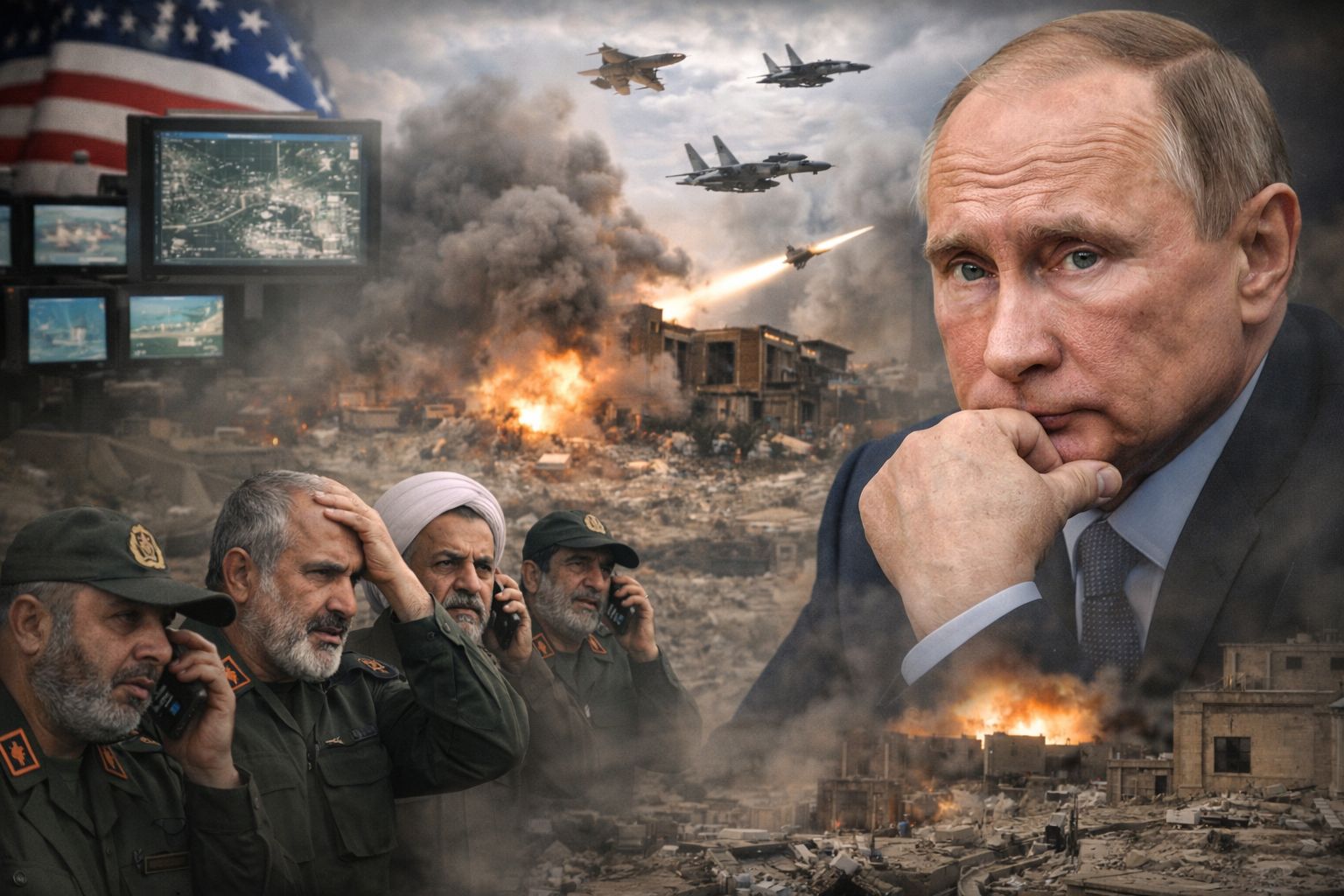
At first glance, the expectations looked obvious. Analysts predicted a brutal war. They warned about tens of thousands of American casualties. They described Iran as a fortress filled with missiles, proxies, and asymmetric tactics. However, reality unfolded in a completely different way. Instead of a long conflict, the United States executed a fast and systemic operation. Instead of mass casualties, it delivered paralysis. Therefore, the real question emerges. How did a large, militarized country collapse so quickly?
The illusion of a traditional war
For years, military thinking relied on outdated assumptions. Experts imagined urban combat, insurgencies, and endless deployments. They pictured Iraq or Afghanistan again. However, modern warfare no longer follows that script. The United States did not seek occupation. It did not aim to control every street. Instead, it targeted the structure of the state itself. As a result, the expected scenario never materialized. Consequently, what looked like an inevitable bloodbath turned into something entirely different.
Intelligence: The war before the war
However, none of this starts with missiles. It starts years earlier. Intelligence prepares the battlefield long before the first strike. The United States builds networks. It collects signals, it maps behavior patterns. And it tracks leadership movements. It studies communication flows. Therefore, when the moment arrives, targets are already known. This is crucial. Without deep intelligence penetration, decapitation fails. You cannot strike what you cannot see. Consequently, the real “trick” begins long before the conflict becomes visible.
Deception and timing: Freezing the system
At the same time, intelligence alone is not enough. Timing determines success. Deception plays a central role. The United States masks intentions. It normalizes activity; it creates false signals. It waits for the right moment. Therefore, when the strike comes, it feels sudden and disorienting. Defenses do not activate in time. Commanders hesitate. Systems lag. Consequently, the first blow does not just damage infrastructure. It shocks the entire decision-making process.
The core strategy: Decapitation and system collapse
Then comes the decisive phase. The United States does not fight the army directly. It targets the system behind it. Therefore, the first operational step focuses on leadership. Precision strikes remove key figures from the top command. Immediately, confusion spreads. Orders stop flowing. Authority fragments. At the same time, communication networks collapse. Headquarters lose coordination. Intelligence nodes fail. Consequently, even surviving units cannot act together. The army still exists, but it no longer functions as a unified force.
Psychological shock: Fear as a weapon
However, the collapse is not only technical. It is psychological. Commanders begin to question everything. They ask who will be targeted next; they fear communication channels are compromised. They doubt their own systems. Therefore, hesitation spreads. Decisions slow down. Initiative disappears. Consequently, paralysis deepens. This is critical. A frightened command structure cannot fight effectively, even if it still has weapons.
Air superiority and total exposure
Once leadership and communication weaken, the next step follows. Air defenses must fall. The United States neutralizes them early. As a result, it gains control of the sky. This changes everything. Continuous strikes become possible. Infrastructure remains exposed. Military assets turn into static targets. Consequently, resistance loses coherence. The battlefield becomes one-sided. The system cannot recover under constant pressure.
Technology and integration: The real advantage
At this point, one must understand the deeper advantage. This is not just about better weapons. It is about integration. The United States combines intelligence, surveillance, precision targeting, and real-time coordination. It connects systems into a single operational network. Therefore, decisions become faster. Strikes become more accurate. Adaptation becomes immediate. In contrast, Iran relies on more fragmented systems. Consequently, the gap is not only technological. It is structural.
Systematic degradation instead of one battle
Instead of seeking a decisive clash, the United States applies continuous pressure. Missile systems degrade. Naval assets weaken. Drone operations collapse. Each strike reduces capability. Each moment increases imbalance. Therefore, the effect compounds over time. Iran still possesses weapons. However, it cannot use them effectively. Consequently, retaliation becomes fragmented and strategically meaningless.
Economic pressure and internal fracture
At the same time, the operation extends beyond the battlefield. Economic infrastructure comes under pressure. Energy systems suffer disruption. Logistics weaken. Exports decline. Therefore, internal strain increases. A weakened economy amplifies military defeat. Consequently, the population begins to feel the impact. Social tension rises. The system does not only break militarily. It begins to fracture internally.
Internal weaknesses accelerate collapse
However, one must add another layer. Iran does not collapse in a vacuum. Internal weaknesses already exist. Sanctions have strained the economy. Political divisions weaken cohesion. Centralized authority creates vulnerability. Therefore, once pressure begins, collapse accelerates. Consequently, the system fails faster than expected. External force meets internal fragility.
Multi-domain warfare: No safe space
At the same time, the battlefield expands. This is not just a military campaign. Cyber attacks disrupt digital systems. Intelligence operations expose vulnerabilities. Regional pressure increases. Allies contribute. Therefore, Iran faces simultaneous threats across multiple domains. There is no single front line. The entire system becomes the battlefield. Consequently, defense becomes nearly impossible.
Moreover, this operation does not happen in isolation. Regional allies provide bases. They enable logistics; they share intelligence. They allow access to airspace. Therefore, operational reach expands dramatically. Without allies, the operation slows. With allies, it becomes overwhelming. Consequently, this is not just American power. It is networked power.
Why Iran could not respond
Iran still launches missiles. It still deploys drones. However, these actions lack coordination. Leadership is disrupted. Communication is broken. Systems do not align. Therefore, strategy disappears. Attacks become isolated events. Consequently, they lose impact. What appears as resistance is, in reality, fragmentation.
Putin watches and calculates
At this moment, one observer becomes crucial. Vladimir Putin watches carefully. He understands power. He understands systems. Therefore, he understands the implications. Russia is large, but it is also centralized. Its command structure depends on key nodes. Consequently, similar vulnerabilities exist.
Putin does not fear invasion. He fears decapitation. And he fears the sudden loss of leadership. He fears communication collapse. If these fail, even a large country can become paralyzed. Therefore, this operation sends a direct signal to Moscow.
At the same time, an important difference remains. Russia possesses nuclear weapons. Iran does not. Therefore, the strategic equation changes. Nuclear deterrence limits escalation. However, it does not eliminate fear. A non-nuclear systemic collapse still threatens stability. Consequently, Putin must calculate carefully. He must protect not only borders, but also the structure of power itself.
The global shockwave
Across the world, reactions emerge rapidly. Countries expected a long war. Instead, they witnessed rapid paralysis. Speed replaced mass. Precision replaced numbers. Therefore, perceptions of power change. States realize that size alone does not guarantee security. Consequently, fear spreads. However, reactions differ. Some countries fear. Others adapt. Some accelerate military development. Others deepen alliances. Therefore, the result is not only deterrence. It also triggers competition.
Autocrats and dictators: The deepest fear
However, the message goes far beyond Russia. Autocrats and dictators around the world watch this development with even greater concern. Their power does not rest on institutions. It rests on control; it rests on centralized authority. It rests on personal networks of loyalty. Therefore, they become uniquely vulnerable to this type of warfare.
A democracy can absorb shocks. It can replace leaders. It can redistribute authority. However, an autocratic system cannot adapt so easily. If the top layer disappears, the entire structure begins to shake. Consequently, decapitation does not only weaken such regimes. It threatens their very existence.
At the same time, these leaders understand another danger. Their inner circle may panic. Loyalty may fracture. Fear may spread inside the regime itself. Therefore, the threat is not only external. It becomes internal. The system begins to distrust itself.
Consequently, dictators now face a new strategic reality. They must protect not only their borders, but also their own survival; they must decentralize without losing control. They must harden systems without creating paralysis. This is a contradiction. Therefore, pressure increases.
Deterrence and its limits
This demonstration creates a powerful message. Large armies do not guarantee survival. Population size does not equal strength. Therefore, escalation becomes less attractive. In this sense, such dominance may deter global war. However, the opposite risk emerges. Confidence increases. Leaders may believe wars can remain short. History suggests otherwise. Therefore, stability and instability grow together.
The dangerous precedent
Moreover, this model raises ethical and strategic questions. Decapitation warfare sets a precedent. Other countries may adopt it. Retaliation norms may change. Therefore, the global system becomes more volatile. What works as deterrence today may fuel conflict tomorrow.
A new model of war
In the end, this conflict reveals a transformation. War no longer revolves around territory. It revolves around systems. The United States did not conquer land. It disrupted functionality. Therefore, the central question of modern warfare has changed. It is no longer about how many soldiers a country has. It is about how quickly its system can collapse.
Leave a Reply