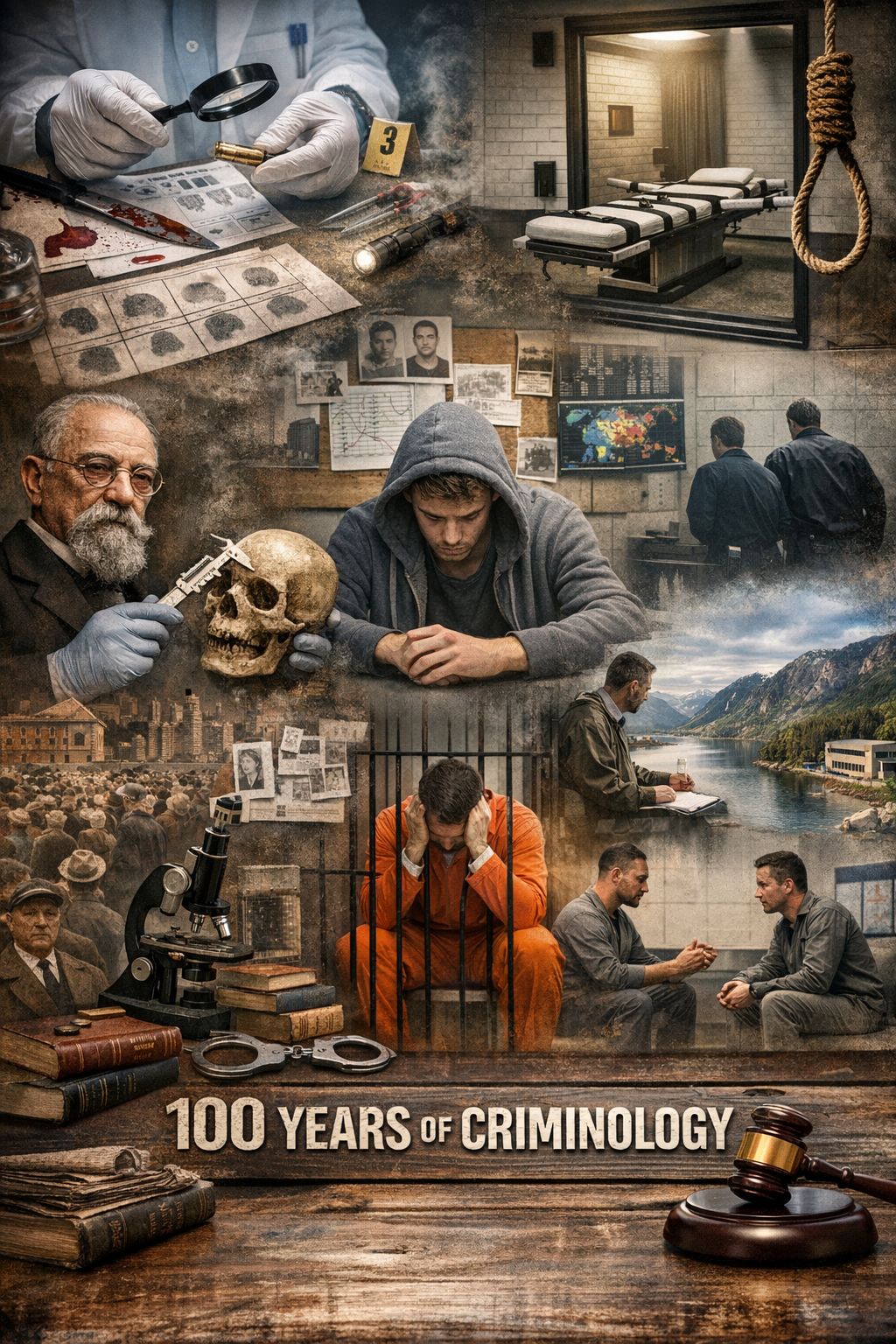
Criminology studies crime as a complex human behavior shaped by biology, psychology, and social structures. It does not stop at identifying offenders. Instead, it seeks patterns, causes, and consequences. Over the past 100 years, this field has evolved dramatically. It moved from speculation and ideology to empirical research and statistical validation. However, despite this progress, many political systems still ignore its conclusions. Therefore, a deep look at its development reveals not only knowledge gained, but also knowledge neglected.
Criminology vs criminalistics: Two very different worlds
Criminology and criminalistics often appear similar, yet they operate in fundamentally different domains. Criminology explains crime. Criminalistics proves crime. This distinction defines the entire justice system.
Criminology focuses on why crime happens. It studies individuals, but also families, communities, and economic systems. It connects crime to inequality, trauma, education, and opportunity. Therefore, it looks forward. It aims to prevent crime before it occurs.
In contrast, criminalistics focuses on solving specific crimes. It operates through forensic science. DNA analysis, fingerprints, ballistics, and digital traces form its core tools. Consequently, it looks backward. It reconstructs events that already happened.
Because of this difference, modern states often misallocate resources. They invest heavily in detection and punishment. However, they underinvest in prevention. As a result, they solve crimes efficiently, yet fail to reduce them structurally.
Lombroso and physical traits expanded
Cesare Lombroso argued that criminals could be identified by physical features. He pointed to skull shape, facial asymmetry, and other anatomical markers. He believed these traits revealed an evolutionary throwback. In his view, criminals represented a more primitive human type.
However, modern criminology rejects this determinism. Physical traits do not predict criminal behavior. Nevertheless, biology did not disappear completely. Today, researchers study genetics, brain development, and hormonal influences. They do so cautiously. They integrate biology with environment instead of reducing crime to appearance.
This evolution matters. It shows how crude biological theories transformed into nuanced interdisciplinary research. It also warns against simplistic explanations that can justify discrimination.
Crime soon became linked to environment rather than body. Urban sociology showed that crime concentrates in specific areas. Poverty, instability, and weak social networks create conditions for crime. Therefore, the focus shifted from “who you are” to “where and how you live.”
As societies changed, criminology incorporated psychology. Researchers began to examine personality, trauma, and learning. Crime no longer appeared as a fixed trait. Instead, it emerged as a process shaped by experience.
Robert K. Merton argued that social pressure drives individuals toward crime. When society promotes success but blocks access, frustration builds. Consequently, some individuals adopt illegal means.
At the same time, Edwin Sutherland showed that crime spreads through interaction. People learn behavior from their environment. They absorb norms, techniques, and justifications.
Together, these theories replaced moral judgment with explanation. Crime became predictable under certain conditions.
Late 20th century: Data, policy, and mass incarceration
During the late 20th century, criminology embraced data. Governments collected statistics. Researchers tested theories. However, political decisions often ignored results.
The United States expanded prisons massively. Leaders believed harsh punishment would deter crime. However, outcomes did not match expectations. Crime trends did not align proportionally with incarceration rates. At the same time, inequality deepened.
Meanwhile, James Q. Wilson promoted aggressive policing of minor offenses. Authorities assumed this would prevent serious crime. In practice, it often led to over-policing without solving structural causes.
21st century: Evidence-based criminology
Modern criminology relies on data and interdisciplinary research. Predictive tools identify risks. However, they can reproduce bias. Therefore, technology requires careful oversight.
Developmental criminology shows that early life matters deeply. Childhood environment shapes future outcomes. Prevention begins long before crime occurs.
Neuroscience contributes as well. It reveals mechanisms of impulse control and decision-making. However, it avoids simplistic conclusions. Biology interacts with environment at every step.
The death penalty debate: Myth vs evidence
The death penalty appears intuitively effective. Fear should deter crime. However, empirical research does not support this assumption. Countries without the death penalty often show comparable or lower crime rates.
Many crimes occur under emotional pressure. Offenders do not calculate consequences. Therefore, extreme punishment fails to deter.
Moreover, wrongful convictions occur. Judicial systems make mistakes. The death penalty cannot be reversed. This creates a fundamental ethical and practical problem.
Evolutionary psychology: Why harsh punishment once made sense
Human behavior evolved in small groups. These groups rarely exceeded 100–150 individuals. Survival depended on cohesion and immediate enforcement of norms.
In such environments, harsh punishment had a clear function. It signaled boundaries. It prevented retaliation cycles. It removed threats quickly. Therefore, what appears draconian today once had adaptive value.
However, modern societies differ radically. They contain millions of individuals. They rely on institutions, not direct personal enforcement. Consequently, extreme punishment loses effectiveness. It no longer stabilizes the system. Instead, it often produces injustice and long-term instability.
This mismatch explains many modern policy failures. People intuitively support harsh punishment because their psychology evolved for small groups. Yet these instincts do not scale to complex societies.
Countries such as Norway and Sweden demonstrate a different approach. Their systems emphasize rehabilitation. Prisons focus on education, mental health, and reintegration.
Conditions remain humane. Prisoners maintain dignity. They prepare for life after release. As a result, recidivism rates remain significantly lower than in punitive systems.
This model aligns with criminological findings. People respond to opportunity and structure. When systems support reintegration, crime decreases. When systems rely only on punishment, cycles repeat.
Major findings across 100 years
Criminology consistently shows that crime has multiple causes. No single factor explains it. Poverty, inequality, and lack of opportunity play major roles. Family environment and early experiences shape behavior deeply.
At the same time, certainty of punishment matters more than severity. Prevention proves more effective than reaction. Education, stability, and social support reduce crime more reliably than harsh penalties.
Persistent myths despite evidence
Many myths persist despite strong evidence. People believe harsher punishment reduces crime. Data does not consistently support this claim. They assume criminals differ fundamentally from others. In reality, most offenders act under circumstances.
The belief in the death penalty continues as well. However, research repeatedly challenges it. These myths survive because they appeal to intuition rather than evidence.
Political misuse of crime
Crime remains a powerful political tool. Media amplifies extreme cases. Politicians use fear to gain support. They promise strict measures. These promises resonate with voters.
However, such policies often ignore criminological evidence. They prioritize visibility over effectiveness. As a result, systems become more punitive without becoming more effective.
Future of criminology
Criminology continues to integrate disciplines. Psychology, neuroscience, and economics expand its scope. Technology introduces new tools and new risks.
Future systems will likely focus on targeted prevention. However, ethical concerns will grow. Surveillance and predictive policing require strict limits.
Conclusion: Knowledge ignored
Criminology has advanced significantly. It explains crime with increasing clarity. It identifies effective strategies.
However, societies often ignore these findings. They prefer simple solutions. They rely on punishment rather than prevention. Therefore, a paradox remains. We understand crime better than ever. Yet we often respond to it irrationally.
Leave a Reply