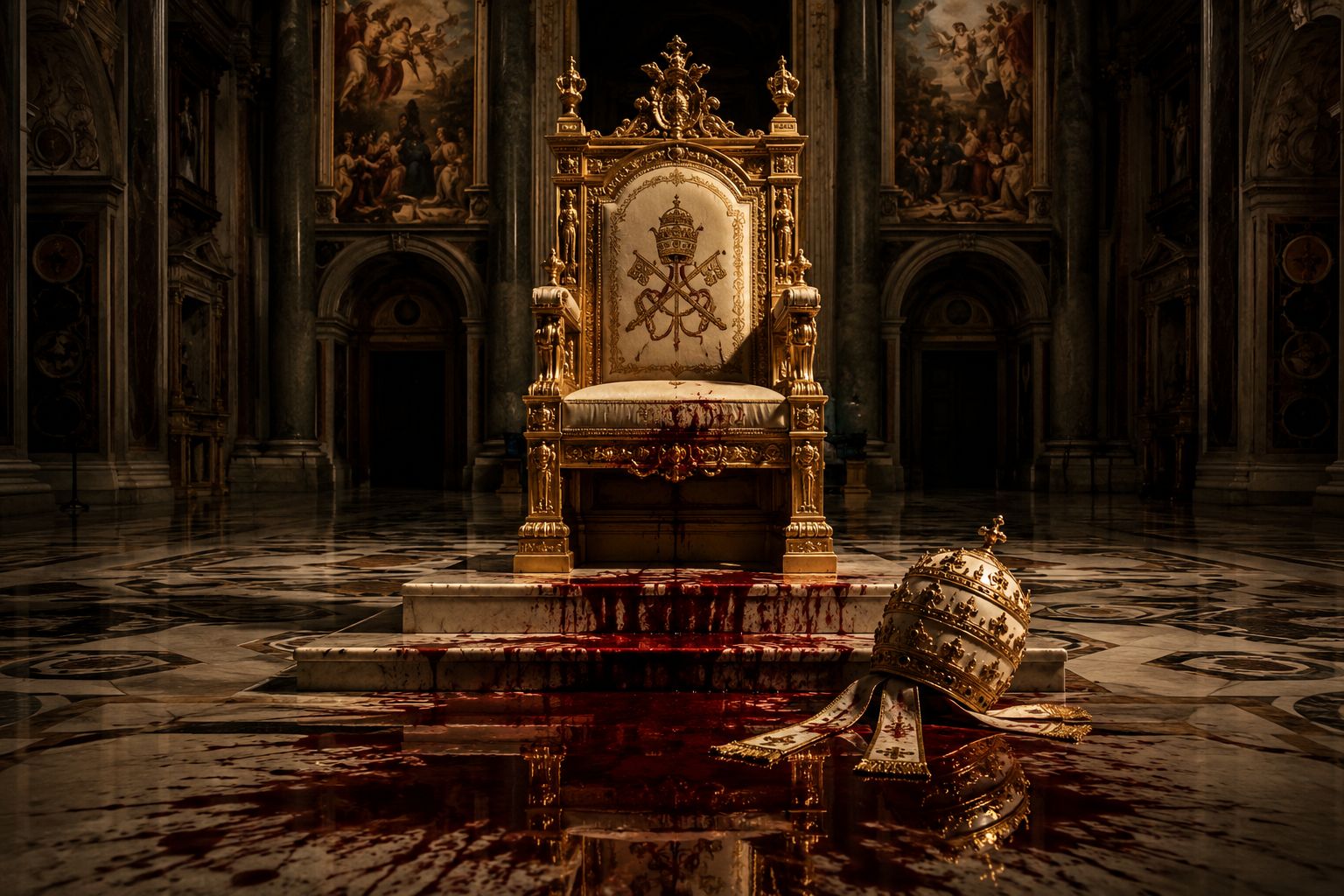
The Pope stands as a figure of supreme spiritual authority. He bridges the divine and the temporal. Yet the history of the Roman Catholic Church contains more than faith and salvation. A darker thread runs through its two-thousand-year narrative. The Church used violence. It wielded the ultimate punishment. Many know the Church as a victim of persecution. Fewer know its role as an arbiter of life and death. Fewer still understand the systematic violence that marked its rise as a temporal power.
The sovereign’s sword: Papal edicts and capital punishment
The Papal States were a sovereign political entity. The Pope was not just a bishop. He was a king. He needed to maintain law and order. That required coercion. That included execution.
Historical records show the Papal administration issuing death decrees. A notable collection of Papal Bulls from the 16th century demonstrates this. Popes Julius III and Paul IV issued these Bulls. They targeted “murderers and brigands condemned to eternal and capital punishment.” The “spiritual sword” of excommunication merged with the “temporal sword” of the executioner.
Renaissance Popes used unique forms of punishment. They aimed to assert authority over the citizenry and nobility. Pope Paul II reigned from 1464 to 1471. Pope Sixtus IV reigned from 1471 to 1484. Both revived the practice of destroying houses as a legal penalty. This act of “damnatio memoriae” erased a family’s legacy. It humiliated enemies; it displayed the Pope’s absolute authority. It ended a family’s political life by destroying its ancestral home.
The murdered Popes: A grim roll call
The history of the papacy bears the blood of its own occupants. From the 9th to the 11th centuries, the papal office became a prize. Wealthy Roman families fought over it. About a third of the popes between 872 and 1012 died under mysterious circumstances. Many died in macabre ways. These violent deaths testify to the perilous nature of the office.
John VIII became the first Pope murdered in office. He reigned from 872 to 882. His death was gruesome. His own entourage poisoned him. They grew impatient waiting for the poison to take effect. So they clubbed him to death.
Stephen VI reigned from 896 to 897. He met a similarly violent end. Stephen presided over the “Cadaver Synod.” He put the corpse of his predecessor Formosus on trial. This grotesque display caused outrage. The outrage likely led to his death. They strangled him in prison.
The early 10th century saw a succession of short-lived Popes. Leo V reigned barely two months in 903. They deposed and imprisoned him. His successor likely ordered his strangulation.
John X reigned from 914 to 928. He crossed Marozia, daughter of the powerful Theophylacti family. They incarcerated him in Castel Sant’Angelo. They smothered him with a pillow.
Fatal stroke or murder?
John XII reigned from 955 to 964. He became Pope as a teenager, he lived more like a frat boy than a pontiff. He turned the Lateran Palace into a den of debauchery. A jealous husband killed him. Other historians suggest he suffered a fatal stroke in the embrace of a mistress. Either way, his reign ended in ignominy.
The Roman noble families continued their power struggles. Benedict VI reigned from 973 to 974. He ran afoul of the powerful Crescentii family. They imprisoned him. A priest strangled him.
John XIV reigned from 983 to 984. He became another victim of the Crescentii. Antipope Boniface VII arrested him. They placed him in Castel Sant’Angelo. He died in captivity. Starvation or poison likely killed him.
The Popes who died at the hands of secular rulers
Many Popes fell to Roman aristocratic factions. Others met their end at the hands of secular monarchs.
Boniface VIII reigned from 1294 to 1303. He had a hot temper. He engaged in a bitter power struggle with King Philip IV of France. In 1303, the “Outrage of Anagni” occurred. French agents stormed Boniface’s residence. They physically assaulted him. They held him prisoner for three days. And they released him. He died shortly after returning to Rome. The trauma broke him.
Adrian III died in 885. His death remains suspicious. Pope Stephen VII reigned from 928 to 931. The exact cause of his death remains uncertain, although some medieval sources have fueled speculation that it may not have been natural. We do not know the exact cause, but violence seems likely. Sergius IV died in 1012. Historians consider his death highly suspect. These less documented deaths speak to the ongoing volatility of the papal office. The Church remained deeply entangled in the political rivalries of Italy and Europe.
The Papacy and early Christian persecution
This pattern of violence against Popes has ancient roots. It begins with the first Pope himself. The Apostle Peter was the first martyred pope. Roman authorities crucified him upside down in Rome during Nero’s reign. He was the first of fourteen popes known or believed to have been martyred between the first and seventh centuries.
Numerous early popes met violent ends during Roman persecution. Pope Fabian suffered beheading in 250 under Emperor Decius. Also, Pope Anterus died in 235 under Emperor Maximinus Thrax. Pope Pontian suffered arrest and exile to Sardinian mines in 235. He resigned and later died. Pope Sixtus II faced decapitation in 258. Imperial Roman troops executed him on orders to kill Church officials. Pope John I reigned from 523 to 526. The Ostrogothic King Theodoric the Great imprisoned him. He starved to death. Pope Martin I reigned from 649 to 655. He opposed the Byzantine Emperor Constans II over a theological controversy. The emperor ordered his arrest. They tried Martin for treason in Constantinople; they beat him; they deposed him. And they exiled him to Crimea. He died of starvation and exposure in 655.
The sword of the spirit: Violence in sacred spaces
The Church militant also sanctioned violence against its internal enemies. It sometimes turned against the faithful themselves.
Violence by the clergy did not deviate from the norm in many historical contexts. It functioned as a normal part of the relationship between the Church and society. Historian Henry Kamen studied the Hispanic world. He noted that “participation in violence became a recognisable feature of the Hispanic Church… not dysfunctional but normal.” The militant clergy of Spain demonstrated this. Religious fervor frequently blended with temporal warfare.
The Church also influenced political assassination. The debate over “tyrannicide”—killing a tyrant—remained a theological and legal gray area. In 1615, Pope Paul V issued a secret brief. He approved and renewed the decree of the Council of Constance on the subject; he effectively endorsed killing a tyrannical ruler under specific circumstances. He hid this brief from public view for centuries. It represents a moment where the Papacy gave tacit approval to the ultimate act of political violence.
Thomas Becket, Archbishop of Canterbury, died in 1170. Though not a Pope, his murder highlights Church violence. King Henry II’s words precipitated the killing. Four knights struck Becket down within Canterbury Cathedral. They acted on a perceived political necessity. This stark example shows how the Church’s temporal entanglements could lead to bloodshed.
This was not an isolated phenomenon. In medieval and early modern Italy, churches often became theatres of conflict and murder. They were not just places of worship. They were the pre-eminent sites for displaying social capital and power. “Politicised violence” erupted. Factions clashed in the aisles. They even murdered rivals there. In Rome, disputed papal elections in the 4th and 5th centuries descended into siege and occupation. Factions of the faithful armed themselves. They occupied basilicas.
The recoil of violence: Anticlerical fury
The institutional power and violence of the Church provoked a violent reaction. When the Church became indistinguishable from the oppressive state, it became a target.
The most brutal modern example occurred during the Spanish Civil War from 1936 to 1939. The Church appeared hostile to the Republic. It aligned with the Nationalist rebels. In the first weeks of the conflict, this hostility erupted into mass violence. People sacked and burnt churches. They killed religious personnel in large numbers. The scale staggers the imagination. At least 6,832 religious died during the conflict. The majority fell in the initial outburst. This was not a side effect of war. This was a deliberate attack on a repressive, violent institution. In cities that fell to the Republic, crowds attacked the clergy. They dug up and desecrated remains. They destroyed sacred objects.
Conclusion: The temporal burden
The Catholic Church’s history includes spiritual leadership. It also includes temporal power. The Church issued death warrants. It sanctioned tyrannicide. It also suffered murder, starvation, and political intrigue. The Papacy played in the brutal theater of political history. The grim tally of violently killed Popes reveals the immense dangers of the throne of St. Peter. The Papal tiara symbolized supreme spiritual and temporal authority. It was often a crown of thorns in the most literal sense. Men wore it. They lived and died at the intersection of faith, politics, and the ever-present threat of violence. To hang a Pope, or to be hanged by one, moves beyond metaphor. It speaks to a time when the keys to Heaven rested in the same hands that signed death warrants. The divine and the political entangled themselves. The result was often fatal.
Leave a Reply