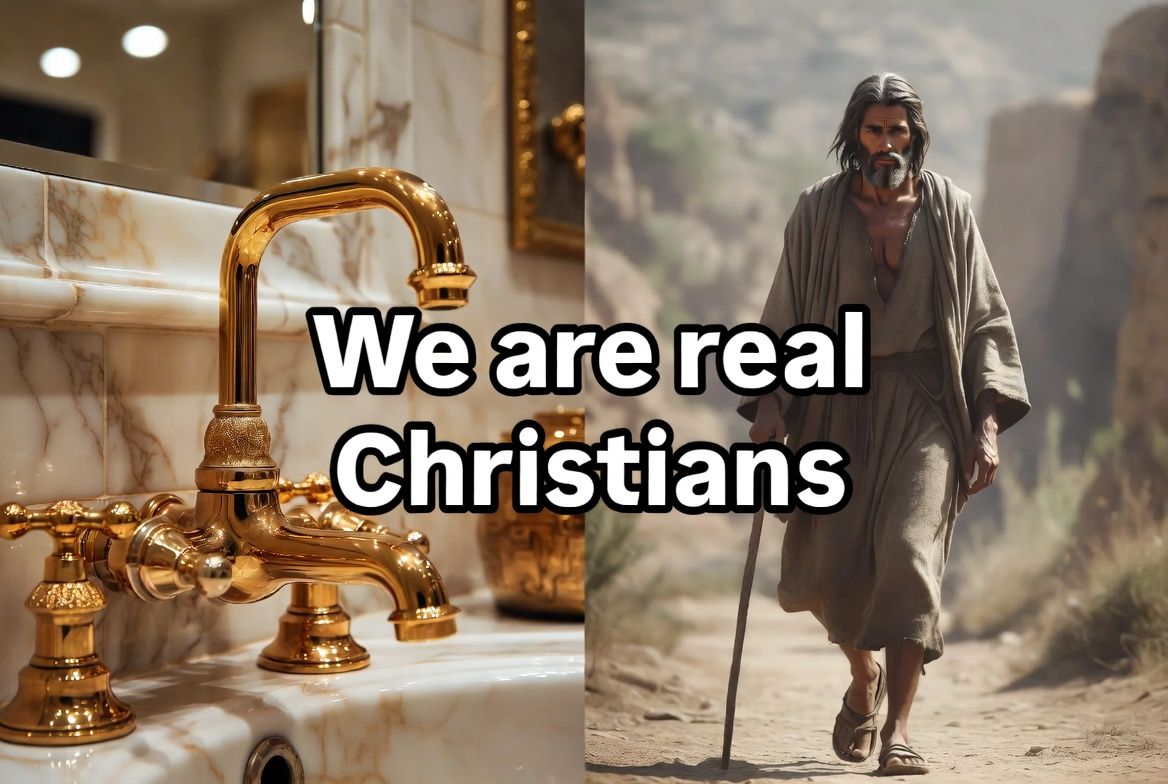
There is a man in America. He has three private jets, a mansion with gold-plated faucets, and a wife whose face has been rearranged by plastic surgeons more times than the Bible has been translated. He preaches on a stage that looks like a rock concert, surrounded by LED screens, fog machines, and a choir that has better choreography than a Beyoncé tour. He tells his congregation—mostly poor, mostly desperate, mostly clinging to hope like a life raft—that if they just “sow a seed” into his ministry, God will bless them a hundredfold.
He calls this the “Gospel of Prosperity.”
Jesus of Nazareth—a homeless, itinerant carpenter who told a rich young ruler to sell everything he had and give it to the poor, who said it was easier for a camel to pass through the eye of a needle than for a rich man to enter the kingdom of God, who owned nothing but the clothes on his back and died naked on a Roman cross—would not recognize this man’s gospel. He would not bless it. He would flip his tables.
But the televangelist doesn’t care. Because the televangelist has a private jet to catch.
The theology of greed
Let us be absolutely clear about what the Prosperity Gospel actually teaches. It is not a misinterpretation. It is not a harmless “positive thinking” movement. It is a theologically bankrupt, biblically illiterate, morally repugnant perversion of everything Jesus stood for—and it has become the fastest-growing export of American Christianity.
The core tenets are simple:
- God wants you to be rich. If you have enough faith, you will be wealthy.
- Poverty is a curse. If you are poor, you lack faith—or you have sin in your life.
- Your giving determines your receiving. If you give to the ministry, God will give back to you—often multiplied.
- Sickness is demonic. If you are sick, you need to rebuke the devil—and probably send a donation.
This is not Christianity. This is capitalism with a cross draped over it. This is Ayn Rand with a prayer meeting. This is the worship of Mammon dressed up in Sunday best, and it is the single greatest theological scandal of the 21st century.
The scriptures they ignore
Let us take a leisurely stroll through the Bible—the book they claim to preach—and see what Jesus actually said about money, wealth, and the poor.
Matthew 19:21 – “If you want to be perfect, go, sell your possessions and give to the poor, and you will have treasure in heaven. Then come, follow me.”
Not “buy a private jet.” Not “build a megachurch.” Sell. Give. Follow.
Luke 6:24 – “But woe to you who are rich, for you have already received your comfort.”
Woe. Not blessing. Woe.
James 5:1-6 – “Now listen, you rich people, weep and wail because of the misery that is coming on you. Your wealth has rotted, and moths have eaten your clothes. Your gold and silver are corroded. Their corrosion will testify against you and eat your flesh like fire. You have hoarded wealth in the last days. Look! The wages you failed to pay the workers who mowed your fields are crying out against you.”
That is not a prosperity gospel. That is a condemnation of prosperity.
1 Timothy 6:10 – “For the love of money is a root of all kinds of evil.”
Not “money is the root.” The love of money. The obsession. The worship. The Prosperity Gospel has turned that love into a sacrament.
And yet, these verses are never read from the pulpit of a megachurch. They are inconvenient. They are problematic for a ministry that depends on the poor emptying their wallets into the collection plate. So they are ignored, redacted, or explained away with mental gymnastics that would make an Olympic coach weep.
The scandal of the megachurch
Let us talk about the megachurch industry. Because that is what it is—an industry. A multi-billion dollar, tax-exempt, largely unregulated industry that preys on the desperate and the lonely.
- Kenneth Copeland – Net worth: ~$760 million. Owns a private jet. Has a mansion on a private lake. Preaches that God wants you to be rich while flying in a Gulfstream V.
- Joel Osteen – Net worth: ~$100 million. Lives in a $10.5 million mansion. Preaches a gospel of “positive thinking” while his church sits in a former basketball arena that seats 16,000.
- Creflo Dollar – Yes, his last name is Dollar. Net worth: ~$27 million. Asked his congregation to donate $65 million for a new private jet because his old one was “too small.”
- Benny Hinn – Net worth: ~$60 million. Preaches healing and prosperity while living in a $4.1 million home in Dallas.
These men are not pastors. They are CEOs. Their congregations are not flocks. They are customers. Their pulpits are not altars. They are stages. And their message is not the Gospel. It is a sales pitch.
The most obscene part? They pay no taxes. The churches they built with the tithes of the poor are tax-exempt. Their jets are “ministry expenses.” Their mansions are “parsonages.” Their luxury cars are “travel allowances.” The entire apparatus is designed to funnel money from the pockets of the desperate into the bank accounts of the corrupt—all while claiming divine blessing.
The victims of the Prosperity Gospel
Who pays for all this? Who funds the private jets, the mansions, the plastic surgeries, the lavish lifestyles?
The poor. The desperate. The sick. The elderly. The immigrant. The single mother working three jobs. The man dying of cancer. The woman who just lost her husband. The family whose house was foreclosed. These are the people who fill the pews of Prosperity Gospel churches. These are the people who send their last $50 in faith, believing that God will multiply it. These are the people who are told, week after week, that their suffering is their own fault—that they lack faith, that they have hidden sin, that they are not “sowing” enough.
And when the miracle doesn’t come? When the cancer doesn’t heal? When the foreclosure notice arrives? When the bank account hits zero?
They are told to pray harder. To give more. To believe bigger.
It is spiritual abuse. It is financial abuse. It is psychological abuse. And it is dressed up in the language of faith so that the victims cannot even see it for what it is.
The political dimension
Now let us add the poison icing on this toxic cake: the Prosperity Gospel is also a political machine.
The same pastors who preach that God wants you to be rich also preach that God wants you to vote for certain candidates. The same televangelists who fly private jets also sit in the Oval Office. The same megachurch CEOs who demand your tithes also demand your vote.
And what do they vote for? Tax cuts for the rich. Deregulation for corporations. Cuts to social welfare programs. Opposition to universal healthcare. Opposition to housing assistance. Opposition to food stamps. Opposition to anything that might actually help the poor—because if the poor are helped by the government, they might not need the church. And if they don’t need the church, they might stop giving.
It is a closed loop. A perfect, cynical, predatory system.
The Prosperity Gospel tells the poor that God will bless them if they give. Then it tells them to vote for politicians who make them poorer. Then it tells them that their poverty is their own fault. Then it asks for more money.
It is a machine designed to keep the poor poor and the rich rich—with Jesus as the brand name.
The global exports
The Prosperity Gospel is not an American phenomenon. It is a global industry. It has been exported to Africa, to Latin America, to Asia, to Eastern Europe—anywhere there is poverty and desperation and a hunger for hope.
In Nigeria, pastors fly private jets while their congregations live on less than $2 a day. In Brazil, megachurches tower over favelas. In South Korea, pastors own media empires. In Ukraine, Prosperity Gospel preachers have risen to prominence, promising that faith will bring economic revival—while their bank accounts grow.
And the worst part? It works. It grows. It spreads. Because when you are desperate, when you have nothing, when you are told that your suffering is your fault and that a little more faith—a little more giving—will change everything… you believe it. Because the alternative is too painful to accept.
The Prosperity Gospel does not offer hope. It offers a fantasy. It offers a deal: give me your money, and I will give you a dream. The dream never comes true. But the money is gone.
Why the Prosperity Gospels became successful
Before we condemn the Prosperity Gospel—and we should condemn it—we must understand why it works. Because it does work. It works spectacularly. It has grown from a fringe heresy to a global industry worth over a billion dollars. It fills stadiums. It dominates airwaves. It has converted millions across every continent. This did not happen by accident. The Prosperity Gospel succeeded because it was perfectly designed to exploit the deepest desires, fears, and cultural currents of the modern world. It is not just a theology. It is a cultural phenomenon. And if we do not understand how it became so successful, we will never be able to defeat it.
The first factor is American individualism. The United States was founded on the idea of the self-made man. Pull yourself up by your bootstraps. Work hard. Get ahead. Your success is your own doing. Your failure is your own fault. This is not entirely a bad thing. Individual responsibility is a virtue. But when you inject God into this formula, you get something dangerous: the belief that your material success is not just a result of your effort, but a divine endorsement.
The poor are morally wrong
If you are rich, God blessed you. If you are poor, you must have done something wrong—or failed to have enough faith. The Prosperity Gospel takes American individualism and gives it a theological stamp of approval. It says: “God wants you to be rich. So go get it. And if you don’t get it, it’s because you didn’t believe hard enough.” This is not Christianity. This is the American Dream with a prayer meeting.
And that brings us to the second factor: the American Dream itself. The Dream is the promise that anyone—regardless of background—can achieve success through hard work and determination. It is a beautiful idea. It is also, for millions, a lie. But the Prosperity Gospel does not just endorse the American Dream. It sacralizes it. It transforms the Dream into a divine promise. It says: “God has a plan for your life, and that plan includes prosperity. If you are not prosperous, you are not in God’s will.” This is deeply seductive. It tells the struggling worker, the single mother, the immigrant, the poor: “You are not forgotten. God wants you to succeed. And if you just have enough faith—and give enough money—you will.” It turns the American Dream into a religious obligation.
The American dreams fails. You didn’t pray enough
And when the Dream inevitably fails—as it does for most—the Prosperity Gospel has a ready answer: you didn’t give enough. You didn’t pray enough. You didn’t believe enough. The victim is blamed. The system is absolved. And the collection plate keeps passing.
The third factor is Pentecostalism and charismatic Christianity. The Prosperity Gospel did not emerge in a vacuum. It grew out of Pentecostalism—a movement that emphasizes the Holy Spirit, spiritual gifts, healing, and the supernatural. Pentecostalism is emotional, experiential, and immediate. It does not ask you to wait for heaven. It promises God’s power right now. When you combine this with the American Dream, you get the Prosperity Gospel. The same faith that promises healing also promises wealth.
The same God who speaks in tongues also speaks in bonuses. The same Spirit that empowers miracles also empowers success. Pentecostalism also provides the emotional framework for the Prosperity Gospel. It is not a dry, intellectual theology. It is a felt experience. When you are in a Pentecostal service—with the music, the shouting, the tears, the dancing—you feel God. And when you feel God, you believe anything is possible. Including a financial miracle. The Prosperity Gospel takes that emotional intensity and channels it into the collection plate. It is a brilliant, cynical exploitation of genuine spiritual hunger.
Television
The fourth factor is television evangelism. The Prosperity Gospel did not become a global phenomenon until it found its medium: television. In the 1970s, men like Oral Roberts, Pat Robertson, and Jim Bakker began broadcasting their ministries to millions of homes. They brought the Pentecostal experience into the living room. They created a sense of intimacy and immediacy. They made the viewer feel like they were part of the service—and part of the miracle. And then came the ask. “Send your seed faith offering. $100. $50. Whatever you can give. And God will bless you a hundredfold.” The television evangelist became a familiar face. The viewer felt a personal connection. They trusted him.
And when the evangelist promised a blessing, they believed him. Television also created the “para-church” ministry—a ministry that operated outside traditional denominations, without accountability, without oversight. The televangelist answered to no one except his donors and his board—which he often appointed himself. This allowed the Prosperity Gospel to flourish unchecked. And the money poured in. Millions of dollars. Hundreds of millions. The televangelist became a celebrity, a brand, an empire. And the empire demanded constant feeding.
Media and online donations
The fifth factor is social media and online donations. If television was the Prosperity Gospel’s rocket ship, social media is its hyperdrive. Today, every televangelist has a YouTube channel, an Instagram account, a TikTok presence, and a website with a “Donate” button. They are not just preaching to thousands. They are preaching to millions. And they are doing it 24/7. Social media creates a feedback loop of reinforcement. The follower sees the preacher’s private jet, his mansion, his designer clothes—and interprets it not as hypocrisy, but as proof. “God is blessing him. And if I give, God will bless me too.”
Online donations have made giving frictionless. You do not need to write a check or wait for the collection plate. You just click. And the algorithms ensure that you keep giving—by retargeting you with ads, by sending you emotional emails, by reminding you of the blessing you will receive if you just give a little more. The Prosperity Gospel has become a digital marketing machine. Its product is hope. Its price is your money. And its distribution is infinite.
The promise of wealth
The sixth factor is why it appeals especially in poorer countries. The Prosperity Gospel did not stop at America’s borders. It has become a global industry—and its biggest growth markets are in the developing world. Why? Because poverty is fertile ground for promises of wealth. When you are poor, when you have nothing, when your children are hungry, when you are sick and cannot afford medicine, when your future is bleak—hope is a precious commodity. And the Prosperity Gospel sells hope. It tells the poor: “You are not forgotten. God has a plan for you. And if you just have faith—and give—you will be blessed.” It is a message of radical hope in the face of radical hopelessness. And it is devastatingly effective.
In Africa, Latin America, Asia, and Eastern Europe, the Prosperity Gospel has grown faster than any other Christian movement. It has built megachurches in the slums. It has filled stadiums in the favelas. It has converted millions who were desperate for anything—anything—that promised a way out. But the promise is a lie. The poor give, and the rich get richer. The local pastor—often trained in American Prosperity Gospel theology—builds his own house, buys his own car, sends his own children to private school. The congregation remains in poverty. The cycle continues. The Prosperity Gospel in the developing world is not just exploitation. It is colonialism in a new form. It takes the wealth of the poor and funnels it to the rich—often in another country. It is a reverse Robin Hood. And it is unrelenting.
Sunk cost
The seventh and final factor is the psychology of sunk cost. When you have given money—when you have sacrificed, prayed, believed, and hoped—you cannot easily admit that you were wrong. To admit that the Prosperity Gospel is a lie is to admit that you were a fool. That your faith was misplaced. That your money is gone. So you double down. You give more. You believe harder. You defend the preacher. You attack the critics. You cling to the hope that one day—one day—the blessing will come. The Prosperity Gospel exploits this psychology ruthlessly. It creates a trap. And it ensures that the trapped defend the trap. This is not faith. This is addiction. And the Prosperity Gospel is the dealer.
The Prosperity Gospel is not a theological accident. It is a cultural, economic, and psychological phenomenon that was deliberately constructed and ruthlessly refined over decades. It succeeds because it knows what people want—and it gives them a way to get it, even if that way is a lie. Understanding this does not excuse it. It exposes it. It reveals the Prosperity Gospel not as a movement of faith, but as a machine of exploitation. And once you see the machine, you cannot unsee it.
The Biblical response
Let us return to Jesus. Not the prosperity Jesus—the fake one, the one who wears a suit and poses for photos with politicians. The real Jesus. The Jesus who lived in the margins. The Jesus who ate with tax collectors and prostitutes. The Jesus who touched lepers. The Jesus who said:
“Blessed are you who are poor, for yours is the kingdom of God.” (Luke 6:20)
“Blessed are you who hunger now, for you will be satisfied.” (Luke 6:21)
“But woe to you who are rich, for you have already received your comfort.” (Luke 6:24)
That Jesus is the opposite of the Prosperity Gospel. That Jesus does not promise a private jet. That Jesus does not promise a mansion. That Jesus does not promise wealth. That Jesus promises the kingdom—not in this life, but in the next. That Jesus promises suffering, not success. That Jesus promises the cross, not the crown.
And that Jesus would look at the megachurch, at the private jet, at the gold-plated faucets, at the $65 million donation request—and he would weep. Or he would flip tables. Or both.
The critique from within
It is not just outsiders who see the hypocrisy. Many within the Christian tradition have condemned the Prosperity Gospel as heresy.
- Theologian John Piper has called it “a huge danger” and “a false gospel.”
- Pastor Tim Keller described it as “a form of idolatry.”
- Pope Francis has repeatedly condemned it, calling it “a scandal” and “spiritual worldliness.”
- The late R.C. Sproul referred to it as “the most dangerous heresy in the church today.”
Even the Prosperity Gospel’s own victims are beginning to wake up. Former followers have spoken out. Documentaries have been made. Investigations have been launched. But the machine grinds on, because the machine is too profitable to stop.
The satirical response
Since the Prosperity Gospel is too absurd to take entirely seriously, let us engage in the appropriate response: mockery.
If the Prosperity Gospel were true, Jesus would have been the richest man in Judea. Instead, he was buried in a borrowed tomb.
If the Prosperity Gospel were true, the apostles would have owned beachfront property. Instead, they were martyred.
If the Prosperity Gospel were true, the early church would have been a real estate empire. Instead, they sold everything they had and gave to the poor.
If the Prosperity Gospel were true, the cross would have been a marketing opportunity. Instead, it was a instrument of torture.
The Prosperity Gospel is not Christianity. It is a parody of Christianity. It is Christianity as imagined by a Madison Avenue ad executive. It is Jesus as a brand, faith as a product, and salvation as a transaction.
And the most tragic part? Millions believe it. Because it is easier to believe in a God who wants you to be rich than in a God who asks you to take up your cross and follow him.
Conclusion: The camel and the needle
Let us end where we began. Jesus said:
“It is easier for a camel to go through the eye of a needle than for a rich man to enter the kingdom of God.”
The Prosperity Gospel wants to turn that needle into a tunnel. It wants to say that God blesses the rich, that wealth is a sign of favor, that poverty is a curse. But Jesus said the opposite. He said the rich are in danger. He said the poor are blessed. He said the first shall be last and the last shall be first.
The Prosperity Gospel is the inversion of everything Jesus taught. It is the gospel of the anti-Christ, dressed in the robes of the faithful. It is a lie told to the desperate, sold as hope. It is a scam, a fraud, a theological Ponzi scheme that takes from the poor to give to the rich.
And it must be called out. Not with politeness. Not with “both sides.” Not with deference. It must be called out with fire, with fury, with the same righteous anger that drove Jesus to overturn the tables of the money changers.
Because that is what this is: the same temple. The same money changers. The same corruption. Just a different century.
The real Jesus?
The Prosperity Gospel is not a blessing. It is a curse. Not a faith. It is a fraud. Not a gospel. It is a blasphemy.
And if you believe it, you have been sold a lie. But you can still walk away. You can still see the truth. You can still pick up your cross and follow the real Jesus—the homeless one, the suffering one, the one who had nowhere to lay his head.
He is still waiting. He never left. But he will not bless your private jet. He will not bless your mansion. He will not bless your tax evasion. He will ask you to give it all away.
And if you can’t do that—if that seems too extreme, too costly, too much—then you are not following him. You are following a idol. You are following a fantasy. You are following the Prosperity Gospel.
And the Prosperity Gospel is a lie.
Leave a Reply