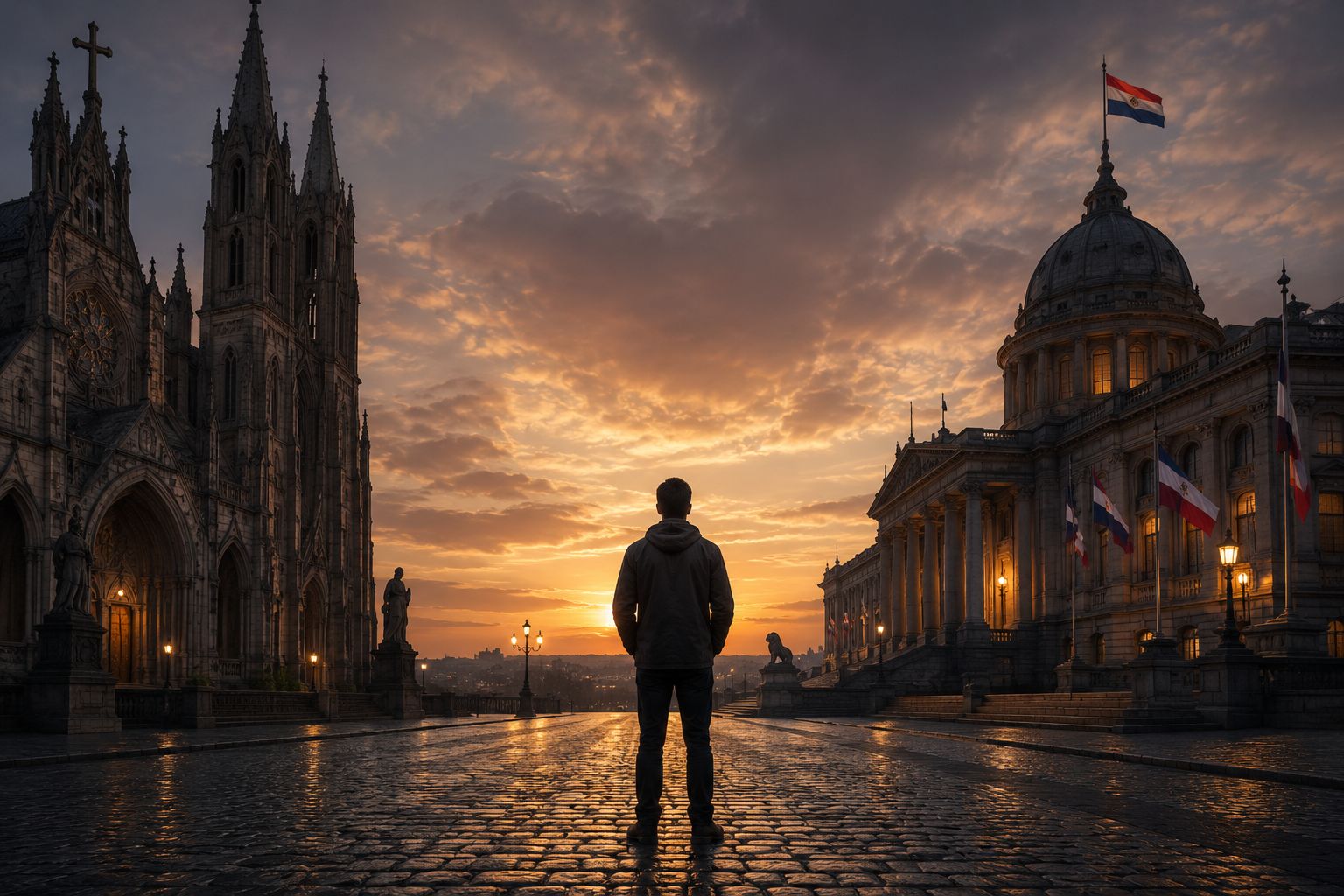
It is easy to be a freethinker in an environment where skepticism, scientific inquiry, and open debate are celebrated. The real test comes when society expects conformity. Throughout history, many of the greatest advocates of reason did not live in liberal democracies. They lived under monarchies, dictatorships, theocracies, or deeply conservative societies where questioning accepted beliefs carried significant personal risks.
Freethought has never depended on geography. It depends on the willingness to examine evidence, reject authority when it conflicts with facts, and change one’s mind when better arguments emerge. That willingness becomes most valuable precisely where it is least welcomed.
Conservative political climates vary enormously. Some simply emphasize tradition, religion, and social stability while still respecting freedom of expression. Others gradually restrict academic freedom, media independence, minority rights, or criticism of those in power. Freethinkers face different challenges in each environment, but the underlying dilemma remains remarkably similar: how does one remain intellectually honest when honesty becomes socially or politically costly?
Conformity is a powerful evolutionary force
Human beings evolved in small tribal groups where social exclusion could be fatal. As a result, our brains developed powerful psychological mechanisms that reward conformity and punish dissent with anxiety, embarrassment, or fear of rejection.
Political systems frequently exploit these instincts. Conservative governments may encourage loyalty to religion, the nation, traditional family structures, or historical narratives. Citizens who publicly question these values can be portrayed as disloyal, immoral, or even dangerous.
The pressure rarely begins with imprisonment. More often it starts with social isolation, employment consequences, online harassment, or exclusion from professional networks. These softer forms of punishment are often sufficient to discourage public disagreement.
For freethinkers, resisting these pressures requires recognizing that the discomfort of dissent is not necessarily evidence that one is wrong. It is often a product of human psychology.
The challenge is not unique to conservatives
Although this article focuses on conservative political climates, intellectual conformity is hardly exclusive to the political right.
History provides numerous examples of authoritarian communist regimes suppressing independent thought, censoring scientists, imprisoning dissidents, and demanding ideological loyalty. Even within democratic societies, progressive majorities can sometimes create environments where expressing unpopular opinions carries significant social or professional costs.
The lesson is broader than left versus right. Freethinkers should be skeptical whenever any political movement treats disagreement as betrayal rather than an opportunity for debate.
The principles of free inquiry must remain politically neutral. If freedom of speech only protects opinions we already agree with, it is no longer genuine freedom.
Religion and nationalism
Many conservative political movements maintain close relationships with religion, nationalism, or both. This does not mean that religious believers or patriots are inherently opposed to freethought. Millions of religious people embrace science, support democratic institutions, and welcome open discussion. Likewise, love for one’s country does not require hostility toward criticism. Patriotism and critical thinking can coexist, provided that neither becomes immune to scrutiny.
The difficulty arises when religious doctrines or national identity are treated as unquestionable truths rather than ideas that can be examined. Once certain beliefs become sacred in the political sphere, challenging them is no longer viewed as part of democratic debate. Instead, criticism is interpreted as an attack on the nation, its traditions, or its moral foundations.
History offers countless examples of governments drawing legitimacy from religion or national myths. Political leaders frequently present themselves as defenders of ancient values, historical destiny, or divine purpose. Such narratives can strengthen social cohesion and provide citizens with a shared identity, but they can also discourage independent inquiry. When leaders claim to represent God, the nation, or history itself, disagreement becomes more than a policy dispute. Opponents may be portrayed as traitors, heretics, or enemies of society.
Many nations consider themselves morally superior
Nationalism can produce similar effects. Pride in one’s country’s achievements is natural and often beneficial. Problems emerge when national identity becomes tied to the belief that one’s own nation is morally superior, uniquely virtuous, or incapable of serious wrongdoing. Every nation has moments of greatness as well as periods of injustice, violence, or oppression. A freethinker recognizes both. Honest patriotism is compatible with acknowledging historical mistakes, whereas ideological nationalism often seeks to erase or justify them.
Religion may also become intertwined with political identity in ways that make objective discussion increasingly difficult. Scientific findings, educational curricula, reproductive rights, or minority protections can cease to be evaluated on their evidence and instead become symbols of cultural conflict. In such circumstances, accepting or rejecting an argument often depends less on its merits than on whether it aligns with one’s religious or political community.
This dynamic affects believers and non-believers alike. Religious individuals may hesitate to question interpretations promoted by influential clergy, while secular citizens may avoid expressing skepticism about dominant national narratives. The social pressure is similar in both cases: loyalty is rewarded, whereas independent thought risks criticism or exclusion.
Every institution, tradition, ideology, and historical narrative should remain open to evidence and criticism. A society becomes intellectually healthier not when everyone reaches the same conclusions, but when people are free to question even its most cherished assumptions without fear of social or political punishment.
Science becomes political
Scientific research occasionally collides with ideological preferences.
Evolution, climate science, vaccination, reproductive health, history, and educational policy have all become political battlegrounds in different countries. Scientists may find themselves pressured to produce politically convenient conclusions rather than objectively accurate ones.
This phenomenon is not unique to conservative governments. Ideological interference with science has occurred under dictatorships, communist regimes, military governments, and democracies alike.
Science advances by allowing hypotheses to fail. Politics often rewards certainty instead.
When political goals determine acceptable scientific conclusions, both science and public policy suffer.
Self-censorship
One of the greatest dangers is not censorship imposed by governments but censorship imposed by ourselves.
People gradually learn which opinions are rewarded and which are punished. Eventually, they stop expressing controversial ideas even without explicit threats.
This process is remarkably effective because it requires no prisons and no police.
Many individuals convince themselves that remaining silent is merely practical. Sometimes it genuinely is. Not everyone can afford to lose employment or place their family at risk.
Nevertheless, widespread self-censorship creates an illusion of consensus. Once enough people stay silent, everyone begins believing that few others disagree.
History repeatedly demonstrates that this illusion can collapse surprisingly quickly once people realize they are not alone.
Building communities
Freethinkers often experience isolation, especially in strongly conservative regions.
The internet has transformed this situation. People living in small towns or authoritarian societies can now communicate with scientists, philosophers, secular organizations, and other skeptics across the world.
These communities provide emotional support as well as intellectual stimulation.
However, online spaces also carry risks. Echo chambers can develop on every side of the political spectrum. Genuine freethought requires exposure to competing arguments rather than constant reassurance from people who already agree with us. Research suggests online communities often reinforce group identities by collectively criticizing opposing viewpoints rather than remaining intellectually diverse.
Courage without martyrdom
Not every disagreement requires public confrontation.
There is an important distinction between courage and recklessness.
Some individuals become effective advocates by writing anonymously, focusing on education, teaching critical thinking, or gradually introducing evidence instead of engaging in endless ideological conflict.
Others choose open activism despite significant personal risks.
There is no universal strategy. The goal of freethought is not to become famous for dissent. It is to pursue truth as honestly as circumstances allow.
The future of freethought
Freethinkers have existed under kings, emperors, dictators, democracies, communist governments, military juntas, and religious states. Political systems change, but the basic challenge remains constant.
Independent thinking has always required intellectual humility. It also requires courage.
A freethinker is not someone who rejects tradition simply because it is old, nor someone who embraces novelty simply because it is fashionable. Freethought means evaluating every claim on its evidence, regardless of whether it comes from a conservative government, a progressive movement, a religious institution, or a scientific authority.
Conservative political climates therefore do not eliminate freethought. They merely make its costs more visible. History suggests that ideas supported by evidence tend to survive far longer than those sustained only by political power, regardless of which ideology temporarily dominates public life. Diverse political views have long existed within freethought itself, but a common commitment to evidence, open inquiry, and freedom of conscience has remained its defining characteristic.
Leave a Reply