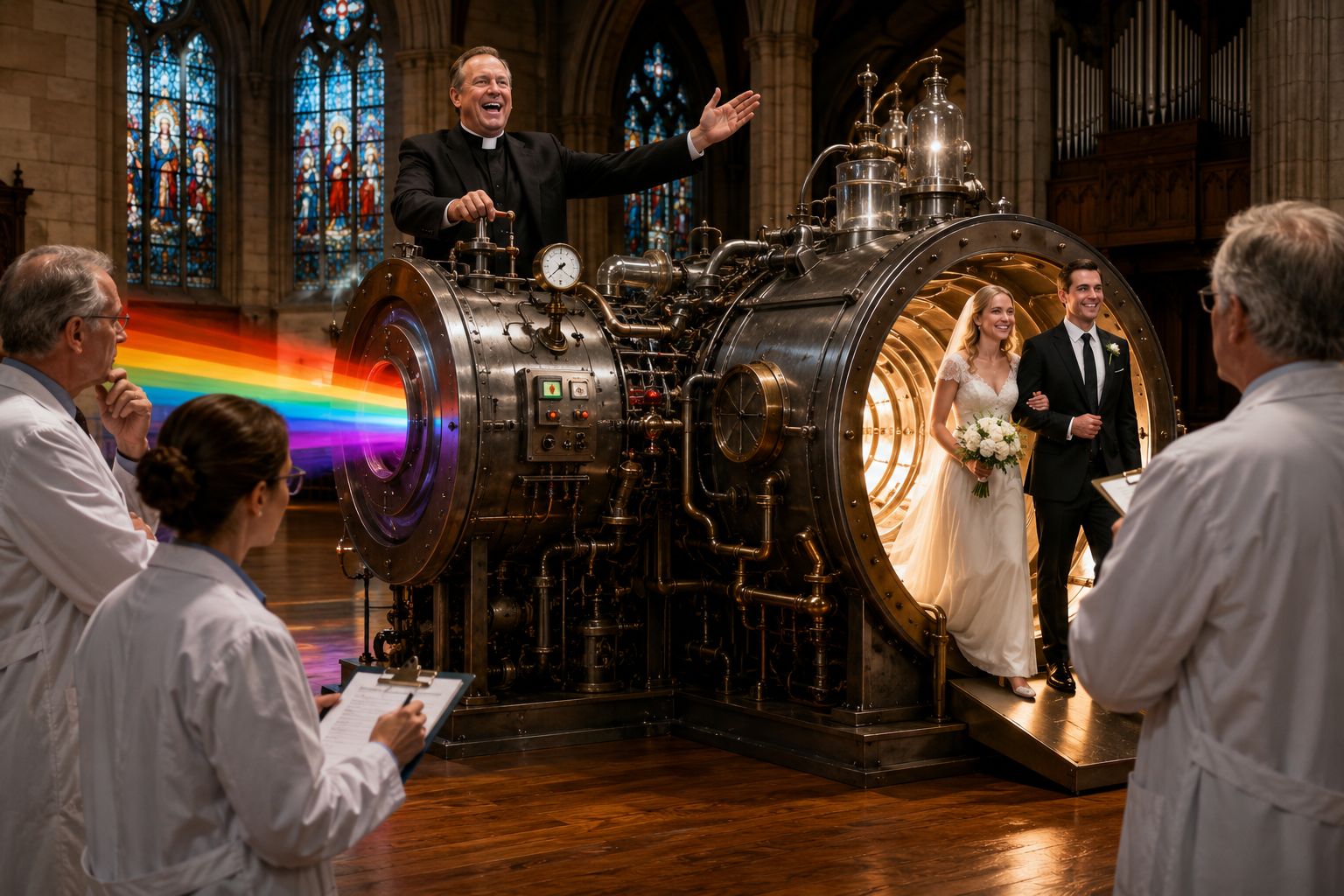
Imagine discovering that you are gay and being informed that the solution is remarkably straightforward. You simply need enough prayer, enough faith, enough counseling and perhaps enough determination. Eventually, according to some religious movements, heterosexuality should emerge from the other end.
It sounds wonderfully convenient. There is only one irritating obstacle: science.
For decades, religious organizations and so-called conversion therapists have claimed that homosexual people can become heterosexual. There are testimonies, marriages, ministries and dramatic conversion stories. Some people have sincerely reported profound changes in their lives. Yet when we ask the considerably less exciting scientific question—whether a religious intervention can reliably change a person’s underlying sexual orientation—the evidence becomes remarkably uncooperative.
God apparently forgot the control group
The traditional conversion story has an appealing simplicity. A person experiences homosexual attraction. He finds God, undergoes counseling, prays intensely, abandons homosexual relationships and eventually announces that he has become heterosexual.
Case closed.
Except that almost every step creates an obvious scientific problem.
Stopping homosexual behavior does not make somebody heterosexual. Neither does celibacy. Marrying a woman does not prove exclusive attraction to women. Calling yourself heterosexual does not necessarily make your pattern of attraction heterosexual either.
These distinctions matter because older “ex-gay” movements frequently blurred behavior, identity and attraction. If a gay Christian stopped sleeping with men, the movement could count this as progress. If he married a woman, it could look like a transformation. If he continued experiencing attraction to men but resisted it, the inconvenient part could remain safely inside his head.
A scientific investigation cannot work that way. If the proposition is that homosexual orientation can be deliberately converted into heterosexual orientation, researchers need evidence that the attraction itself changed because of the intervention.
That evidence has proved extremely difficult to find.
Ted Haggard achieves heterosexuality at remarkable speed
Few stories illustrate the absurdities surrounding the subject better than Ted Haggard.
Haggard was one of America’s most prominent evangelical pastors. He led the enormous New Life Church in Colorado and served as president of the National Association of Evangelicals. He publicly opposed homosexual behavior and same-sex marriage.
He also had a memorable confrontation with atheist evolutionary biologist Richard Dawkins. During the filming of The Root of All Evil?, the two argued about evolution and religion, and their exchange became one of Dawkins’s better-known encounters with American evangelical Christianity.
Then Haggard’s own sexuality became considerably more interesting.
In 2006, male escort Mike Jones alleged that Haggard had paid him for sex. Haggard initially denied the sexual allegations before acknowledging sexual immorality. He subsequently entered a religious rehabilitation process.
Then came what appeared to be a theological miracle.
In 2007, one of the ministers overseeing Haggard’s restoration announced that Haggard was “completely heterosexual.”
Apparently, human sexual orientation had been successfully repaired.
Unfortunately, sexuality neglected to cooperate with the press release.
Years later, Haggard described himself in terms that substantially complicated the claim. In a 2011 interview, he said that if he were 21 at that time, he would probably identify as bisexual. He nevertheless maintained that he could remain exclusively committed to his wife.
That is perfectly plausible. A bisexual person can obviously remain monogamous.
What it does not demonstrate is that religious counseling transformed homosexual attraction into heterosexual attraction.
Exodus International encounters an inconvenient exodus
If Haggard were an isolated example, proponents could dismiss his case as an unfortunate exception. The history of Exodus International makes that considerably harder.
Exodus became perhaps the world’s most famous Christian organization associated with the “ex-gay” movement. For decades, its ministries promoted the possibility of overcoming homosexuality through Christianity.
There could hardly have been a better opportunity to demonstrate that the process worked.
Thousands of people passed through ministries associated with the movement. There were conferences, testimonies, books and married former homosexuals. If Christianity possessed a reliable mechanism for changing sexual orientation, an organization dedicated to precisely that objective should have accumulated extraordinary evidence.
Instead, Exodus eventually collapsed.
Its final president, Alan Chambers, became increasingly candid about what actually happened to participants. In 2012, he publicly rejected the idea that people could simply choose to change their attractions and acknowledged that the overwhelming majority of people he had encountered continued experiencing same-sex attraction.
In 2013, Exodus International shut down. Chambers apologized to members of the LGBT community for harm associated with the organization.
For a movement devoted to demonstrating that homosexual people could change, this was not an especially triumphant conclusion.
Some people really do report change
Satire should not require us to distort the evidence in the opposite direction.
There are people who sincerely report substantial changes in their sexual attractions. Human sexuality is complicated, and sexual orientation does not necessarily remain perfectly static throughout every person’s life.
This phenomenon is usually discussed under the broader concept of sexual fluidity. Research, including work associated with psychologist Lisa Diamond, has documented changes in patterns of attraction and identity over time, particularly among some women.
That creates an important distinction.
“Some people’s attractions change” and “we know how to make people’s attractions change” are completely different propositions.
People sometimes spontaneously lose religious faith. That does not mean psychiatrists have discovered a treatment that reliably converts Christians into atheists. People sometimes experience enormous changes in personality, preferences and relationships over their lifetimes. That does not mean therapists can order those transformations from a catalogue.
The existence of sexual fluidity therefore does not validate conversion therapy.
Indeed, spontaneous change creates another problem for conversion stories. If somebody’s attractions change after five years of prayer, how do we know that prayer caused the change? Without suitable controls and careful measurement, temporal sequence alone proves very little.
People have prayed before recovering from cancer. That does not establish prayer as chemotherapy.
Rosaria Butterfield presents a more complicated case
Rosaria Champagne Butterfield provides one of the best-known contemporary Christian conversion stories.
Butterfield previously identified as lesbian and lived in a relationship with a woman. She later converted to Christianity, eventually married a man and became a prominent conservative Christian writer.
Her life clearly changed enormously.
However, presenting such an individual story as scientific proof of religiously induced orientation change would create several problems. Marriage is not an objective measurement of sexual orientation. Religious identity is not sexual orientation. Behavior is not sexual orientation. Furthermore, one person’s retrospective description cannot establish a causal mechanism applicable to other homosexual people.
Her story may constitute evidence about Butterfield’s personal experience. It cannot establish a general therapeutic principle.
The same problem appears repeatedly in religious testimony. “This happened to me” gradually becomes “God can do this,” which then becomes “you can do this too,” which can finally become “if you haven’t changed, you haven’t tried hard enough.”
The logical distance between the first and final statements is enormous.
Jackie Hill Perry complicates the miracle narrative too
Christian writer Jackie Hill Perry has also spoken publicly about having previously lived as a lesbian before converting to Christianity and later marrying a man.
Her story is frequently mentioned in discussions about Christianity and homosexuality. Yet Perry herself has resisted one of the simplistic conclusions sometimes drawn from such testimonies: that becoming Christian automatically eliminates same-sex attraction.
That distinction is crucial.
Traditional Christianity can consistently say that a believer should refrain from particular sexual behavior. Whether that teaching is morally justified is another debate. At least it constitutes a coherent behavioral rule.
Claiming that faith will change the underlying attraction is an empirical proposition.
Once religion makes empirical claims, science gets to examine them.
The spectacular failure of conversion therapy
Attempts to deliberately alter sexual orientation have taken many forms. Some have involved prayer and pastoral counseling. Others have borrowed the language of psychology. Historically, considerably more disturbing approaches included aversive conditioning and other attempts to associate homosexual stimuli with unpleasant experiences.
None has produced convincing evidence of a safe, reliable method for turning homosexual people heterosexual.
Major professional organizations have consequently rejected sexual-orientation change efforts as scientifically unsupported, and concerns about potential psychological harm have become central to professional opposition to conversion therapy.
There is another methodological problem that deserves attention. Even apparent “successes” can represent several completely different outcomes.
A participant might suppress homosexual behavior while retaining homosexual attraction. Another might discover that he is bisexual and become more focused on opposite-sex relationships. Someone else might change the identity label he uses. Another might enter a heterosexual marriage for religious or social reasons.
Only a subset of imaginable outcomes would constitute the transformation that conversion advocates traditionally promised: a durable change from predominantly or exclusively homosexual attraction to predominantly or exclusively heterosexual attraction caused by the intervention.
Once that definition becomes strict, spectacular testimonials become considerably less spectacular.
The bisexuality problem
Bisexuality creates an especially large headache for simplistic conversion narratives.
Suppose a man experiences attraction to both sexes but strongly prefers men during his twenties. He identifies as gay and exclusively dates men. At 30, he joins a conservative church. He subsequently develops a relationship with a woman, falls in love, marries her and stops identifying as gay.
The church announces another successful conversion.
But what exactly changed?
Perhaps his pattern of attraction genuinely shifted. Perhaps his existing attraction to women became more important. Perhaps social pressure changed his behavior. Perhaps his religious beliefs changed his identity. Perhaps several of these things happened simultaneously.
Without careful evidence, declaring that Christianity “turned a gay man straight” tells us more about the storyteller’s preferred narrative than about the person’s sexuality.
Homosexuality also exists without evangelical pastors
There is an even broader biological problem for simplistic religious explanations of homosexuality.
Same-sex sexual behavior has been documented across numerous animal species. Animals are obviously not perfect models for human sexual orientation, and scientists should not equate every instance of same-sex animal behavior with human homosexuality.
Still, its existence is rather inconvenient for theories portraying homosexuality simply as a modern ideological choice.
Bonobos have not read queer theory. Penguins have not been corrupted by Hollywood. Japanese macaques are not attending Pride marches.
Nature appears perfectly capable of producing same-sex sexual behavior without assistance from secular universities.
Sexual orientation is not a theological light switch
Modern research generally treats sexual orientation as a complex phenomenon rather than a voluntary preference comparable to choosing a shirt.
Genetic influences appear to contribute, but there is no single “gay gene.” Developmental and biological factors also appear relevant, while the precise pathways remain incompletely understood. The important point is that researchers have not discovered a simple switch that religious counseling can deliberately move from homosexual to heterosexual.
That does not mean every gay person’s attractions are immutably fixed from birth until death.
Science rarely rewards such absolute statements.
It means something much less dramatic and much more important: there is no established intervention that reliably converts homosexual orientation into heterosexual orientation.
The difference matters.
Perhaps insufficient prayer was the problem
Conversion movements have an extraordinarily convenient escape mechanism.
If somebody changes, the method worked.
If somebody does not change, perhaps he lacked faith, failed to surrender himself completely, secretly enjoyed his homosexuality, resisted God or simply needed another few years.
This makes the proposition almost impossible to falsify.
Imagine applying the same reasoning to medicine.
A doctor gives 1,000 patients a pill. Ten improve. The doctor points triumphantly to the ten. The other 990 apparently did not believe strongly enough in pharmacology.
The medicine would not survive its first serious clinical trial.
Religious claims should not receive a methodological exemption simply because God appears somewhere in the proposed mechanism.
A heterosexual marriage proves surprisingly little
One of the most persistent mistakes in historical ex-gay literature was treating heterosexual marriage as evidence of heterosexual orientation.
Human history should have taught us otherwise.
Gay men and lesbians have married opposite-sex partners for centuries, particularly in societies where homosexuality carried severe legal, religious or social consequences. Some undoubtedly loved their spouses deeply. Some had children. Some maintained their marriages throughout their lives.
None of those facts logically establishes exclusive heterosexual attraction.
Human beings can choose their behavior. They can choose celibacy. They can choose monogamy. They can choose which relationships to pursue. They can even choose the identity labels they publicly use.
What they apparently cannot do with comparable reliability is sit down on Monday morning and decide which sex will become sexually attractive by Friday.
Religion can change people without changing orientation
None of this means religious conversion is psychologically trivial.
Religion can radically alter someone’s life. A convert may abandon drugs, change friends, end relationships, adopt new moral rules, marry, become celibate or reorganize virtually every aspect of daily existence.
That is genuine change.
A gay Christian who believes homosexual sex violates God’s commandments may therefore choose lifelong celibacy. From within his theology, that may represent an enormous spiritual achievement.
But he remains a rather poor advertisement for the proposition that Christianity makes gay people straight if he continues finding men sexually attractive.
The theological claim and the scientific claim should therefore remain separate.
A religion can command behavior without possessing the ability to redesign attraction.
The miracle that never became a treatment
This is perhaps the strangest feature of the entire history.
If religious conversion could reliably transform homosexual people into heterosexual people, the discovery would be scientifically fascinating.
Researchers could measure it. Independent teams could replicate it. We could compare different interventions, determine success rates, investigate neurological mechanisms and identify which variables predicted transformation.
After decades of attempts, that revolution has not occurred.
Instead, some of the organizations most strongly associated with orientation change have collapsed, moderated their claims or acknowledged that continuing same-sex attraction is common.
There are individual testimonies of change. There is evidence that sexuality can be fluid for some individuals. There are bisexual people whose patterns of attraction shift. There are people who change identity labels, behavior and relationships.
What we do not have is convincing evidence that prayer, repentance, religious counseling or conversion therapy provides a reliable technology for turning gay people straight.
Perhaps God works in mysterious ways.
Statistically reproducible ways would have been considerably more useful.
Leave a Reply