“Well, Mr. Bryxí, I can smell your autism from a long distance,” my psychiatrist once told me.
I decided to ask him a question.
“How many autistic people have you diagnosed during your career?”
“Maybe six. And I have been doing this for 40 years.”
“Do you currently have any other autistic patient besides me, out of your thousands of patients?”
“No. There is one gentleman, but he is borderline.”
This exchange happened in the real world, not on TikTok, Instagram or in an online “neurodivergence” community. My psychiatrist belongs to a generation of doctors for whom autism was an unusual developmental disorder, not a fashionable explanation for being introverted, socially awkward, obsessive, eccentric, sensitive to noise or simply different.
Then look at the numbers.
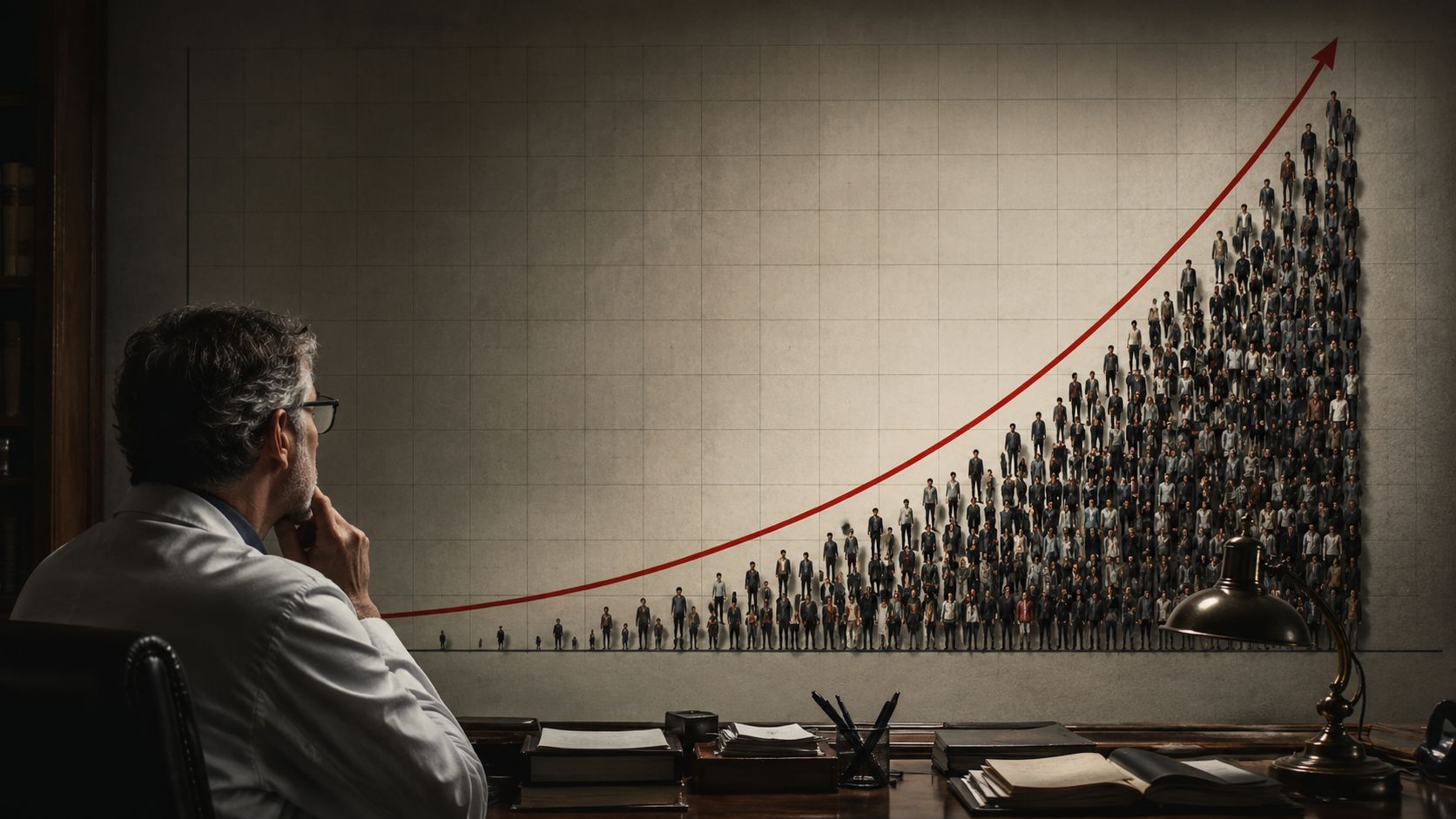
Something extraordinary has happened to autism during the past half-century. In the 1960s, researchers counted autistic children in single digits per 10,000. Today, the latest American surveillance data identify autism in roughly one child out of every 31.
Either humanity has undergone one of the fastest neurological transformations in its history, or the meaning of the word autism has changed enormously.
The second explanation is unquestionably part of the story.
From four in 10,000 to one in 31
One of the earliest major epidemiological studies was Victor Lotter’s 1966 British survey. It produced an estimate of roughly 4–4.5 autistic children per 10,000. Other early studies produced similarly tiny numbers, although estimates varied according to methodology and definitions. A National Academies review summarizes early studies from the 1960s and 1970s as generally finding around two to four cases per 10,000 children.
Compare that with the United States today.
According to the Centers for Disease Control and Prevention, autism was identified in approximately 1 in 31 eight-year-old children across its surveillance sites in 2022. That is 32.2 children per 1,000, or 3.2 percent.
The CDC’s own historical series is remarkable. The figure was 1 in 150 in 2000, 1 in 110 in 2006, 1 in 88 in 2008, 1 in 68 in 2010, 1 in 54 in 2016, 1 in 44 in 2018, 1 in 36 in 2020 and now 1 in 31.
However, putting the 1966 figure next to the 2022 figure and announcing that autism has increased eightyfold would be deeply misleading. We are not measuring precisely the same population under precisely the same definition.
That distinction is crucial.
Autism did not simply become eighty times more common
There are several reasons why identified autism has increased so dramatically: diagnostic criteria broadened, awareness increased, screening improved, children who would previously have received different diagnoses entered the autism category, milder cases became recognizable, services created incentives for identification, and clinicians became better at recognizing autism in people who would once have been overlooked.
Even the concept being measured changed.
Early epidemiological research largely concerned what we might now think of as comparatively narrow or “classic” autism. Modern Autism Spectrum Disorder deliberately encompasses a much broader range of presentations. Researchers have therefore warned for decades against interpreting rising diagnosed prevalence as straightforward evidence of an equivalent rise in the underlying biological condition.
This does not prove that the entire increase is diagnostic. Nor does it prove that autism’s underlying incidence has remained perfectly constant. The scientifically defensible position is more cautious: we cannot treat prevalence figures produced under radically different diagnostic systems as though they were measurements made with the same ruler.
But there is another question we should be willing to ask.
Has that ruler now become too long?
Welcome to the spectrum
The word “spectrum” transformed autism.
There were good reasons for doing this. Autistic characteristics do not fall neatly into a few natural boxes. People can have different combinations of difficulties involving social communication, repetitive behaviour, restricted interests, sensory processing and adaptability. Intellectual and language abilities also vary enormously.
Yet the spectrum created a peculiar linguistic situation.
One person described as autistic may be a successful actor, university professor, programmer or writer living independently. Another autistic person may have substantial intellectual disability, minimal functional language, severe behavioural difficulties and require continuous assistance with basic activities throughout life.
Both receive variations of the same diagnostic label.
That may make sense within a clinical classification system. Outside the clinic, however, it can create tremendous confusion.
Asperger’s syndrome did not disappear because the people disappeared
This becomes particularly obvious when discussing Asperger’s syndrome.
Asperger’s was previously a separate diagnosis. In 2013, DSM-5 eliminated it as an independent diagnosis and incorporated it, together with several other previously separate developmental diagnoses, into Autism Spectrum Disorder. People who would once have received an Asperger’s diagnosis can therefore receive an ASD diagnosis under today’s system.
So Asperger’s did not somehow cease to exist as a human phenotype in 2013. The classification changed. It likely remains part of the autism spectrum.
The term remains widely used informally, and some people diagnosed under the older system continue to identify with it. Clinically, however, Asperger syndrome is no longer a separate DSM diagnosis.
This administrative decision had an enormous cultural consequence. People whom the public previously understood as having Asperger’s syndrome are now simply described as “autistic.”
Then came the autistic celebrity
Now autism has entered celebrity culture.
Robbie Williams recently revealed that he had been diagnosed with autism at 52. He joins a growing collection of famous people who have publicly discussed autism or an Asperger’s diagnosis.
Anthony Hopkins has discussed being diagnosed with Asperger’s, although interestingly he has also expressed considerable skepticism about the usefulness of such labels. Wentworth Miller publicly disclosed his autism diagnosis in 2021. Daryl Hannah has long discussed having been diagnosed as “borderline autistic” when she was young.
There are many other public figures associated with autism in popular discussions, but we should be careful here. Lists circulating online routinely mix professionally diagnosed people, self-diagnosed people, people who merely suspect they are autistic and historical figures who died decades or centuries before modern autism criteria existed. Dan Aykroyd, for example, has often appeared on celebrity-autism lists, yet he has explicitly described his Asperger’s claim as self-diagnosis and said he places no medical weight on it.
Diagnosing Albert Einstein, Isaac Newton or Nikola Tesla from the grave is even less defensible.
That illustrates precisely the problem. Autism has moved beyond medicine and entered popular culture.
Autism has become an identity
There has been an enormously positive side to this transformation.
Autistic people were once institutionalized, mocked, misunderstood or treated as defective. Parents were even blamed for supposedly causing autism through emotional coldness. Increased awareness has allowed countless people to receive accommodations, understand themselves and live better lives.
That achievement should not be reversed.
But normalization can overshoot.
Social media increasingly treats ordinary human personality characteristics as evidence of neurological diagnoses. You hate parties? Autism. You rehearse conversations beforehand? Autism. You become obsessed with particular subjects? Autism. You dislike eye contact? Autism. Certain noises annoy you? Autism. You prefer routines? Autism. You have always felt different? Autism.
The problem is obvious: millions of non-autistic human beings do these things.
Psychiatric diagnoses are not collections of relatable personality quirks. Clinical diagnosis depends on patterns of symptoms, developmental history, severity, functional consequences and differential diagnosis. A 30-second video titled “Five signs you might actually be autistic” cannot perform that job.
When virtually every eccentricity becomes evidence of neurodivergence, the concept risks losing explanatory power.
The spectrum has become almost absurdly broad
The greatest problem is not that mildly autistic people are somehow “fake autistic.” They are not. If someone satisfies properly applied diagnostic criteria, that diagnosis is legitimate.
The problem is that the umbrella has become so broad that two people sharing the same label may have radically different lives and needs.
Consider one autistic adult who lives independently, has a university degree, maintains employment, writes books, travels alone and needs relatively modest accommodations.
Now consider another adult who cannot communicate basic needs reliably, cannot safely cross a street alone, requires assistance with toileting and eating, engages in dangerous self-injury and will require supervision after his parents die.
Saying that both have “autism” is clinically meaningful in one sense. Saying nothing beyond that can be almost meaningless in another.
It is rather like creating a single category called “mobility disorder” encompassing someone who occasionally needs a walking stick and someone with complete quadriplegia. Both genuinely have mobility impairments. Their practical realities nevertheless have almost nothing in common.
Severity matters.
Remember profound autism
This is why the Lancet Commission proposed the term “profound autism.”
The term was intended to identify autistic people with exceptionally high support needs, including people with substantial intellectual disability, minimal language and an inability to manage basic activities of daily living independently. It was not proposed as another formal diagnostic subtype but as a way of ensuring that an especially vulnerable population remained visible to researchers and governments.
Research subsequently suggested that this is hardly a tiny fringe of the autistic population. A CDC-associated study estimated that approximately 26.7 percent of autistic eight-year-olds in its sample met criteria used for profound autism.
The broader disability burden is substantial as well. Among autistic eight-year-olds in the CDC’s 2022 surveillance data who had a documented IQ score, nearly 40 percent had intellectual disability. Whatever arguments society has about the expanding boundaries of autism, a large population of autistic children clearly faces serious cognitive and functional challenges.
Think about what that means.
While social media debates whether autism is an identity, a disability, a difference or a superpower, there are families wondering who will feed, wash, protect and supervise their adult child when they are dead.
Their problem is not insufficient representation in Hollywood.
Their problem is survival.
America should worry less about fashionable autism and more about severe autism
The United States now identifies autism in approximately 3.2 percent of eight-year-olds at the CDC surveillance sites. If society is going to use an extraordinarily broad diagnostic umbrella, public policy must at least become much better at distinguishing different levels of need.
People with relatively mild autism may need understanding, workplace adjustments, psychological support or assistance navigating relationships and sensory environments.
People with profound autism may need something entirely different: specialized education, communication assistance, behavioural support, medical care, respite services for families, protected housing, lifelong supervision and ultimately a functioning system capable of caring for them after their parents can no longer do so.
Those priorities should not be enemies. Supporting one autistic population does not logically require abandoning another.
Yet public attention is finite.
A celebrity announcing an adult autism diagnosis generates headlines around the world. A 55-year-old mother wondering what will happen to her non-speaking autistic son after she dies rarely does.
That imbalance should trouble us.
Stop turning every personality trait into pathology
There is also a broader cultural problem.
Human beings differ.
Some are introverted. Some are socially clumsy. Some hate fluorescent lights. Some collect obscure objects. Some memorize railway timetables. Some cannot tolerate small talk. Some become fascinated by one subject for twenty years. Some prefer eating the same breakfast every morning.
Not every unusual personality requires a medical explanation.
The expansion of psychiatric vocabulary into everyday life risks converting normal human variation into a collection of syndromes. Autism is particularly vulnerable because many autistic traits exist continuously throughout the general population. The presence of a trait is not equivalent to having the disorder.
This distinction should not be controversial.
If everyone who becomes nervous has an anxiety disorder, “anxiety disorder” stops distinguishing ordinary nervousness from pathological anxiety. If everyone who occasionally becomes distracted has ADHD, ADHD loses its clinical meaning. Likewise, if every socially unusual person becomes autistic, autism eventually tells us remarkably little.
No, everyone is not autistic
There is nothing shameful about autism.
There should also be nothing prestigious about it.
It is not an insult, an achievement, a fashion accessory or a shortcut to explaining one’s entire personality. It is a neurodevelopmental condition whose manifestations range from relatively subtle difficulties to profound lifelong disability.
The extraordinary increase in diagnosed prevalence deserves serious scientific investigation rather than slogans from either side. It would be foolish to claim that every additional diagnosis is false. It would be equally foolish to pretend that changing diagnostic boundaries, greater awareness and dramatically expanded ascertainment have nothing to do with the numbers.
My psychiatrist spent four decades treating thousands of people and remembers diagnosing perhaps six autistic patients. Today’s American surveillance system identifies roughly one autistic eight-year-old in every classroom-sized group of 31 children.
Every celebrity has autism
Those facts do not prove that the old psychiatrist was right and modern psychiatry is wrong.
They prove that the meaning, recognition and boundaries of autism have changed enormously.
That should make us curious. It should also make us cautious.
Keep the spectrum if it is scientifically useful. Keep diagnosing people who genuinely meet its criteria. Keep fighting stigma. Keep providing accommodations to people whose autism is comparatively mild.
But stop turning every eccentricity into autism. Stop treating self-diagnosis as equivalent to clinical assessment. Stop retroactively diagnosing every brilliant dead person who behaved strangely. Stop pretending that a highly successful celebrity discovering autistic traits at 52 represents the entire reality of the condition.
And above all, stop allowing the most fashionable end of the spectrum to make the most disabled end invisible.
If the United States wants to have a serious national conversation about autism, it should begin with the people who cannot give TED Talks about their autism, cannot write Instagram posts about their autism and may never be able to explain their autism at all.
They need society to speak for their needs without speaking over everyone else.
They need schools, doctors, researchers, housing, caregivers and money.
And unlike another celebrity autism announcement, that would actually be news worth celebrating.
Leave a Reply