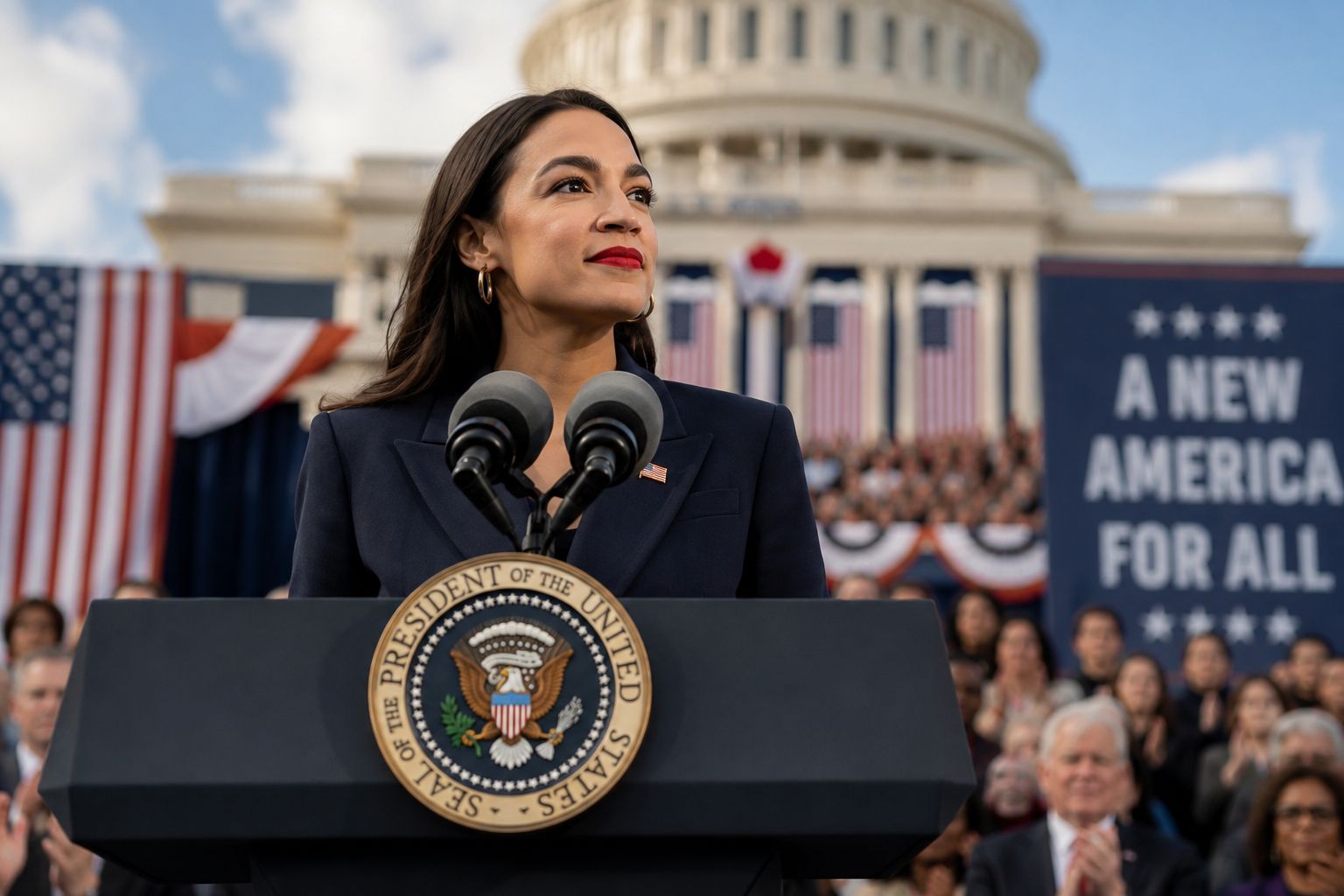
Alexandria Ocasio-Cortez has spent much of her political career being treated as simultaneously too young, too radical, too inexperienced and too influential. Now another question is becoming increasingly difficult to dismiss: could she become president of the United States?
The speculation is no longer confined to progressive activists or political obsessives. The Guardian has examined the possibility of an AOC presidential campaign in detail, while recent polling has placed her among the serious potential contenders for the 2028 Democratic nomination. Ocasio-Cortez herself has conspicuously declined to close the door.
At 36, she already possesses something presidential candidates traditionally spend enormous amounts of money trying to manufacture: a national political identity. Millions of Americans know who she is. Millions love her. Millions hate her. Very few politically engaged Americans are indifferent to her.
That is an extraordinary advantage.
It is also an extraordinary danger.
AOC is no longer merely a congresswoman
When Ocasio-Cortez defeated Joe Crowley in the 2018 Democratic primary, she was widely presented as the young insurgent who had unexpectedly humiliated a powerful Democratic establishment figure. Eight years later, that description is hopelessly outdated.
AOC has become a national political brand.
More importantly, the progressive movement surrounding her no longer looks quite as geographically isolated as it once did. Recent progressive victories have strengthened the argument that dissatisfaction with the Democratic establishment extends beyond a few extremely liberal congressional districts. The Guardian recently pointed to victories such as Abdul El-Sayed’s Michigan Senate primary win as evidence of a broader leftward insurgency inside the Democratic Party.
That does not mean America has suddenly become socialist. It certainly has not. However, it suggests that economic populism has a constituency that establishment Democrats would be foolish to dismiss.
Healthcare costs, housing, wages, inequality, corporate power and the extraordinary political influence of billionaires are hardly niche concerns.
AOC has spent years talking about precisely these subjects.
Her greatest advantage may be authenticity
Modern politicians frequently spend enormous sums trying to appear spontaneous.
AOC actually can be spontaneous.
That distinction matters enormously in the age of Donald Trump, TikTok, Instagram, podcasts and political influencers. The traditional presidential campaign—carefully prepared speeches, television advertisements, newspaper endorsements and choreographed appearances—has increasingly collided with a media environment in which voters encounter politicians directly through their phones.
Ocasio-Cortez understands this environment almost instinctively.
Her recent decision to discuss freezing her eggs demonstrates why. She took an intensely personal subject involving fertility, career, ageing and reproductive choice and communicated about it directly. The videos generated millions of views and another enormous wave of national attention.
Whether the episode was political strategy, personal disclosure or some combination of both almost misses the point.
AOC can create a national political conversation without waiting for CNN, Fox News or the New York Times to give her permission.
That ability could become one of the most powerful weapons available to a presidential candidate.
If AOC runs, she should not merely use social media as an accessory to a conventional presidential campaign. Social media should become one of the central infrastructures of the campaign.
Donald Trump demonstrated the political power of direct communication long ago. Even during the 2016 campaign, Pew Research Center found that Trump generated dramatically more engagement than Hillary Clinton despite the candidates posting at broadly similar rates. His average Twitter post was retweeted almost four times as often as Clinton’s during the period Pew studied.
The lesson was not simply that Trump was better at Twitter.
Trump sounded like Trump.
Clinton’s digital presence often sounded like a campaign committee.
That difference is fundamental.
AOC should appear on podcasts. She should livestream. She should answer hostile questions. She should make short explanatory videos about healthcare, taxation, housing and foreign policy. She should speak directly to young voters who barely consume traditional television news. She should allow people to see her personality rather than endlessly polishing it through political consultants.
Most importantly, she should resist the temptation to become “presidential” in the old-fashioned sense.
Her political imperfections are part of her appeal.
Hillary Clinton offers several warnings
Any Democratic woman contemplating the presidency inevitably enters the enormous shadow of Hillary Clinton’s 2016 campaign.
Some criticism of Clinton has been unfair. She won the popular vote, faced an extraordinarily unusual opponent and encountered circumstances that extended far beyond campaign strategy. Sexism also unquestionably surrounded her candidacy.
Nevertheless, her campaign made serious strategic mistakes.
Perhaps the most notorious involved the industrial Midwest. Clinton did not campaign in Wisconsin during the general election and her campaign underestimated the danger in Michigan and other traditionally Democratic states until extremely late. Contemporary post-election reporting found that Democratic strategists had assumed too much about their strength in the region.
Advertising decisions reflected the same overconfidence. Clinton and allied groups invested resources in ambitious targets while leaving crucial states comparatively exposed. The election was ultimately decided by extraordinarily narrow margins across Michigan, Wisconsin and Pennsylvania.
AOC cannot repeat that mistake.
She cannot assume that demographic change will automatically produce Democratic victories. She cannot assume union members will vote Democratic. She cannot assume Latinos will vote for her because she is Latina. She cannot assume young people will actually turn out because they like her TikTok videos. Nor can she assume that voters suffering economically will prioritize ideological consistency over grocery prices, rent and employment.
Every vote has to be earned.
Do not campaign primarily against the opponent
There is another Clinton-era lesson.
A campaign cannot consist primarily of explaining why the Republican candidate is terrible.
Clinton’s campaign devoted enormous attention to Trump’s temperament, scandals and offensive statements. There were perfectly legitimate reasons to do so. Yet demonstrating that an opponent is unfit for office is not the same thing as giving voters an emotionally compelling reason to vote for you.
AOC would need an affirmative message.
What would President Ocasio-Cortez actually do for a warehouse worker in Pennsylvania? What would she offer a struggling family in Wisconsin? What would her presidency mean for someone paying $2,000 a month in rent? What happens to healthcare costs? What happens to wages? What happens to taxes?
Progressive language about inequality must become kitchen-table language.
“Tax the rich” may excite activists. Explaining exactly how government policy could leave an ordinary family with more money at the end of the month is much more powerful.
Then there is America’s problem with women
There is also an uncomfortable issue Democrats should stop pretending does not exist.
America has a misogyny problem.
That does not mean every American is misogynistic, nor does it mean Hillary Clinton or Kamala Harris lost simply because they were women. Elections involving hundreds of millions of people never have a single explanation.
But sexism is not an imaginary variable invented by disappointed Democrats.
A 2026 study examining attitudes surrounding the 2024 presidential election found that several prejudicial gender attitudes predicted support for the Trump-Vance or Harris-Walz tickets. The researchers concluded that gender itself appears to have played a meaningful role in voting behavior.
Research surrounding Clinton provides another disturbing indication. An analysis of more than nine million tweets referring to her found that misogynistic language increased after she announced her presidential campaign and continued rising during the campaign.
Earlier experimental research also found evidence that female presidential candidates could be judged less qualified than comparable male candidates and disadvantaged in general-election matchups.
America elected its first Black male president in 2008. Yet as of 2026, it has still never elected a woman.
Hillary Clinton lost.
Kamala Harris lost.
That does not prove that Americans categorically refuse to elect women. It does demonstrate that any female presidential candidate must take sexism seriously rather than treating it as an embarrassing subject that sophisticated political strategists should avoid discussing.
AOC would face misogyny on steroids
For Ocasio-Cortez, the problem could become particularly vicious because several identities that provoke American political hostility converge in one person.
She is a woman.
She is Latina.
She is young.
She is from New York.
She is associated with democratic socialism.
She is outspoken.
She is ambitious.
And she has spent years being transformed by conservative media into a symbol of practically everything the American right dislikes about the modern left.
The attacks would therefore be relentless.
Her intelligence would be questioned. Her appearance would be discussed. Her clothes would become news stories. Her relationships would become political material. Her reproductive choices already have. Her voice, facial expressions, age and personality would all become legitimate subjects of political “analysis” in ways rarely applied equally to male politicians.
AOC cannot eliminate this double standard.
She can refuse to let it control her.
Statistics
The argument that misogyny remains a political obstacle in the United States is not based merely on the fact that the country has never elected a female president. The numbers provide stronger evidence. In a 2023 Pew Research Center survey, 47% of Americans said gender discrimination was a major reason women remain underrepresented in high political office, while 46% said a major reason was that many Americans simply were not ready to elect women to higher office. Moreover, 54% said women have to do more than men to prove themselves in politics. During the 2024 presidential campaign, 30% of registered voters believed Kamala Harris’s being a woman would hurt her with voters, while only 7–10% thought Donald Trump’s being a man would hurt him.
Perhaps most tellingly, a nationally representative study conducted immediately after the 2024 election found that prejudicial gender attitudes were associated with whether people voted for Trump or Harris, with male Trump voters showing the highest endorsement of several sexist attitudes examined by the researchers.
None of this proves that Clinton or Harris lost because they were women, but it makes it equally difficult to pretend that gender played no role. AOC would enter a presidential race carrying the same disadvantage—and, as a young, outspoken Latina progressive, she could face an even more intense version of it.
Do not make sexism the campaign either
There is an important distinction, however, between recognizing misogyny and campaigning primarily on victimhood.
That would be another mistake.
If voters attack AOC because she is a woman, call it what it is. If opponents spread sexist nonsense, confront it. But then return immediately to healthcare, housing, wages, corruption, education and economic inequality.
The objective should not be to tell Americans endlessly that they ought to elect a woman.
It should be to make enough Americans want to elect this particular woman.
That difference matters.
Hillary Clinton’s candidacy inevitably acquired enormous historical symbolism. Electing the first female president would indeed have been historic. But symbolism cannot substitute for a political movement.
AOC’s strongest argument would therefore not be “America needs its first woman president.”
It would be “America needs political and economic change, and I can deliver it.”
Becoming the first female president should be the consequence, not the central sales pitch.
She also has to escape the progressive bubble
Winning a Democratic primary and winning the Electoral College are completely different exercises.
AOC can dominate among young progressives and still lose the presidency badly.
The Guardian’s analysis highlights precisely this problem. Her political future depends partly on whether she can expand beyond the constituencies that already admire her, including improving progressive appeal among working-class voters who do not necessarily identify with the cultural language of the activist left.
That means entering politically uncomfortable territory.
She should appear before audiences that disagree with her. She should speak to rural voters. She should talk to working-class Trump voters without treating them as anthropological specimens. She should go on hostile television programs and conservative podcasts when useful.
Social media makes this easier because ideological boundaries are increasingly porous. A compelling clip from a hostile interview can reach millions of people who would never intentionally watch an AOC campaign speech.
That is precisely where her communication skills could become strategically valuable.
Bernie Sanders showed part of the path
AOC’s obvious political predecessor is Bernie Sanders.
Sanders demonstrated that economic populism can attract people who do not fit neatly into conventional progressive stereotypes. His language was frequently ideological, but the underlying message was remarkably simple: ordinary Americans work hard while extremely wealthy individuals and corporations possess disproportionate economic and political power.
AOC can inherit that argument while modernizing its delivery.
She is younger. She is a far more natural product of the internet age. She can communicate political arguments through a congressional hearing, a rally, a livestream or a 90-second video without appearing to transform into four different people.
That consistency is politically valuable.
But she must preserve it.
The greatest danger of a presidential campaign may therefore come not from Republicans but from the army of consultants who would inevitably surround her.
They would conduct focus groups.
They would test phrases.
They would soften positions.
They would manufacture biographical advertisements.
They would tell her how presidential candidates are supposed to speak.
Eventually, they might successfully transform one of America’s most recognizable political communicators into another generic Democrat.
That would be disastrous.
The Senate may be safer, but the presidency matters more
There is another possibility. Instead of running for president, AOC could challenge Chuck Schumer for the Senate in 2028. She has not ruled out either option.
From a conventional career perspective, the Senate route makes enormous sense. Winning statewide in New York would expand her institutional power, strengthen her résumé and potentially prepare her for a later presidential campaign.
But political opportunities do not always arrive according to a sensible career schedule.
By 2028, AOC will be 38.
She could represent a generational break from America’s extraordinarily old political leadership. She already has national recognition. She already has a fundraising network. She already has millions of people capable of distributing her political messages without traditional media intermediaries.
Most politicians spend decades trying to acquire those assets.
She already possesses them.
America may be ready—or it may prove that it isn’t
The real question is therefore not whether Alexandria Ocasio-Cortez is famous enough to run for president.
She is.
It is not whether she could raise enough money.
She probably could.
Nor is it whether she could win a Democratic primary.
Recent polling and her enormous progressive following make that possibility increasingly plausible. A New Hampshire poll this summer even placed her at the front of the prospective Democratic field, although polling this far from an election should obviously be treated cautiously.
The real question is whether she can construct a coalition broad enough to survive America’s ideological polarization, racial divisions, class divisions and persistent sexism.
If she runs, she should learn from Hillary Clinton without becoming Hillary Clinton. She should campaign relentlessly in states Democrats are tempted to take for granted. She should speak about economics in concrete rather than academic language. She should acknowledge misogyny without making her gender the reason Americans are supposed to vote for her.
Above all, she should exploit the political weapon she understands better than almost any other major Democrat: direct communication.
Do not wait for television networks to explain AOC to America.
Let AOC explain herself.
The United States has never elected a female president. It has also rarely encountered a potential presidential candidate quite like Alexandria Ocasio-Cortez.
Perhaps America is finally ready for President AOC.
If it isn’t, a campaign by her might reveal exactly why.
Leave a Reply