Latin America suffers from some of the world’s most serious problems with homicide, organized crime, extortion and drug trafficking. Governments therefore face a legitimate and exceptionally difficult obligation: protecting ordinary citizens from violent offenders while maintaining institutions capable of investigating crimes, conducting fair trials and administering punishment.
Yet punishment itself has become part of the institutional crisis.
Across parts of Latin America, prisons combine overcrowding, inadequate healthcare, corruption, gang governance, extortion and recurrent extreme violence. The precise conditions vary substantially between countries and institutions, and describing every Latin American prison as a “concentration camp” would be analytically indefensible. Nevertheless, some individual facilities display characteristics that should be profoundly disturbing in states that describe themselves as constitutional democracies.
The fundamental problem is not that imprisonment is inherently illegitimate. Dangerous offenders sometimes must be incapacitated. The problem begins when the judicially imposed punishment of deprivation of liberty becomes an unofficial additional sentence involving hunger, disease, extortion, assault, torture or death.
A parallel government behind prison walls
The conventional model of imprisonment assumes that the state exercises a monopoly on legitimate authority inside a correctional institution.
In significant parts of Latin America’s prison system, this assumption has broken down.
Researchers Marcelo Bergman and Gustavo Fondevila describe violence as a persistent feature of many Latin American prisons. They identify inmate self-government, insufficient healthcare, gang competition, extortion and chronic overcrowding among the region’s recurring problems.
This phenomenon has sometimes produced institutions in which the formal prison administration controls the perimeter while criminal organizations exercise considerable authority over everyday life inside.
Ecuador provides an especially important contemporary case. Research published in an academic journal describes Ecuadorian prisons as environments in which drug trafficking, corruption and extortion became mechanisms of informal prison regulation, while large institutions facilitated the reproduction of complex criminal organizations.
The consequences extend beyond prison walls.
The Council on Foreign Relations has described Ecuadorian gang leaders as becoming de facto prison wardens and profiting from extortion of inmates and their families. Competition for these criminal economies contributed to prison massacres that killed hundreds.
The prison therefore risks becoming something very different from its intended function. Instead of dismantling criminal organizations, a poorly governed prison can provide them with a concentrated population over which they can exercise authority.
You may literally have to pay to remain alive
The phrase “pay for protection” sounds almost metaphorical until the economic structure of gang-controlled imprisonment is examined.
In Ecuador, investigations have documented systems in which gangs charged prisoners for necessities and protection. Families could become part of the extortion mechanism. According to InSight Crime, relatives were sometimes sent videos showing prisoners being beaten, accompanied by threats that the prisoner would be killed unless money was paid. Prisoners perceived as having money could face particularly severe violence and torture.
Earlier reporting on Latin American prisons described essentially the same economic structure: prisoners could be required to pay for basic necessities, sleeping arrangements and ultimately protection from violence.
This deserves to be understood as more than ordinary prison corruption.
If the state incarcerates an individual in an institution where another organization can demand money in exchange for not killing him, the state has failed at one of the most elementary functions associated with lawful imprisonment: physical custody.
The prisoner cannot leave. He cannot select another accommodation provider. He cannot realistically choose another police force. The state has intentionally deprived him of the ability to protect himself while simultaneously failing to provide that protection.
That creates an extraordinary degree of dependency.
One of the most disturbing documented examples comes from Brazil.
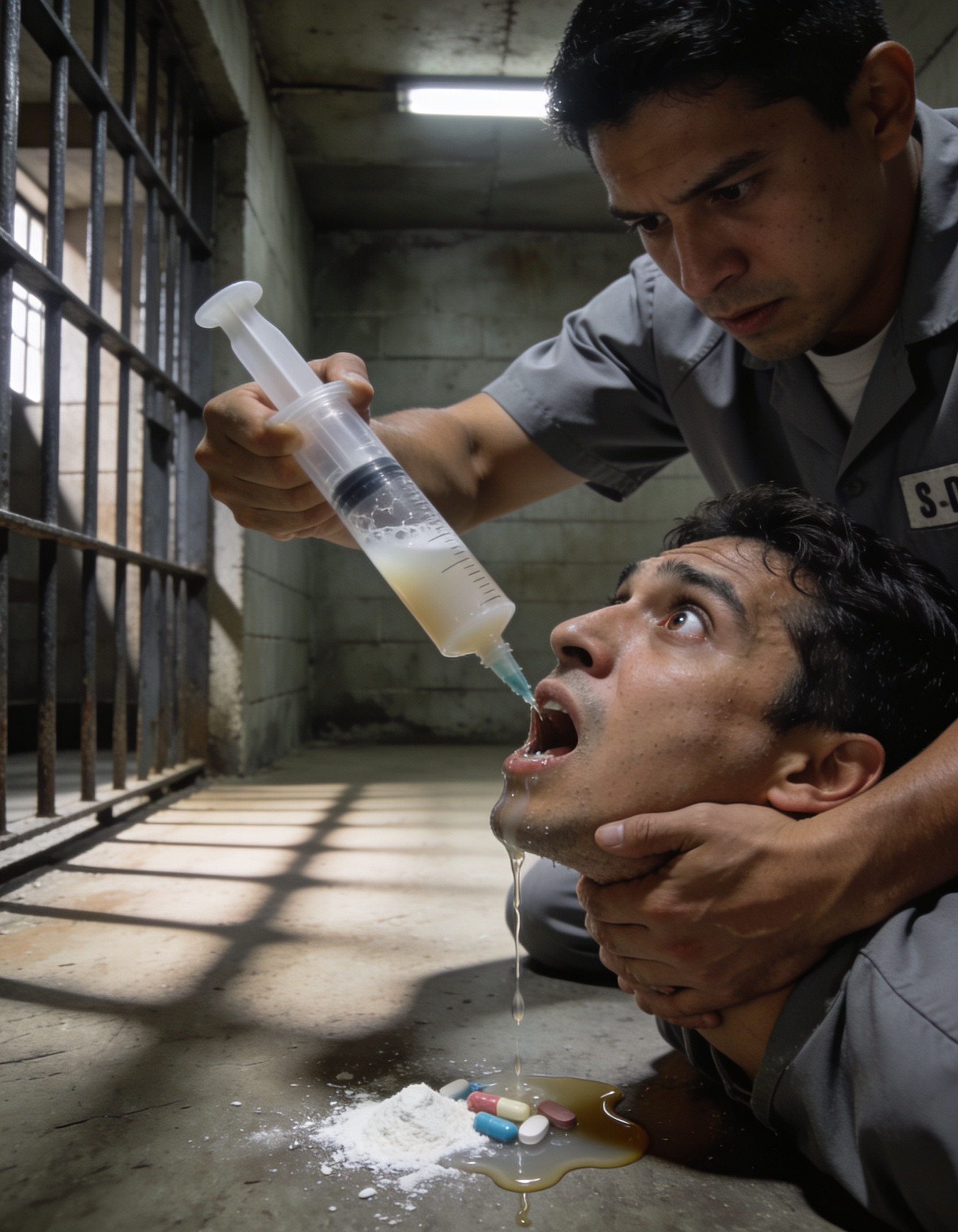
A 2012 report in The Economist examined the power of the Primeiro Comando da Capital, or PCC, within São Paulo’s prisons. Human-rights lawyer Marcos Fuchs reportedly would not speak privately with prisoners without a gang leader listening because doing otherwise could expose the prisoner to retaliation.
That retaliation had a name: “Gatorade.”
According to the account, the punishment involved forcibly administering a mixture containing cocaine, Viagra and water in quantities large enough to cause cardiac arrest.
The significance of this example goes considerably beyond its brutality.
The victim is not voluntarily consuming recreational drugs. Drugs themselves become instruments of coercion and potentially lethal violence. The distinction between overdose and homicide consequently becomes blurred: pharmacological toxicity can be deliberately imposed upon a captive person.
Imagine the institutional absurdity.
A state claims to be fighting drug trafficking. It incarcerates people partly in the name of suppressing the illegal drug economy. Inside the institution, a criminal organization controls an illegal drug market. That organization can then reportedly use drugs as an instrument of punishment against prisoners who violate its rules.
This is not evidence that every Brazilian prisoner faces such treatment, nor should an account from particular prisons be generalized to an entire continent. It is evidence of what becomes possible when the state loses effective control of imprisonment.
Drugs do not disappear when the prison door closes
More systematic evidence reinforces the broader problem.
Research published by Cambridge University Press estimates that approximately one in five inmates in the Latin American prison populations studied was incarcerated for a drug-related offense, while at least one in three prisoners regularly used drugs inside prison.
The researchers examined not merely consumption but also who supplied drugs, who controlled their distribution, how much prisoners spent and how prison drug markets functioned. Their conclusion challenges one of the central assumptions behind highly punitive drug policy: imprisonment has achieved only limited success in reducing the illegal drug supply.
This creates a serious criminological contradiction.
The state incarcerates drug offenders while allowing conditions to develop in which an illegal drug economy continues inside prison.
Meanwhile, enforcement frequently captures replaceable participants at the lower levels of drug markets rather than dismantling the organizational structures that make those markets possible. The result can be simultaneously punitive and ineffective.
Criminology has long recognized that incarceration does not automatically produce rehabilitation.
Prisons concentrate offenders together. Under appropriate institutional conditions, that concentration can be used to provide education, addiction treatment, psychological interventions and structured rehabilitation.
Under dysfunctional conditions, the opposite can occur.
A young offender enters an institution populated by more experienced criminals. Gang affiliation provides physical protection. Informal criminal hierarchies regulate everyday life. Illegal markets provide economic opportunities. Violence establishes status and discipline.
The institution may therefore strengthen precisely the social networks that criminal justice is supposed to disrupt.
Brazil’s PCC provides an extraordinary historical example. The organization originated inside the prison system in the 1990s before developing into one of Latin America’s most powerful criminal organizations. By 2024, estimates cited by The Economist placed its network at tens of thousands of members plus a much larger group of associates or contractors.
That history should destroy the simplistic assumption that harsher imprisonment necessarily weakens organized crime.
Sometimes prison becomes organized crime’s university, recruitment center, marketplace and headquarters.
Overcrowding is not merely uncomfortable
Overcrowding amplifies virtually every other institutional problem.
It places greater pressure on sanitation, medical services, food distribution and correctional staff. It also makes effective classification of prisoners more difficult and increases the number of people competing for scarce resources.
The consequences can become extreme.
Accounts of Brazilian prisons have described cells constructed for eight people holding several dozen prisoners, untreated tuberculosis and gangrene, inadequate food, routine beatings and prisoners confined for prolonged periods without daylight.
These conditions should not be confused with punishment itself.
A court can legitimately sentence someone to ten years of imprisonment. It does not sentence him to tuberculosis; it does not sentence him to gang extortion. It does not sentence him to being beaten by guards or other prisoners.
The distinction is fundamental to the rule of law.
Torture cannot become an unofficial supplementary sentence
The philosophical justification for punishment differs between legal systems and political traditions. It may involve incapacitation, deterrence, retribution and rehabilitation.
None requires torture.
If a court sentences an offender to imprisonment, the legitimate punishment is deprivation of liberty under the conditions prescribed by law. When guards or prisoners subsequently administer beatings, sexual violence, forced drug consumption or other forms of physical abuse, they are not executing the judicial sentence.
They are committing additional acts of violence.
This distinction remains true regardless of the prisoner’s original crime.
A person convicted of murder may deserve lifelong incapacitation. That does not authorize guards to break his bones.
A rapist may deserve decades of imprisonment. That does not authorize another prisoner to torture him.
A drug trafficker can legitimately lose his freedom. That does not authorize a gang to force cocaine into his body until his cardiovascular system fails.
A democratic legal system cannot simultaneously condemn private violence and tolerate it as an informal component of public punishment.
The problem of pretrial detention makes the argument even stronger
There is another reason why the popular phrase “criminals deserve it” is intellectually inadequate.
Not everyone in prison is a convicted criminal.
Latin American criminal-justice systems have historically made extensive use of pretrial detention. Drug enforcement has also contributed significantly to prison overcrowding. Comparative research covering Argentina, Bolivia, Brazil, Colombia, Ecuador, Mexico, Peru and Uruguay found that punitive drug legislation disproportionately imprisoned vulnerable participants while doing relatively little to disrupt the larger drug economy.
A detainee awaiting trial remains legally presumed innocent.
If such a person is beaten, extorted, infected with preventable disease or killed inside prison, society cannot retreat behind the argument that criminals deserve harsh treatment.
The state has not yet established that the person is a criminal.
When the wealthy can evade the prison system altogether
There is an additional inequality that makes brutal prison conditions even harder to defend: exposure to the prison system is not distributed equally. In countries with weak judicial institutions, corruption, political interference and severe socioeconomic inequality, wealth can influence not merely the quality of a defendant’s legal representation but the probability that punishment will occur at all.
The relevant concept is impunity. Latin America has historically suffered exceptionally high levels of impunity for serious crime, although the magnitude varies enormously between countries. Weak investigative capacity, overloaded courts, corruption, intimidation of witnesses and prosecutors, political influence and organized crime can all prevent homicide and other serious offenses from producing convictions. The United Nations has repeatedly identified impunity as a major obstacle to human rights and the rule of law across parts of the region.
Wealth can interact with these institutional weaknesses. Affluent defendants can purchase elite legal representation, commission expert evidence, sustain litigation for years and exploit every procedural mechanism available to them. More seriously, where corruption or political patronage exists, economic and political power can provide forms of protection unavailable to ordinary defendants. The scientifically defensible claim is not that every wealthy murderer escapes justice, but that unequal institutional power can substantially affect who is investigated, prosecuted, detained and ultimately punished.
The marginalized defendants
This produces one of the most perverse possible criminal-justice systems. At one end, poor and marginalized defendants can enter overcrowded prisons—including through pretrial detention—where they may face extortion, gang violence, disease and abuse. At the other end, sufficiently powerful suspects may possess vastly greater resources for avoiding detention, delaying proceedings or, in corrupt systems, escaping accountability altogether.
The contrast becomes especially disturbing in homicide cases. A legal system cannot plausibly defend degrading prison conditions on the grounds that severe punishment is necessary for deterrence while simultaneously allowing money, connections or corruption to reduce the probability that some serious offenders will ever experience that punishment. Deterrence depends not simply on severity but on the perceived probability and predictability of punishment. A terrifying prison means little to an offender who believes wealth or influence can keep him out of it.
This also helps explain why spectacular prison brutality can coexist with high crime. An effective criminal-justice system does not maximize the suffering of whichever offenders happen to reach prison. It maximizes the probability that crimes are detected, offenders are correctly identified, trials are fair and proportionate sentences are reliably enforced.
From this perspective, a system characterized by low certainty but extreme severity is almost the inverse of rational criminal justice. Some offenders escape punishment entirely, while others encounter conditions far exceeding the sentences imposed by courts.
The rule of law requires something much less theatrical and much more difficult: rich and poor defendants should face approximately the same probability of investigation and prosecution, the same evidentiary standards and the same lawful punishment for comparable crimes. A murderer who is wealthy should not be able to purchase practical immunity. A poor thief should not receive an unofficial sentence of torture because he lacks the money to purchase protection inside prison.
Why doesn’t extreme punishment solve extreme crime?
If extraordinarily harsh prisons reliably eliminated violent crime, Latin America should provide unusually strong evidence for the deterrent effect.
Reality is considerably more complicated.
The region has simultaneously experienced severe prison conditions, rapidly expanding incarceration and extraordinarily high levels of criminal violence. The coexistence of these phenomena does not by itself prove that incarceration causes crime. Crime itself generates political demand for imprisonment, producing an obvious problem of reverse causation.
Nevertheless, it demonstrates something important: brutal prison conditions are not sufficient to create public security.
Punishment operates only after numerous other institutions have either succeeded or failed.
The probability of being identified and apprehended matters. Police legitimacy matters. Judicial efficiency matters. Corruption matters. The speed and predictability of punishment matter. So do childhood environments, education, employment opportunities, drug markets and exposure to violence.
A spectacularly brutal prison has little deterrent value to an offender who believes he will never be arrested.
Prevention is not softness
The alternative to punitive populism is often caricatured as refusing to punish criminals.
That is a false dichotomy.
A rational criminal-justice system can simultaneously imprison dangerous offenders and invest heavily in reducing the probability that people become dangerous offenders in the first place.
Education matters. Preventing school dropout matters. Addiction treatment matters. Employment matters. Early interventions for high-risk children matter. Effective policing matters. Reducing corruption matters.
These policies operate at different stages of the causal chain leading to criminal behavior.
Prison intervenes at the end.
Social policy can intervene decades earlier.
That does not mean poverty mechanically causes crime or that employment programs will eliminate murder. Human behavior is far more complicated. But treating criminality exclusively as an individual moral failure ignores the substantial effects that social environments, peer networks, institutional quality and economic incentives can have upon offending.
Rehabilitation protects future victims
Rehabilitation is frequently discussed as though it were something society provides primarily for the prisoner’s benefit.
That misunderstands its most important function.
Most prisoners will eventually leave prison.
The relevant policy question is therefore not whether society likes them. It is what condition society wants them to be in when they return.
Consider two hypothetical institutions.
The first gives an offender education, addiction treatment, psychological intervention, vocational skills and gradual reintegration while maintaining strict physical security.
The second subjects him to violence, humiliation, gang recruitment, drug markets and chronic fear.
Both release him after eight years.
Which former prisoner would you prefer living next door?
Rehabilitation is victim protection conducted years before the potential victim exists.
The politics of deserved suffering
Why, then, are appalling prison conditions politically sustainable?
One explanation is public indifference.
Prisoners form an unusually unsympathetic population. Politicians can obtain electoral rewards from appearing punitive, while improvements in prison sanitation, healthcare or nutrition can easily be portrayed as generosity toward criminals.
Victims of violent crime may understandably have little emotional concern for offenders.
But constitutional government exists partly to prevent momentary public anger from determining the boundaries of permissible state violence.
Human rights are meaningful precisely because they are not contingent upon popularity.
If rights belong only to admirable people, they are not human rights. They are rewards for good behavior.
The concentration-camp comparison
Calling Latin American prisons “concentration camps” requires caution.
Historically, concentration camps refer to systems of mass detention outside ordinary criminal incarceration and are associated with very different political circumstances, ranging from colonial detention systems to totalitarian mass imprisonment and, in the Nazi case, genocide and extermination.
Using the expression indiscriminately therefore weakens rather than strengthens criticism.
But rejecting the historical equivalence does not require sanitizing contemporary prison conditions.
A facility in which people are densely confined, deprived of adequate healthcare, subjected to routine violence, governed partly by criminal organizations and sometimes forced to pay for their physical survival represents an extreme institutional failure regardless of the terminology used.
The more scientifically defensible description is perhaps more damning: these are prisons in which the state has partially surrendered its monopoly on coercion.
International consequences should follow systematic abuse
Sovereignty should not provide unlimited protection from international scrutiny.
States routinely criticize and sanction governments for torture, arbitrary detention and other serious violations of human rights. Prisoners should not somehow disappear from this moral framework.
Where systematic abuses are credibly documented, foreign governments and international institutions should consider targeted responses.
Blanket economic sanctions can harm innocent populations and may produce serious unintended consequences. More discriminating mechanisms are preferable: sanctions against responsible officials, restrictions on cooperation with abusive security institutions, independent prison monitoring, international investigations and conditioning relevant assistance on measurable institutional reforms.
Democratic governments should face these standards too.
Holding elections does not transform torture into democracy.
A state cannot outsource cruelty
There is ultimately a simple principle beneath the statistics and criminological theory.
The government controls the prisoner’s physical location.
The prisoner cannot walk away from a dangerous gang. He cannot change neighborhoods; he cannot choose another hospital. And he cannot seek another employer. He cannot even decide to sleep somewhere else.
That extraordinary power creates an extraordinary obligation.
If the state places someone in a building and prevents him from leaving, the state assumes responsibility for maintaining basic physical security within that building.
Allowing gangs to decide who sleeps where, who obtains medicine, who is beaten and who must pay to remain alive represents a partial privatization of sovereign power to criminal organizations.
And when prisoners can reportedly be punished through the forced administration of potentially lethal quantities of drugs, the contradiction becomes almost surreal.
The institution created to combat criminality has itself become an environment in which criminal organizations can exercise coercive government.
Punishment should mean punishment prescribed by law
Latin America needs effective criminal justice.
Its staggering homicide rates, organized criminal networks and endemic extortion cannot be dismissed as products of rhetoric or inequality alone. Murderers must be arrested. Violent gang members must be incapacitated. Criminal organizations must be dismantled. Victims deserve justice.
But severity and effectiveness are not synonyms.
A state demonstrates strength when it can investigate crimes, apprehend offenders, conduct fair trials, protect witnesses, resist corruption, maintain secure prisons and reduce reoffending.
Allowing prisoners to murder one another is not strength; allowing gangs to govern cellblocks is not strength. Allowing drugs to circulate through institutions supposedly designed to suppress drug crime is not strength.
And forcing prisoners to buy their own physical survival is not justice.
A democratic state may deprive a convicted person of liberty. In the most serious cases, it may do so for the remainder of that person’s life.
But the sentence imposed by a judge must remain the sentence actually administered.
Everything beyond that—extortion, torture, gang domination, deliberate medical neglect or potentially lethal forced drug ingestion—is not criminal justice.
It is another form of criminality, occurring inside an institution operated in the name of the state.
Leave a Reply