For generations, American churches presented themselves as places where parents could safely leave their children. Priests heard confessions, pastors organized youth groups, ministers counseled troubled teenagers and religious institutions taught families that their leaders deserved trust. For thousands of children, that trust became a vulnerability.
The Catholic sexual abuse scandal exposed one of the most catastrophic institutional failures in modern American religious history. Thousands of people accused Catholic priests and deacons of sexually abusing them as minors. Church authorities sometimes knew that individual clergy members posed dangers, yet failed to remove them permanently or report them to police. In some notorious cases, accused priests were transferred to other assignments, where they gained access to new communities and new potential victims.
Catholicism, however, does not have a monopoly on religious sexual abuse. Investigations involving Southern Baptists and other Protestant organizations have exposed allegations against pastors, youth ministers, volunteers and other religious figures. Different denominations have different structures, doctrines and safeguarding systems, but the recurring ingredients can look disturbingly familiar: trusted authority, vulnerable children, institutional reputation, secrecy and enormous reluctance to believe that a respected religious leader could be a predator.
America’s church abuse scandal is therefore not merely a story about sex. It is a story about power.
Thousands of Catholic victims
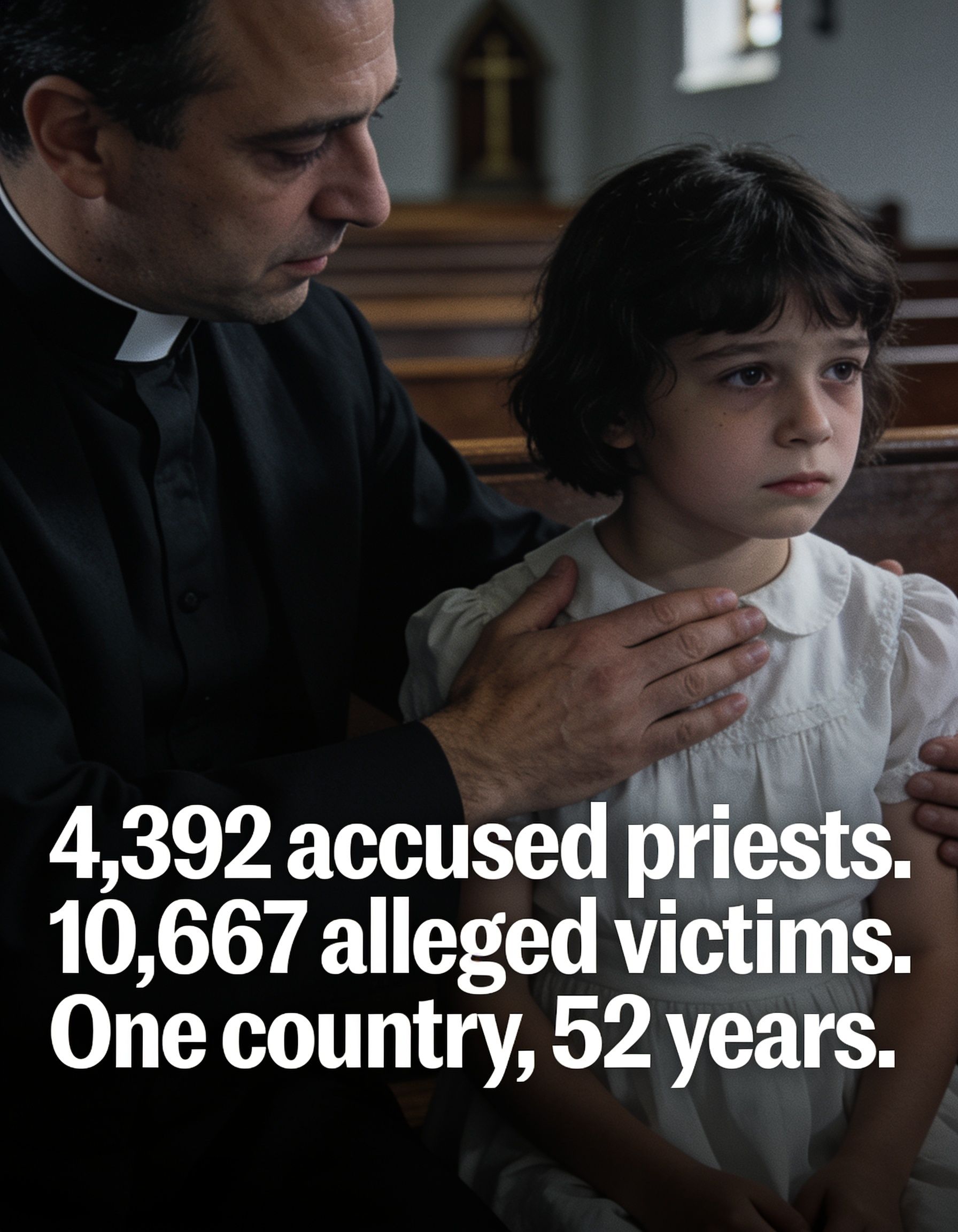
The scale of the American Catholic scandal is difficult to comprehend. The landmark John Jay study examined allegations involving Catholic priests and deacons between 1950 and 2002. It found that 10,667 people had made allegations of child sexual abuse and that allegations not withdrawn or known to be false had been made against 4,392 priests during the period studied.
That amounted to approximately 4% of priests active during those decades. The figure does not mean that 4% were criminally convicted, nor does an allegation itself establish criminal guilt. However, the enormous number of allegations across dioceses demonstrated that the problem could not credibly be dismissed as a handful of isolated offenders.
The known victims were predominantly male, and many were adolescents. According to the John Jay research, 81% of reported victims were male, while many were between 11 and 14 years old. Abuse allegations appeared across regions and dioceses rather than being confined to one unusual corner of American Catholicism.
Even these numbers cannot tell us exactly how many children were actually abused. Sexual abuse is notoriously underreported, particularly when the alleged perpetrator holds enormous authority over the victim. Many allegations emerged only decades after the events themselves, when victims were finally able or willing to describe what had happened.
The numbers are therefore not simply statistics about priests. Behind every number was a child who entered a church, school, rectory or other religious environment expecting adults to protect them.
The priest was not just another adult
Sexual abuse of children involves an enormous imbalance of power regardless of who commits it. When the alleged perpetrator is a priest, however, another layer of authority can be added.
For believing Catholic families, a priest is not simply a teacher, neighbor or family acquaintance. He administers sacraments, hears confessions, celebrates Mass and speaks from a position invested with spiritual significance. Children can be taught to respect him as a representative of the Church and, indirectly, of God.
That can create an extraordinarily dangerous environment when the person possessing that authority decides to abuse it.
A child may already struggle to understand sexual abuse. Add spiritual authority, fear, shame and the possibility that parents will believe the priest rather than the child, and disclosure becomes even harder. A predator does not necessarily need physical force when he possesses trust, prestige and psychological authority.
The religious environment can therefore provide something valuable to both decent clergy and predators: access to people who trust them. For the overwhelming majority who do not abuse that trust, this allows pastoral work to function. For an offender, it can provide opportunity.
The scandal was also about bishops
If the Catholic scandal consisted entirely of individual priests secretly committing crimes that their superiors immediately reported once discovered, it would still be horrific. But it would be a fundamentally different scandal.
The institutional response transformed individual abuse into a crisis of the Church itself.
Documents, lawsuits and investigations revealed cases in which church authorities received complaints about priests but responded internally. Some accused priests received treatment or counseling, some were reassigned. Some were transferred between parishes instead of being permanently removed from positions that gave them access to children.
The logic was disastrous.
A church institution could view the abusive priest as a spiritual or personnel problem to be managed. A child-protection system should view credible evidence of sexual abuse as a potential crime and an immediate danger to other children.
Those priorities are not the same.
Protecting the reputation of the Church, avoiding scandal, preserving clerical careers or hoping that treatment would solve the problem could all conflict with the one priority that should have dominated every decision: protecting children.
Boston changed everything
The American Catholic abuse crisis exploded into national consciousness in 2002, when The Boston Globe Spotlight team documented sexual abuse by priests and the institutional mechanisms that allowed accused clergy to remain in ministry.
The reporting showed that the problem was not simply the existence of abusive priests. Church leaders had possessed information about some dangerous clergy and had nevertheless allowed them to continue operating within the institution.
The revelations transformed public understanding of the scandal. An abusive priest could no longer be presented simply as a sinful individual who had betrayed Catholic teaching. The decisions of bishops, diocesan officials and lawyers became part of the story.
Soon, allegations and records emerged across the United States. What had appeared to some Catholics as a local scandal became impossible to contain geographically.
The Church had to confront not only the question of how priests could abuse children, but also a much more damaging question: how could people responsible for protecting the faithful know that children might be endangered and still fail to protect them?
The perfect institution can become a dangerous idea
Religious institutions face a temptation that is hardly unique to religion. Governments, universities, corporations, sports organizations and charities can all protect themselves when acknowledging wrongdoing threatens their reputation.
Religion can nevertheless add another dimension.
A corporation rarely claims divine authority. A church does.
When an institution presents itself as a guardian of morality, admitting that its representatives sexually abused children can threaten much more than its public image. It can threaten people’s confidence in the institution’s moral authority.
That creates a terrible incentive to treat exposure itself as a danger.
The institution may convince itself that preventing scandal protects the faithful. Officials may fear that revelations will drive believers away, damage vocations, weaken donations or provide ammunition to enemies of the Church. Protecting the institution can then be rationalized as protecting something sacred.
But an institution that protects its reputation at the expense of children is not protecting morality. It is protecting itself.
Protestant churches are not immune
The Catholic Church has received enormous attention partly because of the scale of the documented scandal and partly because its hierarchical structure produced extensive institutional records. But Protestant America has also had to confront sexual abuse by religious leaders.
The Southern Baptist Convention became the center of a major abuse scandal after survivors spent years accusing denominational leaders of failing to take their reports seriously. An independent investigation found that survivors and advocates had repeatedly encountered resistance from senior leaders while trying to force the denomination to address abuse more systematically.
One particularly disturbing revelation concerned a list maintained by an SBC staff member containing hundreds of people accused of abuse. For years, advocates had demanded a searchable database that could help churches identify alleged or convicted offenders, while denominational leaders argued that the decentralized structure of Baptist churches limited what the national organization could do.
That decentralization creates a different problem from Catholic hierarchy. A Catholic bishop can exercise substantial authority over priests in his diocese. Southern Baptist congregations are autonomous, which can make centralized enforcement and information-sharing more difficult.
Different organizational structures can therefore fail children in different ways.
A hierarchy can conceal information from above. A decentralized system can allow information to disappear between independent congregations.
Neither structure automatically protects a child.
Predators do not need a particular denomination
It would be intellectually dishonest to argue that sexual abuse is uniquely Christian or uniquely religious. It is not.
Children are abused in families, schools, sports organizations, youth organizations, residential institutions and countless other environments. Religious people are not inherently more likely to become sexual predators merely because they believe in God.
The important question is different: what characteristics of an institution make abuse easier to commit, conceal or repeat?
Several risk factors recur across institutions. Adults may have unsupervised access to children. Leaders may command unusual trust. Victims may fear retaliation or disbelief. Organizations may prioritize reputation. Complaints may remain inside internal disciplinary systems rather than reaching independent authorities.
Religious institutions can possess all of these characteristics at once.
That does not mean religion creates every predator. It means religious authority can become one of the tools a predator exploits.
Celibacy is an easy explanation—and an inadequate one
The Catholic scandal inevitably generated arguments about priestly celibacy. The explanation is intuitively attractive: Catholic priests cannot marry, therefore sexual repression supposedly produces sexual abuse.
The evidence does not support such a simple causal story.
The John Jay research found no single cause or predictor capable of explaining clergy sexual abuse. Situational factors and opportunities mattered, while the historical pattern of abuse rose sharply and later declined even though the celibacy requirement remained.
Child sexual abuse also occurs among married people and within religious traditions whose clergy can marry. Protestant abuse scandals alone demonstrate why marriage cannot be treated as a vaccine against predatory behavior.
Celibacy can reasonably be debated for many reasons. It may affect recruitment, loneliness, relationships or clerical culture. But explaining child sexual abuse primarily as the consequence of priests being unmarried risks replacing a complicated institutional problem with an appealingly simple theory.
The more useful question is why offenders obtained access to children and why institutions sometimes failed to stop them.
Homosexuality is not the explanation either
Another explanation has repeatedly appeared in debates about Catholic abuse: because a large majority of identified victims in the John Jay data were boys, homosexuality must somehow explain the scandal.
That conclusion does not follow.
Sexual abuse of children is not equivalent to adult sexual orientation. Opportunity, access, age and institutional environment all influence victim selection. Historically, Catholic priests often had greater unsupervised access to boys through altar service, schools and other church activities.
Blaming gay men also risks shifting attention away from the actual institutional failures. The relevant questions concern why particular adults abused children, why warning signs were missed or ignored and why some offenders remained in environments where they could find additional victims.
A gay priest who never abuses anyone is not part of the abuse problem. A heterosexual priest who abuses a child is.
The dividing line is abuse, not orientation.
Why children stay silent
One of the most persistent misunderstandings surrounding sexual abuse is the question victims are sometimes asked years later: why didn’t you say something?
Many did. Others could not.
Children may not understand what is happening to them. They may feel ashamed, guilty or frightened. Predators can manipulate them into believing they participated voluntarily or that disclosure will destroy their families. Some victims fear punishment, disbelief or humiliation.
Religion can intensify those fears when the alleged abuser possesses spiritual authority.
Imagine being a child in a deeply Catholic household and accusing the family priest. Imagine believing your parents admire him; imagine hearing him speak about sin, confession, heaven and hell. And imagine wondering whether anyone will believe a child over a man whom the entire community calls “Father.”
Silence under those circumstances is not mysterious.
It is predictable.
That is precisely why adults and institutions carry such enormous responsibility.
The cost cannot be measured only in dollars
The financial consequences of the American Catholic scandal have been enormous. Dioceses and religious institutions have paid billions of dollars in settlements, legal costs and other abuse-related expenses. Some dioceses have sought bankruptcy protection while facing large numbers of claims.
Money matters because victims deserve compensation, and financial liability can force institutions to confront failures they might otherwise prefer to ignore.
But money cannot reverse sexual abuse.
A settlement cannot return someone’s childhood. Bankruptcy proceedings cannot erase decades of trauma. No amount of compensation can recreate the life a victim might have lived without abuse.
The consequences can persist through adulthood in relationships, sexuality, mental well-being, trust and attitudes toward religion. For someone abused by a representative of God, the damage may also become spiritual.
The person who was supposed to embody safety can become associated with terror.
Has the Catholic Church improved?
Any fair assessment must acknowledge something critics of the Church sometimes overlook: the situation has changed substantially.
The great majority of known American Catholic abuse allegations concern incidents that occurred decades ago. After the scandal erupted, the American Church introduced stronger safeguarding policies, background checks, training programs, reporting requirements and review boards.
The number of newly occurring cases is dramatically lower than during the peak decades documented by the John Jay research.
That matters.
If reforms reduce the number of children being abused, they deserve recognition regardless of what we think about Catholic theology. Protecting children is more important than maintaining a convenient narrative that nothing ever changes.
But improvement does not erase history.
Nor does it eliminate questions about transparency, accountability, compensation and the treatment of survivors whose allegations concern events from decades ago. New allegations continue to surface because many survivors disclose abuse only after enormous delays.
The decline in new cases is evidence that prevention can work. It is not evidence that the scandal is over.
The allegations keep arriving
The latest annual report from the U.S. Catholic bishops illustrates the distinction. During the 2024–25 audit period, dioceses and religious communities received more than a thousand allegations from hundreds of survivors. Most did not describe abuse newly committed during that year.
Many concerned events alleged to have happened decades earlier.
That distinction is essential. Saying that the Catholic Church received more than a thousand allegations in a recent reporting period does not mean more than a thousand children were sexually abused by priests during that period.
Yet the continued arrival of historical allegations tells us something important about sexual abuse itself. Victims may need decades before they can speak publicly, confront an institution or even fully process what happened to them.
An abuse scandal can therefore continue long after many of the perpetrators are dead.
The institutional consequences outlive the individuals who created them.
When confession becomes more important than reporting
The conflict between religious practice and child protection remains strikingly current.
In August 2026, the Arizona Supreme Court ruled that clergy members who learn about child abuse through religious confession or other protected confidential religious communications can be exempt from requirements to report it.
The case involved the Church of Jesus Christ of Latter-day Saints rather than the Catholic Church. Three children who had been sexually abused by their parents sued the church and bishops who had learned about the abuse but did not report it to authorities. The abuse continued for years.
The legal question is complicated because religious freedom and confidentiality are genuine constitutional interests. But the moral question should make us uncomfortable.
When an adult learns that a child is being sexually abused, what deserves greater protection: religious confidentiality or the child?
A society can respect religious freedom without treating religious institutions as morally untouchable.
The child cannot choose another childhood.
Believe institutions less, protect children more
One lesson from America’s church abuse scandals extends far beyond Christianity.
Institutions should never investigate themselves exclusively when serious crimes are alleged. Religious status should not shield information from legitimate criminal investigation. Clergy should not receive greater presumptions of innocence than ordinary citizens, but neither should they receive fewer. Allegations require evidence, defendants deserve due process and victims deserve serious investigation.
Most importantly, protecting an institution’s reputation should never enter the calculation when a child may be in danger.
Churches should have independent safeguarding systems, mandatory reporting procedures wherever legally possible, external review mechanisms, background checks and clear restrictions on unsupervised access to children. Information about credibly accused or convicted offenders should not disappear simply because a minister moves somewhere else.
Parents should also abandon the assumption that a religious title guarantees moral character.
“Father,” “Pastor,” “Reverend” and “Bishop” are titles.
They are not background checks.
Christian churches have spent centuries teaching societies about sexual morality. They have condemned adultery, premarital sex, homosexuality, masturbation, contraception and countless other aspects of private sexual behavior. Catholic priests in particular speak from an institution that claims enormous authority over questions of sexuality and morality.
That history makes the abuse scandal especially grotesque.
While churches scrutinized the consensual sexual behavior of adults, some children were being sexually abused inside religious institutions. While priests taught congregations about sexual sin, some priests were themselves committing acts incomparably more destructive than the consensual behavior their churches condemned.
This does not make Christianity false. A religious proposition does not become logically false because some of its representatives are criminals or hypocrites.
But it does destroy the assumption that religious authority automatically produces moral authority.
A clerical collar does not make someone good.
A Bible does not make someone safe.
A church does not become morally trustworthy merely because it says that God stands behind it.
The scandal belongs to the institutions too
Sexual predators ultimately bear responsibility for their abuse. We should never dilute that fact.
But institutions bear responsibility for what they do after warning signs appear.
If leaders report credible allegations, remove dangerous people from access to children, cooperate with independent investigators and support victims, they are responding as responsible institutions should.
If they conceal allegations, intimidate victims, transfer offenders, destroy evidence or prioritize reputation over safety, they become part of the scandal.
That distinction matters because predators will probably always exist. No safeguarding system can guarantee that every person entering a church, school or youth organization is harmless.
What institutions can control is how difficult they make abuse to commit and how rapidly they respond when someone reports it.
The objective cannot merely be finding better priests and pastors.
It must be building institutions that do not require children to gamble their safety on the goodness of individual adults.
Children come before churches
America’s clergy abuse scandals are not ancient history. Many of the most notorious offenses occurred decades ago, and safeguarding has improved substantially in parts of American Christianity. Yet survivors are still coming forward, lawsuits continue, institutions continue confronting their pasts and arguments over reporting obligations remain alive today.
The lesson should not be that priests are predators or that pastors cannot be trusted. Most clergy members will never sexually abuse a child, and treating an entire profession as criminal would be both irrational and unjust.
The lesson is much less comfortable.
Good people are not enough.
Institutions need safeguards because trust can be exploited. Religious institutions need them precisely because the trust placed in clergy can be unusually powerful. Children need adults outside those institutions who will listen to them, independent authorities willing to investigate and laws designed around their safety rather than the reputation of organizations.
For decades, churches told children to trust priests and pastors.
The scandals revealed why trust without accountability can become dangerous.
When the interests of a church and the safety of a child collide, there should never be a difficult decision to make. The institution can survive scandal, lawsuits, lost money and damaged prestige.
A child gets only one childhood.
Leave a Reply