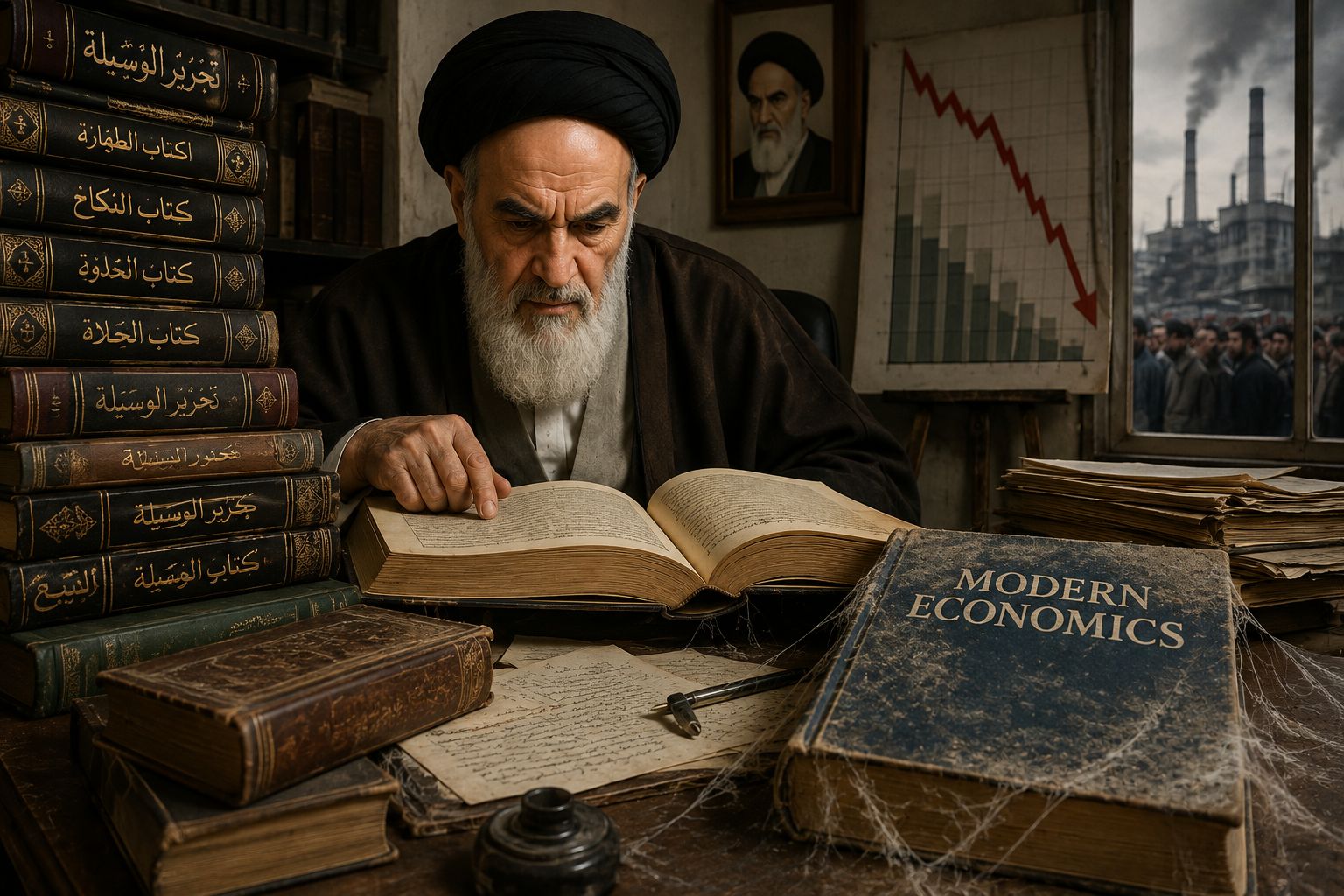
Ruhollah Khomeini is remembered primarily as the architect of Iran’s 1979 Islamic Revolution and the founder of the Islamic Republic. He was also a prolific Islamic jurist. Some of his writings demonstrate just how extensively religious law can intrude into the most intimate—and sometimes deeply disturbing—areas of human behavior.
His Tahrir al-Wasilah is not some collection of quotations invented decades later by his enemies. It is a major work of Shiite jurisprudence. Khomeini completed it in the 1960s, and it was first published in Najaf in 1969. After the revolution, it became a regularly taught text in Iran’s religious seminaries.
Its enormous range is remarkable. Khomeini wrote detailed rules concerning prayer, fasting, property, marriage, divorce, food, reproduction, punishment and sexual behavior. Some of the sexual rulings are particularly difficult to read through a modern understanding of consent and children’s rights.
Sex with children
The most disturbing material concerns girls below the age of nine.
Khomeini’s jurisprudence prohibited intercourse with a wife before she reached nine. That statement alone illustrates a radically different conception of childhood from the one underlying modern child-protection standards.
Yet the qualification that follows is even more disturbing. Tahrir al-Wasilah states that other forms of sexual gratification—including lustful touching, embracing and sexual activity involving the thighs—were not similarly prohibited. The ruling notoriously extends this principle even to a nursing infant.
This distinction is important because the passage is sometimes inaccurately summarized online as Khomeini simply permitting intercourse with babies. That is not what the text says. The actual rule is more specific: penetration was prohibited before nine, while certain other sexual acts were considered permissible.
Accuracy hardly makes the underlying principle less horrifying.
A baby cannot understand sexuality, much less consent to sexual activity. Modern child-protection principles recognize sexual activity imposed upon infants and young children as abuse. Constructing elaborate theological distinctions between different sexual acts does nothing to address that fundamental reality.
Khomeini went even further. His jurisprudence considered what should happen if intercourse with a girl below nine caused severe physical injury. Instead of beginning with the modern premise that such an act against a child should never occur, the legal discussion establishes consequences and obligations arising after the injury.
This is what happens when morality becomes an exercise in interpreting inherited religious rules rather than beginning with the welfare, autonomy and suffering of actual human beings.
And then there were the animals
Another notorious subject in Khomeini’s jurisprudence is bestiality.
Here, however, accuracy is especially important.
Internet memes frequently claim that Khomeini simply instructed Muslims that they could have sex with sheep, cows or camels. That characterization is misleading. His jurisprudence discusses what happens legally and ritually after bestiality has occurred. It should not be represented as a straightforward recommendation or permission to commit the act.
The rules themselves are nevertheless extraordinary.
They distinguish between different categories of animals and prescribe what should subsequently happen to them. In the case of animals ordinarily used for food, such as sheep, cattle or camels, the animal can become forbidden for consumption and may have to be slaughtered and burned.
Different consequences apply to animals ordinarily used for transportation, such as horses, donkeys and mules. The legal discussion can involve removing the animal from the locality and selling it elsewhere.
Pause for a moment and consider the intellectual energy involved.
A religious scholar has constructed detailed rules governing what happens to an animal after a human being sexually abuses it: whether people may consume it, whether it should die, whether it should be burned or whether it should instead be transported somewhere else and sold.
One might reasonably wonder whether a revolutionary leader had more pressing subjects to study.
Sex, menstruation and the marriage bed
Khomeini’s sexual jurisprudence did not end there.
Tahrir al-Wasilah also contains detailed discussions of sexual relations within marriage, including anal intercourse and intercourse during menstruation. These are treated as matters requiring religious classification, restrictions and, in some circumstances, religious penalties.
This was hardly unusual within traditional jurisprudence. Religious legal systems have spent centuries regulating food, clothing, marriage, menstruation and sexuality. Nor is Islam unique in possessing ancient religious rules that appear bizarre or objectionable from a modern secular perspective.
The broader question is what happens when such jurisprudence becomes politically powerful.
Khomeini was not merely an obscure theologian producing hypothetical rulings for other scholars. He eventually became the leader of a revolution and established a political system in which clerical interpretations of Islamic law became fundamental to the state.
That makes his priorities politically relevant.
Perhaps economics would have been more useful
While Khomeini devoted enormous attention to religious jurisprudence, his attitude toward material economic concerns was strikingly different.
After the revolution, he dismissed complaints about declining living standards by arguing that Iranians had not made their revolution merely for cheaper goods. His attitude toward economics has often been summarized by the famous line attributed to him that economics was essentially a matter for donkeys. More reliably documented accounts show the same underlying worldview: Khomeini explicitly rejected the idea that economic prosperity was the purpose of the revolution and placed Islamic and spiritual objectives above material ones.
Perhaps he should have reversed his priorities.
Understanding inflation, productivity, investment, institutions, international trade, incentives, technological development and the management of a modern industrial economy might have been rather more useful to millions of Iranians than determining what should happen to a sheep after someone has sex with it.
Iran was not an insignificant country that could afford to ignore economics. It possessed enormous oil and gas resources, a large population, an educated middle class and considerable potential for industrial and technological development.
The post-revolutionary economy nevertheless faced immense difficulties. Those problems cannot simply be blamed on Khomeini’s religious ideology. Iran endured the devastating Iran-Iraq War, international isolation, sanctions, dependence on petroleum revenues and major political upheaval. Serious analysis requires acknowledging all of those factors.
Yet ideology mattered too.
A political system inevitably reflects what its founders consider important. When religious purity, revolutionary ideology and clerical authority take precedence over competent institutions and pragmatic governance, ordinary people eventually pay part of the price.
The problem is bigger than Khomeini
It would be easy to turn these passages into nothing more than ridicule of one dead cleric.
That would miss the more important point.
Human beings have inherited enormous bodies of religious law written in societies with radically different assumptions about women, children, marriage, sexuality, punishment and individual autonomy. Some believers reinterpret those traditions. Others reject particular rulings. Still others attempt to enforce ancient jurisprudence in modern societies.
The crucial distinction is therefore not simply between Muslims and non-Muslims, or religious people and atheists.
It is between systems of morality that can be challenged and revised according to evidence, human welfare and individual rights, and systems in which an ancient or supposedly divine rule acquires authority precisely because questioning it becomes difficult.
Children do not need theological classifications of which sexual acts adults may perform upon them.
They need absolute protection from sexual exploitation.
Animals do not need elaborate rules determining their ritual status after sexual abuse.
They need protection from cruelty.
And a country of tens of millions of people does not primarily need clerics debating the minutiae of medieval sexual jurisprudence.
It needs competent institutions, human rights, science, education—and people who understand how to run a modern economy.
Leave a Reply