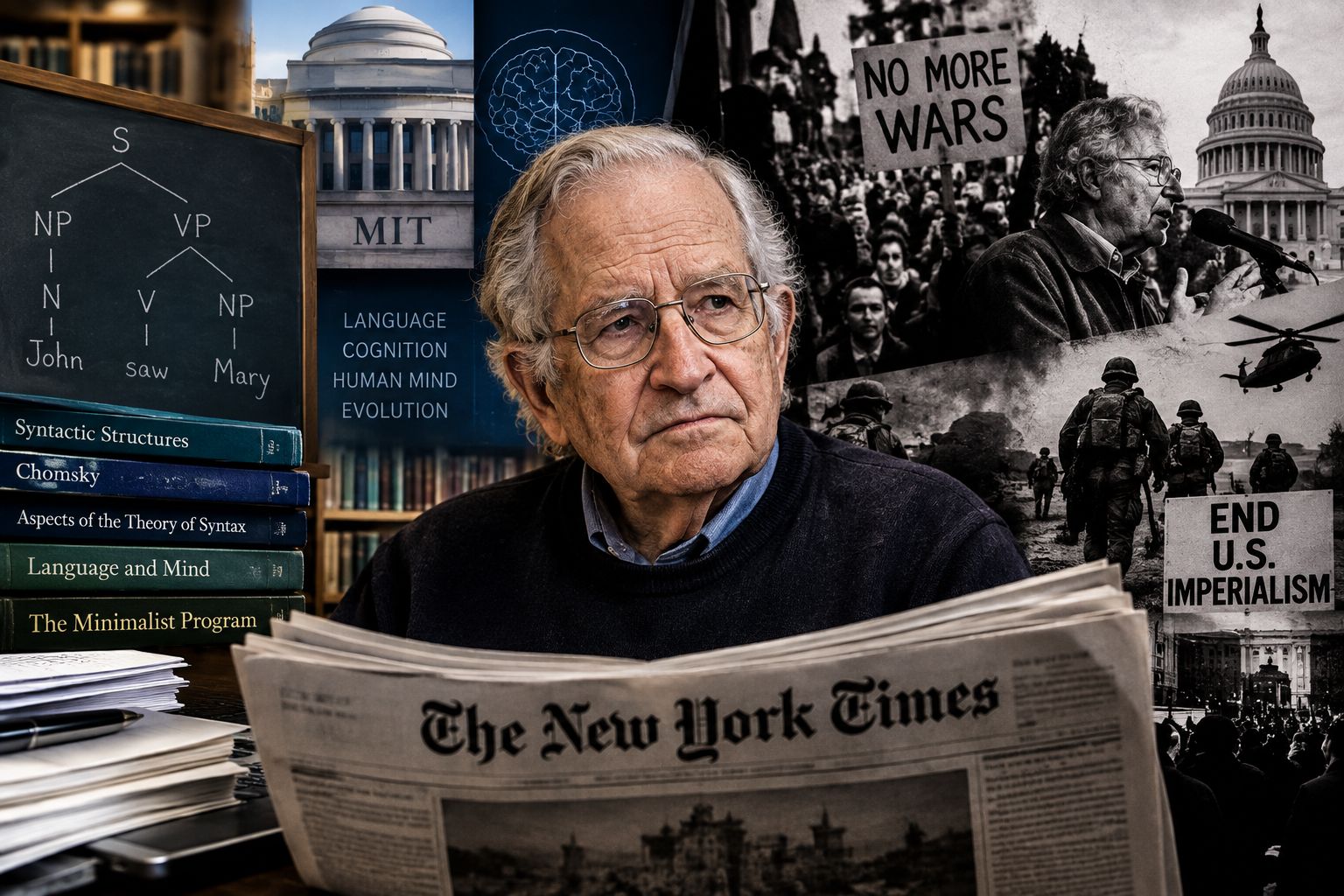
I am not saying I do not wish this esteemed professor many long years to live. I certainly do wish him that. But the question is not whether The New York Times will publish his obituary. It definitely will publish it. The real question is how much you must be pro-establishment, pro-war, and a believer in American exceptionalism to get your obituary published there. Chomsky does have some connections to the establishment. He held a prestigious chair at MIT for decades. He has won major academic awards. Nevertheless, the main reason he gets heard at all is his enormous scientific contribution to linguistics. That contribution is so monumental that even his harshest critics cannot dismiss him. His scientific legacy forces the paper to take him seriously, even when his politics make its editors deeply uncomfortable.
We must also consider the paper’s ownership. The New York Times belongs to the Sulzberger family. They are Jewish. I must say this not out of prejudice but because it is a documented fact. For much of the family’s history, it has been nearly impossible for a member to marry a Gentile and remain in the inner circle. This means the paper’s editorial outlook has long reflected a distinctly Jewish-American perspective. That perspective includes a strong attachment to Zionism and to the state of Israel. Chomsky himself is of Jewish ancestry. His father was a renowned Hebrew scholar. Chomsky wrote his master’s thesis on Modern Hebrew. Yet he has become the world’s most famous Jewish critic of Zionism. He supports a one-state solution that would dismantle the Jewish state. This creates a profound and ironic tension between him and the people who own the paper.
Chomsky is Jewish, so?
Because of his ancestry, however, the obituary’s actual publication may become more likely. The paper cannot ignore a Jewish intellectual of his stature. The editors will feel a complicated kinship with him, even as they reject his politics. Furthermore, the paper maintains about 2,500 advance obituaries at all times. It only prepares these for figures who have shaped the world on a grand scale. Chomsky almost certainly has had a fully written obituary sitting in their files for years. This became clear back in 2006. That year, the paper briefly and erroneously reported his death due to a poor translation. The paper had to retract the item quickly. But the error revealed that they were already tracking his life with the same care they apply to presidents and Nobel laureates.
The real challenge will be the obituary’s framing. The editors face a profound contradiction. On one hand, they must honor his scientific genius. He revolutionized our understanding of language and the human mind. On the other hand, they must contend with his decades of relentless activism. He has called the United States the world’s leading terrorist state. He has condemned every major American war from Vietnam to Iraq to Afghanistan. He has excoriated the media for serving as a propaganda arm of corporate power.
NYT doesn’t like his views
The Sulzberger family and much of the American Jewish establishment hold these views in deep contempt. The obituary will therefore become a masterpiece of careful evasion. It will praise the scientist while subtly diminishing the activist. It will separate his academic work from his political writings, as though the two were unrelated. Chomsky himself has always insisted that his linguistics and his politics spring from the same Enlightenment commitment to reason and human freedom. The Times will ignore that connection.
The paper will almost certainly call him a “controversial” or “polarizing” figure. This is standard code in establishment journalism for someone who has stepped outside acceptable boundaries. The obituary will also give ample space to his detractors. It will quote generals, diplomats, and fellow academics who have called him a conspiracy theorist or an apologist for tyranny. At the same time, it will frame his criticisms of American power as excessive, unbalanced, or naïve. This is how the Times handles dissidents who are too famous to bury but too dangerous to embrace.
Nevertheless, the obituary will still appear prominently. It will most likely run on the front page the day after his death. His stature is simply too great to ignore. The paper’s own professional standards demand that they cover figures of his magnitude. Interestingly, Chomsky himself developed the “propaganda model” with Edward Herman. That model explains how the mainstream media systematically filter news to serve establishment interests. The Times will demonstrate this model perfectly in its own pages. It will show precisely how it handles a critic who has spent a lifetime attacking everything the paper represents.
A powerful intellectual
We should also examine how the obituary will treat his Jewishness. The paper will mention his father’s work as a Hebrew scholar. It will note his own early training in the language. But it will almost certainly avoid connecting this heritage to his anti-Zionism. Doing so would force the paper to acknowledge a painful truth. A Jewish intellectual of impeccable credentials has reached conclusions fundamentally at odds with the mainstream Jewish-American consensus. The Sulzberger family has its own deep ties to Israel. It has historically been sensitive to accusations of being a “Jewish newspaper.” The editors would prefer to leave this tension unexamined. They will treat his Jewishness as a biographical curiosity rather than a central lens for understanding his politics. This omission will itself be a telling act of editorial judgment.
At the same time, the paper might treat him more fairly than his critics expect. His scientific contributions are so overwhelming that even his political adversaries respect his intellectual integrity. The Times has also published thoughtful obituaries for other radical figures like Howard Zinn. Edward Said received a more mixed treatment, however. The paper emphasized Said’s flaws and minimized his achievements in a way that many found deeply unjust. Chomsky’s obituary will likely fall somewhere between genuine respect and subtle dismissal. It will honor the linguist while questioning the activist. This hybrid approach will satisfy the paper’s professional obligation to report the facts. It will also satisfy its institutional instinct to defend the American establishment.
Chomsky’s rightful for NYT
Ultimately, the deeper irony will not escape careful readers. Chomsky himself has always viewed The New York Times as a quintessential propaganda organ. He has repeatedly argued that its journalists are not really journalists at all. He sees them as public relations agents for the state and for corporate interests. He would not be surprised or especially troubled by whatever distortions appear in his own obituary. He has often said that the truth will eventually out if one follows the evidence. His obituary, no matter how carefully framed, will still contain the basic facts of his life. Those facts include his books, his theories, his speeches, and his activism. Those facts will speak for themselves to any reader who approaches them with an open mind.
Therefore, the answer to the original question is clear. Yes, The New York Times will publish Noam Chomsky’s obituary. It will do so with all the care, calculation, and institutional bias we have come to expect from the paper of record for the American establishment. However, the publication will not mark the end of his influence. His ideas have already spread too widely. His scientific legacy is already too secure to undo with a single newspaper article. The very act of publishing his life story will introduce millions of new readers to his work. Many of those readers will go on to read his books. They will discover for themselves the uncomfortable truths that the Times would prefer to contain.
An unpleasant obituary
Consequently, the obituary will serve a dual purpose. It will attempt to manage his legacy for a mainstream audience. But it will also inadvertently extend his reach to a new generation of skeptics and seekers. This is precisely the kind of irony that Chomsky himself has always appreciated about the media system. He has spent his life dissecting that system. In the end, the establishment paper will write the story of its greatest critic. It will do so not despite his radicalism but because of it. His radicalism made him newsworthy in the first place. The paper’s own professional logic demands that it cover figures who matter. It covers them regardless of whether those figures threaten the very worldview the paper exists to defend.
Leave a Reply