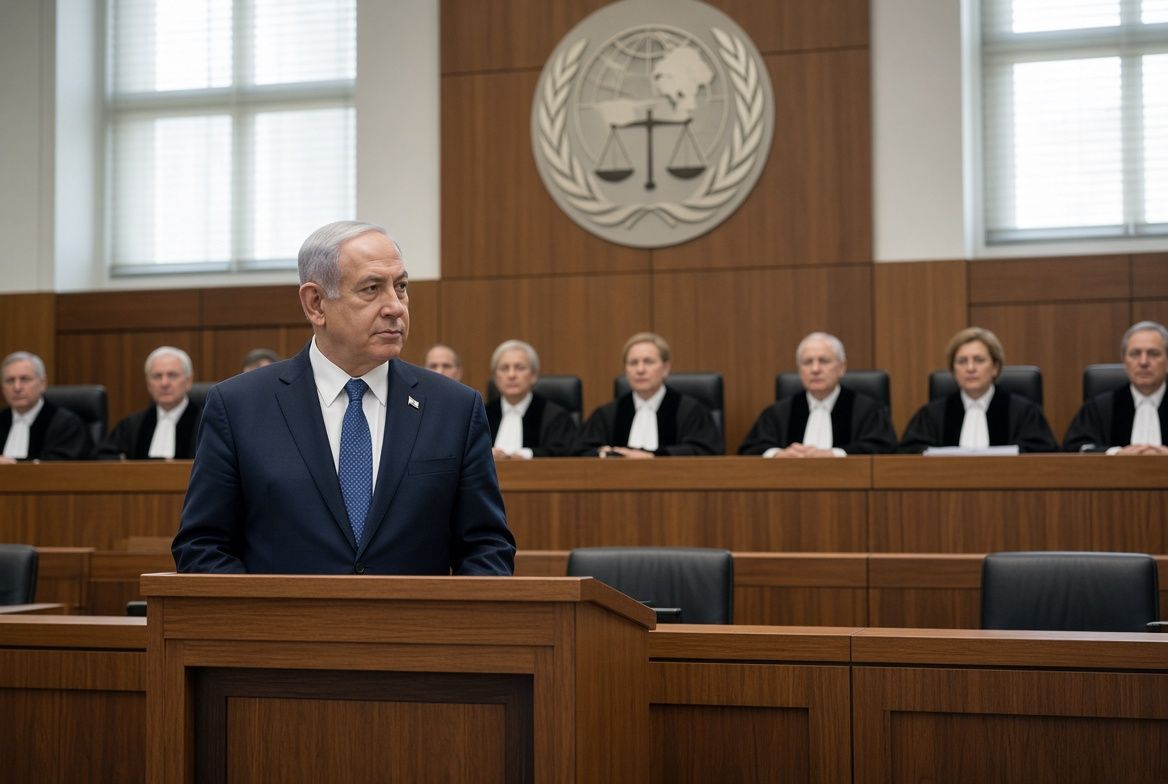
Freethinkers International readers may have been spot on.
When we recently asked whether Israeli Prime Minister Benjamin Netanyahu would eventually appear before the International Criminal Court in The Hague, most respondents predicted that he would not.
At the moment, their skepticism looks justified.
The International Criminal Court issued an arrest warrant for Netanyahu in November 2024 over alleged war crimes and crimes against humanity connected to the Gaza war. Nearly two years later, however, Netanyahu remains free, and the warrant has exposed an uncomfortable reality about international justice: a court can issue an arrest warrant, but it cannot enforce one by itself.
The ICC has a warrant but no police
The ICC does not have its own police force capable of traveling to Israel, arresting Netanyahu, and putting him on a plane to the Netherlands.
It depends on states to enforce its warrants.
That distinction is crucial. Netanyahu does not simply have to lose a legal argument. For him actually to stand before the ICC, authorities somewhere must arrest him and surrender him to the court.
Israel rejects the ICC’s jurisdiction and has challenged the proceedings. The United States is not an ICC member either and has long opposed the court exercising jurisdiction over nationals of nonmember states without their consent.
That already leaves the court without cooperation from Israel and its most powerful ally.
Hungary demonstrated the ICC’s weakness
Perhaps the clearest demonstration came in April 2025.
Netanyahu traveled to Hungary despite the ICC warrant. Hungary was still bound by the Rome Statute at the time, yet its authorities did not arrest him. The ICC subsequently found that Hungary had failed to comply with its obligation to cooperate with the court.
That episode demonstrated the enormous difference between international law on paper and international law in practice.
The ICC could determine that Hungary had failed to cooperate. What it could not do was send officers into Budapest and arrest Netanyahu itself.
International institutions ultimately depend on governments being willing to enforce their decisions.
The United States is actively fighting the ICC
The problem now extends far beyond passive noncooperation.
The Trump administration has intensified its campaign against the ICC and imposed sanctions on court officials. Most recently, ICC President Tomoko Akane herself was sanctioned. She has warned that attacks on the institution threaten the international rule of law and has appealed to Japan and other countries for stronger support.
The United States has also been pressing other countries to distance themselves from the court. Reuters reported this week that Akane urged Japan to resist Washington’s campaign and help prevent additional countries from abandoning the institution.
This makes the Netanyahu case about considerably more than one Israeli politician.
It has become a test of whether an international criminal court can function effectively when one of the world’s most powerful countries is determined to protect an ally from it.
The pro-Israel Jewish lobby matters
We all know there are two kinds of Jewish lobbies: pro-Israel and anti-Israel. Without the first, it would be impossible to maintain Israel’s extremely strong position in world affairs.
Israel wasn’t built just on people’s back. The super-rich Jewish families put hands on it and built it.
The same goes for the cover-up of Israel’s undoubtedly massive war crimes.
Even Europe is divided over enforcement
Europe formally provides considerably stronger support for the ICC. All 27 EU countries are currently members of the court.
Yet even there, enforcement of Netanyahu’s warrant has produced ambiguity.
European officials have repeatedly differed over how they would respond if Netanyahu entered their territory. As recently as August 2026, countries including France, Germany, and Italy had declined to give unequivocal public commitments that they would enforce his warrant.
This illustrates the fundamental weakness of international criminal justice.
Rules can appear universal until enforcing them becomes politically expensive.
The international community is not entirely silent
Governments, human-rights organizations, UN officials, European politicians, legal experts, and civil-society groups have repeatedly defended the ICC and demanded accountability. European leaders have also condemned the latest US sanctions against court officials.
The more defensible criticism is that condemnation has often been much stronger than enforcement.
Statements are relatively cheap. Arresting the sitting prime minister of Israel while facing enormous diplomatic pressure from Washington would be something entirely different.
That is where international justice encounters political power.
International law is only as strong as states make it
The Netanyahu case illustrates a structural problem that extends well beyond Israel.
International institutions do not constitute a world government. They possess only the authority and enforcement mechanisms that states have agreed to give them.
The ICC has issued warrants against powerful figures before. Their effectiveness has always depended heavily on geography, political circumstances, changes of government, and state cooperation.
This creates an uncomfortable inequality.
A defendant without powerful allies can be arrested. A leader protected by powerful governments may travel much more carefully, but remain beyond the court’s physical reach for years.
The law may theoretically apply to both. The ability to enforce it does not.
Netanyahu probably won’t see the inside of the ICC
Nobody can know Netanyahu’s ultimate fate.
Governments change. Alliances change. Leaders lose power. A country willing to protect someone today may cooperate with international prosecutors tomorrow. Netanyahu’s ability to travel has also been constrained by the existence of the warrant.
So saying that he will never stand trial in The Hague would go beyond the evidence.
But the probability currently appears low.
The ICC has an arrest warrant. What it does not have is control over Israeli territory, its own international police force, American cooperation, or guaranteed enforcement even among governments formally committed to the court.
Meanwhile, Washington is not merely declining to cooperate. It is actively putting pressure on the institution and its officials.
Freethinkers International readers who predicted that Netanyahu would never appear before the ICC may therefore prove correct.
And if they do, the most disturbing conclusion will extend far beyond Benjamin Netanyahu.
International justice can prosecute powerful people only when political power allows international justice to reach them.
Leave a Reply