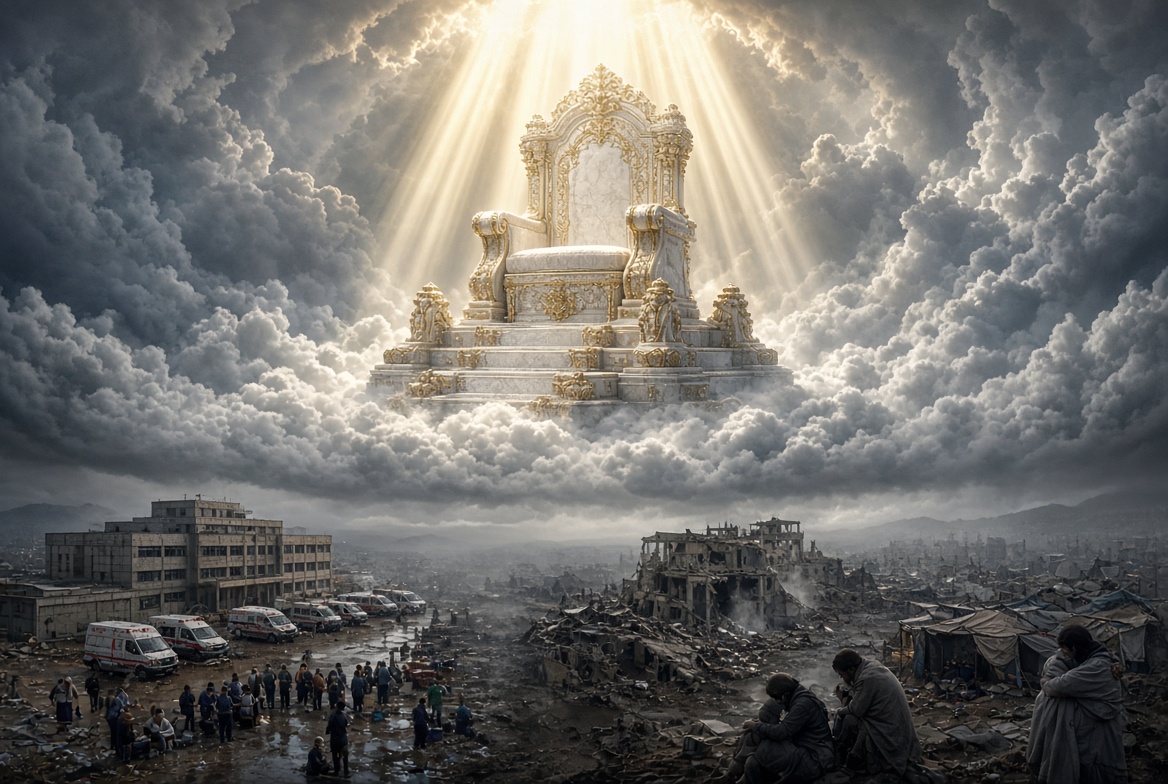
For thousands of years, believers have described the existence of God as the greatest possible source of hope. God supposedly gives our lives meaning, establishes morality, watches over humanity and promises that death is not the end.
But imagine for a moment that the traditional monotheistic God really existed. Not a vague force somewhere beyond the universe, but the omnipotent, omniscient creator described by major religious traditions.
Would that actually be good news?
Perhaps we should feel extraordinarily lucky that there is no convincing evidence that such a being exists. A world governed by an all-powerful supernatural ruler could be considerably more disturbing than a universe governed by impersonal natural laws.
The problem becomes especially obvious when we consider free will, human fallibility, eternal punishment, morality, cognitive biases and the enormous amount of suffering built into life itself.
God created imperfect people and then blamed them
Religious doctrines frequently place enormous responsibility on human beings. We supposedly possess free will. We choose between good and evil, and God judges us according to those choices.
There is an immediate problem.
Even if free will exists in the strong religious sense, God supposedly designed the creature making the choices.
He created the human brain. He created its limitations. He created our emotions, impulses, desires and vulnerabilities. He created the circumstances in which our decisions occur. An omniscient God would also know every consequence of his design before creating anything.
Humans make mistakes constantly.
We misunderstand situations. We become angry. We panic. We follow crowds. We trust unreliable people. We misremember events. We make impulsive decisions. We fail to understand long-term consequences. Sometimes we hurt others without even realizing what we are doing.
None of this resembles the behavior of perfectly rational agents.
Yet many religions tell us that a perfect God created these deeply imperfect creatures and then established a cosmic system for judging their mistakes.
That is a strange definition of justice.
Free will does not solve the problem
Free will is commonly offered as the great religious explanation for evil.
God does not cause human cruelty, believers argue. Humans freely choose it.
But saying “free will” does not magically remove God’s responsibility if God deliberately created the entire system.
Suppose an engineer knowingly designed a machine with severe defects. The engineer understood exactly how those defects would behave and knew that they would eventually cause enormous harm. We would hardly absolve the engineer by saying that the machine was responsible for what happened.
The theological problem is even greater.
An omniscient creator would know the complete future before creating the universe. He would know every murder, rape, war, genocide and act of torture that would occur. He would know exactly which individuals would commit them and exactly which victims would suffer.
He would nevertheless choose to create precisely that universe.
There is also a deeper philosophical problem. Our decisions emerge from brains that we did not choose, genes that we did not choose, childhoods that we did not choose and environments that we did not choose.
Even if some meaningful form of free will exists, human freedom is obviously constrained by biology and circumstances.
We did not design ourselves.
According to religion, God did.
Then comes eternal punishment
The doctrine of eternal punishment makes the situation far worse.
Humans live finite lives. We possess limited intelligence, incomplete information and imperfect judgment. We make mistakes under conditions we did not choose.
Some religious traditions nevertheless teach that the consequences can be infinite.
Hell is perhaps one of the most morally grotesque ideas humanity has ever invented.
No finite crime deserves infinite punishment.
Even the worst human being imaginable can commit only a finite number of crimes during a finite lifetime. Eternal torture could continue for a billion years, then a trillion years, then a trillion trillion years — and it would still have barely begun because eternity has no endpoint.
Nothing could justify that.
A justice system should protect others, reduce harm, rehabilitate people where possible and perhaps deter destructive behavior. Punishment for its own sake produces additional suffering without undoing the original suffering.
Eternal punishment is infinitely worse. It has no rehabilitative endpoint. It cannot restore victims. It cannot eventually release a transformed offender.
It simply creates suffering forever.
If a human government proposed infinitely torturing prisoners, we would call it monstrous.
Calling the ruler “God” does not make the principle morally better.
God’s morality is supposed to be perfect
Religion frequently reverses the normal process of moral reasoning.
Instead of asking whether a command is ethical, believers may begin with the assumption that whatever God commands must necessarily be ethical.
That assumption becomes extremely difficult to defend when we actually examine religious texts.
Sacred scriptures contain rules, commands and stories involving slavery, collective punishment, extreme violence, discrimination, executions for religious or sexual offenses and deeply unequal treatment of human beings.
These ideas reflect the societies that produced them remarkably well.
That should not surprise us if humans wrote the texts.
It becomes much harder to explain if an infinitely intelligent and perfectly moral being inspired them.
Morality should not become good merely because someone powerful commands it.
If cruelty is wrong when a human orders it, supernatural authority does not transform cruelty into kindness.
Power and morality are different things.
An omnipotent being could possess unlimited power while still behaving immorally.
We can improve morality
Human morality is deeply imperfect, but unlike supposedly divine commandments, it can change.
That is one of its greatest strengths.
We can discover that previous generations were wrong. We can abolish institutions once considered normal. We can expand moral concern beyond our tribe, nationality, race, religion, species or generation.
We can replace commandments with ethical reasoning.
And perhaps morality can eventually improve toward something much more systematic: total utilitarianism.
From that perspective, what ultimately matters is the total well-being of conscious creatures. We should attempt to maximize positive conscious experience and minimize suffering, regardless of whose happiness or suffering is involved.
Such a moral system is not automatically easy. Utilitarianism creates difficult philosophical questions of its own. Measuring well-being is enormously complicated, and simplistic applications can produce terrible conclusions.
But unlike allegedly infallible religious morality, an evidence-based ethical system can be criticized, refined and improved.
We can ask what actually causes suffering.
We can study what increases well-being.
We can change our conclusions when better evidence or arguments appear.
A morality carved permanently into an ancient text cannot do that.
God supposedly gave us cognitive biases
There is another strange feature of the supposed divine design: the human brain is filled with cognitive biases.
We are not naturally objective reasoning machines.
Confirmation bias encourages us to notice information supporting what we already believe. In-group bias makes us favor people we perceive as belonging to our group. Authority bias makes us disproportionately trust powerful or prestigious figures. Availability bias distorts our perception of probability. Motivated reasoning helps us construct arguments for conclusions we emotionally want to believe.
These are not obscure defects.
They influence politics, religion, relationships, financial decisions, prejudice and countless everyday judgments.
Human beings can partly overcome them through education, science, statistical reasoning, critical thinking and institutions designed to correct individual mistakes.
But why would a perfect designer build these distortions into our minds in the first place?
The evolutionary explanation is straightforward.
Our brains were not designed from scratch to discover perfect truth. They evolved gradually because particular psychological mechanisms helped our ancestors survive and reproduce. Evolution does not care whether our reasoning is philosophically perfect. It only favors traits that successfully propagate genes under particular environmental conditions.
A divine explanation creates the opposite problem.
God would have intentionally designed minds vulnerable to systematic error and then demanded that those minds correctly identify religious truth.
Worse, according to some religions, getting that answer wrong can have eternal consequences.
And then there is suffering
Finally, there is the oldest problem of all.
Suffering.
The world contains an almost incomprehensible amount of it.
Children develop cancer. People die in earthquakes. Babies are born with devastating diseases. Parasites consume living organisms from inside. Animals starve, freeze, suffocate and are eaten alive.
Much of this suffering has absolutely nothing to do with human free will.
A child does not freely choose leukemia.
An animal being slowly killed by disease did not commit a theological offense.
Earthquakes are not moral agents.
Viruses do not sin.
For hundreds of millions of years before humans even existed, animals experienced injury, starvation, predation, disease and death.
If God intentionally designed nature, then God designed that system too.
Evolution explains why nature looks like this without requiring cruelty or benevolence. Natural selection has no compassion. Organisms survive and reproduce when they possess advantageous traits. Suffering can exist on an enormous scale because evolution has no moral objective.
But an omnipotent and perfectly benevolent designer would have alternatives.
An all-powerful God would not face engineering constraints.
He could create conscious life without cancer. He could create ecosystems without animals eating one another alive. He could eliminate devastating genetic diseases. He could prevent earthquakes from crushing children beneath buildings.
If omnipotence means anything, God could create happiness without requiring suffering as its price.
Yet suffering is everywhere.
We should be glad there is no evidence for such a ruler
None of this proves with mathematical certainty that no conceivable god exists.
A deistic creator, an indifferent supernatural intelligence or some entity completely unlike the gods of traditional religions presents different philosophical questions.
But the traditional combination of omnipotence, omniscience, perfect goodness, divine judgment and eternal punishment creates extraordinary contradictions.
We are supposedly created imperfect, given cognitively biased brains and placed in environments we did not choose.
We make mistakes.
We suffer.
We are told that we possess free will, although our decisions depend heavily on biology and circumstances beyond our control.
We inherit moral commandments that can be considerably worse than ethical principles humans have subsequently developed.
And in some versions of the story, if we reach the wrong conclusions during our short and confused lives, the punishment lasts forever.
That is not comforting.
A universe without such a God may initially seem colder. There is no cosmic parent watching over us. There is no guarantee that justice will ultimately prevail. There may be no predetermined purpose waiting for us.
No dictator
But there is also no celestial dictator.
There is no divine authority making bad morality eternally unquestionable. There is no supernatural creator deliberately designing cognitive biases and then punishing us for being mistaken. There is no omnipotent being watching preventable suffering while choosing not to prevent it.
And there is no eternal torture chamber waiting for finite human beings who make finite mistakes.
Instead, morality becomes our responsibility.
We can recognize our cognitive limitations and try to overcome them. We can use science to understand suffering. We can improve our ethical systems. We can expand the circle of beings whose well-being matters. Perhaps, eventually, we can move toward a morality centered entirely on maximizing well-being and minimizing suffering for every conscious creature capable of experiencing either.
There is no guarantee that humanity will succeed.
But at least our mistakes are not sacred.
We can correct them.
And perhaps that is one more reason to be truly lucky that God doesn’t exist.
Leave a Reply