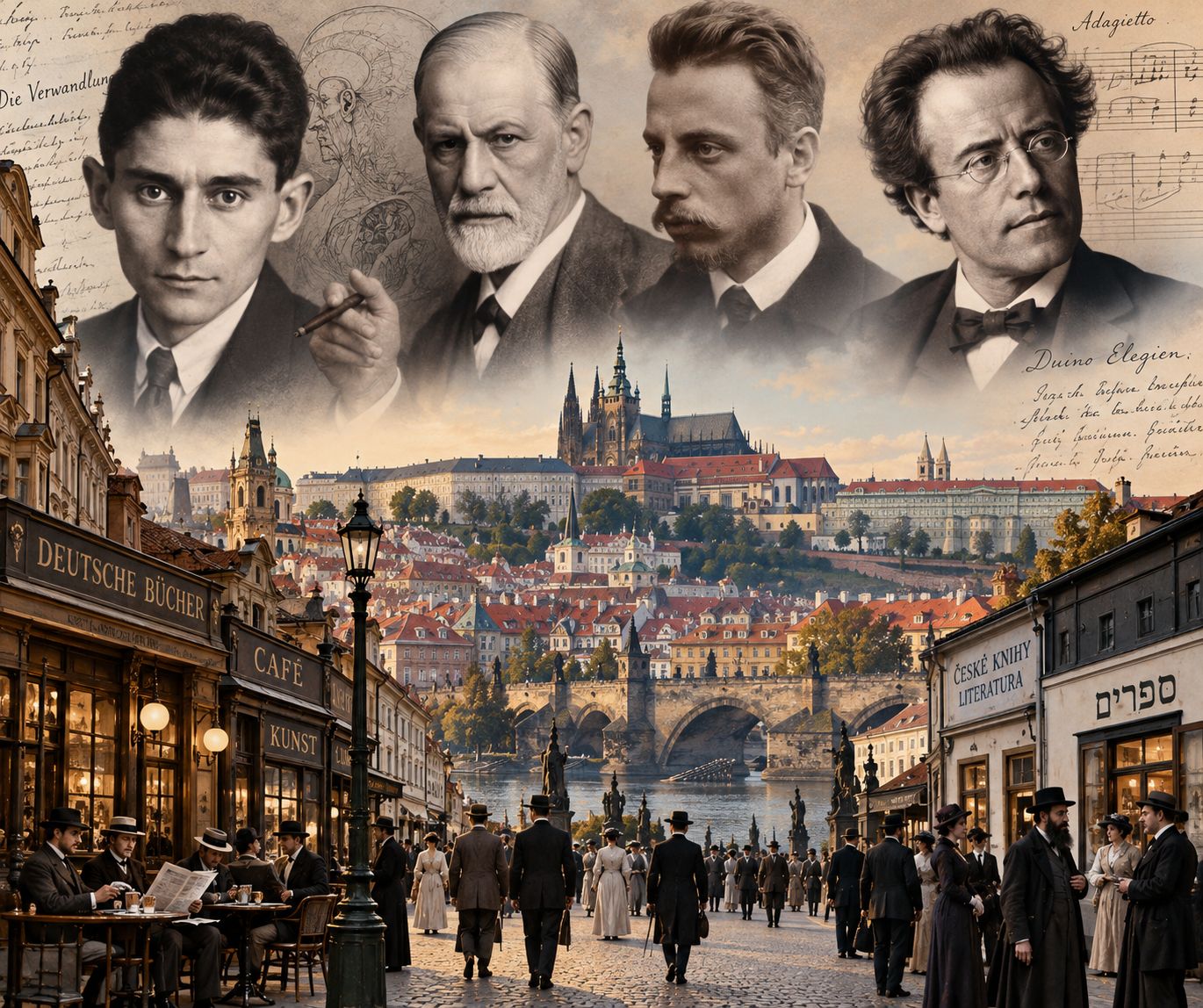
The Czech lands have produced an impressive number of scientists, writers, composers, philosophers and other intellectuals. Yet there is a historical complication that modern national narratives can easily obscure: many of the most internationally famous people born in what is now the Czech Republic were not Czech in the modern ethnic or linguistic sense.
They were Germans, German-speaking Jews, or members of communities whose identities do not fit neatly into today’s national categories.
This is not an argument against Czech culture. The Czech lands also produced extraordinary Czech-speaking figures, from Karel Čapek and Jaroslav Hašek to Jaroslav Seifert. Rather, it is a reminder that geography, nationality, ethnicity and language are not the same thing—particularly when discussing the multinational Habsburg Empire.
Franz Kafka was a German-speaking Jew
The most obvious example is Franz Kafka. He was born in Prague in 1883, but his principal language was German, and he wrote his literary works in German. Kafka belonged to Prague’s German-speaking Jewish community.
He was hardly alone. Prague produced an extraordinary German-language literary culture that included Max Brod, Franz Werfel, Egon Erwin Kisch, Oskar Baum and Ernst Weiss. YIVO describes this Prager deutsche Literatur as one of the great achievements of modern German literature.
This community was numerically small. Around the beginning of the twentieth century, Czech speakers constituted the overwhelming majority of Prague’s population. Yet the German-speaking minority produced figures such as Kafka, Werfel, Kisch and Rainer Maria Rilke. One historical review notes explicitly that the cultural importance of Prague’s Germans greatly exceeded their numerical share of the population.
Rilke presents another striking example. Born in Prague in 1875, he became one of the greatest German-language poets of the twentieth century.
Freud and Mahler came from the Czech lands too
Move beyond Prague and the list becomes even more remarkable.
Sigmund Freud was born in Freiberg in Mähren—today Příbor in the Czech Republic—in 1856. His Jewish family moved to Vienna when he was a small child. Freud became one of the most influential intellectual figures of the twentieth century, but calling him simply a famous “Czech” would be historically misleading.
Gustav Mahler, one of the most important composers and conductors of his era, was born in Kaliště in Bohemia in 1860. He grew up in a German-speaking Jewish family and spent much of his professional life within the German-speaking cultural world.
Deutsche Welle has highlighted precisely this historical paradox: Mahler, Freud and Rilke were all born within the borders of today’s Czech Republic, although they were German speakers and are not ordinarily remembered internationally as Czech cultural figures.
The Czech lands were therefore not simply a Czech cultural space. They were a meeting point of Czech, German, Austrian and Jewish cultures.
Even the Nobel Prize list tells the story
The same complication appears when Nobel laureates are classified according to birthplace.
Bertha von Suttner, born in Prague in 1843, became the first woman individually awarded the Nobel Peace Prize, in 1905. She was a German-speaking Austrian-Bohemian aristocrat rather than a Czech nationalist figure.
Then there were Gerty Cori and Carl Cori, who shared the 1947 Nobel Prize in Physiology or Medicine with Bernardo Houssay. Both were born in Prague.
Gerty Cori came from a Jewish family and studied medicine at the German University of Prague, where she received her medical doctorate in 1920. The Coris subsequently emigrated to the United States and conducted the research that made them famous there.
This demonstrates why counting Nobel laureates by the borders of present-day countries can become misleading. A person can have been born in today’s Czech Republic without having regarded himself or herself as Czech.
Why were German speakers so disproportionately visible?
This raises a much more interesting question than simply arguing about nationality: why did relatively small German and German-Jewish communities produce so many prominent intellectuals?
One important answer is social environment.
For centuries, German occupied a privileged position within the Habsburg world. It was associated with imperial administration, universities, professional advancement and much of Central Europe’s educated urban culture. YIVO describes German as a language of both high culture and imperial administration in the Habsburg territories.
Prague possessed not only Czech institutions but an extensive German intellectual infrastructure: a German university, technical university, secondary schools, theaters, newspapers, coffeehouses and cultural organizations.
Jewish history added another dimension. Joseph II’s reforms opened public schools and universities more widely to Jewish children while promoting German-language secular education. Jewish schools taught subjects including German, mathematics and geography.
By the nineteenth century, many upwardly mobile Jewish families had therefore become deeply connected to German education and bourgeois culture. In 1890, roughly 74% of Prague’s Jewish population reported German as their everyday language, although this proportion subsequently declined substantially as Czech linguistic identification increased.
Urbanization mattered as well. By 1910, more than one-third of Bohemia’s Jewish population lived in Prague, while nearly 70% lived in towns with more than 10,000 inhabitants.
That meant greater proximity to universities, libraries, publishers, theaters, professional networks and other educated people.
Social status also helps explain the disproportionate prominence of German-speaking intellectuals in the Czech lands. For much of the Habsburg period, German was associated with imperial administration, higher education, urban elites and prestigious professions. German-speaking families were therefore disproportionately positioned within social environments that offered better access to universities, books, professional networks and intellectual life.
These advantages could accumulate across generations: educated and relatively affluent parents were better able to provide their children with nutrition, education and cognitive stimulation. This is relevant to IQ as well. Intelligence has a substantial genetic component, but environmental conditions influence cognitive development and measured IQ. More importantly, even exceptional intelligence produces little intellectual output without education and opportunity. The prominence of German-speaking Germans and Jews therefore cannot be separated from the historically advantageous social position many of their communities occupied.
IQ does not develop independently of environment
There is also a broader lesson here about intelligence.
People sometimes look at the extraordinary intellectual output of particular ethnic or religious populations and immediately search for genetic explanations. That is far too simplistic.
Measured cognitive ability is influenced by both genetic and environmental factors. Education, nutrition, childhood health, socioeconomic conditions, literacy, intellectual stimulation and family environment all matter. More importantly, becoming a famous scientist or writer requires much more than possessing high cognitive ability.
A highly intelligent child without adequate nutrition or education, surrounded by illiteracy and excluded from universities, has dramatically fewer opportunities to become a professor or Nobel laureate than an equally capable child raised in an educated urban household with access to books, schools and professional networks.
The relevant historical comparison therefore isn’t simply “Jews versus Czechs” or “Germans versus Czechs.” It also involves urban versus rural populations, educated bourgeois families versus poorer families, access to German-language institutions, occupational structure, migration and social networks.
A remarkable culture that nationalism destroyed
Perhaps the greatest irony is that the extraordinary intellectual environment of Prague and the Czech lands resulted partly from their lack of cultural homogeneity.
Czechs, Germans and Jews lived alongside one another, competed with one another and influenced one another. Prague became a particularly unusual intellectual laboratory. Scholars studying Kafka’s generation describe German-Jewish intellectual productivity in Prague as extraordinary relative to the community’s small numbers.
Then that world disappeared.
The Holocaust destroyed most of the Jewish community. After World War II, the expulsion of most ethnic Germans from Czechoslovakia eliminated another centuries-old population. A cultural environment that had produced Kafka, Rilke, Mahler, Freud, Werfel, Kisch and many others effectively ceased to exist.
One assessment of Czech Jewish history describes the sequence starkly: the Nazis destroyed the Jewish community during 1939–1945, while the postwar expulsion removed the Germans, bringing an end to the Czech-German-Jewish cultural symbiosis that had existed before the war.
Modern Czech culture has every reason to celebrate its extraordinary figures. But it should also acknowledge something more interesting than a simple national success story.
Some of the greatest people produced by the Czech lands were Czech. Others were German. Others were Jewish and German-speaking. And some belonged simultaneously to several cultural worlds that modern national labels cannot adequately describe.
That diversity was not an embarrassing footnote to Czech history. It was one of the reasons the Czech lands became such an extraordinary center of European intellectual life.
Leave a Reply