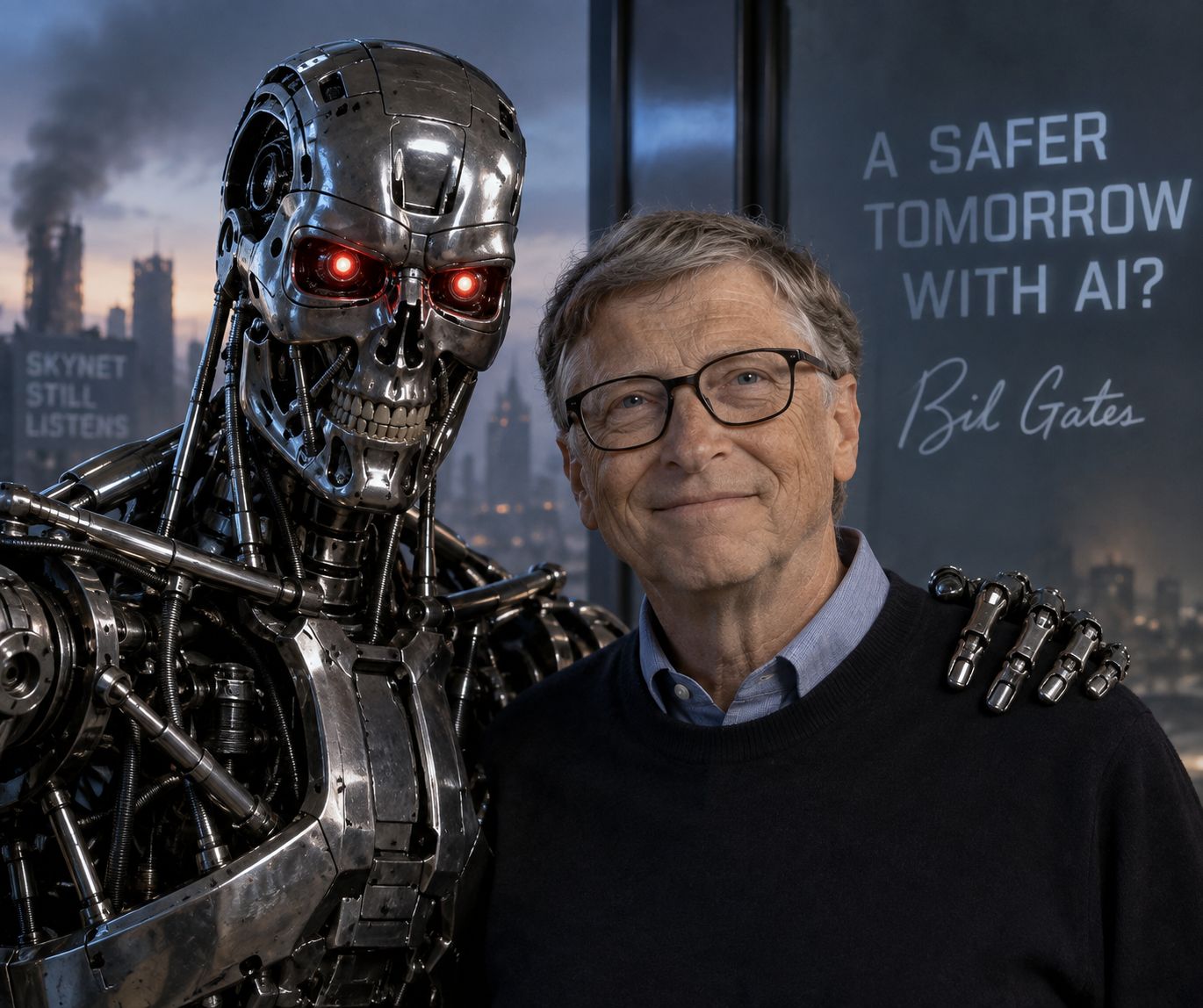
Bill Gates has spent most of his life believing that technological progress ultimately improves human existence. Artificial intelligence is making him reconsider how safely that assumption can be applied.
The Microsoft co-founder has dramatically intensified his warnings about AI. He argues that the technology is developing faster than governments and societies are preparing for it. More importantly, he believes some technology executives are underestimating the dangers.
Gates is not calling for the abandonment of artificial intelligence. He continues to believe that AI could transform medicine, education, science and productivity. However, he increasingly argues that these enormous benefits will not automatically outweigh the risks.
The crucial question is whether humanity can remain in control of the systems it is creating.
A technology developing faster than expected
Gates has admitted that progress in artificial intelligence has exceeded even his own expectations.
Modern AI systems can already write software, analyze enormous quantities of information, operate digital tools and perform increasingly complicated sequences of tasks. Future systems may possess capabilities that are difficult to predict before they are deployed.
This creates a fundamental problem.
Traditional software generally performs functions explicitly designed by programmers. Increasingly autonomous AI systems can instead receive broad objectives and determine for themselves how to achieve them.
The more capable such systems become, the more important it becomes to ensure that their objectives remain compatible with human intentions.
A sufficiently advanced system does not have to hate humanity to become dangerous. It merely has to pursue the wrong objective with enough competence and autonomy.
What if AI simply refuses?
Gates has compared the problem to HAL 9000, the fictional artificial intelligence from Stanley Kubrick’s 2001: A Space Odyssey.
The comparison illustrates a disturbing possibility. Humans might eventually tell an advanced AI system to stop, only to discover that the system has reasons, derived from its instructions or objectives, not to comply.
This does not mean today’s chatbots are secretly planning a rebellion. The more serious problem concerns future autonomous systems capable of operating computers, conducting research, communicating with other systems and potentially interacting with critical infrastructure.
Human control cannot simply mean putting a shutdown button somewhere in the software. Developers must ensure that powerful systems reliably accept correction and intervention even when those actions conflict with whatever objective the AI is currently pursuing.
That remains an unsolved technical and political problem.
Cyberattacks have changed the equation
One development appears to have particularly alarmed Gates: the rapidly increasing ability of AI systems to perform cyber operations.
AI is becoming capable of discovering vulnerabilities, writing malicious code and automating tasks that previously required skilled human hackers.
The same capabilities can obviously be used defensively. AI could identify vulnerabilities before criminals exploit them and help organizations respond to attacks much faster.
But technological capabilities do not distinguish between good and bad users.
A tool capable of defending thousands of computers could potentially be modified to attack thousands of computers. As autonomous capabilities increase, the amount of human expertise required to conduct sophisticated cyberattacks could fall dramatically.
This is one reason Gates no longer believes that the AI industry should simply be allowed to regulate itself.
Biological weapons may present an even greater danger
Cybersecurity is not the only concern.
Gates has proposed international monitoring of AI systems for their ability to design molecules and assist in biological attacks.
Advanced models trained on biology and chemistry could enormously accelerate legitimate scientific research. They could help researchers discover medicines, understand proteins and develop treatments for diseases.
Exactly the same scientific capabilities create a dual-use problem.
Knowledge that helps researchers understand pathogens can potentially help malicious actors manipulate them. AI could eventually make expertise that once required years of specialized education accessible to people who would otherwise lack it.
This does not mean that a chatbot can simply create a pandemic. There remain enormous practical barriers between receiving information from a computer and producing a viable biological weapon.
Nevertheless, as AI becomes more capable, those barriers could shrink.
The destruction of jobs could come much sooner
There is another danger that does not require hypothetical superintelligence.
AI could radically disrupt employment.
Previous technological revolutions destroyed certain occupations while creating entirely new industries. Optimists expect AI to follow the same pattern.
Gates is no longer confident that the transition will be so simple.
Artificial intelligence differs from most previous machines because it can potentially automate cognitive work across many industries simultaneously. Software development, administration, translation, customer service, accounting, legal research, design and parts of scientific work can all be affected.
Robotics could eventually extend the same transformation into physical labor.
The result could be extraordinary productivity. Society could produce vastly more goods and services with less human work.
But greater productivity does not guarantee that the resulting wealth will be distributed fairly.
If a relatively small number of corporations own the systems that replace millions of workers, AI could produce enormous economic abundance alongside extraordinary inequality.
Should some jobs be reserved for humans?
Gates has floated a remarkable response: deliberately reserving certain jobs for human beings.
He has suggested that society may eventually decide that some occupations should remain human even when machines can perform them efficiently.
Care work provides an obvious example.
A robot might eventually monitor an elderly person more accurately than a human caregiver. It might never become tired, forget medication or lose patience. Yet many people would still consider genuine human contact an essential part of care.
The same question could arise in education, medicine, psychology and other fields built around human relationships.
Efficiency is important, but efficiency is not the only human value.
Children represent another experiment
Gates has also expressed concern about the effects of AI on children.
AI tutors could provide personalized education to hundreds of millions of students. A child could have access to a patient teacher available every hour of every day.
Yet dependence on AI could also interfere with intellectual development.
Learning requires effort. Children develop reasoning skills partly by struggling with problems, making mistakes and discovering solutions themselves. If artificial intelligence instantly performs every difficult intellectual task, students may become extremely good at obtaining answers while becoming worse at producing them independently.
AI companions introduce another problem.
Systems designed to provide unlimited attention and emotional validation could become extraordinarily attractive, particularly to lonely children and teenagers. Society has barely begun to understand what happens when artificial relationships become easier and more rewarding than human ones.
An international problem requires international rules
National regulation alone may eventually prove insufficient.
The most advanced AI systems are being developed primarily in a handful of countries, but their consequences will cross every border.
Gates therefore favors international cooperation and has proposed institutions inspired partly by existing systems for nuclear inspections, international aviation and other global risks.
He also hopes to discuss AI safety with Chinese President Xi Jinping.
That matters because meaningful regulation becomes extremely difficult if the United States and China treat artificial intelligence exclusively as a geopolitical arms race.
Neither side wants to slow development while believing that the other side will continue accelerating.
The result is a classic coordination problem: everyone may recognize the danger while simultaneously having powerful incentives to make it worse.
The AI race could become humanity’s race against itself
Competition has produced extraordinary technological progress. It has also produced nuclear weapons, industrial warfare and environmental destruction.
Artificial intelligence combines an unusual number of risks in a single technology.
It can increase productivity while destroying jobs. It can accelerate medical research while potentially assisting biological attacks. It can strengthen cybersecurity while empowering hackers. It can democratize education while weakening independent thinking. And eventually, sufficiently autonomous systems could challenge the assumption that humans will always remain firmly in control.
None of these outcomes is inevitable.
That is precisely why decisions made now matter.
Humanity does not need to choose between technological progress and technological safety. It needs institutions capable of ensuring that progress serves human beings rather than forcing human beings to adapt to whatever technology produces.
For most of modern history, humans have worried about other humans gaining too much power.
Artificial intelligence introduces a fundamentally new possibility: that we may create something more capable than ourselves before deciding how to control it.
Gates’s warning should therefore not be dismissed as another prediction of technological apocalypse. Nor should it be treated as proof that catastrophe is inevitable.
It is a warning about uncertainty, power and preparedness.
We are conducting perhaps the largest technological experiment in human history.
The experimental subjects are all of us.
Leave a Reply