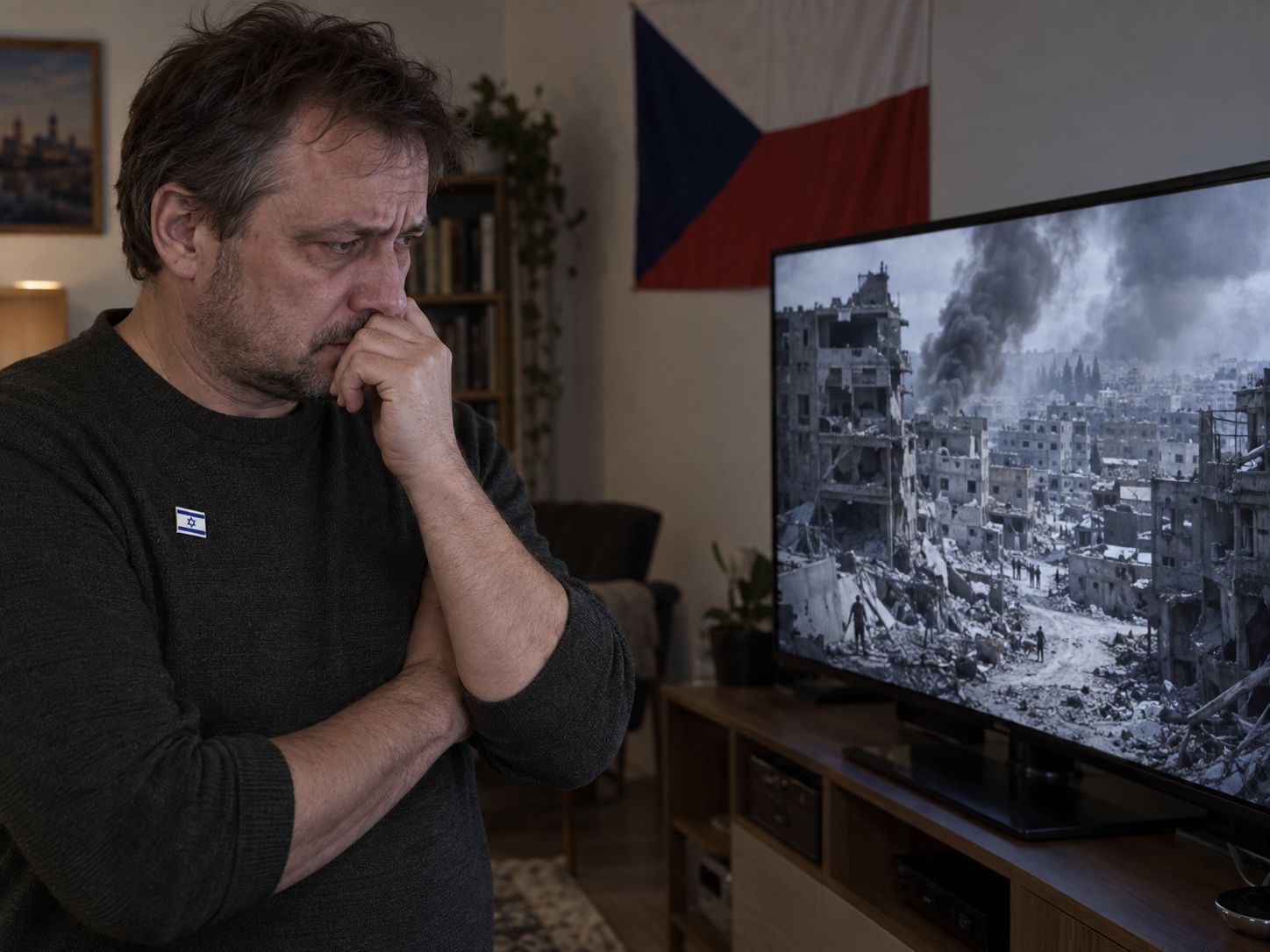
I do it. I read Czech discussions where Palestinians are described as Islamist, stupid, terrorist “brown monkeys” who never work. Where Israel is always right. Where people say immigrants should be shot simply for trying to cross the border. Where Putin should be the leader of the Czech Republic. And so on.
It is a mixture of comments from various outlets. But something is changing. Even some longstanding supporters of Israel on the Czech right have changed their views. Some now describe what is happening in Gaza as genocide or ethnic cleansing.
“I believe that Israel has no better friend in Europe than the Czech Republic,” Benjamin Netanyahu said during a visit to Prague in 2012.
I am no tribalist. I don’t consider myself Czech or European. I consider myself a global citizen. But hearing something like that made me embarrassed to be a native Czech speaker.
Netanyahu then repeated the point when questioned by Czech Television: “We have friends throughout the world, but I don’t think we have a better friend in Europe.”
Even amid overwhelmingly pro-Israel commentary in much of the Czech political establishment, something appears to be changing. People who go out of their way to make clear that they have nothing against Jews, respect Israeli history and have traditionally supported Israel are increasingly saying: this has gone too far.
Which raises the larger question: when does it become too much even for Israel’s longstanding supporters elsewhere in the world?
The historical parallels they don’t want you to remember
What makes this moment so strange, so revealing, is that the Czech relationship with Israel was never supposed to be simple. It was never supposed to be this uncomplicated love affair that the current political class pretends it always was. The history is messier. And the messiness matters.
Czechoslovakia as midwife to Israel
The story Czech politicians love to tell begins in 1947. Czechoslovakia sat on the United Nations Special Committee on Palestine. It helped draft the partition plan. When the vote came on November 29, 1947, Czechoslovakia was among the 33 nations that voted yes. The Arabs rejected it immediately. Violence followed.
Then came the part that became legend. The new state of Israel, declared in May 1948, was immediately invaded by its Arab neighbors. It had almost no weapons. Its survival was genuinely in doubt. And Czechoslovakia, despite a United Nations arms embargo, became its arms dealer.
The numbers are staggering. By January 1948, a contract was signed for 4,500 rifles, 200 machine guns, and fifty million rounds of ammunition. More followed: artillery, anti-aircraft guns, even Messerschmitt fighter planes. The total volume of military equipment delivered from Czechoslovakia between 1947 and 1949 is estimated at over one billion Czechoslovak crowns.
And then there was the Žatec airlift. From May to August 1948, a secret air bridge operated between the Czechoslovak military airport at Žatec and airfields in Israel. Weapons, ammunition, aircraft – all flown out under the nose of the UN embargo. Czech technicians disassembled Messerschmitts, loaded them onto planes, and sent them to Tel Aviv. Israeli pilots were trained on Czechoslovak soil. A brigade of Jewish volunteers from Eastern Bloc countries, the so-called Gottwald Brigade, was organized and trained in Czechoslovakia in 1948.
This is the founding myth of Czech-Israeli friendship. And it is real. It happened. Israel would likely not have survived its first year without Czechoslovak weapons.
The Stalinist turn: When “Zionist” became a death sentence
The same communist regime that armed Israel in 1948 was executing “Zionists” in 1952.
By the early 1950s, the Soviet Union had turned against Israel. Czechoslovakia, as a loyal satellite, followed. The break was not gradual. It was brutal.
In November 1952, the Slánský trial began in Prague. Rudolf Slánský, the General Secretary of the Communist Party of Czechoslovakia, was the main defendant. Of the fourteen accused, eleven were Jews. They were forced to confess to a “Zionist conspiracy” – to being agents of Western imperialism, of international Jewry, of the state of Israel itself.
The trial was a show. The confessions were extracted through torture, sleep deprivation, and psychological breakdown. Eleven defendants were hanged. Three received life sentences.
The Slánský trial was not just a political purge. It was an antisemitic spectacle. The accusation of “Zionism” became a coded language for “Jew” – a way to revive old stereotypes under a new ideological label. The Israeli embassy in Prague was described as a “nest of imperialist spies”. Zionist organizations in Czechoslovakia were dissolved. Jewish communities were monitored. Lists of Jews were compiled. Emigration was forbidden.
As the Cold War intensified and Soviet policy toward Israel changed, Czechoslovak support gradually came to an end and relations deteriorated. Diplomatic relations were formally cut in 1967, following the Soviet lead during the Six-Day War. For the next two decades, Czechoslovakia was a reliable supporter of the Arab world, selling arms to Egypt, Syria, and Iraq.
The same state that had helped birth Israel now helped arm its enemies. The same communist party that had trained Jewish volunteers now hanged Jewish communists as “Zionist conspirators.”
The 1989 reversal: Choosing sides again
After the Velvet Revolution of 1989, Czechoslovakia did a remarkable thing. It reversed its Middle East policy almost overnight.
The new democratic leadership, eager to distance itself from the communist past, embraced Israel as a symbol of everything the old regime had opposed. Pro-Israel sentiment became a marker of democratic credentials, a way of saying: we are not the communists anymore.
Czechoslovakia renewed diplomatic relations with Israel. It became one of the most reliably pro-Israel voices in Europe. In 2012, the Czech Republic was the only EU member state to vote against granting Palestine non-member observer status at the United Nations.
The Czech relationship with Israel has never been a straight line. It has been a zigzag. A pendulum. A series of sharp turns driven by ideology, geopolitics, and the desperate need to pick a side.
The elite consensus and its costs
The Czech political class remains committed. Foreign Minister Petr Mačinka has stated that Czechia will block EU sanctions against Israel “even if it means we have to block them alone”. He has called European countries critical of Israel “more or less Islamist”.
The political elite is more pro-Israel than the public. A survey of Czech parliamentarians and citizens found that MPs are more supportive of pro-Israel policies, blame Palestinians more for the conflict, and view Czech-Israeli relations more positively than the general population.
This is a democracy, but on this issue, the leadership is ahead of its people – or behind them, depending on how you read the numbers. Either way, there is a gap.
Conclusion
Czech support for Israel has never been as historically straightforward as it is sometimes portrayed. It has shifted dramatically before, and it can shift again. What matters now is whether even Israel’s longstanding supporters increasingly conclude that what is happening in Gaza has crossed a line they can no longer defend.
Leave a Reply