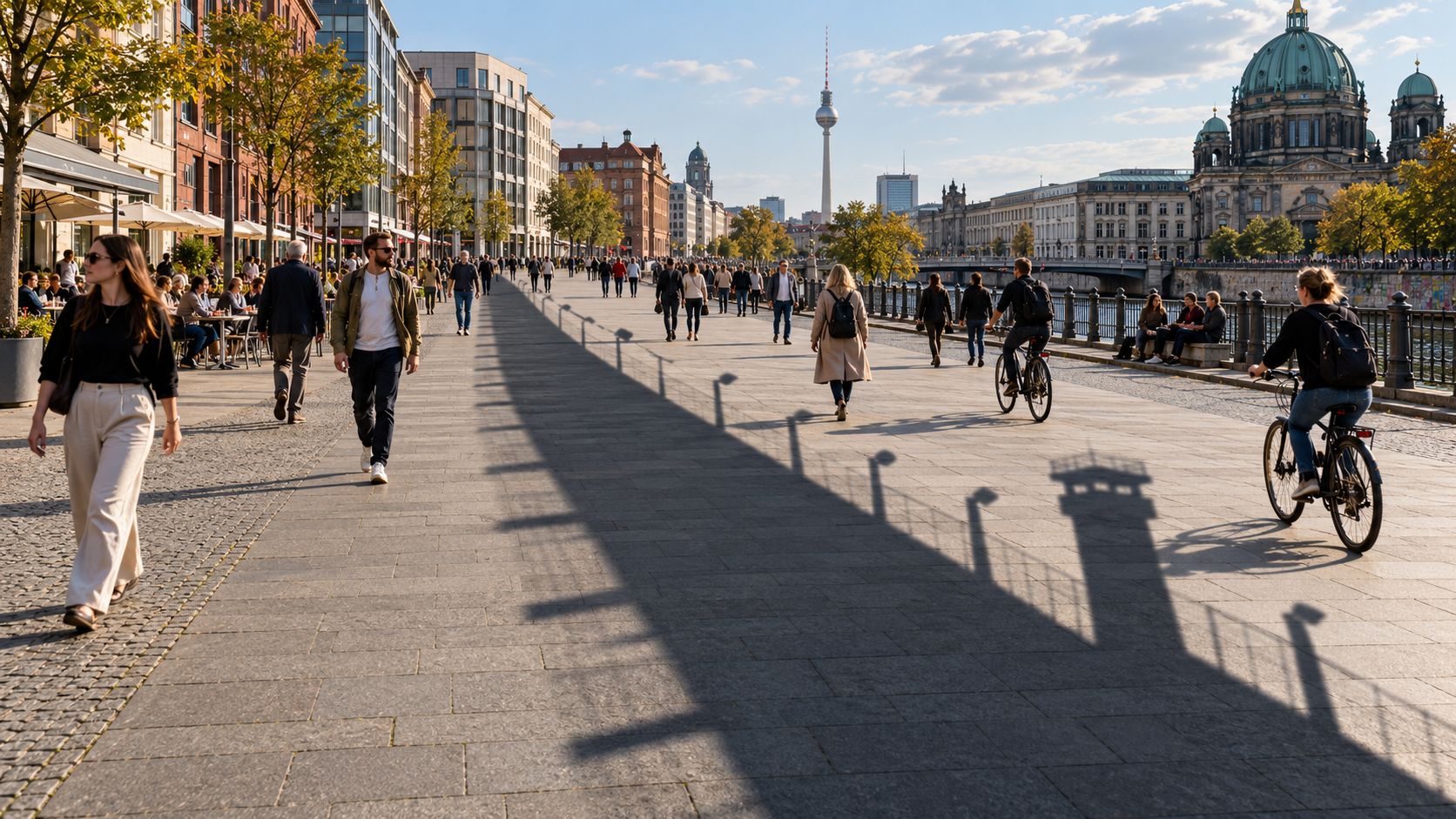
Germany reunited in 1990, but a shared constitution did not erase different experiences of religion, work, authority, and belonging. Those differences still appear in family life, regional identities, and election results. Yet their history reaches further back than the Berlin Wall.
In the 2025 federal election, the Alternative for Germany, or AfD, won 38.6% of second votes in Thuringia. Its share reached 37.3% in Saxony, compared with 20.8% nationwide. These party-list votes provide a clear example of the electoral divide. However, they do not explain its origins. [1–3]
The explanation involves several historical layers. Religious divisions shaped local communities centuries before German unification. Industrialization created competing political traditions. Nazi rule devastated independent institutions, while the Cold War established two very different states. Reunification then transformed eastern livelihoods and redistributed economic power.
None of these developments produced a uniform eastern or western personality. Instead, they changed the environments in which people formed expectations, built relationships, and judged political promises. Understanding those environments makes the electoral map more intelligible without turning geography into destiny.
Before the wall, there were many German worlds
For centuries, German-speaking Europe consisted of overlapping kingdoms, principalities, bishoprics, and self-governing cities. People lived under different laws and rulers. Local institutions mattered long before a German national government could claim their loyalty.
The Reformation added another powerful boundary. The Peace of Augsburg in 1555 gave territorial rulers a central role in determining religious affiliation. Later settlements modified that arrangement, but the broader result endured: neighboring territories could develop different religious institutions and public cultures. [4]
Religion influenced much more than worship. It shaped education, communal rituals, charitable activity, and the relationship between local authorities and residents. Over generations, these institutions helped make regional identities durable. Political culture developed through repeated social experience, rather than through theology alone. [5]
However, this religious map was never a simple division between East and West. Protestant regions also covered much of northern and western Germany. Catholic communities survived within territories that later became eastern Germany. Any account that draws a straight line from Martin Luther to today’s AfD skips centuries of upheaval.
How religion became a political community
After national unification in 1871, the German Empire united populations with competing loyalties. Prussia dominated the new state, but neither Catholics nor socialists automatically identified with its political order. National unity did not dissolve religious and class divisions. [6]
The Catholic Centre Party offered a political home to many Catholics. During Bismarck’s Kulturkampf, government attempts to restrict Catholic influence helped strengthen solidarity within that community. Pressure from above could reinforce attachment to a party that promised protection. [7]
This offers an important mechanism for understanding lasting voting patterns. Political choices can become embedded in organizations, friendships, and family traditions. A voter may support a party partly because trusted people and institutions repeatedly present it as a defender of their community.
Such loyalties require organizations that reproduce them. They do not pass unchanged through the centuries. When churches lose members or associations disappear, the social foundations of established parties can weaken as well.
Factories created another political Germany
Industrialization introduced a different source of solidarity. Workers developed collective interests around wages, working conditions, and political representation. German social democracy emerged as an independent political force during the nineteenth century, rather than remaining within bourgeois liberalism. [8]
Saxony provides a useful corrective to today’s stereotypes. It had a powerful socialist tradition long before it became associated with strong AfD results. Its industrial communities belonged to the history of organized labor and social democracy. The region did not possess a permanently right-wing political character. [9]
Meanwhile, Bismarck’s anti-socialist legislation targeted organizations, meetings, and publications. Yet social democrats continued to contest elections. Repression did not eliminate their support; it helped create a political community defined partly by exclusion from the existing order. [7]
The older German landscape therefore contained several overlapping divisions: Catholic and Protestant, industrial and agricultural, urban and rural. These mattered alongside differences between territories and ruling institutions. Today’s East–West boundary cuts across that more complicated history.
Two states taught different political lessons
Nazi dictatorship destroyed democratic competition and independent political organization throughout Germany. The war, genocide, population displacement, and occupation then transformed the country again. Cultural history cannot treat these events as a brief interruption between two comparable electoral maps.
Researchers Sascha Becker, Lukas Mergele, and Ludger Woessmann have challenged the idea that Germany’s division created a perfectly controlled experiment. They found socioeconomic differences across the later border in prewar data. They also emphasized unequal wartime experiences and selective migration before the Berlin Wall. [10]
Their argument has two consequences. First, historians should not attribute every later difference to communism. Second, earlier differences do not establish a timeless eastern mentality. War, migration, and institutional change altered both populations and their circumstances.
The boundaries themselves also demand care. The former GDR does not represent every territory historically described as eastern Germany. Nor do Prussian history and the GDR share identical borders. Loose geographical labels can create an illusion of continuity where the historical populations and institutions changed substantially.
After 1945, the western occupation zones developed competitive political institutions. In the Soviet zone, communist leaders progressively removed meaningful competition. The forced merger of the SPD and KPD in 1946 created the Socialist Unity Party, or SED. Other parties continued to exist, but their presence did not make the later GDR a pluralist democracy. [11]
This distinction mattered for older working-class traditions. The GDR claimed socialist legitimacy while preventing an independent social democratic alternative. Therefore, the existence of a communist state did not simply preserve the earlier diversity of socialist political life.
West Germans could replace governments through competitive elections and participate in organizations independent of the ruling party. East Germans encountered a system in which political authorities controlled far more of public life. These arrangements created different opportunities to practice negotiation, opposition, and accountability.
Neither population responded uniformly. Some people supported their system, others accommodated it, and others resisted. Nevertheless, repeated encounters with institutions offered different lessons about whether public participation could influence decisions.
Western liberalization developed through conflict
Postwar West Germany did not begin as a fully liberal society in the contemporary cultural sense. Its democratic institutions developed alongside conservative social expectations and unresolved conflicts over the Nazi past. Later changes emerged through argument and political struggle.
During the 1960s, public debate over authoritarianism and National Socialism became increasingly contentious. Students and other critics challenged established institutions and older generations. In the GDR, the ruling party’s official antifascism constrained a similarly open confrontation with the past. [12]
These differences affected the language of dissent. Western critics could campaign against particular institutions within a competitive political system. Eastern critics faced a party that claimed to embody historical progress and treated organized challenges as threats to its authority.
However, western democracy did not remove racism or authoritarian attitudes. Nor did official eastern antifascism eliminate them. The relevant distinction concerns the institutions available for confronting such attitudes, and the forms that public conflict could take.
Secularism became ordinary in the East
Religion offers one of the clearest historical contrasts. According to a synthesis published by Germany’s Federal Agency for Civic Education, almost 85% of West Germans still belonged to one of the two major churches in 1989. In the GDR, almost 70% had no religious affiliation. These are historical figures, not present-day membership rates. [13]
The GDR’s pressure on religious institutions contributed to a wider cultural transformation. Nonreligious family life became normal across generations. When parents stopped transmitting religious practices, the absence of religion acquired continuity of its own.
Consequently, the end of communist rule did not automatically restore earlier religious participation. Legal freedom could remove restrictions on churches, but it could not instantly recreate family habits or community attachments. Institutional histories continued through everyday life. [13]
The political implications resist easy labels. Secularism does not guarantee liberal attitudes on immigration, national identity, or authority. Equally, religious membership does not determine every political preference. These are separate dimensions of belief, even when parties bundle them together.
Women and family life challenge the usual stereotypes
The East–West comparison looks different when the subject shifts to mothers and paid employment. The GDR promoted women’s participation in the workforce and developed extensive childcare provision. West Germany retained a stronger tradition of the male breadwinner and the mother responsible for domestic life. [14]
In 1991, 74% of eastern respondents, compared with 43% of western respondents, held the view that mothers’ employment did not harm their children. Later surveys showed substantial convergence, especially as western attitudes changed. These findings complicate any picture of an uniformly progressive West and conservative East. [14]
Employment did not bring complete equality. Women continued to carry much of the unpaid domestic workload on both sides. Nevertheless, eastern experience made combining motherhood and employment more socially ordinary. Childcare institutions helped sustain that expectation after reunification. [15]
This illustrates how political outlooks can combine positions that commentators often separate. Someone may support working mothers and public childcare while holding restrictive views on immigration. A single liberal–conservative scale can conceal that combination.
Immigration created different everyday experiences
West Germany’s economic expansion brought organized labor recruitment from abroad. Agreements included Italy in 1955 and Turkey in 1961. Over time, settlement and family formation made immigration an enduring part of many western workplaces and neighborhoods. [16]
The GDR also recruited foreign workers, including people from Vietnam and Mozambique. However, its contract-labor arrangements often involved tightly regulated accommodation and limited prospects for permanent settlement. Official international solidarity did not necessarily mean equal participation in everyday social life. [17]
These histories created different settings for later arguments over immigration. They do not prove that greater contact always produces tolerance. Western Germany has its own history of exclusion, while eastern communities contain many people committed to welcoming newcomers.
Moreover, attitudes depend on how people interpret change. National news, political campaigns, and expectations about the future can matter alongside direct contact. A community’s migrant population alone cannot explain its election result.
Eastern Germans also made a democratic revolution
Accounts centered exclusively on obedience overlook the courage of 1989. Eastern demonstrators challenged a dictatorship whose capacity for repression remained real. Their protests helped destroy the political order under which they had lived. [18]
Churches played a role that their declining membership might otherwise obscure. They offered space for peace groups, environmental activism, discussion, and cultural expression. In several cities, these protected spaces helped opposition networks develop. [19]
This history belongs alongside surveillance and conformity. The same society contained people who accommodated power and people who risked their freedom to confront it. Neither can stand for the entire population.
The legacy also makes claims to represent the people politically potent. However, invoking 1989 does not establish that a contemporary movement shares its democratic purposes. The historical achievement involved opening political competition, not granting one organization permanent ownership of popular legitimacy.
Reunification brought freedom and profound disruption
The first free Volkskammer election in March 1990 demonstrates how strongly many eastern voters embraced rapid change. The conservative Alliance for Germany won about 48% of the vote. An electorate supposedly destined to reject western institutions initially gave substantial support to politicians promising reunification. [20]
Yet political freedom arrived alongside an economic transformation of extraordinary speed. The Treuhand agency oversaw the restructuring and privatization of state-owned enterprises. Job losses, closures, and uncertainty disrupted communities organized around industrial employment. [21]
There was no single cause. The inherited economy had serious weaknesses. Currency conversion, collapsing trading relationships, market competition, and privatization decisions shaped the transition together. Reducing the outcome either to inevitable failure or deliberate western destruction obscures that interaction. [21]
For affected households, the consequences extended beyond income. Losing a job could also mean losing colleagues, status, routines, and confidence in professional skills. A political system could deliver new freedoms while its arrival coincided with deeply destabilizing personal experiences.
Unequal recognition became part of regional identity
Reunification incorporated eastern Germany into the Federal Republic’s existing institutional framework. Western officials and professionals played a major role in the transformation. Research on elite recruitment documents substantial eastern underrepresentation in several powerful sectors during the following decades. [22]
This history helps explain why improved infrastructure cannot answer every grievance. People may welcome better housing and greater prosperity while questioning who owns businesses or makes consequential decisions. Material improvement and equal influence are different things.
Regional identity can also become stronger when outsiders continually assign it significance. A person described as eastern in workplaces, media debates, or political arguments may become more conscious of that identity. Feeling misrepresented can matter even to someone who has prospered economically.
However, resentment does not mechanically produce a particular vote. People can respond through democratic campaigning, withdrawal, left-wing opposition, or nationalist politics. Parties compete to define both the grievance and the appropriate response.
Migration changed the communities that remained
Population movement complicates comparisons further. People do not relocate at random. Opportunities, education, family responsibilities, and personal preferences influence who leaves and who stays. Over time, migration can change the composition of a region as well as its population size.
A large study of regional personality found differences between eastern Germans who moved west and those who remained. Movers scored higher, on average, in openness, extraversion, conscientiousness, and emotional stability. The authors treated selective migration as a possible contributor to regional personality patterns. [23]
That finding does not demonstrate that moving caused those traits. Nor does it establish anything about an individual’s worth. It shows why regional averages cannot simply measure the effect of a political system on an unchanged population.
The wider political implications require similar care. Departure may alter local networks, but a shrinking town does not possess one political response. Decisions by employers, public authorities, associations, and parties can still influence its future.
What personality research actually finds
Psychologists have examined these differences using the Big Five: openness, conscientiousness, extraversion, agreeableness, and neuroticism. This framework emerged through factor-analytic research. Researchers typically measure the traits with questionnaires, rather than conducting a fresh factor analysis for every geographical comparison. [24]
A study covering 73,756 participants across 97 German regions found relatively small regional effects. Its eastern participants were, on average, less extraverted, less open to experience, and higher in neuroticism. The latter describes a tendency toward negative emotions; it is not a psychiatric diagnosis. The online sample also warrants caution about representativeness. [23,25]
A separate 2015 working paper using German Socio-Economic Panel data reported higher conscientiousness and neuroticism among former GDR residents. It also found lower openness and a lower internal locus of control. That final measure concerns how strongly people attribute outcomes to their own actions rather than external circumstances. [26]
These results do not establish two distinct personality types. Individuals overlap substantially, and findings depend on samples, measures, and statistical choices. Furthermore, a 2025 study of 1,897 eastern and 5,051 western Germans found mostly similarities in the networks connecting personality traits. That examines a different question from average trait levels. [27]
Personality research can enrich the article’s explanation, but it cannot substitute for electoral evidence. A regional correlation between a trait and voting does not establish an individual psychological cause. Researchers must test those relationships directly and account for competing explanations.
Eastern voters have repeatedly changed direction
Eastern Germany’s political history since 1990 contradicts the idea of an electorate permanently attached to one extreme. Alongside early Christian Democratic success, the SPD won close to 40% of eastern second votes in the 2002 federal election. The Left Party reached 28.5% in the East in 2009. [28]
These were different responses to changing circumstances. Parties offered different combinations of economic protection, political leadership, regional representation, and opposition. Support shifted as voters reassessed those offers.
Research on party identification also documents weaker attachments in the East than in the West across much of the post-unification period. Weaker inherited loyalties can give challengers more opportunities, although new loyalties can subsequently become established. [29]
However, aggregate results cannot trace individual journeys. A decline for the Left and a rise for the AfD do not mean every lost left-wing voter became a far-right voter. Changes in turnout, generational replacement, and movement between several parties all contribute.
Why the AfD benefits from the divide
The AfD connects opposition to immigration with attacks on established political leadership. Its development from a party focused on the euro toward nationalist and anti-immigration politics expanded the cultural conflicts it could mobilize. Research describes its presentation of itself as a defender of local culture, particularly in eastern Germany. [30]
This message can combine several grievances: distrust of decision-makers, anxiety about change, and a belief that established parties neglect one’s community. The party offers a story about who belongs, who holds power, and who deserves blame.
Economic and cultural concerns can reinforce each other. An analysis of survey research found immigration and social justice frequently appearing together among AfD voters’ leading concerns. That finding challenges explanations that insist voters must care either about economics or about identity. [31]
Nevertheless, describing all support as protest would also mislead. Voters can agree with a party’s substantive positions. Understanding discontent does not remove the need to examine exclusionary beliefs, policy preferences, and political responsibility.
The historical interpretation is therefore conditional. Weaker party loyalties can create an opening; experiences of upheaval can supply grievances; nationalist campaigning can give those grievances a target. This combination offers an explanation to investigate, rather than a formula that predicts every eastern voter.
The divide runs through regions as well as between them
The personality research itself reveals the limits of a two-part map. Leipzig and Dresden appeared among the places with comparatively high openness, alongside western metropolitan areas. Local environments can differ markedly from their surrounding regions. [23]
Religion, employment, age, education, and urbanization cross the former border in different ways. A university community and an industrial town need not share the same political culture simply because both lie in Saxony. Likewise, western Germany contains conservative rural districts and struggling industrial communities.
For this reason, an East–West comparison should ask two questions. How much do the populations differ in composition? And what differences remain when researchers compare people with similar circumstances? Confusing those questions can turn a demographic pattern into an unsupported claim about mentality.
Germany’s cultural differences developed through institutions that organized ordinary life. Churches sustained communities, factories created solidarities, dictatorships restricted participation, and families passed on expectations. Reunification then changed the value of skills, the ownership of workplaces, and the distribution of influence.
These histories help explain why identical political messages can carry different meanings. A promise of protection may evoke security for one voter and interference for another. An appeal to national pride may suggest belonging, exclusion, or danger, depending on the listener’s experience and convictions.
Yet the history also records repeated change. Saxony’s socialist traditions, eastern support for reunification, and later shifts among competing parties resist any claim of a fixed regional destiny. Cultural differences influence the choices available to people; they do not relieve people or political leaders of responsibility for the choices they make.
Sources
Historical statistics retain their original dates. The electoral comparison uses the 2025 federal election, not an estimate of voting intentions in September 2026.
1. Federal Returning Officer: Thuringia, 2025 federal election.
2. Federal Returning Officer: Saxony, 2025 federal election.
3. Federal Returning Officer: Germany, 2025 federal election.
4. bpb: The religious peace of 1555.
5. bpb: Confession and territorial politics.
6. bpb: External and internal foundation of the German Empire.
7. bpb: Politics in the Bismarck era.
8. bpb: The German Empire as a nation-state.
9. bpb: Social democracy between exceptional laws and social reforms.
10. Becker, Mergele, and Woessmann: Rethinking Germany as a natural experiment, 2020.
11. bpb: Formation and development of the Soviet-zone/GDR party system.
12. bpb: Between reform and revolt, 1961–1969.
13. bpb: Church affiliation and religiosity in East and West.
14. bpb: Changing gender roles and family ideals.
15. bpb: Childcare and child-rearing in East and West.
16. bpb: History of migration to and from Germany.
17. bpb: Women contract workers in the GDR.
18. bpb: Peaceful revolution and German unity, 1989–1990.
19. bpb: Churches as spaces of freedom in the GDR.
20. bpb: The first and last free Volkskammer election.
21. bpb: The Treuhand and economic transformation.
22. bpb: Eastern Germans in elites after unification.
23. University of Jena: The psychological map of Germany, research summary, 2018.
24. SOEP: Big Five measurement documentation.
26. Friehe, Pannenberg, and Wedow: Socialist regimes and personalities in Germany, working paper, 2015.
27. Kura and Rentzsch: Context effects on the personality network, 2025.
28. bpb: Voting behavior in East and West over time.
29. bpb: Party identification.
Leave a Reply