
I don’t believe conspiracy theories about 9/11, even though the establishment clearly benefited from this tragedy by the unprecedented restriction of civic freedoms whose lasting effects we still see today
We all know the US establishment is something evil – denies people health care, didn’t mind hook them on opioids and caused 500,000 people died, human experiments and so on.
US atrocities in a nutshell
I wrote this article because I could no longer tolerate the sanitized version of U.S. history fed to the world through schoolbooks, media, and polished speeches. Behind the image of democracy and human rights lies an empire built on pain, coercion, and deception. I started with something few dare to explore in detail—unethical human experimentation. This was not fringe science—it was institutionalized horror.
The U.S. government infected Guatemalans with syphilis, denied treatment to Black men in Tuskegee, tortured minds with LSD in MKUltra, and infected disabled children with hepatitis at Willowbrook. Children were psychologically broken in the Monster Study. Poor women were given experimental birth control without consent. Prisoners were used like disposable lab animals, injected with radiation or doused with dioxin. Even conscientious objectors, often religious, were turned into biological warfare test subjects. These were not accidents. These were policy decisions made in boardrooms, universities, and federal labs. What they all shared was one thing: disregard for human dignity—especially if the humans were poor, colored, voiceless, or vulnerable.
Native American massacres
But I did not stop there. I also showed that American cruelty has always extended far beyond its borders. The U.S. committed genocide against Native Americans, not just by wiping them out in massacres like Sand Creek or Wounded Knee, but by stealing their land, erasing their culture, and forcing children into abusive assimilation schools. Then came Latin America. With CIA black sites and training programs like the School of the Americas, the U.S. exported torture on an industrial scale—arming regimes that raped, disappeared, and executed thousands. After 9/11, this cruelty reached new heights.
Secret prisons appeared across the globe. The CIA kidnapped suspects, tortured them, and buried their stories in classified files. Sleep deprivation. Waterboarding. Coffin-like boxes. All while Washington called it “freedom.” Meanwhile, drone strikes in the Middle East turned weddings into bloodbaths. Civilians died by metadata. Journalists were labeled collateral damage. Millions were displaced. Four and a half million people died—either directly or indirectly—because of the so-called War on Terror. And those who dared expose it, like Snowden or Assange, faced exile, black sites, or slow death in solitary confinement.
The criminal War on Drugs
Yet none of this is fully over. The War on Drugs still destroys Latin America. The same banks that funded both sides in World War I now launder cartel money while presidents look away. American elites pushed us into Vietnam for power, into Iraq for oil, and into endless surveillance for control. The military-industrial complex thrives on death, and the media plays along.
All of this, I wrote, not as some academic lecture—but as a citizen shouting against the tide of lies. These atrocities—slavery, genocide, torture, medical abuse, economic warfare—are not history. They are the operating system. They are happening right now, often in silence, often in shadows. I wrote this because if we do not expose it, if we do not resist it, we will remain slaves to a system that feeds on human suffering and calls it security. I wrote it not to be liked, but because it is true.
Deaths due to lack of health care
Tens of thousands of Americans die every year not because they are sick, but because they are poor or uninsured. That is the tragic truth behind the country’s fragmented, market-driven healthcare system.
According to a 2009 study published in the American Journal of Public Health, around 45,000 people die each year in the U.S. simply because they do not have health insurance. That means one person every 12 minutes. These are not obscure, speculative numbers. This is preventable death, in one of the richest countries on Earth. And the numbers have stayed consistent.
Other reports estimate between 35,000 and 44,000 deaths annually—working adults, students, unemployed, people with chronic conditions—all dying due to a lack of affordable access. And in recent years, some estimates have gone even higher. According to a 2023 fact sheet from Senator Bernie Sanders, the figure may now be closer to 68,000. All because they could not afford basic medical care. Not cancer treatments. Just regular, life-saving checkups and medications.
This is not a tragedy of biology. It is a failure of policy. In every country with universal healthcare, such deaths are close to zero. In the United States, the health of your wallet still determines whether you live or die. Lack of access to treatment, delay of diagnosis, unaffordable medications—these kill more people than most diseases themselves.
And it is not just about the poor. Even the middle class live in fear of falling sick. Medical bankruptcy is one of the top causes of personal bankruptcy in America. Behind the statistics are lives cut short, families broken, and a system that was designed—intentionally—not to treat everyone, but only those who can pay.
Russians couldn’t care less about human life, could Americans?
The Sackler family’s Purdue Pharma played a central role in igniting the U.S. opioid epidemic through the aggressive marketing of OxyContin. By minimizing the drug’s addictive potential and promoting its widespread use, Purdue contributed to a surge in opioid prescriptions and subsequent misuse. Over the past two decades, this crisis has led to more than 450,000 deaths in the United States. In 2022 alone, opioid-related overdoses claimed approximately 82,000 lives, accounting for about 76% of all drug overdose deaths that year.
In response to mounting lawsuits, the Sackler family and Purdue Pharma agreed in 2025 to a $7.4 billion settlement, with the Sacklers contributing up to $6.5 billion over 15 years. This settlement, one of the largest of its kind, aims to fund opioid addiction treatment, prevention, and recovery programs across the country. Despite these efforts, the opioid crisis remains a significant public health challenge, with overdose deaths continuing to impact communities nationwide.
The conspiracies are crazy
I have read the 9/11 conspiracy theories. All of them. From the idea that the Twin Towers were brought down by explosives to the claim that no plane hit the Pentagon. At first glance, many of these theories seem compelling. They point to real anomalies, they use technical-sounding language. They question authority, which is always healthy in a democracy. But once we examine the evidence closely—once we apply physics, chemistry, engineering, and common sense—the narrative collapses. It is not the government’s story that breaks down under scrutiny. It is the conspiracies.
Let us begin with the central claim: that the Twin Towers were brought down not by planes, but by pre-planted explosives. This theory became popular because of the way the buildings fell. The collapse looked too symmetrical, too smooth, almost like a controlled demolition. Videos of demolitions were compared to the collapse of the World Trade Center, and indeed, the visual similarities sparked suspicion. But what the videos do not show are the internal mechanisms of destruction.
Real demolitions use months of planning, timed charges on key structural points, and a clear upward-to-downward chain reaction. The Towers fell from the top down. The collapses began exactly where the planes hit—floor by floor—because the intense jet fuel fires weakened the steel trusses that held each floor in place. These trusses sagged, bent, and finally snapped, pulling the outer columns inward. When the top of the building began to fall, its mass triggered a chain reaction—floor crushing floor. The momentum became unstoppable.
Questioning the facts
Now comes the objection: steel does not melt at the temperatures jet fuel burns. That is true. But this point misses the mark. Steel does not need to melt to fail. It loses about 50% of its strength at 600°C and over 90% at 1000°C. Jet fuel can easily reach temperatures between 980 and 1100°C in open-air combustion, especially with extra material like carpets, paper, furniture, and oxygen-rich airflow. The National Institute of Standards and Technology (NIST) conducted extensive tests and found that steel beams exposed to those temperatures would sag, buckle, and collapse—exactly what happened. The floors pancaked, and the perimeter columns gave in. No explosives were necessary. The theory sounds elegant, but it is based on a false requirement: that only molten steel can bring a building down.
Let us turn to World Trade Center 7. This building was not hit by a plane, and it collapsed later that day, which led many to cry foul. “It looked like a demolition!” they say. But the facts show otherwise. WTC 7 was severely damaged by debris from the collapse of the North Tower. Fires broke out on multiple floors and burned uncontrolled for seven hours. The sprinkler system failed because the main water line was destroyed when the towers fell. The building was already compromised structurally. What many do not know is that WTC 7 had an unusual design: it was built over a massive Con Edison power substation with trusses transferring loads. When the fires weakened these transfer trusses, the entire structure became vulnerable. NIST concluded after years of modeling that a single column failure (Column 79) initiated a progressive collapse. Not symmetrical. Not mysterious. Just tragic physics.
Pentagon destruction
Next comes the theory about the Pentagon. Some claim a missile hit it. Others say no plane wreckage was found. But again, these claims rely on partial evidence. Hundreds of eyewitnesses saw a plane—American Airlines Flight 77—fly low over the city and crash into the building. They described the sound, the shape, even the colors of the aircraft. Surveillance footage, though limited, shows the impact. Plane wreckage, bodies, and black boxes were recovered and identified. The plane hit at an angle, burrowed through three rings of the Pentagon, and was largely destroyed by the impact and explosion.
The wings shattered. The tail disintegrated. But fragments of engines, fuselage, and landing gear were found both outside and inside the building. The reason people think the hole was too small is because they are looking at the exit hole—not the entry point. The idea that a missile hit the Pentagon would require an invisible plane to disappear, fake debris to be planted, and hundreds of eyewitnesses to be either lying or manipulated. That is not skepticism. That is delusion.
Passangers missing
Another theory involves the passengers. “Where are they?” conspiracy theorists ask. The answer is simple and tragic. They died. Their families buried them. DNA was recovered. Calls were made from the planes. Air traffic controllers tracked them. People spoke to their loved ones during the hijackings. These calls were recorded. Some were left on voicemails. There is no logical way to fake hundreds of grieving families, thousands of eyewitness accounts, multiple black box recordings, and air traffic data—all at once and without a single leak in over 20 years. If that had happened, it would be the most successful conspiracy in human history. But it did not. It would require perfect silence from thousands of people—technicians, pilots, recovery workers, families, firefighters, intelligence agents—all keeping the biggest secret in American history. That is not how human beings work.
9/11: A reason to start a war
And then there is the claim that the U.S. government orchestrated 9/11 to start wars. It is true that the Bush administration used the attacks to justify the invasion of Afghanistan and later Iraq. It is also true that some individuals and corporations profited from the chaos. But the fact that power elites exploited a tragedy does not mean they created it. Opportunism is not the same as orchestration. Historically, all empires have used crises to expand influence. That does not mean every crisis was manufactured. To leap from “they benefited” to “they did it” is to replace evidence with suspicion. Yes, the U.S. made tragic and immoral decisions after 9/11. But we cannot let disgust with the aftermath distort our view of the event itself.
Conspiracy went wrong
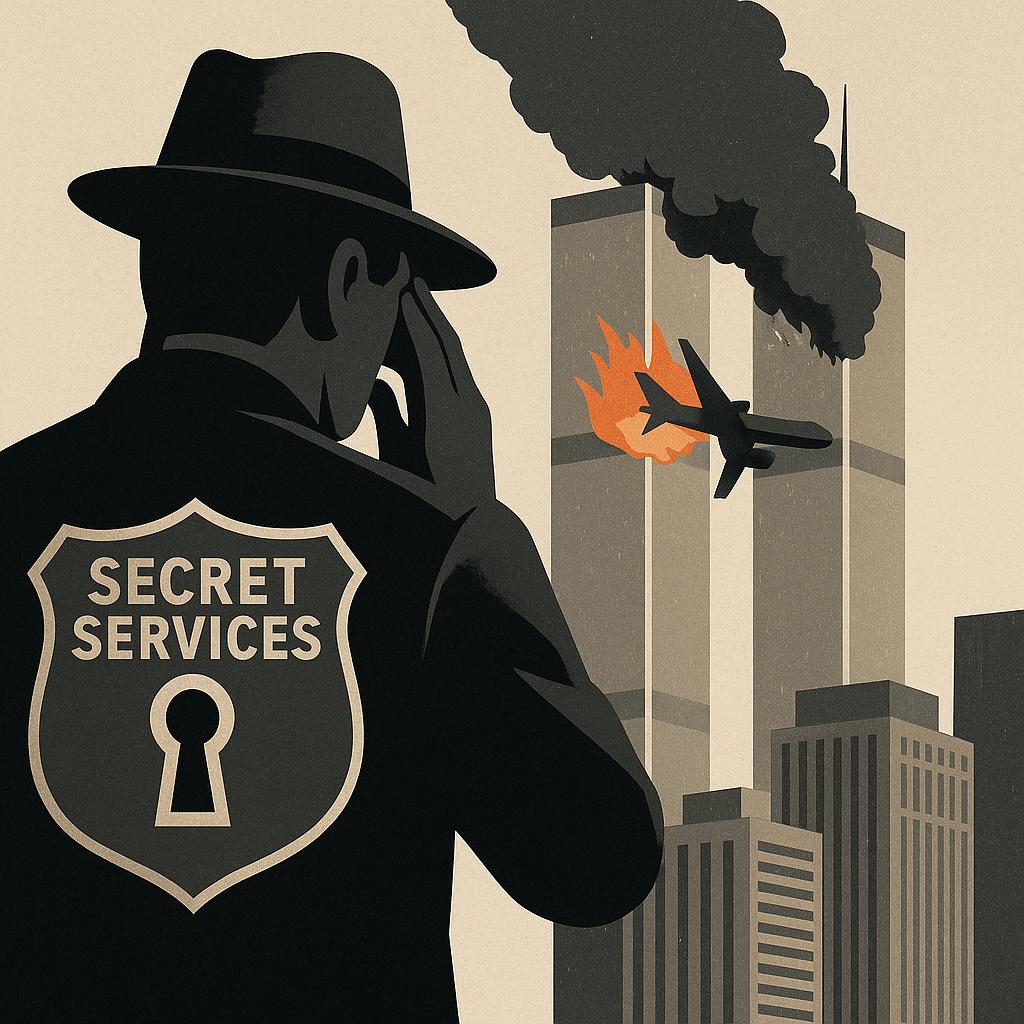
Finally, the real danger of 9/11 conspiracy theories is not just that they are wrong. It is that they distract us from what really happened. The U.S. failed to act on intelligence. The intelligence community was fragmented. Multiple warnings were ignored. Airport security was lax. These were real, devastating failures. But instead of demanding reforms or accountability, conspiracy theorists turned public attention to fantasy. And fantasy lets the guilty go unpunished. It comforts us with the illusion that evil is always planned, rather than the more terrifying truth: that we were vulnerable, disorganized, and human.
I understand the impulse. In a world full of lies, suspicion feels safer than trust. But we must resist the temptation to turn tragedy into mythology. 9/11 was a real event. It was carried out by 19 men who hijacked four planes, armed with box cutters and a plan. They did it in broad daylight. And they succeeded, not because the government helped them, but because the system was too blind, too arrogant, and too slow to stop them. That is the truth. And it is horrible enough.
Did secret services intentionally overlook it? They had some of the knowledge, they let it happen
The 9/11 attacks were not just a tragedy. They were a monumental intelligence failure. But calling it a failure is too soft. Too clean. In truth, the system did not just collapse. It refused to function, it dismissed warnings. It ignored patterns. And in some cases, it actively blocked people from connecting the dots. What happened before 9/11 was not a lack of data. It was a lack of institutional honesty, trust, and coordination. And yes—some negligence might have been deliberate.
In the years leading up to 2001, the CIA, NSA, and FBI collected piles of data. Surveillance programs were already monitoring Al-Qaeda. They knew Osama bin Laden had declared war on the United States. And they intercepted communications. They tracked individuals. They watched financial transactions. In fact, in 1995, the Philippines had already warned the U.S. of a terror plot to hijack planes and crash them into American targets—called “Project Bojinka.” That information sat unused. Years later, CIA officers tracked two known Al-Qaeda operatives—Nawaf al-Hazmi and Khalid al-Mihdhar—as they entered the United States. They knew these men had attended a terror summit in Malaysia. But despite this knowledge, the CIA never told the FBI. Why? They claimed it was to protect “sources and methods.” But what it really protected was institutional ego and inter-agency secrecy.
9/11: This is exactly what the establishment wanted
And it gets worse. In August 2001, just a month before the attacks, the CIA briefed President George W. Bush with the now-infamous memo: “Bin Laden Determined to Strike in U.S.” The memo clearly stated that operatives might hijack planes. It even warned of activity in New York. Yet it was brushed aside as vague. Bush went on vacation. Intelligence chiefs downplayed the risk. No urgent inter-agency meetings followed. Nothing was mobilized. No airlines were warned. No special alerts were issued. And when FBI field agents noticed strange behavior—like Middle Eastern men attending flight schools and asking to learn how to steer but not land—they sent memos. Those memos were buried or ignored.
So why did this happen? Part of the answer is incompetence. Bureaucracies are slow, turf-driven, and allergic to collaboration. The CIA did not trust the FBI. The FBI distrusted the NSA. All of them protected their own domains. They did not share intelligence because they feared losing influence. But the other part—the darker part—is that the United States had spent decades building an intelligence machine designed not to stop lone actors, but to monitor governments, military installations, and Cold War enemies. Bin Laden operated from caves, using satellite phones and couriers. The system was never designed to catch him. And when it came to reform, no one wanted to admit this publicly.
The possible intention?
Moreover, the idea of 19 men with box cutters taking down the financial and military heart of the country simply did not fit the mental model of American intelligence elites. They expected threats to look like tanks, missiles, or troop movements—not suicidal men on domestic flights. There was arrogance. And that arrogance made the warnings sound unbelievable. Even after the embassies were bombed in Kenya and Tanzania in 1998—even after the USS Cole attack in 2000—no one internalized the threat. It was not because they lacked data. It was because they lacked imagination. And worse, they feared political consequences if they acted too loudly and were wrong.
And then there is another possibility—one too uncomfortable for mainstream history. What if some actors inside the system intentionally let it happen? Not because they supported Al-Qaeda. Not because they wanted to kill Americans. But because they knew that only a catastrophe would allow the political establishment to expand the surveillance state, justify foreign wars, and consolidate executive power. After all, look at what happened after 9/11: the Patriot Act passed within weeks, giving sweeping surveillance powers. Wars in Afghanistan and Iraq were launched. Defense budgets exploded. Intelligence agencies gained new tools, new money, and almost no oversight.
9/11? It had happened before
This idea is not fantasy. It is institutional behavior. Governments have a long history of exploiting crises. From Pearl Harbor to the Gulf of Tonkin, events have often been used—or manipulated—to produce political momentum. Letting something happen on purpose is not the same as orchestrating it. But in both cases, the cost is human life. And the reward is institutional growth.
In the aftermath of 9/11, no one was held accountable. No CIA officer was fired. No NSA chief was demoted. The FBI blamed others. The White House buried documents. The media focused on retaliation, not introspection. And the victims’ families—those who asked questions—were dismissed as unpatriotic. The intelligence agencies were rewarded for failure. They were given more funding, more authority, and more freedom to operate in the shadows. That alone should make us skeptical of the official narrative.
So what do we call this? Not a conspiracy. Not an accident. But a case of willful blindness and strategic negligence. The truth is not that the U.S. government “did 9/11.” The truth is that those in power saw the signs, had the warnings, noticed the patterns—and chose to look away. Whether for reasons of cowardice, arrogance, or calculation, the result was the same: thousands died, and the system responsible was rewarded, not punished.
And that, in many ways, is the most damning truth of all.
Secret services intentionally overlook it? My conclusion
In my opinion, 9/11 was a real terrorist attack—deliberate, brutal, and planned by foreign operatives. It was not an inside job. It was not fake. Planes did hit the buildings. People did die. And the attackers were real men with a real ideology. But what made it succeed was not just their will. It was the catastrophic failure of the American intelligence services. The CIA, FBI, and NSA had the tools. They had the data. They even had the names. Yet they failed at every level. Not because they were powerless—but because they were dysfunctional, egocentric, and utterly incapable of working together.
They ignored warnings, they blocked communication. They let personal and institutional rivalries destroy any chance of prevention. And that is what truly haunts me. It was not just a failure—it was an exposure. A revelation that the most powerful intelligence system on Earth was hollow when it mattered most. The attackers exploited this blind spot. And the agencies proved that, despite all their budgets, surveillance, and secrecy, they could not—or would not—act. It was a real terrorist act. But the system made it possible. And that failure remains one of the most shameful chapters in modern history. So, no secret services intentionally overlooked it.
Leave a Reply