The Cold War defined the fate of Europe. Yet, although real history produced NATO, the Warsaw Pact, and a fragile balance of neutral states, this outcome was not inevitable. Instead, the order of the continent was the product of choices, compromises, agreements, and accidents. Alternate-history games explore these uncertainties, offering players the chance to imagine what could have happened if different hands had signed treaties, if different armies had marched, or if different parties had seized power.
Therefore, the Cold War becomes not a single path but a branching tree. In some versions, Europe falls completely under Soviet control. In others, it submits to American leadership more fully than it ever did. There are darker versions, in which Nazi Germany survives and reshapes the continent. In still other timelines, neutrality expands and small nations resist domination. Finally, in the most radical scenarios, strange federations and experiments replace familiar states altogether.
Thus, to understand these alternate orders, it is helpful to move step by step through the major possibilities. Only then can we see how fragile Europe’s fate truly was, and how many futures might have been possible.
The Soviet Order
The first and perhaps most obvious path is a Europe under Moscow’s firm grip. Historically, the USSR carved out the Eastern Bloc, imposing communist governments on East Germany, Poland, Czechoslovakia, Hungary, Romania, and Bulgaria. Yet, in alternate scenarios, this bloc expands much further.
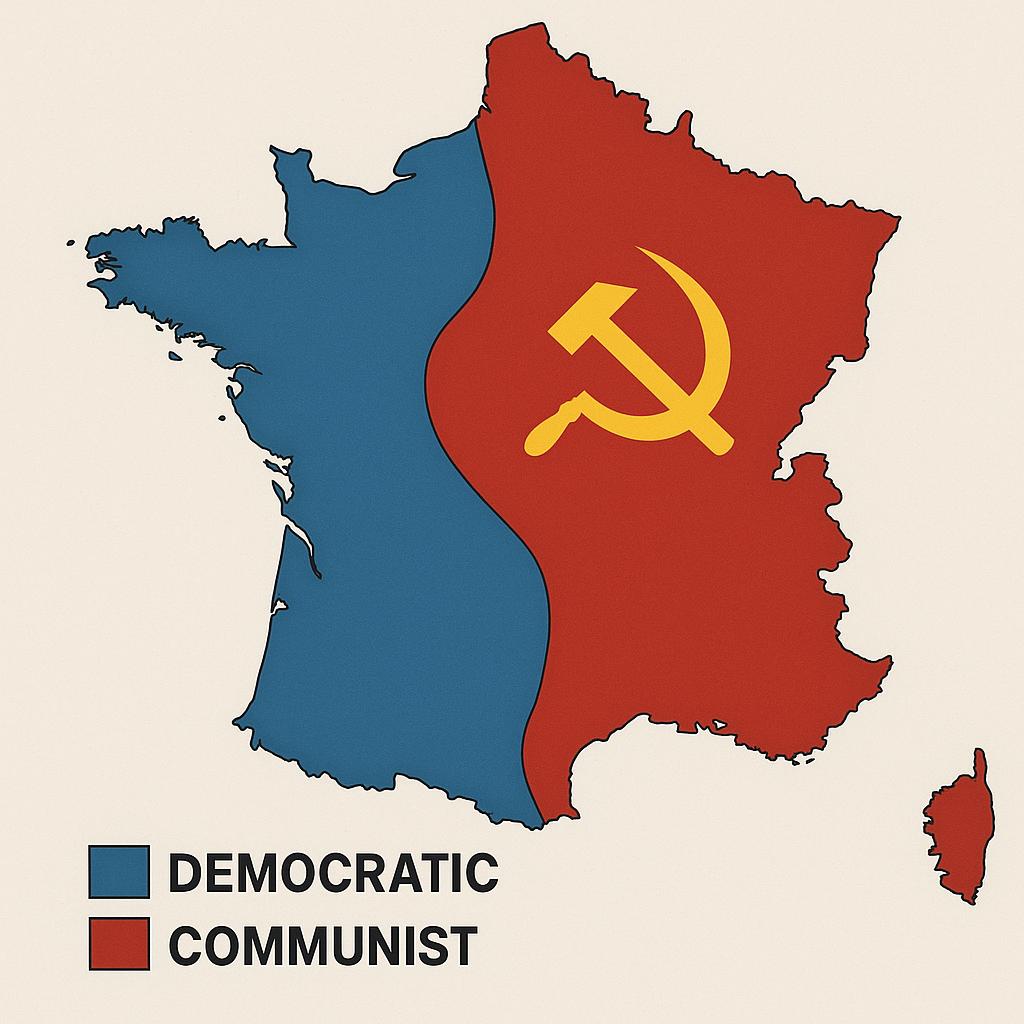
For example, France could fall to a communist revolution. Italy’s powerful Communist Party might ride postwar discontent to electoral victory. Britain, shaken by general strikes, might collapse into revolutionary upheaval. And beyond Europe, Japan might collapse into socialism after the war, creating a Eurasian red bloc stretching from Paris to Tokyo.
Consequently, Europe becomes not merely a divided continent but a single fragment of a massive Eurasian empire. Such a development would have fulfilled the worst nightmares of Washington and London. Instead of a Cold War balanced between two camps, the West would find itself isolated, struggling to defend the Atlantic from a global communist order.
The Western Order
The second path places Europe firmly under American leadership. Historically, NATO served as the backbone of this order. West Germany, France, Britain, and Italy formed its pillars, while the Benelux states and later Spain anchored its flanks. However, alternate scenarios often push this integration even further.
Sometimes France abandons Gaullist independence, aligning fully with Washington. Sometimes Germany reunifies early under Western terms, creating a powerful and prosperous NATO core. Also, sometimes uprisings in Eastern Europe succeed rather than fail, pulling Poland, Hungary, or Czechoslovakia into the Western orbit decades earlier than in reality.
As a result, NATO evolves into more than a military alliance. It becomes a proto-European Union under American oversight. Bases stretch across the continent, while US influence penetrates every government. The balance of power shifts completely, leaving Moscow on the defensive. Europe no longer balances between East and West but becomes an Atlantic empire under American command.
The Nazi Order
The most radical scenarios emerge when Nazi Germany wins the Second World War. If the Reich survives, the European order changes beyond recognition. France is transformed into a Reichskommissariat or reduced to a Vichy-style puppet regime. Belgium and the Netherlands are annexed or placed under German civil governors. Poland and Ukraine become colonies, stripped of resources and population. Britain is defeated and either occupied, partitioned, or forced into collaboration.
In such a world, the Cold War does not disappear. Instead, it takes on a new form: Nazi Germany facing off against the Soviet Union. The United States is pushed out of the continent, unable to project influence. Small states lose all autonomy. The continent is carved into racial empires, where resistance movements are crushed and economies are bled dry.
Therefore, this order is not only radical but also unstable. It rests on conquest and brutality, and its continuation requires endless repression. In these scenarios, Europe becomes a dark battlefield between totalitarian giants.
The neutral and fragmented order
Yet not all alternate orders are defined by domination. Some imagine a fragmented Europe where neutrality prevails. Historically, Austria, Finland, Switzerland, and Yugoslavia already stood outside both NATO and the Warsaw Pact. But in alternate histories, neutrality expands far beyond these few.
France itself, for instance, was considered for partition into zones of occupation, just like Germany. Only de Gaulle’s defiance preserved its unity. Germany and Austria, of course, were actually divided into four zones, and only Austria later returned to neutrality. Poland was literally redrawn at Yalta, losing its eastern Kresy to the USSR while gaining German land in the west. Italy, too, was nearly divided into northern and southern zones during the Allied advance, before the idea was abandoned. And in the Balkans, Churchill and Stalin signed the “percentages agreement,” casually assigning shares of influence over Romania, Bulgaria, Greece, and Yugoslavia. Even Turkey faced Soviet proposals that would have stripped it of eastern provinces and transferred the Straits to joint or international control.
Thus, neutrality and fragmentation often emerged not from revolution but from quiet diplomacy and great-power bargaining. These agreements reveal that Europe might have been carved up on paper, its destiny sealed before its people had a chance to act. Alternate games reflect this by offering paths where neutral belts stretch from Scandinavia through Central Europe to the Balkans, creating a fragile but fascinating buffer between East and West.
Radical experiments
Finally, some scenarios abandon realism altogether and experiment with radical new orders. In mods like The New Order, states collapse and reassemble into unfamiliar shapes. The Balkans form socialist federations. Iberia falls to communism and exports revolution to Latin America. France revives syndicalist communes. Poland creates an Intermarium federation from the Baltic to the Black Sea. Scandinavia unites into a Nordic federation. Even Japan joins a communist Pacific bloc.
Therefore, the continent does not merely shift between blocs. Instead, it reinvents itself entirely, abandoning familiar boundaries and creating political experiments that defy conventional categories. These versions remind us how fragile real history was. A few uprisings, a few coups, or a few bargains might have delivered a Europe that looks utterly alien to us today.
Country-by-country atlas
Because each state had multiple potential fates, it is useful to map them individually. This atlas outlines the main alignments: Western, Soviet, Axis, neutral, division by agreement, and radical experiments.
France
Western: NATO pillar, early EU core, nuclear deterrent, sometimes tighter to Washington.
Soviet: communist revolution, people’s republic, French Red Army divisions stationed in Central Europe.
Axis: Vichy regime entrenched or Reichskommissariat.
Neutral: Gaullist “Europe for Europeans,” or partition into Allied zones by agreement.
Radical: syndicalist communes, French-led European federation.
Germany
Western: West Germany NATO engine, later reunification under Western terms.
Soviet: united people’s Germany under Moscow.
Axis: Großdeutsches Reich, colonies across Europe.
Neutral: permanent four zones, never unified.
Radical: socialist councils, Bavarian autonomy, pan-German confederation.
Austria
Western: Alpine NATO member and EU state.
Soviet: people’s republic carved from Soviet zone.
Axis: Ostmark fully integrated.
Neutral: restored neutrality after four-power occupation.
Agreement-based division: split into Western and Soviet halves like Germany.
Radical: Danubian federation.
Italy
Western: Christian-democratic NATO anchor.
Soviet: PCI electoral victory, Mediterranean red bastion.
Axis: fascist Italy as German junior partner.
Neutral: Tito-style socialism, Vatican neutrality.
Agreement-based division: Allied planning in 1943–44 envisioned a north–south split.
Radical: Roman republic, papal political project, or permanent peninsula partition.
Poland
Western: Solidarity succeeds early, NATO entry decades sooner.
Soviet: Warsaw Pact bastion.
Axis: German colony, General Government expanded.
Neutral: buffer between East and West.
Agreement-based division: Yalta redraws borders, Kresy east to USSR, German land to the west. In alternates, further partition or dual protectorates possible.
Radical: Intermarium leader.
Balkans (Yugoslavia, Romania, Bulgaria, Greece, Albania)
Western: NATO southeastern flank.
Soviet: fully absorbed into Moscow’s orbit.
Axis: partitioned Yugoslavia, Greater Romania and Bulgaria.
Neutral: Yugoslavia’s Non-Aligned leadership continues.
Agreement-based division: Churchill–Stalin percentages agreement freezes into zones.
Radical: Balkan socialist federation or anarchist communes.
Turkey
Western: NATO keystone, straits guarded for the West.
Soviet: coup or invasion aligns Ankara with Moscow.
Axis: Caucasus partner under Berlin.
Neutral: independent regional pole balancing East and West.
Agreement-based division: Soviet proposals succeed, Turkey loses Kars and Ardahan, and the Bosporus and Dardanelles fall under joint or international control.
Radical: Anatolian socialist republic or pan-Turkic federation.
Conclusion
Thus, the alternate orders of Europe after 1945 can be grouped into five great families: Soviet domination, American leadership, Nazi survival, neutral fragmentation, and radical experimentation. Yet within each family lie countless variations. Some arise from revolutions, others from elections, still others from coups, and many from backroom deals. France could have been partitioned. Austria and Germany actually were. Poland was redrawn. The Balkans were balanced on percentages scribbled on paper. Even Turkey nearly lost the Straits through negotiation.
Therefore, the Cold War order was never secure. It was contested, fragile, and open to radical change. Games capture this uncertainty by offering players branching timelines. But history itself already contained these possibilities. The fact that only one order prevailed reminds us how narrow the path of real history was, and how easily the world could have looked very different.
Leave a Reply