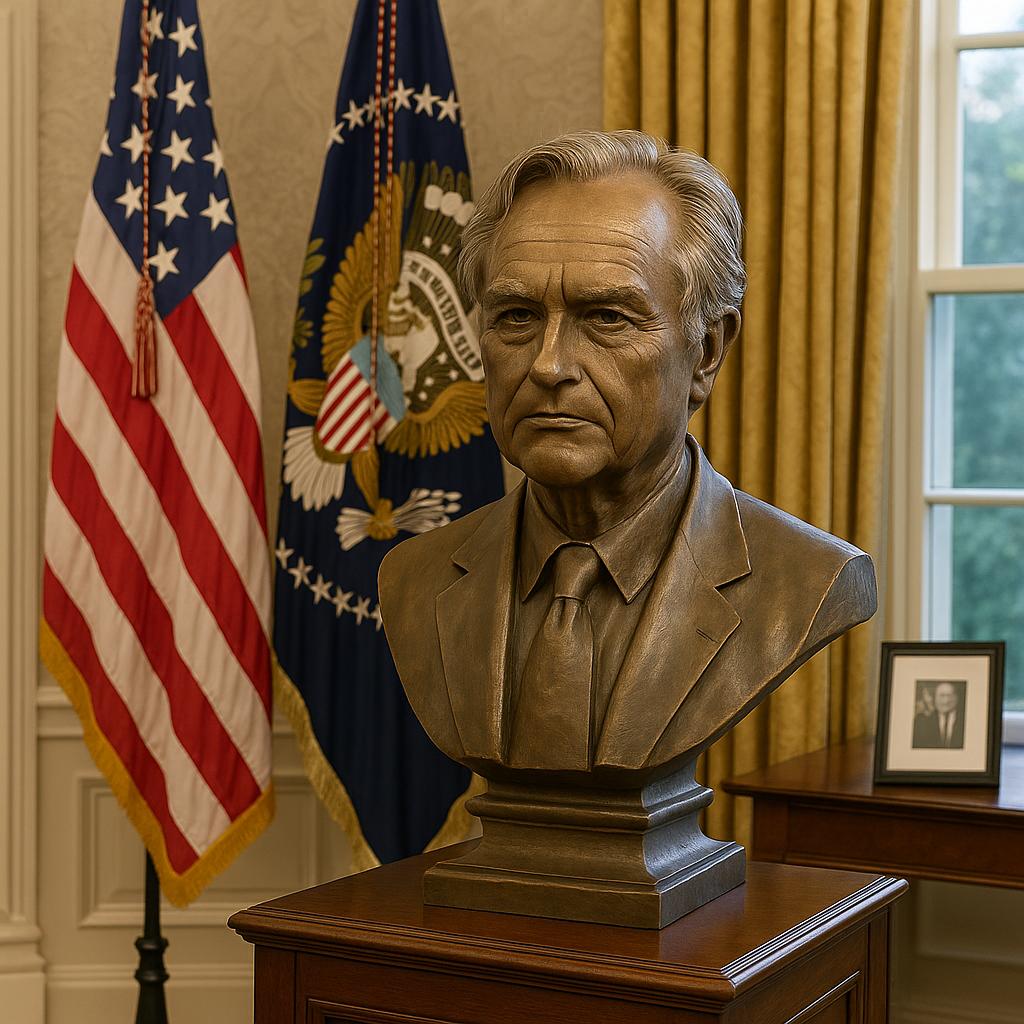
It may sound absurd today — a bust of outspoken atheist Richard Dawkins being in the White House. But as American society grows increasingly secular, and as public trust in organized religion continues to decline, the idea of an atheist U.S. president no longer seems unthinkable. In fact, it is inevitable.
Roughly 30% of Americans now identify as religiously unaffiliated — up from just 16% in 2007. Among adults under 30, the number jumps to nearly 40%. These “nones” — a mix of atheists, agnostics, and the unaffiliated — represent one of the fastest-growing demographic shifts in the U.S. They are no longer confined to the academic fringe. They are teachers, engineers, public servants, entrepreneurs, and increasingly, political organizers. With time, one of them will make a serious bid for the presidency.
Younger generations are even less religious: in 2023 about 36% of 18–29‑year-olds were unaffiliated (up from 32% in 2013). Overall, secular “nones” grew from 16% of the population in 2006 to 27% in 2023.
If current trends continue, secular Americans may soon outnumber Christians. A Pew analysis projects that by the 2050s the “nones” will be the largest group, and by 2070 they could be 52% of the population (vs. ~35% Christian).
So why Richard Dawkins?
Not because he’s universally beloved — he’s not. Even among atheists, Dawkins is a polarizing figure. Some see him as a sharp thinker who brought secular ideas into public discourse. Others find his tone arrogant, his worldview elitist, and his rise dependent on an ecosystem of insider connections. In that sense, Dawkins doesn’t just represent secularism. He represents secularism with credentials — the kind of voice that emerges not only from logic and science, but from institutional privilege.
That’s the irony: the symbolic atheist president might not be the humble rationalist from your local science club. It might be someone molded by elite academia and global media circuits. Like Dawkins, that figure might benefit from gatekept publication networks, global lecture tours, and intellectual clientelism. After all, there are thousands of potential Dawkinses — thinkers and skeptics around the world — but only a select few ever make it onto bookshelves, talk shows, or university stages. Why? Because access matters. Fame, even in rationalist circles, is rarely rational.
Many busts: Winston Churchill, Martin Luther King, Richard Dawkins
And yet — symbolic flaws aside — a secular leader could mark a turning point in American politics. For decades, religion has been both a moral compass and a political litmus test. A president who openly identifies as nonreligious would disrupt that status quo. It would force voters, lawmakers, and institutions to separate personal belief from public ethics — to ask whether morality requires dogma at all.
Of course, there would be anger. Religious hardliners would declare it the end of American greatness. Campaign ads would warn of “godless government.” Talk shows would howl. But beneath the hysteria, the reality is simple: secular voices are growing louder. The question is no longer if, but when.
For the record, this isn’t a celebration of Dawkins. His own motto — “nice guys finish first” — might work for headlines, but it glosses over the machinery behind his success. Dawkins has long operated within exclusive editorial circles and high-level platforms. He is not the everyman of non-belief. There are thousands like him — equally intelligent, equally driven — whose voices remain unheard because they lack the right affiliations.
So if we do one day see a Dawkins-like figure rise to the presidency, or at least to national prominence, let it prompt reflection — not just celebration or outrage. Not only on where secularism is headed, but on who gets to represent it. And why.
Because if humanity survives long enough — and that’s not guaranteed — we will have an atheist president. What matters is not whether it happens, but how we tell the story when it does. But as Obama put the bust of Martin Luther King, the new atheist president will replace the current bust with Richard Dawkins.
Leave a Reply