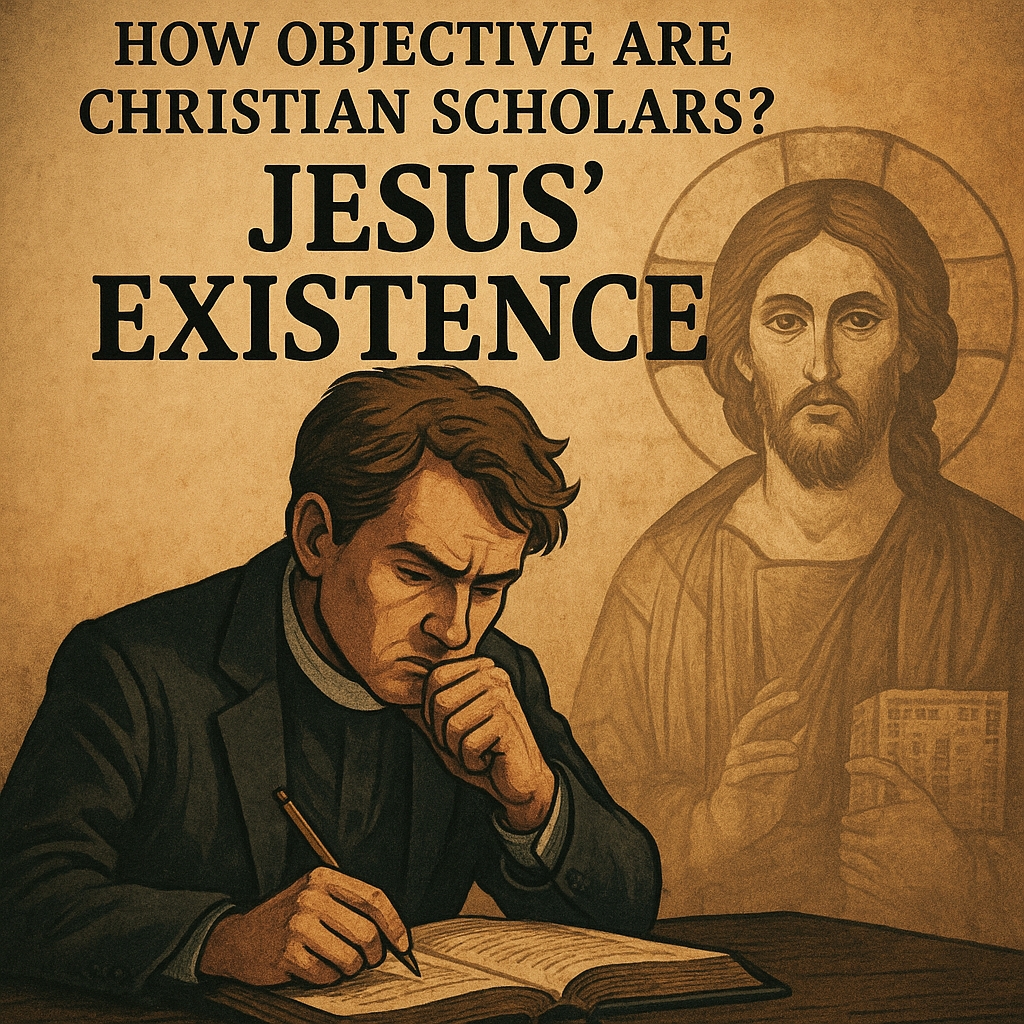
The question of Jesus’ existence looks simple. Yet every Christian institution treats it like radioactive material. The entire religion stands on one figure. The entire moral universe depends on one narrative. Therefore Christian scholars do not enter the debate freely. They enter it with identity, salvation, morality, community, and eternity stacked on their shoulders. And once those pressures settle in their minds, objectivity becomes almost impossible.
Christian scholars face a deeper problem. They do not analyze Jesus from a neutral position. They analyze him from within a world that collapses without him. And this internal conflict shapes every interpretation, every assumption, and every conclusion.
The built-in conflict of interest
Christian scholars work inside institutions designed to protect doctrine. They teach in seminaries, theological schools, and religious universities, they publish in faith-based journals. They depend on churches for employment. Therefore they cannot reach conclusions that undermine their employers. They cannot dismiss the foundation of their spiritual economy. And they cannot treat Jesus like any other ancient figure.
Because their careers depend on belief, neutrality collapses before research even begins.
The psychological cage
Cognitive dissonance hits every believer who tries to evaluate Jesus historically. The brain protects identity first. It protects meaning. It protects childhood conditioning. And it protects emotional security. Therefore Christian scholars feel threatened long before they read a single text.
Fear shapes their reaction, the fear of hell. Fear of betrayal. Add fear of being wrong. Fear of losing the world that holds them together. These fears push scholars toward conclusions they already want. And emotion becomes stronger than evidence.
The social pressure
Christian scholars live inside communities that treat Jesus as sacred truth. Pastors expect loyalty. Congregations expect devotion. Families expect obedience. Colleagues expect orthodoxy. Therefore doubting Jesus’ existence means social punishment. It means exile from the group. It means betrayal of their own people.
Because the social cost of honesty is enormous, scholars avoid honesty altogether.
Starting with the conclusion
Christian scholars do not ask “Did Jesus exist?” They ask “How did Jesus exist?” This one assumption destroys objectivity. Once the conclusion becomes fixed, the method becomes contaminated. Therefore every piece of evidence gets interpreted toward the same predetermined answer.
And because this conclusion shapes the methodology, the research cannot escape bias.
The silence of contemporary sources
Every chronicler of the era described prophets, cult leaders, riots, magicians, rebellions, executions, strange movements, and minor figures. Yet none described Jesus. Not Philo. Not Seneca. Not Pliny the Elder. Not Justus of Tiberias. Not any official Roman record. Not any Jewish administrative text.
This silence matters. And Christian scholars feel the pressure. Therefore they reinterpret silence as “lost documents” or “hidden evidence.” They fill gaps with speculation instead of data. Because they need Jesus to exist, silence cannot stand.
The Josephus problem
Christian scholars cling to Josephus because they need one ancient source. Yet the Testimonium Flavianum contains Christian vocabulary Josephus never used. It contains theological claims Josephus never believed. And it appears in manuscripts copied by Christian scribes.
Most Christian scholars now admit heavy forgery. Yet they salvage tiny fragments. They claim a “partially authentic core.” They do this because total forgery demolishes their last historical anchor. Therefore they protect the passage even while admitting corruption.
The Tacitus problem
Tacitus wrote around 115 CE. He wrote a century after the events. He likely repeated Christian claims. His information does not come from Roman records. It comes from Christians themselves. Yet Christian scholars treat Tacitus as “independent confirmation.”
They must exaggerate this reference, because without Tacitus, their external evidence collapses completely.
The Gospel problem
The gospels are anonymous. They contradict each other, they rely on earlier myths. And they follow literary patterns, not eyewitness accounts. They were written decades after the events by people who never met Jesus.
Yet Christian scholars cannot accept this. Therefore they call contradictions “theological emphasis.” They call mythic structure “symbolic narrative.”`; they call anonymous authors “community memory.” They reinterpret evidence to protect belief. And they fight mythic parallels with emotional resistance, not historical analysis.
The double standard across religions
Christian scholars reject Horus, Mithras, Krishna, and Zoroaster without hesitation. They demand strict evidence for those figures. They apply hard skeptical methods. Yet they refuse the same standards for Jesus.
This double standard exposes the problem. Faith decides the method. Not history.
The problem of theological training
Most New Testament scholars train inside religious institutions. They do not learn neutral historiography, they learn doctrinal preservation. They learn apologetics disguised as scholarship. And they learn methods designed to support belief.
Therefore they cannot fully detach from their own worldview. They cannot analyze their own tradition with the same brutality they apply to others. Their training shapes their conclusions long before they examine evidence.
The career problem
Every scholar knows the cost of doubt. If they question Jesus’ existence, they lose employment. They lose publishing platforms, they lose recommendations. And they lose conferences. They lose safety. Because their careers depend on faith, they protect it.
This structural pressure kills objectivity.
Cases of punished scholars
Thomas Brodie concluded that Jesus likely never existed. His order expelled him. His career ended instantly. Robert Price used standard critical methods and became marginalized. Several others lost funding, positions, and respect.
These cases prove the rule: honesty destroys careers in Christian scholarship.
The fear of community backlash
Scholars fear public reaction. They fear being labeled heretics. They fear losing credibility among believers. Therefore they avoid the mythicist question entirely. They pretend the debate does not exist. And they treat anyone who raises the question as fringe, even when the methods are standard historical tools.
Why secular historians offer cleaner methods
Secular historians evaluate all ancient figures with consistent criteria. They demand contemporary witnesses, they demand independent confirmation; they demand reliable sources. They demand non-theological texts.
Jesus fails every requirement. And secular scholars have no fear of this conclusion. Their careers do not depend on belief. Therefore their neutrality is real.
The consensus myth
The claim “scholars agree Jesus existed” hides a trick. The consensus includes scholars trained inside Christian institutions. It excludes secular historians, it excludes mythicists. It excludes anyone outside theological systems.
Therefore the consensus becomes circular. Believers confirm believers. The conclusion becomes self-referential.
The strength of mythicist argumentation
Mythicists apply standard historical tools. They analyze silence, they analyze textual layers; they analyze myth structure; they analyze contradictions. And they analyze literary borrowing. They analyze political motives.
They follow evidence without emotional limits. And they reach conclusions that Christian scholars cannot accept because acceptance destroys their world.
Identity as the final barrier
Christian scholars see Jesus as savior, moral model, and cosmic anchor. Therefore losing Jesus means losing identity. It means losing purpose, it means losing community. It means losing the story that explains their world.
Identity attachment shapes interpretation more than data ever could. Therefore neutrality cannot survive.
Why objectivity is emotionally impossible
The emotional cost of accepting Jesus’ non-existence becomes too high. It destroys the system that gives scholars meaning. It destroys the worldview that gives them stability. And it destroys the hope that gives them comfort.
Emotion outweighs evidence. And faith outweighs method.
What true objectivity would require
True objectivity requires no doctrinal loyalty. It requires no fear of consequences. It requires no institutional pressure, it requires no theological training. And it requires no identity attachment. It requires no emotional stake in the answer.
Christian scholars cannot meet these conditions. They do not operate in an environment where honesty is safe.
How secular scholarship approaches the question
Secular scholars treat Jesus like any other ancient figure. They use the same tools they use for Caesar, Alexander, Socrates, or Pythagorashey follow evidence; they do not protect any doctrine. They accept uncertainty. And they accept non-existence as a normal conclusion, not a threat.
Christianity depends on Jesus’ existence
If Jesus never existed, Christianity loses its anchor. It loses its authority. It loses its theology. And it loses its claim to truth. Therefore Christian scholars defend the existence of Jesus because their world collapses without him.
Belief shapes research. Research does not shape belief.
Conclusion: Faith cannot judge its own foundations
Christian scholars cannot evaluate Jesus’ existence objectively. The conflict of interest is structural. The emotional burden is overwhelming. The social pressure is intense. The institutional expectation is rigid. And the identity attachment is deep.
Objectivity dies when a belief system investigates itself.
Only secular, independent scholarship can judge the evidence honestly.
Leave a Reply