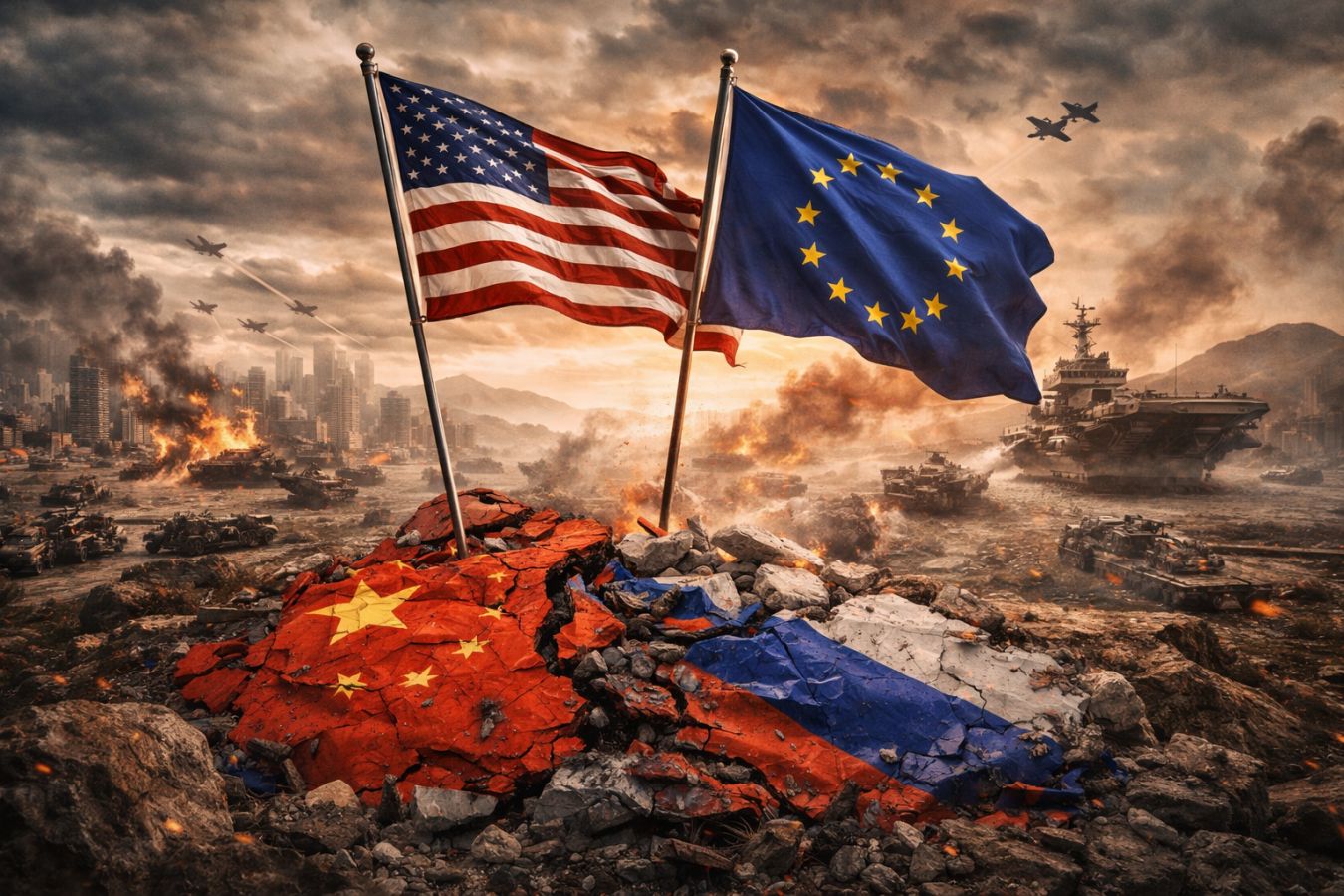
Modern Western politics often behaves like a nervous committee rather than a strategic civilization. The United States and Europe still dominate many sectors of the global system. They control enormous financial networks. Their universities produce cutting-edge science, their military alliances span continents. Their corporations shape global technology, communication, and industry.
Yet the West increasingly lacks long-term geopolitical discipline. Decision-making often reacts to crises rather than shaping them. Political leaders focus on election cycles rather than generational strategy. Meanwhile rival powers think in decades.
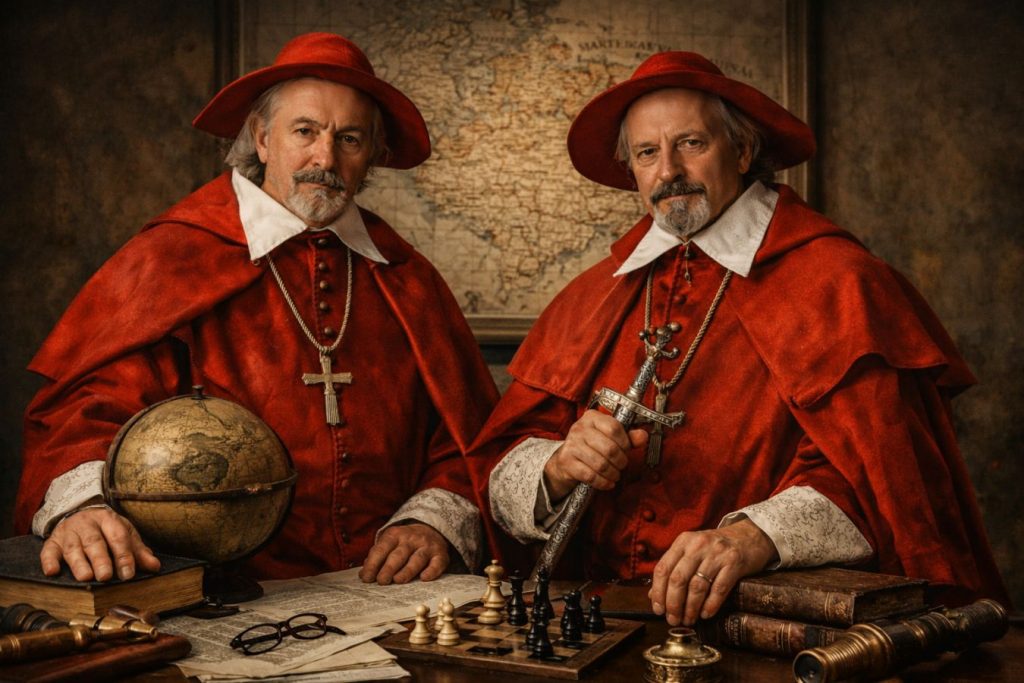
History offers a powerful analogy. In seventeenth-century France, Cardinal Richelieu, one of the most skilled politicians in history, rose from relatively modest origins to become the dominant political figure in France. He transformed a fragmented kingdom into a centralized strategic actor. France faced internal aristocratic rebellions, religious tensions, and powerful external enemies. Richelieu did not simply manage crises. He redesigned the architecture of power itself.
The modern West needs a similar mindset. Not authoritarian rule, but strategic coherence. The United States and Europe require leaders who think like Richelieu: pragmatic, disciplined, and focused on long-term survival of their political system.
In practice, this means something radical. Europe needs a Richelieu capable of transforming the European Union into a real geopolitical power. The United States needs another Richelieu capable of restoring Western strategic coordination and technological leadership against rising authoritarian competitors.
The Richelieu principle: Strategy before sentiment
Cardinal Richelieu understood that ideals alone cannot defend a state. He spoke the language of legitimacy and faith, yet he pursued power through institutions, intelligence networks, economic reforms, and military modernization.
He crushed aristocratic rebellions inside France; he reduced the political autonomy of regional elites who weakened national authority; he centralized administration around the crown and created a more efficient system of governance.
Externally, Richelieu acted with remarkable pragmatism. Despite being a Catholic cardinal, he supported Protestant powers during the Thirty Years’ War because weakening the Habsburg Empire served French strategic interests.
His method was simple. Survival and strength of the state came first.
The West today faces a similar structural reality. Without coordination, power fragments. Without strategy, rivals gradually gain ground.
Europe’s paradox: Enormous wealth, limited geopolitical power
Europe represents one of the largest economic systems on the planet. The European Union’s combined GDP rivals that of the United States and China. Its population exceeds 440 million people. Its industries remain technologically advanced.
However, Europe still behaves politically like a collection of cautious middle powers.
Foreign policy decisions frequently require unanimous agreement among numerous governments with different priorities. Military capabilities remain fragmented across national armies. Strategic industries often remain vulnerable to external economic influence.
This structural fragmentation weakens Europe’s ability to act decisively in geopolitical crises.
A European Richelieu would focus on a single objective: transforming Europe from an economic union into a strategic power capable of defending its interests globally.
Transforming Europe into a strategic actor
Such transformation would require several major institutional changes.
First, foreign policy and security decisions would move away from unanimity toward strategic majority authority. A geopolitical union cannot function effectively if a single government can block collective action.
Second, Europe would gradually integrate defense capabilities. National armies would increasingly coordinate under unified command structures. Joint procurement, shared logistics, and integrated intelligence networks would increase efficiency dramatically.
Third, Europe would treat strategic industries as pillars of security. Semiconductor production, artificial intelligence research, space infrastructure, biotechnology, and energy systems would become central elements of European power.
These reforms could transform Europe within two decades from a cautious economic bloc into a fully capable geopolitical actor.
The American Richelieu: Restoring Western strategic leadership
The United States faces a different but equally important challenge.
America remains the strongest military power in the world. Its technological ecosystem leads in artificial intelligence, aerospace, biotechnology, and software infrastructure. American universities continue to dominate global scientific research.
However, domestic polarization and shifting political cycles often weaken long-term strategic planning.
A Richelieu-like American leader would focus on restoring continuity across administrations. Strategic planning would extend beyond electoral cycles. Alliances would receive stable commitments. Industrial and technological policy would follow long-term objectives.
The central goal would be preserving Western leadership in the global system.
The shock of Western unity during the invasion of Ukraine
One moment in recent history revealed something extremely important about global power perception.
When Russia launched its full-scale invasion of Ukraine in 2022, many observers expected division within the Western world. Moscow believed NATO and the European Union would respond slowly or inconsistently. Some analysts in Beijing also expected Western fragmentation.
The opposite happened.
The United States, the European Union, Britain, Canada, Japan, and other allies responded with remarkable speed and unity. Massive financial sanctions targeted Russian banks. Technology exports were restricted. Military support flowed toward Ukraine. European states suddenly increased defense spending and reduced dependence on Russian energy.
For the first time in decades, the West acted as a coherent strategic bloc.
Reports from diplomatic and intelligence circles suggested that this sudden unity shocked many geopolitical observers in Beijing. Chinese leadership had long assumed that Western democracies had become too fragmented and politically polarized to coordinate decisive action.
The early phase of the war demonstrated something different. When confronted with a clear geopolitical threat, Western systems were still capable of rapid alignment.
For Xi Jinping, this moment carried an important strategic lesson. A united Western alliance remains the most powerful geopolitical coalition in the world.
However, such unity cannot be taken for granted. It appeared largely as a reaction to crisis rather than the product of permanent institutional coordination.
Two Richelieus could transform that temporary unity into lasting strategic architecture.
Current leadership: A theater of clowns
The contrast between historical statecraft and contemporary politics is striking. When one compares figures like Richelieu, Metternich, Bismarck, or even early Cold War strategists with today’s leadership class, the difference appears almost surreal.
Modern politics increasingly resembles political theater rather than strategic governance.
Many contemporary politicians behave less like architects of national strategy and more like performers in a permanent election campaign. They obsess over polling cycles, social media reactions, and short-term media narratives. Long-term geopolitical planning rarely appears in their thinking.
Debates often descend into symbolic gestures, ideological slogans, and partisan quarrels that barely touch the real structural challenges facing Western civilization.
Strategic vision
Instead of strategic vision, we see reactive improvisation; instead of disciplined leadership, we see political marketing. Instead of coordinated statecraft, we see fragmented decision-making across dozens of agencies, committees, and interest groups.
From the perspective of long-term history, this political class sometimes appears almost comical. Faced with systemic technological competition, rising authoritarian powers, demographic shifts, and global economic restructuring, many Western leaders behave like a confused crowd of administrators rather than strategic decision-makers.
In moments of crisis they often appear overwhelmed by the scale of the problems they are supposed to manage.
This is precisely why the metaphor of Richelieu matters. Richelieu represented a type of leadership that modern politics rarely produces: strategic patience, intellectual seriousness, and ruthless clarity about power.
The West does not need more charismatic campaigners or media personalities. It needs leaders capable of designing institutional strategy for decades.
Until such leadership emerges, Western politics risks looking increasingly like a stage filled with clowns while the real geopolitical chess game continues elsewhere.
Rebuilding the transatlantic strategic core
The transatlantic alliance remains the most powerful geopolitical partnership in modern history.
Together the United States and Europe represent roughly half of global economic output. Their financial institutions dominate international markets. Their military alliances span NATO and numerous bilateral agreements.
Yet the alliance sometimes weakens due to trade disputes, regulatory differences, and inconsistent political signals.
A Richelieu-like strategist in Washington would prioritize restoring deep structural alignment with Europe.
Joint technology strategies would coordinate artificial intelligence standards, cybersecurity frameworks, and digital infrastructure. Defense industries would integrate supply chains. Intelligence cooperation would expand into cyberwarfare, satellite systems, and space security.
The result would be a coherent Western strategic bloc capable of shaping global rules.
China’s challenge and systemic competition
China represents the most significant geopolitical challenger of the twenty-first century.
Its leadership integrates industrial policy, technological development, military modernization, and geopolitical influence through centralized planning. Long-term infrastructure projects, advanced manufacturing initiatives, and global investment networks form a comprehensive strategy.
Artificial intelligence, quantum computing, biotechnology, and advanced materials represent key areas of competition.
If the West remains fragmented, China could dominate several of these technological domains by mid-century.
However, coordinated Western investment could produce a very different outcome. Shared research funding, integrated innovation networks, and synchronized industrial policy could maintain Western leadership across emerging technologies.
The strategic role of global power networks
Modern geopolitical strategy does not operate only through governments.
Major financial institutions, global asset managers, influential families, multinational corporations, religious institutions, and lobbying networks also shape the architecture of global power.
Organizations such as Vanguard and BlackRock influence enormous portions of global capital markets. Historic financial families like the Rothschilds and the Rockefellers have shaped banking networks and philanthropic institutions for generations. The Vatican maintains global diplomatic connections and financial influence across continents.
Multinational lobbyists connect governments with corporate interests and international regulatory frameworks.
These actors often operate independently, pursuing their own institutional objectives. Yet their economic influence can shape technological development, political priorities, and international policy.
A Richelieu-like strategist would not ignore these power centers. Instead, he would require coordination.
Financial giants would need to align investment strategies with long-term Western technological leadership. Multinational corporations would integrate supply chains within secure allied systems. Lobbying networks would support coherent strategic planning rather than fragmented regulatory battles.
In essence, the most powerful economic actors of the Western world would need to listen to strategic leadership rather than pursuing purely short-term profit incentives.
The future battlefield: Technology, infrastructure, and space
The geopolitical conflicts of the twenty-first century will increasingly unfold through technological competition rather than traditional military confrontation.
Artificial intelligence will reshape economic productivity and military systems. Quantum computing could revolutionize encryption and information security. Biotechnology may transform medicine, agriculture, and bioengineering.
Space infrastructure will become another arena of competition. Satellite networks already support communication, navigation, intelligence gathering, and financial transactions.
By 2050, dominance in these sectors may determine which civilization leads the global system.
A coordinated Western strategy could produce powerful innovation ecosystems across universities, corporations, and research laboratories on both sides of the Atlantic.
Futuristic projections: The West in 2050
Looking ahead several decades reveals how decisive strategic leadership could become.
If the West remains politically fragmented while rivals pursue centralized planning, the balance of power could gradually shift toward alternative political systems.
However, coordinated Western leadership could create a very different future.
By 2050, a unified Western technological sphere could dominate artificial intelligence infrastructure, space exploration, advanced medicine, and sustainable energy systems. Fusion energy, next-generation computing, and revolutionary medical therapies could emerge from transatlantic research networks.
Global digital governance frameworks could preserve open communication systems rather than centralized state surveillance.
In this scenario, the West would remain the central hub of global innovation and institutional legitimacy.
Internal resilience: Strengthening democratic societies
External competition cannot be separated from internal stability.
Western societies face growing polarization, institutional mistrust, and information fragmentation. Digital communication platforms often amplify ideological conflict and disinformation.
Strategic leadership would address these vulnerabilities through institutional reform rather than authoritarian control.
Education systems would emphasize scientific literacy and analytical reasoning. Governments would strengthen transparency and administrative efficiency. Strategic communication systems would counter disinformation campaigns conducted by hostile states.
Democratic legitimacy must remain the foundation of Western power.
Strategic leadership within democratic systems
Invoking Richelieu does not mean abandoning democratic principles.
The lesson lies in long-term thinking. Richelieu understood that survival requires strategic clarity, institutional strength, and coordination of power.
Modern democracies often struggle with short-term electoral incentives. Leaders frequently focus on immediate political gains rather than generational strategy.
The West needs leaders capable of thinking in decades rather than election cycles.
Conclusion: From fragmented influence to coordinated civilization
The Western world still possesses extraordinary advantages.
Its economies remain powerful; its scientific institutions lead global research; its financial networks dominate global markets. Its cultural influence shapes global media and technology.
However, these advantages require coordination.
History shows that civilizations decline not when they become weak but when they fail to organize their power effectively.
Four centuries ago Cardinal Richelieu transformed a vulnerable France into a durable geopolitical power through strategic discipline and institutional reform.
The twenty-first century may demand a similar transformation.
America and Europe do not need literal cardinals. They need strategic architects capable of coordinating governments, financial power centers, corporations, and institutions toward a shared long-term vision.
Two Richelieus—one in Europe and one in the United States—could transform Western fragmentation into strategic coherence and shape the global order for the rest of the century.
Leave a Reply