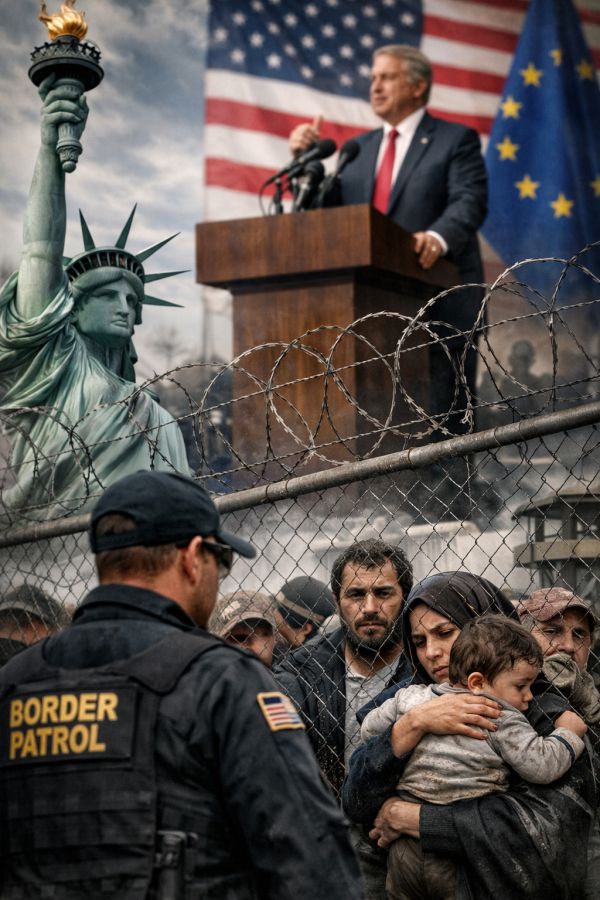
Modern democracies constantly celebrate dissent. Presidents praise brave activists abroad. Parliaments pass resolutions condemning dictatorships. Media outlets highlight courageous journalists who resist repression. The rhetoric sounds noble and principled.
However, the story often changes the moment those dissidents seek protection.
Suddenly admiration turns into bureaucracy. Applause turns into suspicion. Immigration systems begin to demand perfect documentation from people who escaped secret police, prison cells, or torture chambers.
This contradiction sits at the center of modern democratic politics. Democracies love the symbolism of dissent. They struggle with the practical consequences of protecting dissidents.
The United States illustrates this paradox particularly clearly. No country in the modern world has spoken louder about liberty, human rights, and freedom of speech. Yet again and again, when real dissidents request asylum, the system reveals hesitation, delay, and rejection.
Freedom sounds powerful in speeches. Protection becomes complicated at the border.
The historical promise of asylum
The idea of asylum is ancient. Long before modern immigration law existed, societies already understood that power sometimes persecutes individuals for political reasons.
In ancient Greece, temples served as places of sanctuary. Individuals escaping violence or political persecution could seek protection inside sacred spaces. Although political authorities sometimes violated those protections, the basic idea already existed: a person fleeing injustice deserved refuge.
Medieval Europe continued similar traditions. Churches often sheltered fugitives or victims of political conflict. Kings sometimes respected these protections because religious institutions possessed moral authority over secular rulers.
The modern legal structure of asylum emerged after the disasters of the twentieth century. Fascism, totalitarian regimes, and world war produced millions of refugees. Entire populations fled persecution, genocide, and political repression.
In response, democratic countries helped create international legal frameworks. The 1951 Refugee Convention established the principle of non-refoulement. States should not return individuals to countries where they face persecution.
The moral logic seemed simple. If a government persecutes someone for political beliefs, other societies should offer protection.
However, the gap between legal principle and political practice quickly became visible.
Cold War asylum as geopolitical theater
During the Cold War, asylum often functioned as a geopolitical tool.
Western governments welcomed defectors from communist countries with enthusiasm. Every Soviet dissident, every East German defector, every Czech or Hungarian intellectual who escaped repression reinforced the narrative that liberal democracies offered freedom while communist regimes produced oppression.
Asylum therefore served both humanitarian and strategic purposes. Accepting dissidents helped demonstrate the supposed superiority of Western political systems.
The United States in particular used asylum as a form of soft power. A Soviet scientist defecting to America symbolized the failure of the Soviet model. A Cuban refugee escaping communism reinforced the ideological battle between Washington and Havana.
However, this generosity contained a strategic calculation. Dissidents from enemy states were valuable. They strengthened the propaganda war.
The end of the Cold War changed this dynamic dramatically.
The collapse of ideological incentives
After the collapse of the Soviet Union, asylum lost much of its geopolitical symbolism.
Western democracies no longer faced a single ideological enemy. Consequently, the strategic value of every dissident decreased.
Domestic politics began to dominate immigration debates. Governments increasingly framed asylum within the broader context of migration control, border security, and electoral politics.
Political leaders worried about public perception. Accepting refugees or dissidents could trigger backlash from voters concerned about immigration. As a result, asylum systems became more restrictive.
Legal procedures grew longer and more complex. Documentation requirements became stricter. Credibility tests became harsher.
The language of humanitarian protection remained intact. The administrative reality changed dramatically.
The American paradox
The United States continues to describe itself as a global defender of freedom. American political rhetoric frequently highlights human rights violations in authoritarian states.
However, the U.S. asylum system often contradicts this narrative.
Applicants face complicated legal procedures that may last years. Courts demand extensive documentation and detailed testimony. Many individuals fleeing repression cannot provide the level of evidence that immigration authorities require.
Even applicants from clearly authoritarian countries frequently face rejection.
Political calculations sometimes overshadow humanitarian principles. Governments must balance diplomatic relations, intelligence concerns, and domestic political pressures.
As a result, the image of America as a sanctuary for dissidents often clashes with bureaucratic reality.
Prominent dissidents who struggled to find refuge
Famous cases illustrate the contradiction with unusual clarity.
Edward Snowden revealed one of the largest global surveillance systems ever exposed. His disclosures triggered international debates about privacy, government power, and civil liberties.
However, when Snowden sought asylum in democratic countries, he discovered how limited that protection could be. The United States charged him under espionage laws. European governments refused to confront Washington directly.
Snowden eventually received temporary protection in Russia, an authoritarian state frequently criticized by the West.
The irony was striking. A whistleblower who exposed surveillance abuses could not find refuge in the countries that constantly defend civil liberties.
Julian Assange represents another controversial case. This episode demonstrates how geopolitical pressures shape asylum decisions.
Assange spent years inside the Ecuadorian embassy in London to avoid extradition. Western governments treated the case primarily through legal and security frameworks rather than through the traditional lens of political asylum.
These cases highlight an uncomfortable reality. Even prominent figures with global visibility may struggle to obtain protection.
Russian dissidents illustrate this problem even more dramatically.
Russian dissidents and the limits of Western protection
Modern Russia has produced many dissidents who openly challenge the regime.
Journalists, opposition politicians, activists, and whistleblowers face intimidation, imprisonment, or assassination attempts. Several prominent critics of the Kremlin have fled abroad after surviving poisoning or political persecution.
Yet many Russian dissidents encounter enormous difficulties obtaining stable legal protection in Western countries.
Some receive temporary visas but not permanent asylum. Others live in long-term legal uncertainty. Governments often hesitate because of diplomatic tensions, intelligence concerns, or fears of espionage infiltration.
The case of Alexei Navalny also demonstrated the limits of external protection. Although Western leaders condemned his persecution, they could not ultimately protect him from returning to Russia and facing imprisonment.
Countless lesser-known Russian journalists and activists remain trapped in similar uncertainty.
They receive praise from Western politicians and media. However, legal protection often arrives slowly, inconsistently, or not at all.
Invisible victims of repression
While famous dissidents occasionally attract attention, the majority of asylum seekers remain invisible.
Thousands of activists, bloggers, minority advocates, and local journalists apply for asylum every year. Many come from regimes that imprison critics, torture detainees, or suppress freedom of speech.
However, asylum systems frequently treat these applicants with suspicion.
Officials often assume exaggeration or fabrication. Applicants must reconstruct traumatic experiences with precise timelines. Translation errors, psychological trauma, and cultural misunderstandings easily undermine credibility.
Even minor inconsistencies can lead to rejection.
The system thus produces a paradox. The people most likely to face persecution often possess the least documentation to prove it.
Political fear and electoral pressure
Domestic politics plays a major role in shaping asylum policy.
Immigration has become one of the most controversial political issues in many democracies. Populist movements often portray asylum seekers as security threats or economic burdens.
Governments therefore face pressure to appear strict. Generous asylum policies may provoke electoral backlash.
Politicians respond by tightening procedures, increasing border enforcement, and raising evidentiary standards.
The language of national security frequently merges with asylum debates. Authorities fear infiltration by spies or extremists. These concerns sometimes overshadow humanitarian considerations.
The result is a system designed more to prevent abuse than to protect victims.
Geopolitical selectivity
Democracies also demonstrate selective compassion depending on geopolitical interests.
Dissidents from hostile states often receive more public attention. Their stories reinforce existing political narratives.
However, activists persecuted by allied governments sometimes receive far less support.
Strategic alliances complicate asylum decisions. Granting protection to certain individuals may strain diplomatic relations or disrupt intelligence cooperation.
Consequently, moral principles often collide with geopolitical calculations.
Damage to democratic credibility
This inconsistency carries long-term consequences.
When democracies praise dissidents but fail to protect them, authoritarian regimes gain propaganda opportunities. They can accuse Western governments of hypocrisy and double standards.
Dissidents themselves may lose faith in democratic rhetoric. They hear speeches about freedom yet struggle to obtain visas, legal status, or security.
The credibility of the global human rights narrative weakens.
What genuine protection would require
A consistent asylum policy would require political courage.
Governments would need to distinguish more clearly between political persecution and ordinary migration. They would need faster procedures and specialized protections for journalists, whistleblowers, and activists.
International cooperation could distribute responsibility among democratic countries rather than concentrating it in a few states.
Above all, democracies would need to align their actions with their rhetoric.
Freedom cannot exist only in speeches. It requires institutions willing to protect individuals who challenge power.
Conclusion
Modern democracies often present themselves as champions of dissent. They celebrate the courage of those who resist authoritarian regimes. They condemn repression abroad and speak about universal liberty.
However, the treatment of asylum seekers frequently tells a different story.
When real dissidents request protection, admiration often turns into hesitation. Bureaucratic systems delay decisions. Political fears override humanitarian commitments.
The result is a persistent contradiction. Democracies loudly defend freedom in theory while quietly limiting protection in practice.
As long as that contradiction continues, the moral authority of democratic rhetoric will remain fragile. Praising dissent costs little. Protecting dissenters requires courage.
Leave a Reply