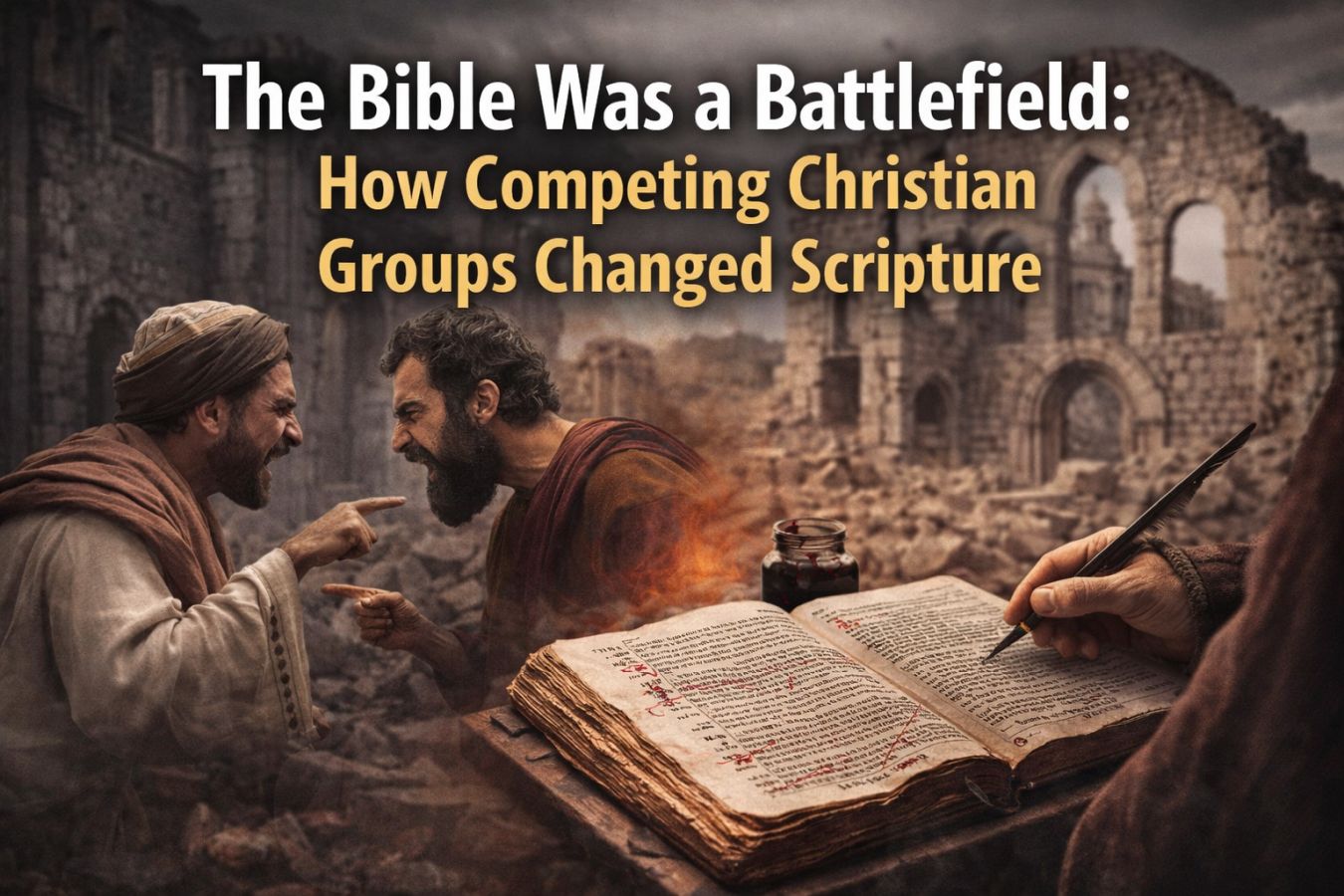
Most Christians imagine the Bible as a stable and unified book. They assume the same message passed unchanged from the time of Jesus to the present. According to this view, the text simply traveled through history while scribes faithfully copied every word.
However, the historical reality looks very different.
The Bible did not emerge as a finished document. It developed slowly across centuries. During that long period, competing Christian groups wrote, edited, copied, and reshaped texts in order to defend their theological positions.
Instead of a single tradition, early Christianity resembled a battlefield of ideas.
Early Christianity was deeply fragmented
Modern readers often imagine the early church as a unified community guided by a clear doctrine. In reality, the first centuries of Christianity contained numerous competing movements.
Some groups believed Jesus was divine from birth. Others believed he became divine at baptism. Some described him as purely human. Others insisted he was a cosmic spiritual being who only appeared to have a human body.
These disagreements were not minor theological details. They concerned the very identity of Jesus.
Groups such as the Ebionites viewed Jesus primarily as a human prophet. Gnostic communities described him as a revealer of secret spiritual knowledge. Marcionite Christians rejected the Jewish scriptures entirely and promoted their own version of Christian teaching.
Each movement produced texts supporting its interpretation.
As a result, early Christianity generated a large and diverse body of literature rather than a single authoritative scripture.
Conflicts already appeared among the first Christians
The fragmentation of Christianity began very early. Even the earliest Christian leaders disagreed strongly with one another.
A major conflict developed between the teachings of Paul the Apostle and the Jerusalem community led by James the Just and Peter the Apostle.
Paul promoted a version of Christianity that moved away from Jewish law and opened the movement to non-Jewish converts. The Jerusalem community remained much closer to traditional Jewish practices.
These tensions appear even inside the New Testament itself. The disagreements reveal that Christianity did not begin as a single coherent doctrine but as a movement full of internal disputes.
The explosion of competing Gospels
Today the New Testament contains four gospels. Many believers assume these were the only accounts ever written.
Historical evidence shows otherwise.
Early Christian communities produced many gospels describing Jesus’ life and teachings. Among them were the Gospel of Thomas, the Gospel of Peter, the Gospel of Mary, the Gospel of Judas, and the Gospel of the Hebrews. Each text reflected the theological priorities of the community that produced it.
Some gospels emphasized mystical knowledge. Others focused on resurrection narratives. Some presented Jesus as a spiritual teacher rather than a miracle worker.
These texts circulated widely during the first centuries of Christianity. Different regions preferred different writings.
The idea that only four gospels existed is therefore a later development.
Lost sources behind the gospels
Even the four canonical gospels likely depended on earlier texts that no longer exist.
Many scholars believe the authors of Matthew and Luke used a now-lost collection of sayings known as the Q source. If such a document existed, it would mean that parts of the gospel tradition depend on writings that have disappeared from history.
This possibility shows how complex and layered the formation of the New Testament really was.
The role of scribes and copying changes
For centuries, the Bible existed only as handwritten manuscripts. Every copy had to be produced manually by scribes.
This process inevitably introduced changes.
Some alterations resulted from simple mistakes. A scribe might skip a line, repeat a phrase, or replace unfamiliar words with more familiar ones. Over generations of copying, these variations accumulated.
Other changes appear more deliberate.
Scribes sometimes clarified passages that seemed ambiguous. In other cases they strengthened statements supporting particular theological positions.
Modern scholars studying ancient manuscripts have identified thousands of textual differences among surviving copies. Famous manuscripts such as the Codex Sinaiticus and the Codex Vaticanus demonstrate how the biblical text evolved through centuries of copying.
Famous passages that appeared later
Modern textual criticism has revealed that several well-known biblical passages do not appear in the earliest manuscripts.
One example involves the ending of the Gospel of Mark. The oldest manuscripts end abruptly with the discovery of the empty tomb. Later copies include additional verses describing appearances of the resurrected Jesus.
Another example concerns the famous story of the woman accused of adultery, where Jesus says “Let him who is without sin cast the first stone.” This passage does not appear in the earliest manuscripts of the Gospel of John.
Such cases show how passages could enter the text centuries after the original composition.
Contradictions between gospel accounts
The gospels themselves also contain significant differences.
For example, the genealogies of Jesus differ between the Gospel of Matthew and the Gospel of Luke. The narratives describing Jesus’ birth and resurrection also vary in important details.
These differences indicate that multiple traditions about Jesus circulated among early Christian communities before the texts were eventually compiled into the New Testament.
The struggle to create a canon
Because so many texts circulated among early Christians, the question of which writings should count as authoritative became increasingly important.
Different communities promoted different collections of scriptures.
In the second century, the Christian teacher Marcion proposed his own canon. He accepted only a modified version of the Gospel of Luke and several letters of Paul. He rejected the Jewish scriptures entirely.
Other Christian leaders strongly opposed this proposal.
Over time, church authorities attempted to establish a standard list of accepted texts. This process unfolded gradually through debates, councils, and theological disputes.
By the fourth century, the core of the New Testament canon began to stabilize.
H2: Imperial Power and the Standardization of Christianity
The political environment also played an important role in shaping Christian doctrine.
After the conversion of Constantine the Great, Christianity gained powerful imperial support. Councils such as the First Council of Nicaea helped establish official theological positions.
With imperial backing, certain interpretations of Christianity gained dominance, while alternative views gradually disappeared from the mainstream.
The question of whether Jesus existed
Another issue complicates the picture even further.
The historical evidence for Jesus himself remains surprisingly thin. No contemporary Roman administrative record clearly describes him. No Hebrew chronicle from the period documents his life. The earliest Christian texts appear decades after the events they claim to describe.
This absence of contemporary evidence has led some historians and researchers to question whether Jesus existed as a historical individual at all. Jesus likely never existed.
If a miracle-working preacher gathered large crowds, challenged religious authorities, and caused political disturbances under Roman rule, one might expect contemporary records. Instead, the story of Jesus appears mainly in texts written by believers long after the supposed events.
Suppressed and forgotten Christian texts
Once the canon became dominant, many alternative writings disappeared from mainstream circulation.
Church authorities labeled them heretical and discouraged their use. Some texts survived only in fragments. Others vanished completely for centuries.
Occasionally discoveries reveal how diverse early Christianity once was.
In 1945, a collection of ancient manuscripts was discovered near Nag Hammadi. These texts contained gospels and writings associated with early Gnostic communities and presented very different interpretations of Jesus.
A text shaped by centuries of conflict
The history of the Bible reveals a long process of composition, copying, editing, and selection. Competing Christian communities produced many texts. Scribes introduced changes during centuries of manual copying. Church authorities later determined which writings would become canonical.
This complex history means the Bible cannot be treated as a pristine and untouched document.
Instead, it represents the final outcome of centuries of theological conflict, institutional power, and editorial change.
Understanding that process reveals how deeply the Bible reflects the struggles of the early Christian world.
Leave a Reply