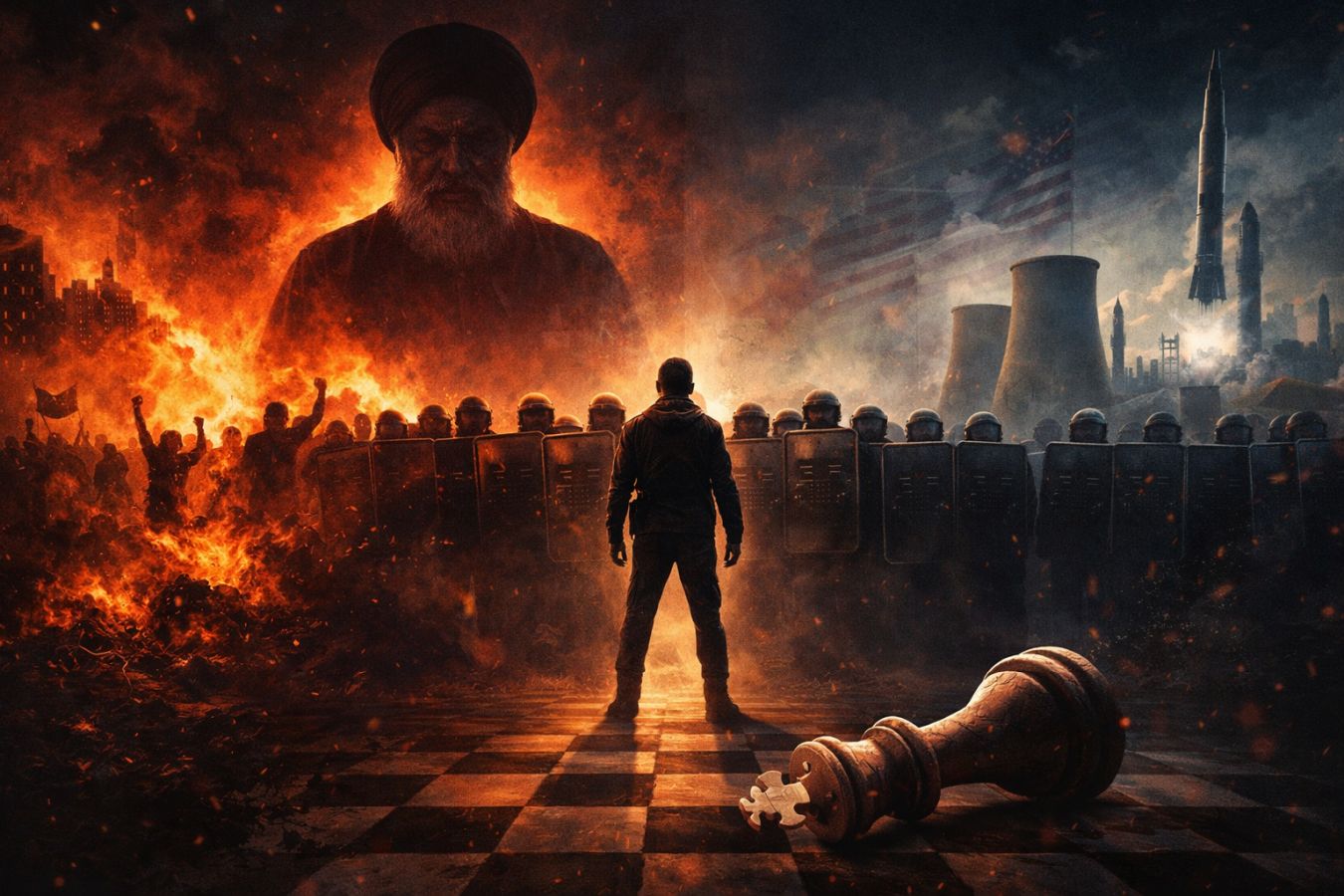
At the most basic level, leadership carries responsibility. If leaders truly cared about their population, then they would step down when their rule produces suffering, isolation, and death. In other words, this is not an abstract moral idea. Rather, it is a concrete test of responsibility.
Therefore, we must ask a direct question. What does it say about a regime when preserving power matters more than the lives of its citizens?
In this context, Iran offers a clear answer. Over time, its leadership has repeatedly chosen survival over wellbeing. More importantly, it has chosen control over reform. As a result, it has built a system that resists correction even when the cost becomes unbearable.
The birth of the regime: revolution and consolidation
To understand the present, we must begin with the origin. The Iranian Revolution began with promises. It promised justice; it promised independence. It promised dignity.
At first, many believed the country would move toward a more open system. However, the opposite happened. Instead of dispersing power, the revolution concentrated it again.
Under Ruhollah Khomeini, religion fused directly with state authority. Consequently, this fusion did not create balance. Rather, it removed constraints entirely.
Soon after, opposition disappeared. Political rivals were eliminated, exiled, or silenced. At the same time, new institutions emerged, not to represent society, but to protect ideology.
Thus, the revolution did not end authoritarianism. Instead, it redesigned it.
War as foundation: Normalization of sacrifice
However, the true consolidation of the regime came through war. The Iran–Iraq War shaped the system far more deeply than any internal reform.
For eight years, the country lived in constant conflict. As a result, hundreds of thousands died. Entire generations experienced loss as normal.
Crucially, the leadership framed sacrifice as virtue. In addition, it elevated martyrdom into a political tool. Consequently, suffering itself became proof of ideological strength.
Because of this, a lasting shift occurred. Extreme human cost no longer triggered reconsideration. Instead, it reinforced legitimacy.
At the same time, the Islamic Revolutionary Guard Corps rose to power. Initially, it functioned as a military body. However, over time, it evolved into an economic and political empire.
Therefore, from this point onward, the regime did not rely only on belief. It relied on a structure that benefits directly from its survival.
The ideological core: Absolute religious authority
At the center of the system stands velayat-e faqih.
Fundamentally, this doctrine gives ultimate authority to a religious jurist. As a result, it transforms politics into theology.
Consequently, legitimacy no longer comes from citizens. Instead, it comes from interpretation of divine will.
Because of this, disagreement becomes dangerous. It is not merely dissent. Rather, it becomes deviation.
Therefore, leaders do not see themselves as negotiators. Instead, they see themselves as guardians of truth. Unsurprisingly, such a belief makes retreat almost impossible.
The psychology of regime survival
Over time, power reshapes perception. Gradually, leaders stop separating themselves from the state.
As a result, survival of the regime becomes survival of identity.
From that moment on, every protest feels existential. Every reform feels like collapse. Every concession feels like the beginning of the end.
To maintain control, the system deploys multiple mechanisms. It controls narratives; it suppresses dissent. It rewards loyalty. When necessary, it spreads fear.
Eventually, a fundamental shift occurs. National interest becomes secondary. Regime survival becomes primary.
Engineering untouchability
At this stage, ideology alone is not enough. Therefore, the system builds structural protection.
Institutions filter participation. Elections exist, yet outcomes remain constrained. Meanwhile, opposition fragments before it can organize. Critics face imprisonment or exile.
Simultaneously, the Islamic Revolutionary Guard Corps expands its reach across the economy. It connects to construction, energy, infrastructure, and foreign operations.
Consequently, a powerful feedback loop emerges. Those who hold power also control resources. Therefore, losing power means losing everything.
Externally, the regime strengthens deterrence. It builds regional influence. And it uses proxy networks. It creates strategic ambiguity.
Taken together, these elements make removal of power extremely difficult without systemic disruption.
Internal repression: Control through force and fear
At the same time, control manifests directly in society.
Protests face suppression. Dissidents face imprisonment. Public expression remains limited.
Moreover, women’s rights become a visible point of control. Social rules extend into everyday life.
In addition, information flows remain restricted. Narrative becomes managed.
As a result, resistance exists, yet organization remains fragile.
Propaganda and belief: Shaping reality
However, force alone cannot sustain such a system. Therefore, the regime also shapes perception.
It presents itself as defender of Islam, sovereignty, and resistance. Importantly, this narrative resonates with history and identity.
Because of this, parts of the population accept or tolerate the system.
Thus, opposition faces not only repression, but also competing belief systems.
The cost: A nation constrained
Over time, consequences accumulate. Economic stagnation grows. Isolation deepens. Opportunities shrink.
Meanwhile, sanctions intensify internal weaknesses. At the same time, internal policies amplify them further.
Yet despite all this, the system continues unchanged.
Therefore, a harsh conclusion emerges. When leadership prioritizes survival, suffering becomes acceptable.
At extreme levels, it even appears that massive human cost would not trigger change.
Strategic hostility: Iran and the United States
In parallel, external conflict reinforces internal control.
Iran uses pressure from the United States to consolidate unity. Conversely, the United States applies sanctions and strategic pressure to limit Iran.
As a result, each side strengthens the other’s hardliners. Each escalation justifies the next.
Thus, a closed loop forms. Tension becomes stable. Conflict becomes managed rather than resolved.
Ultimately, the population remains trapped inside this dynamic.
Trump, war, and the illusion of disruption
At first glance, Donald Trump appeared to challenge traditional war politics. He criticized interventions. He promised reduction of conflict.
However, in practice, a different pattern emerged.
Military spending increased. Tensions with Iran escalated. Most importantly, the withdrawal from the Joint Comprehensive Plan of Action removed a key stabilizing mechanism.
Consequently, diplomacy narrowed while pressure intensified.
Soon after, the killing of Qasem Soleimani pushed both countries toward direct confrontation.
Although Trump did not initiate full-scale war, he reinforced escalation without resolution.
More importantly, his presidency revealed a deeper truth. Despite different rhetoric, American foreign policy maintains continuity across leaders.
Therefore, the issue does not lie in one individual. Rather, it lies in the structure itself.
The nuclear dimension: Survival through deterrence
In addition, the nuclear program plays a central role.
It functions as leverage. It provides protection. And it signals that the regime cannot be easily removed.
As a result, it strengthens internal authority and external positioning.
Therefore, it becomes another layer of untouchability.
The missing alternative: fragmented opposition
However, transition requires an alternative.
At present, opposition remains fragmented. Internal repression weakens organization. External exile creates distance from society.
Furthermore, different groups pursue different visions. Coordination remains limited.
As a result, the regime faces no unified challenge.
The breaking point: Legitimacy versus control
Eventually, a fundamental question emerges. When does a government lose moral legitimacy?
If leadership knowingly maintains policies that harm millions, then legitimacy collapses.
Thus, clinging to power despite systemic damage does not demonstrate strength. Instead, it reveals failure.
The humane alternative: Stepping down
At this stage, a humane path becomes clear.
Leadership would recognize its limits. It would acknowledge its role in the problem.
It would open space for opposition. And it would allow transition. It would prioritize recovery over control.
In this sense, stepping down is not weakness. Rather, it represents the highest form of responsibility.
Iran: Why they will not leave
Nevertheless, reality moves in the opposite direction.
Those in power face enormous risks if they step down. They fear retribution; they fear loss of protection. They fear collapse of identity.
Moreover, the system reinforces these fears. It rewards loyalty. It punishes vulnerability.
Therefore, voluntary transition remains extremely unlikely.
Conclusion: Power that refuses to end
In the end, the conclusion becomes unavoidable.
A regime that cannot step aside when it harms its own people reveals its true priority.
Not faith.
Not nation.
Not humanity.
Only survival.
And therefore, if humanity were truly the guiding principle, they would already be out of the game.
Leave a Reply