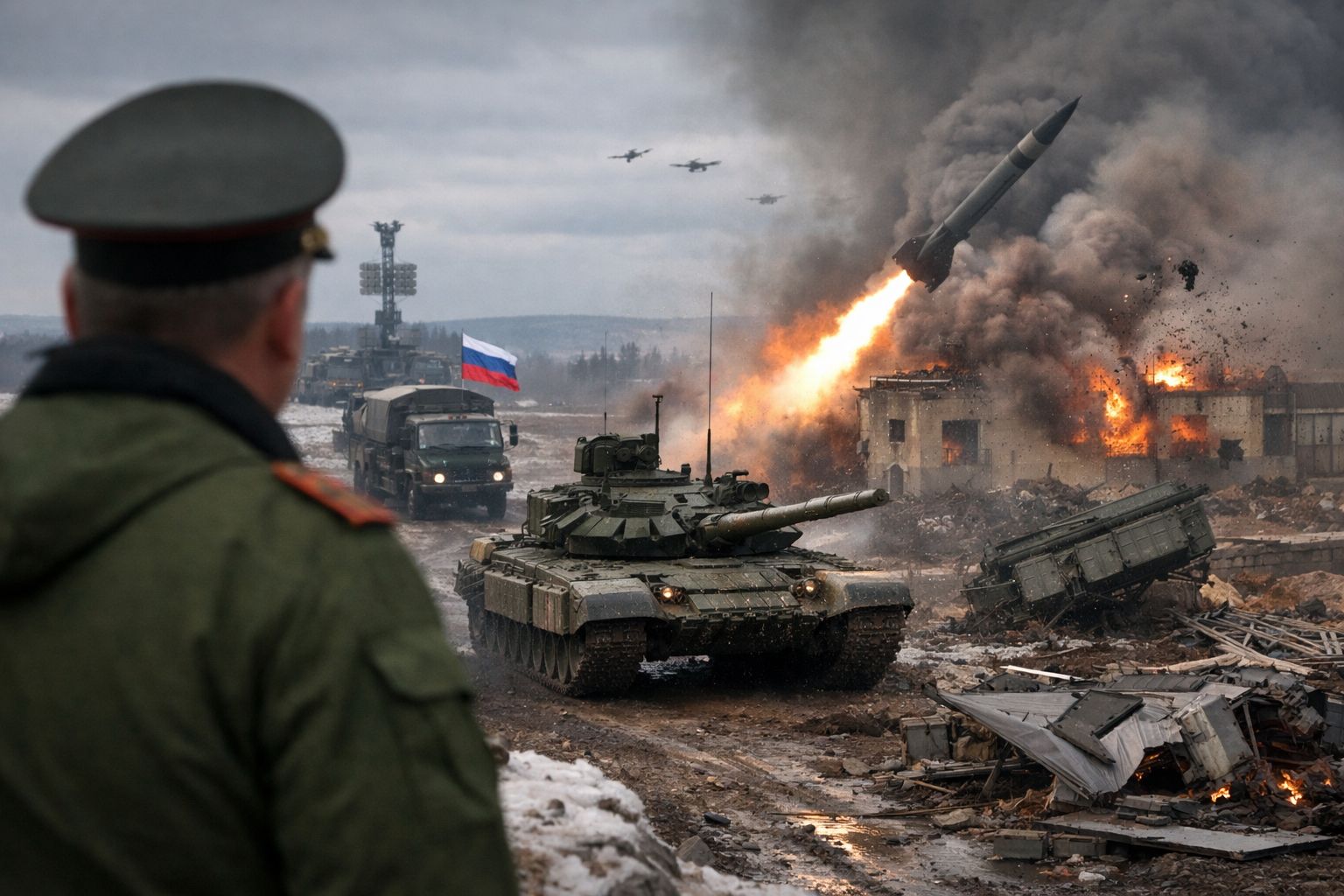
Russian officials repeat a clear and confident claim. The United States cannot cripple Russia. They argue that Russia is too large, too armed, and too resilient for any external power to meaningfully degrade its ability to wage war. In their view, even a direct confrontation would not lead to paralysis. Russia would absorb the blow, adapt, and continue fighting. This belief has become a central part of Russian strategic thinking.
However, this confidence rests on a flawed assumption. It assumes that war must end in total collapse to be effective. It assumes that anything short of complete paralysis does not matter. That assumption no longer holds in modern warfare.
Russia builds its confidence on scale, depth, and deterrence. It has vast territory, large reserves, and layered defenses. It also possesses nuclear weapons, which make full-scale invasion extremely unlikely. From this, Russian officials conclude that their military system cannot be crippled. They accept that damage is possible, but they reject the idea of systemic degradation. As long as the state survives, they assume the military remains effective.
Outdated model
This thinking comes from an older model of war. In the past, wars were decided by mass confrontation, large-scale offensives, and territorial control. Victory required overwhelming force and often total defeat of the opponent. Under that model, Russia’s assumption appears reasonable. A country of such size and capacity would indeed be difficult to destroy.
However, modern warfare operates differently. It relies on constant surveillance, precision targeting, and real-time intelligence. Advanced systems allow for the identification and destruction of key assets without the need for full invasion. War no longer requires total confrontation. It can proceed through systematic, targeted degradation.
This is where the Iranian case becomes crucial. Iran built its military doctrine around survival under pressure. It dispersed its infrastructure, hardened its facilities, and relied on redundancy. The assumption was clear. Even if attacked, the system would endure. It would remain functional and capable of retaliation.
Iran
However, recent developments show a different outcome. Iran was not destroyed as a state, but its military capability was severely degraded. Precision strikes targeted key systems, including infrastructure, command structures, and production capacity. The result was not immediate collapse, but something more significant. Iran’s ability to operate effectively was reduced.
This distinction is critical. Iran did not fall, but it was crippled. Its systems were not eliminated, but they were weakened to the point where their effectiveness dropped sharply. The country could still act, but it could not act in the same way as before.
This directly challenges the Russian assumption. Russian officials focus on survival. They argue that as long as the state continues to function, it cannot be considered crippled. However, the Iranian case shows that survival is not the key variable. Capability is.
Army’s inability to perform effectively
A military does not need to be destroyed to be neutralized. It only needs to be degraded to the point where it cannot perform effectively. Precision warfare makes this possible. It targets coordination, logistics, and critical systems rather than seeking total destruction.
Russia already shows signs of this vulnerability. The war in Ukraine has demonstrated the impact of drones, precision strikes, and intelligence-driven targeting. Russian logistics have been disrupted, command structures have been pressured, and equipment losses have accumulated. Despite this, Russia continues to fight, which reinforces the belief that it remains strong.
However, this endurance can be misleading. Continuing to fight does not mean maintaining full capability. A system can operate while becoming progressively weaker. Over time, this degradation affects efficiency, coordination, and strategic flexibility.
Modern warfare
The real shift in modern warfare lies here. Victory no longer requires complete destruction. It requires sustained degradation. A military can be weakened step by step until its ability to act effectively is significantly reduced.
Iran demonstrates this clearly. It was not necessary to destroy the entire system. It was enough to target key components and reduce their effectiveness. The result was a crippled military structure that still exists but operates under severe limitations.
This is the uncomfortable implication for Russia. The claim that the United States cannot cripple Russia depends on an outdated definition of what crippling means. If crippling requires total collapse, then the claim holds. However, if crippling means systematic degradation of military capability, then the situation changes.
Russia may not collapse. It may not be invaded or destroyed. However, it can be weakened in ways that significantly reduce its effectiveness. That is what modern warfare enables.
The belief that “it cannot happen to us” is not new. It appears repeatedly in history. It is based on past models of conflict and assumptions about scale and strength. However, new forms of warfare change what is possible.
Iran shows that even systems designed for survival can be degraded. It shows that resilience does not equal immunity. It shows that a military can continue to exist while losing its ability to function at full capacity.
Russia may still believe that it cannot be crippled. However, the definition of crippling has already changed. That is the real strategic shift.
Leave a Reply