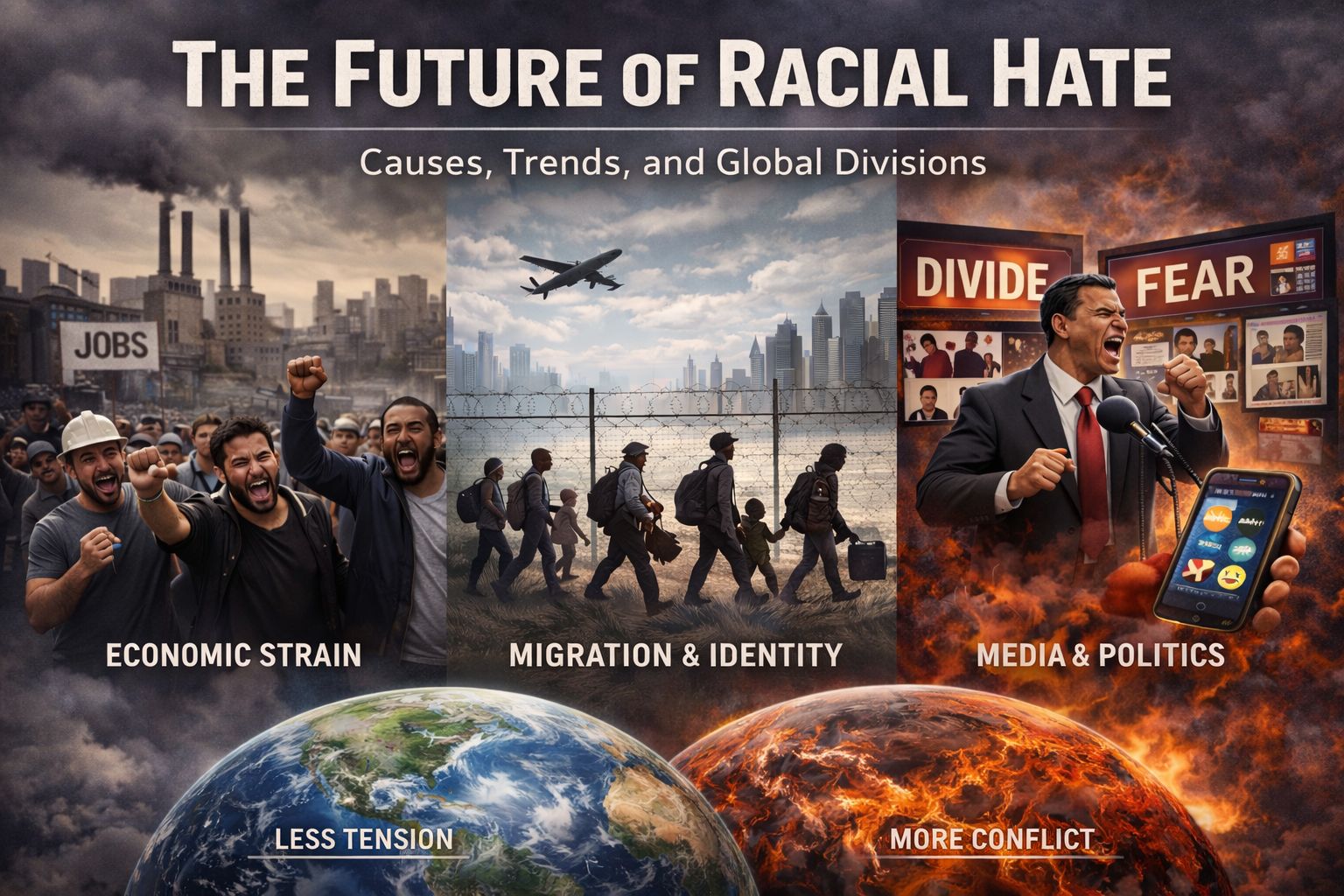
At first glance, people ask a simple question. Is racial hate rising or declining? However, the answer is more complex. It does not simply increase or decrease. Instead, it transforms. It shifts form, language, and visibility. In some places, it becomes subtle. In others, it becomes direct and violent. Therefore, to understand its future, one must examine the mechanisms that produce it.
The evolutionary foundation: In-group and out-group
To begin with, human beings evolved in small groups. Survival depended on cooperation within the group and caution toward outsiders. As a result, this created a basic psychological structure. People favor those who look, speak, and behave like them. At the same time, they remain suspicious of those who do not.
Importantly, this mechanism did not disappear. Instead, it scaled. As societies grew, tribes became ethnicities. Then, ethnicities became nations. Eventually, race emerged as a visible marker layered on top of deeper instincts. Consequently, what appears as racial conflict often reflects older patterns expressed in modern categories.
Race as a modern abstraction
At the same time, race is not a fixed biological category in a strict scientific sense. However, perception matters more than classification. Humans react to visible differences quickly. Skin color, facial features, and language act as signals. Therefore, these signals trigger group identification.
Over time, societies built narratives around these differences. Moreover, laws, institutions, and cultural norms reinforced them. As a result, race became a powerful organizing principle, even if its biological basis is limited.
Economic pressure as an amplifier
Furthermore, racial tension does not operate in isolation. It intensifies under economic stress. When resources are abundant, societies tolerate diversity more easily. However, when resources become scarce, competition increases.
Consequently, jobs, housing, and social services become contested. Groups begin to compare outcomes. If one group perceives disadvantage, resentment grows. In turn, this resentment often takes racial form, even when the root cause is economic.
Therefore, periods of recession, inflation, or inequality act as catalysts. They do not create racial hate from nothing. Rather, they activate and amplify existing divisions.
Migration and demographic change
In addition, large-scale migration changes the composition of societies. It introduces new languages, cultures, and identities. As a result, this process creates both opportunity and tension.
On the one hand, migration supports economic growth and cultural exchange. On the other hand, it challenges established identities. Native populations may perceive loss of status or cultural dilution. Meanwhile, migrant communities may face exclusion or discrimination.
Ultimately, the outcome depends on integration. Where integration succeeds, conflict decreases over time. However, where it fails, parallel societies emerge. Consequently, these parallel structures reinforce division and increase the probability of conflict.
Media, perception, and amplification
At the same time, modern media systems transform how people perceive reality. Social media platforms prioritize engagement. Therefore, content that provokes strong reactions spreads faster. In particular, conflict, outrage, and fear receive more attention than stability.
As a result, isolated incidents appear representative. A single event can shape global perception. Moreover, narratives of racial conflict circulate rapidly. Consequently, people begin to believe that such conflict is constant and widespread.
This creates feedback loops. Perception influences behavior. Behavior, in turn, reinforces perception. Over time, media does not just report conflict. Instead, it helps structure it.
Political incentives and identity mobilization
Similarly, political actors respond to incentives. Identity is a powerful tool. It simplifies complex issues. It creates clear divisions. Therefore, it mobilizes voters effectively.
As a result, leaders can frame economic or social problems in racial terms. This shifts responsibility and concentrates support. In effect, it transforms diffuse dissatisfaction into targeted opposition.
Importantly, this process is not limited to one region. It appears across political systems. In stable periods, it remains controlled. However, in unstable periods, it intensifies.
At the same time, stable societies rely on shared narratives. These narratives create trust. They allow individuals from different backgrounds to cooperate.
However, when these narratives weaken, fragmentation increases. Groups begin to define themselves separately. They develop distinct norms, values, and perspectives. As a result, interaction decreases, and misunderstanding increases.
Without a shared framework, small differences become significant. Consequently, conflict becomes more likely because there is no common ground to resolve it.
Education and its limits
Of course, education reduces explicit prejudice. It introduces norms of equality and tolerance. It provides tools for critical thinking. However, it does not eliminate underlying instincts.
Therefore, people can hold egalitarian beliefs while still reacting emotionally to difference. This creates tension between rational ideals and intuitive responses.
In other words, education changes expression more than impulse. As a result, racial hate may become less visible, but it does not disappear.
Regional divergence
At the same time, racial dynamics differ across regions. In many Western countries, conflict often appears in indirect forms. It manifests through policy debates, institutional structures, and cultural disagreements.
In contrast, in other regions, conflict can be more direct. It may involve violence, segregation, or open hostility. This difference reflects levels of stability, governance, and economic conditions.
Nevertheless, despite these differences, the underlying mechanisms remain similar. Only the expression changes.
Technology and the future of identity
Looking ahead, technology introduces new variables. Artificial intelligence, surveillance systems, and data analysis shape how information flows. Depending on their use, they can reduce misinformation or amplify it.
At the same time, digital environments create echo chambers. People interact mainly with those who share their views. Consequently, this reinforces identity boundaries and reduces exposure to alternative perspectives.
Therefore, technology can connect the world. However, it can also divide it more precisely.
The stability variable
Above all, the most important factor in predicting racial hate is stability. Stable societies suppress conflict. Institutions function. Economies provide opportunity. Therefore, people tolerate difference because the system works.
However, when stability declines, underlying tensions surface. Economic crises, political instability, and social disruption weaken constraints. As a result, conflict becomes more visible and more intense.
In this sense, racial hate often remains latent. It does not disappear. Instead, it waits for conditions that allow expression.
Future trajectories
Looking forward, two broad trajectories are possible.
The first is fragmentation. Societies divide into distinct groups. Interaction decreases. Consequently, conflict becomes more frequent. Identity replaces shared citizenship.
The second is integration. Groups mix over time. New hybrid identities emerge. Differences remain, but they lose their sharp boundaries.
Ultimately, which path dominates depends on policy, economic conditions, and cultural adaptation.
Conclusion: Transformation, not disappearance
In conclusion, racial hate is unlikely to disappear. It is rooted in deep psychological mechanisms. However, it will continue to change form.
In some contexts, it will become more subtle. In others, more direct. It will shift between visible and hidden states depending on conditions.
Therefore, the key is not to assume a simple trend. Instead, one must understand the system. Only then can one predict where and how it will emerge.
Leave a Reply