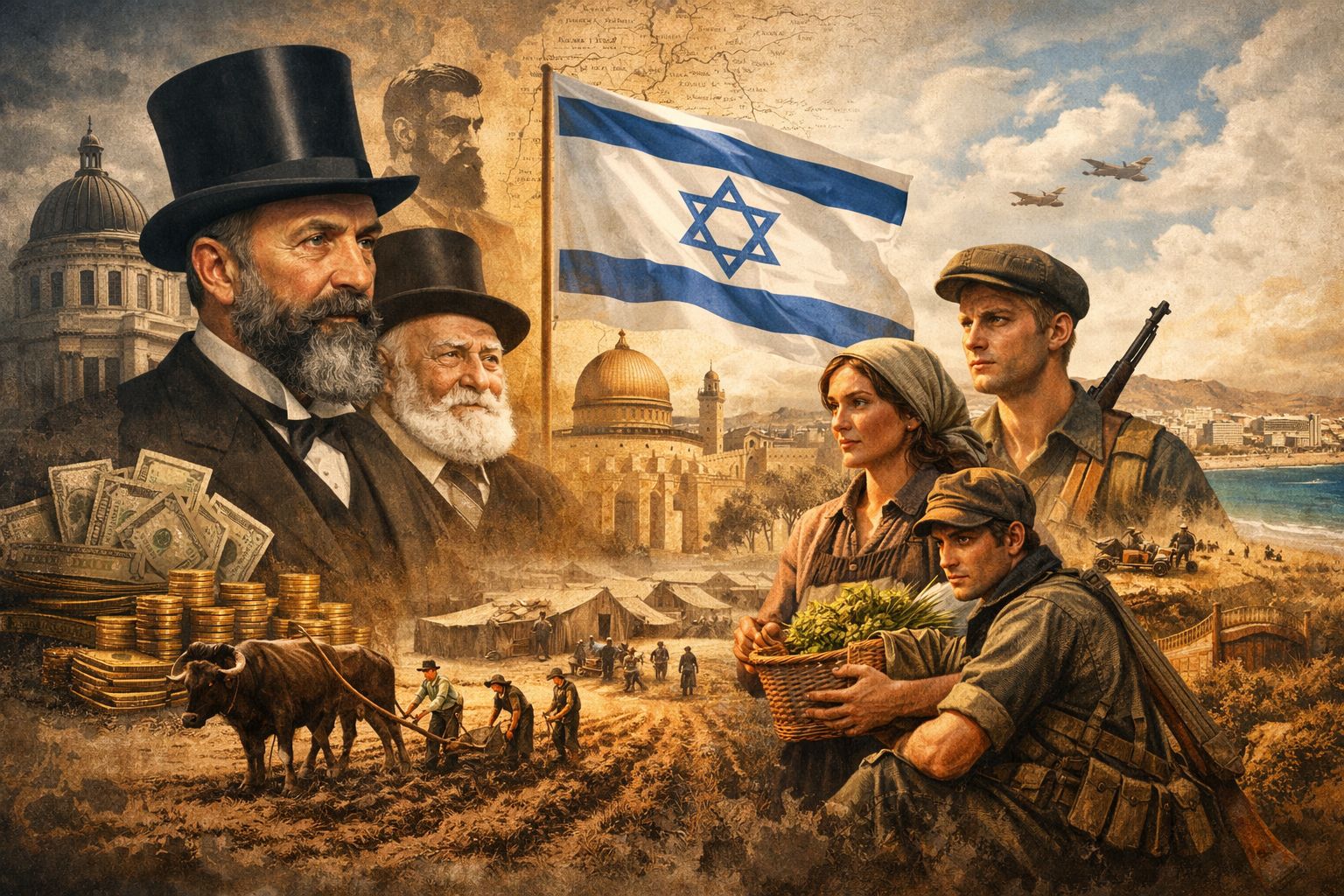
The question invites a simple answer. Some say powerful families built Israel. Others say ordinary Jewish migrants did everything. Both views miss the structure of how states actually emerge. Israel did not come from one source. It emerged from a long interaction between ideas, money, migration, institutions, and conflict. To understand it, one must separate myth from mechanism.
The idea before the state
No state appears without an idea. In the late nineteenth century, modern political Zionism formulated a clear goal: a Jewish homeland with political sovereignty. Theodor Herzl did not build settlements with his own hands. However, he transformed dispersed aspirations into a political project. He organized congresses, framed demands, and pushed the issue into international politics.
At the same time, other thinkers and activists contributed to the intellectual foundation. Figures such as Ahad Ha’am emphasized cultural revival. Chaim Weizmann later connected the movement to major powers. These individuals did not create the state alone. They created the framework within which others could act.
Capital and early settlements
Ideas alone do not build infrastructure. Early Jewish settlements required land, tools, agricultural development, and financial backing. Here, elite families played a visible role.
The most cited example is the Rothschild family. In particular, Edmond de Rothschild financed vineyards, agricultural colonies, and technical expertise in Ottoman Palestine. His support stabilized fragile early settlements that might otherwise have failed.
However, the Rothschilds were not the only financiers. Other wealthy Jewish families and networks contributed. The Montefiore family, through figures like Moses Montefiore, supported earlier Jewish communities in the region. The Warburg family, including Felix Warburg, funded institutions and migration support. The Schiff family, led by Jacob Schiff, also contributed to Jewish causes connected to migration and development.
These families provided capital. They reduced risk. They allowed settlements to survive early instability. However, they did not create a state by themselves. Money can support a project, but it cannot replace population, labor, and political organization.
Migration as the core driver
The decisive force behind the creation of Israel was migration. Several waves of Jewish immigration, known as Aliyah, brought hundreds of thousands of people to the region. These migrants came from Eastern Europe, Central Europe, the Middle East, and North Africa.
Their motivations varied. Some fled persecution and pogroms. Others followed ideological commitments. Still others sought economic opportunity. Regardless of motive, they became the population base necessary for state formation.
Migration changed demographics. It created communities. It established continuity. Without it, no amount of funding or political advocacy could have produced a state.
Labor and physical construction
Migration alone does not build infrastructure. Settlers had to cultivate land, construct housing, and create economic systems. Much of this work fell on ordinary people rather than elites.
Kibbutzim and collective settlements became central. These communities emphasized shared labor and agricultural development. They transformed land into productive space. They built roads, irrigation systems, and local industries.
This phase required physical effort. It required organization at the local level. It required persistence under difficult conditions. While financiers provided resources, migrants provided labor. Both were necessary, but they operated at different levels.
The role of ordinary people
Ordinary Jewish migrants formed the backbone of state-building. They did not provide large capital or high-level diplomacy. Instead, they created the physical and social reality on the ground. Without them, the project would have remained theoretical.
First, they built settlements. They cleared land, constructed housing, and established agricultural systems under difficult conditions. Many arrived with limited resources and had to adapt quickly. Their work transformed territory into livable and productive space.
Second, they created local economies. Small-scale farming, workshops, and trade networks emerged from daily activity. These were not elite-driven projects. They were the result of continuous effort by individuals and communities trying to survive and stabilize their environment.
Third, they developed collective structures such as kibbutzim. These communities relied on shared labor and mutual support. They allowed efficient use of limited resources and created strong internal cohesion. This model helped sustain early settlements that might otherwise have failed.
Collective defense
Fourth, they contributed to defense. Local groups organized protection against attacks and instability. Over time, these efforts evolved into more structured defense organizations. Ordinary people thus played a direct role in securing the conditions necessary for state formation.
Fifth, they built social infrastructure. Schools, healthcare systems, and community institutions did not appear from above. They emerged from local initiative. Teachers, doctors, and organizers created networks that supported everyday life.
Finally, they ensured demographic continuity. Migration alone is not enough without retention and reproduction. Ordinary people established families, communities, and long-term presence. This created the stable population base required for a functioning state.
In sum, elites provided resources and direction, but ordinary people executed the project in practice. They transformed ideas into reality.
Institutional development
A population and economy alone do not produce a state. Institutions must emerge to coordinate activity. During the pre-state period, Jewish communities developed proto-state structures.
The Jewish Agency functioned as a central administrative and political body. It coordinated immigration, settlement, and international diplomacy. Defense organizations such as the Haganah developed parallel to civilian structures.
Education systems, healthcare networks, and economic institutions also expanded. These systems created internal coherence. They allowed the emerging society to function as more than a collection of settlements.
International context and political leverage
No state forms in isolation. External powers shape outcomes. During World War I, the Balfour Declaration signaled British support for a Jewish national home in Palestine. This did not create a state, but it provided political legitimacy.
Under the British Mandate, the region became a site of competing national claims. Jewish and Arab populations developed parallel political movements. Tensions increased. Violence occurred. The situation became unstable.
After World War II, global conditions shifted. The United Nations proposed a partition plan. This external decision created a framework for statehood, though it did not resolve conflict.
Leadership and state formation
Leadership translated structure into action. Figures such as David Ben-Gurion played a decisive role. Ben-Gurion did not build settlements alone. However, he coordinated political, military, and institutional efforts at a critical moment.
In 1948, the State of Israel was declared. This moment marked the transition from movement to state. However, the declaration was not the beginning of the process. It was the result of decades of preparation.
What “building Israel” actually means
The phrase “who built Israel” compresses a complex process into a simple question. In reality, multiple layers contributed:
Financial capital came from elite families such as the Rothschilds, Warburgs, Montefiores, and others.
Ideological direction came from Zionist thinkers and political leaders.
Population growth came from mass migration across regions.
Physical infrastructure came from the labor of ordinary settlers.
Institutional capacity developed through organizations like the Jewish Agency.
Political legitimacy emerged through international decisions and diplomacy.
Each layer was necessary. None was sufficient alone.
The problem with simplified narratives
Simplified explanations often focus on one factor. Some emphasize wealthy families. Others emphasize grassroots labor. Both approaches distort reality. State formation is not a single-variable process.
Focusing only on elites ignores the role of migrants and workers. Focusing only on ordinary people ignores the importance of capital and international politics. Accurate analysis requires integrating all components.
Conclusion: A system, not a single actor
Israel was not built by one family. It was not built solely by ordinary people. It emerged from a system in which different actors performed different roles.
Elite families provided resources and early stability. Political leaders provided direction. Migrants provided population and labor. Institutions provided structure. International actors provided recognition.
Together, these elements produced a state. Separately, none of them could have done so.
Understanding this complexity does not simplify the story. It clarifies it.
Leave a Reply