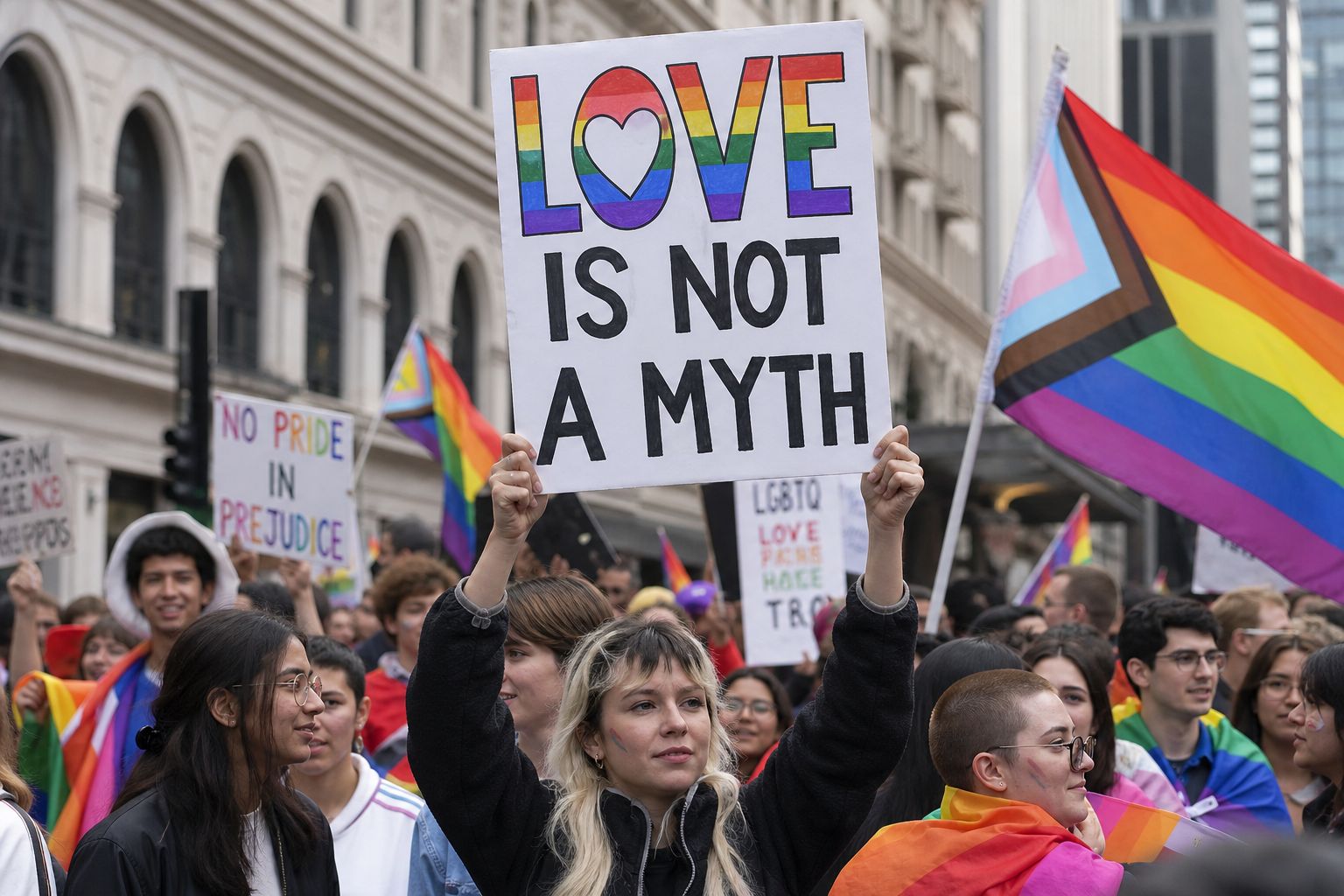
Beliefs do not survive because they are true. They survive because they are simple, repeated, and socially rewarded. Therefore, myths about LGBTQIA persist even when evidence contradicts them.
Moreover, these myths act as cognitive shortcuts. They reduce complex human variation into simple binaries. As a result, they feel intuitive. They feel obvious. However, intuition often replaces analysis. Consequently, false ideas gain stability.
At the same time, these myths do not remain abstract. They shape policy, behavior, and social norms. Therefore, understanding them is not optional. It is necessary.
How myths are built
Before examining specific claims, one must understand their structure.
Most myths rely on simplification. They compress complex phenomena into clear categories, they rely on generalization, they take limited cases and apply them universally. And they rely on moralization. They turn descriptive claims into moral judgments. They rely on emotional amplification. Fear and disgust increase acceptance.
Thus, myths are not random errors. They are structured products of cognition.
Myth 1: “It is a choice”
This myth reduces identity to a voluntary decision. It assumes that because behavior can be observed, it must be chosen.
However, this reasoning confuses levels of analysis. Behavior may vary. Underlying orientation does not respond to simple voluntary control. Evidence from psychology shows stability across time. Attempts to change orientation often fail.
This myth reflects the introspection illusion. People assume others experience choice as they do. It also reflects the fundamental attribution error. It overemphasizes personal control.
In addition, it commits a category error. It treats identity as a decision rather than a disposition.
To combat it, one must shift the frame. Focus on development; focus on consistency across cultures. Focus on the failure of conversion efforts. Replace intuition with observable patterns.
Myth 2: “It is a modern trend”
This claim confuses visibility with existence. It assumes that because something appears more often, it must be new.
However, historical records show otherwise. Same-sex behavior and gender diversity appear across centuries and cultures. The difference lies in visibility, not emergence.
This myth relies on the availability heuristic. What people see frequently feels recent. It also relies on recency bias.
Moreover, it commits an argument from ignorance. Lack of awareness becomes evidence of absence.
To counter it, present continuity. Use historical examples. Use anthropological data. Show that variation has always existed.
Myth 3: “It threatens society”
This myth assumes a causal link between LGBTQIA presence and societal decline.
However, complex systems do not operate through single variables. Societies depend on institutions, economics, governance, and stability. There is no clear mechanism through which LGBTQIA existence destabilizes these systems.
This belief relies on fear bias. It overestimates threats. It also relies on ingroup-outgroup bias.
In addition, it commits a slippery slope fallacy. Acceptance becomes collapse without evidence.
To combat it, examine functioning societies. Show that inclusive systems operate effectively. Demonstrate the absence of causal links. Replace fear with analysis.
Myth 4: “It is a mental disorder”
This claim persists despite decades of revision.
Major psychiatric institutions removed homosexuality from diagnostic frameworks. Modern understanding distinguishes between identity and distress. Distress often results from social pressure, not identity itself.
This myth reflects status quo bias. Older classifications persist in belief. It also reflects misplaced authority bias.
It commits an appeal to outdated authority. And it also uses equivocation by confusing identity with pathology.
To counter it, clarify the evolution of scientific standards. Distinguish between condition and context. Show how classifications changed with evidence.
Myth 5: “Children are being indoctrinated”
This claim assumes that exposure creates identity.
However, information does not generate orientation. It generates awareness. Children do not become something through exposure. They understand what already exists.
This myth relies on moral panic. It exaggerates perceived threats; it also relies on negativity bias.
And it commits a false cause fallacy. It assumes exposure leads directly to identity.
To combat it, distinguish between awareness and influence. Use developmental psychology. Show that education reduces confusion and harm rather than creating identity.
Myth 6: “It is against nature”
This argument appears biological but relies on selective interpretation.
Same-sex behavior appears across species. Biological systems display variation. Therefore, labeling something “unnatural” reflects definition, not evidence.
This belief relies on essentialism. It assumes fixed categories. And it also relies on intuitive appeals to nature.
It commits the naturalistic fallacy. It assumes that what is “unnatural” is wrong.
To counter it, clarify what “natural” means. Show variation in biological systems. Remove moral conclusions from descriptive claims.
Myth 7: “LGBTQIA people have special privileges”
This claim confuses corrective measures with advantage.
Legal protections aim to reduce discrimination. They do not create superiority. At the same time, disparities in safety and opportunity persist.
This belief reflects zero-sum thinking. Gains for one group appear as losses for another.
It commits a false equivalence. It treats equality as privilege.
To counter it, present data on discrimination. Distinguish between equality and advantage. Show structural constraints that remain.
Myth 8: “It is one homogeneous group”
This myth reduces a diverse population to a single category.
However, LGBTQIA includes varied identities, experiences, and challenges. Therefore, generalizations fail.
This belief reflects outgroup homogeneity bias. Differences within the group are ignored.
It commits a composition fallacy. It assumes that what applies to part applies to all.
To combat it, highlight internal diversity. Show variation across identities. Replace simplification with structure.
Myth 9: “Visibility equals promotion”
This claim assumes that representation changes identity.
However, visibility reduces stigma. It allows recognition. It does not alter fundamental orientation.
This belief relies on the illusion of causality. It also relies on the availability heuristic.
It commits a false cause fallacy.
To counter it, distinguish between recognition and influence. Show how visibility reduces psychological harm. Clarify that identity does not emerge from exposure.
The deeper mechanism: Why myths resist change
Correcting myths is difficult because beliefs are not purely rational.
People rely on confirmation bias. They accept evidence that supports existing beliefs; they use motivated reasoning. And they defend identity. They experience cognitive dissonance. Contradictions create discomfort. Therefore, they reject conflicting information.
Moreover, beliefs often signal group membership. Changing them carries social cost.
Thus, myths persist not because they are strong. They persist because they are reinforced.
Why evidence alone fails
Providing facts does not guarantee change.
People do not update beliefs like machines. They filter information, they protect identity. They avoid social risk.
Therefore, simply presenting evidence often fails.
Understanding this limitation changes strategy. It shifts focus from information to persuasion mechanisms.
Strategies to combat myths
First, use precision. Replace slogans with structured explanations.
Second, address fear. Many beliefs are emotional, not logical.
Third, combine layers. Use evidence, concepts, and framing together.
Fourth, avoid direct confrontation when possible. Confrontation triggers defensiveness.
Fifth, reframe. Replace incorrect models with better ones instead of only negating them.
Limits of persuasion
Not everyone will change their beliefs.
Some individuals remain resistant due to identity attachment. Others lack the cognitive framework to process complexity. Some face social incentives to maintain beliefs.
Therefore, persuasion operates probabilistically. It shifts distributions. It does not produce universal change.
Conclusion: From myths to mechanisms
Myths simplify reality. However, simplification leads to distortion.
Therefore, the goal is not only to refute myths. It is to expose the mechanisms that create them.
Once these mechanisms become visible, myths lose their stability.
At that point, discussion can move beyond reaction. It can move toward understanding.
Leave a Reply