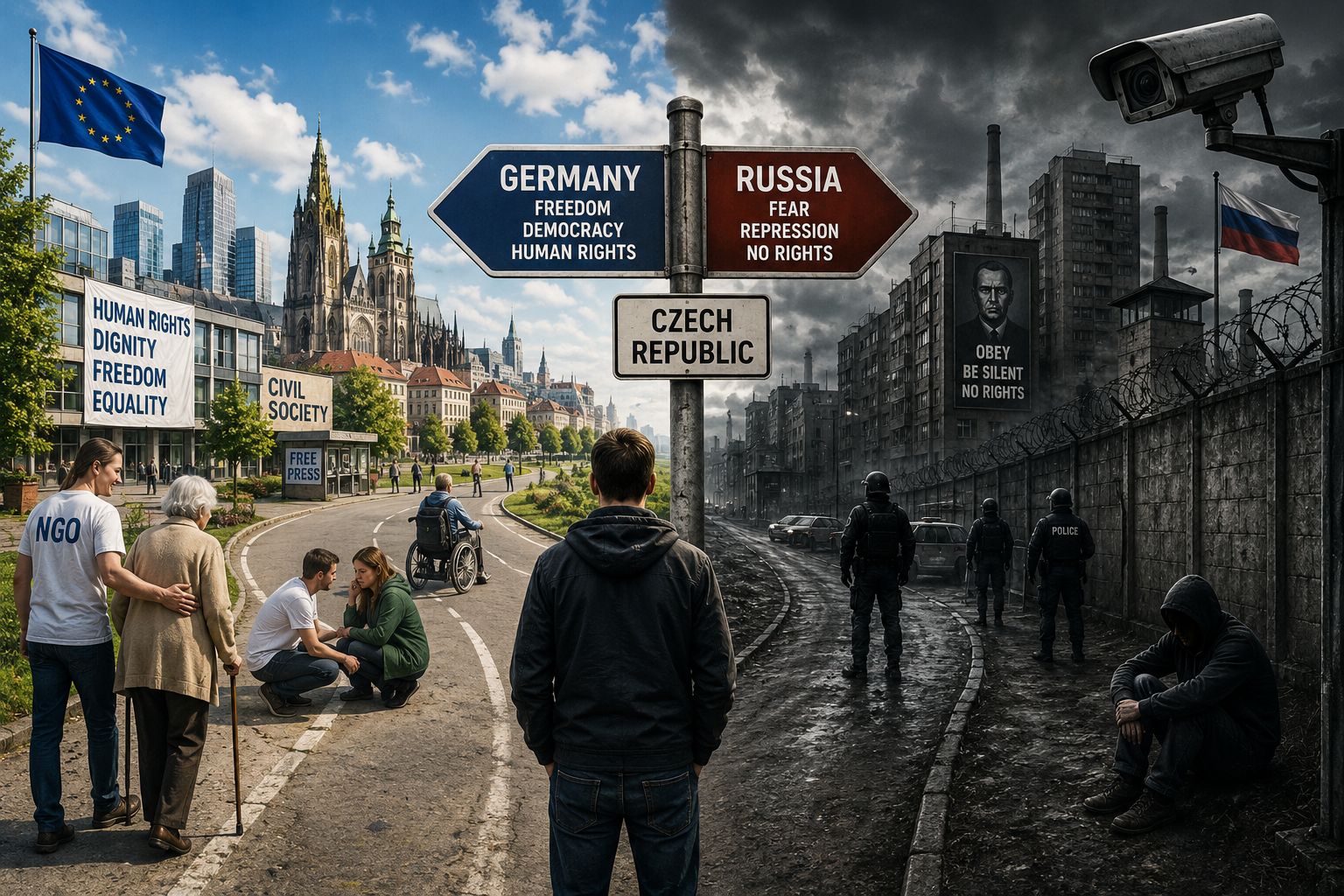
People in my country increasingly hate NGOs. They applaud every budget cut, every political attack, and every resignation of an NGO leader. They want the government to stop funding civil society and redirect every available crown to sports. That sounds attractive until someone asks a simple question: who will help the people whom the state cannot or will not help?
The Czech Republic stands somewhere between Russia and Germany. We still enjoy many freedoms that define Western democracy, but more and more people cheer every attack on NGOs and human rights. They forget that both belong to the same system that protects their own freedoms.
NGOs care for people with dementia. They support those living with mental illness. And they assist the partially sighted and the blind. They help victims of domestic violence, lonely seniors, disabled people, and many others. Government institutions provide many essential services, but they cannot reach everyone. NGOs fill the gaps, react faster, mobilize volunteers, and often solve problems before public offices even notice them.
This government has placed an enormous burden on the non-profit sector. Bureaucracy keeps growing. Political pressure keeps increasing. Many respected NGO leaders have already resigned because they no longer see a future under these conditions. Instead of asking why experienced professionals keep leaving, many people celebrate their departure. They act as if every blow against an NGO represents a victory for society.
Nothing could stand further from the truth.
Some of them really deserve criticism
Of course, not every NGO deserves praise. Some organizations waste public money. Some exist mainly to collect grants. Others produce endless reports without delivering meaningful results. Citizens should criticize them. Authorities should investigate fraud. Taxpayers deserve transparency and accountability.
I also have serious reservations about some organizations dealing with Roma issues. Many spend years repeating that Roma people suffer discrimination. Real discrimination certainly exists, and nobody should deny it. At the same time, endless complaints alone solve nothing. Some of these organizations would achieve much more if they helped people find jobs, encouraged education, promoted responsibility, and taught practical skills instead of constantly portraying Roma communities only as victims.
Criticism strengthens democracy. Hatred weakens it.
Many people no longer distinguish between good NGOs and bad ones. They lump them together and cheer whenever one loses funding or closes its doors. They treat “NGO” almost like an insult. Yet these same people rarely complain when an organization helps a blind person regain independence, supports a family caring for a relative with dementia, or assists someone battling severe depression. They condemn the institution while happily accepting the services it provides
So you hate human rights and NGOs? Go and live in Russia or China
Even worse, many of these critics also dismiss human rights. They speak about them as if they represented an unnecessary luxury or an obstacle to ordinary people. They forget one simple fact. Human rights protect everyone. They protect conservatives and liberals, they protect the wealthy and the poor. They protect government supporters and government critics. Without them, nobody stands between an individual and unlimited state power.
If they truly hate human rights that much, they should move to Russia or China.
There they can experience life without genuine political rights. They can forget about independent organizations defending ordinary citizens. They can also forget about many social rights that Europeans simply take for granted. If they lose their job, fall into poverty, or become victims of state abuse, they will quickly discover that the state rarely stands on the side of the individual.
No economic rights
Economic reality may surprise them as well. In Czech, we have a rather crude expression: “holá prdel,” literally “a naked ass.” We use it to describe someone who has absolutely nothing. Someone who has become desperately poor. Many people who despise human rights and civil society would discover exactly what that expression means.
And if they decide to complain?
The authorities may rip their fingernails out.
That image sounds brutal because authoritarian rule is brutal. Dictatorships rarely answer criticism with debate. They answer it with fear, intimidation, prison, torture, and silence.
Many people enjoy freedom every single day without realizing who helps defend it. Independent journalists defend it. Courts defend it. Civil society defends it. NGOs defend it. None of these institutions work perfectly. All of them deserve scrutiny. None of them deserve blind hatred.
People should stop confusing imperfect organizations with the values they defend. A democracy without independent NGOs quickly becomes weaker. A country that celebrates attacks on human rights does not become stronger. It simply takes another step toward the kind of regime that many of its loudest supporters would never dare to live under.
The alternative has a name.
It is not democracy.
Leave a Reply