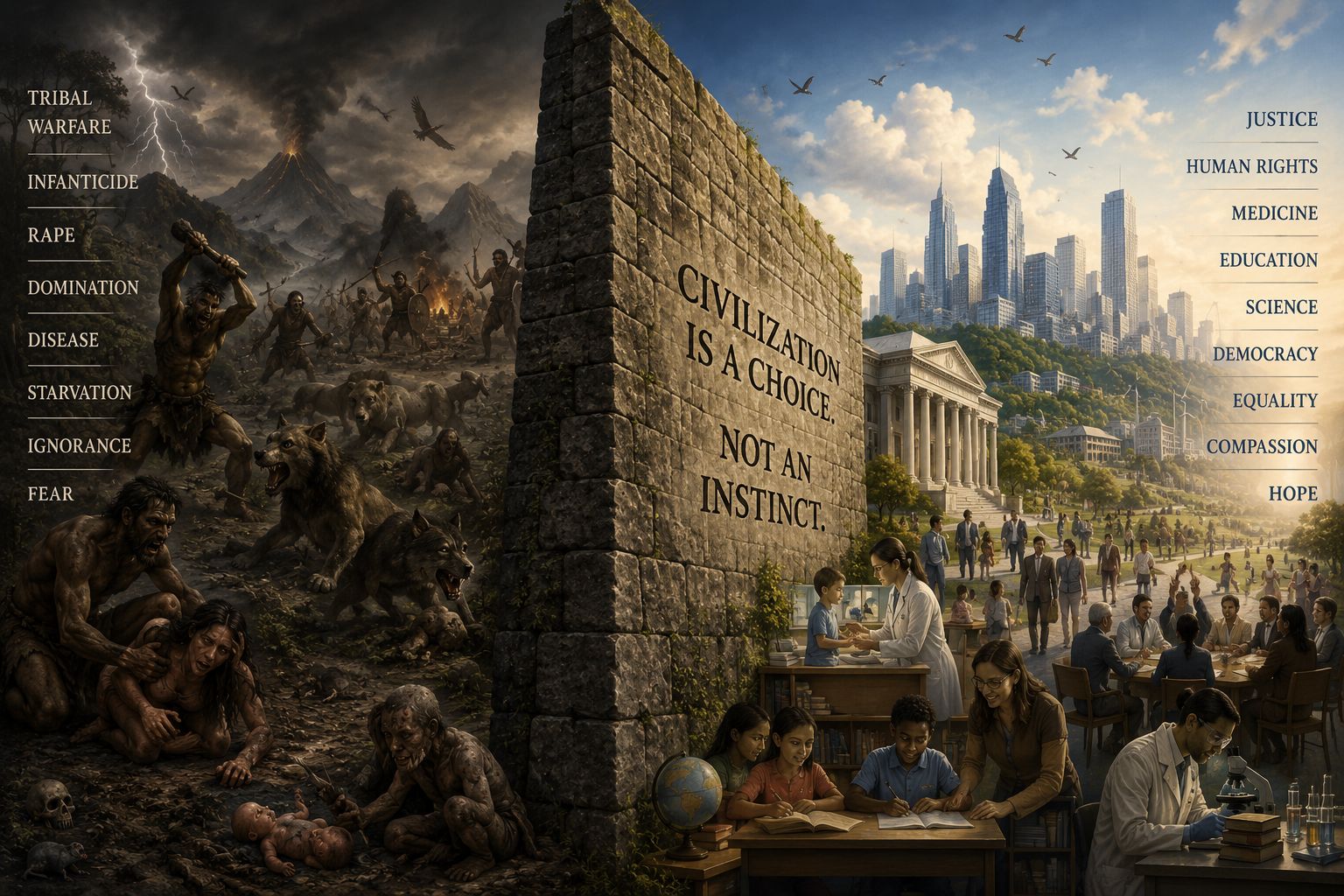
“It is perfectly natural.” Few arguments sound more convincing. People invoke nature to defend traditional gender roles, justify eating meat, condemn homosexuality, excuse aggression, or claim that hierarchy and inequality will always remain necessary. Although the subjects differ, the hidden conclusion remains the same. If something is natural, it must also be morally acceptable.
This argument feels intuitive because human beings evolved in nature. Our bodies, emotions, desires, and instincts emerged through natural selection. Therefore, many people assume that evolution also produced a moral guide. They move silently from a biological description to an ethical command. Humans behaved this way for thousands of years, so we should continue behaving this way today.
However, the argument collapses as soon as we examine nature honestly. Nature contains cooperation, parental love, empathy, and sacrifice, but it also contains killing, rape, infanticide, cannibalism, parasitism, disease, domination, and abandonment. If natural behavior automatically became moral behavior, we would have to approve of all of it rather than selecting only the parts we already like.
The appeal to nature therefore works selectively. People invoke it when nature appears to support their existing beliefs, yet they abandon it the moment nature produces a conclusion they find horrifying. Few conservatives who defend “natural” gender roles also demand the restoration of infant exposure. Few nationalists who praise tribal loyalty openly support massacring neighboring tribes. Nevertheless, both practices have deep roots in human history.
Nature may explain why a behavior exists. It cannot tell us whether we should preserve it.
The death penalty is natural
Human beings have executed other human beings for thousands of years. Ancient Egypt used capital punishment. Ancient Greece used it. Rome crucified, burned, beheaded, and strangled offenders. Medieval states executed people for murder, treason, theft, heresy, and numerous other crimes. Even today, many governments continue to kill prisoners in the name of justice.
The death penalty therefore qualifies as natural in the ordinary sense in which people use the word. It appears repeatedly across cultures, historical periods, religions, and political systems. Human beings developed it independently in different societies, while rulers and communities often treated it as a normal response to serious wrongdoing. If historical continuity proved moral legitimacy, capital punishment would possess an extraordinary moral pedigree.
Yet millions of people oppose it. They argue that courts make mistakes, governments abuse power, and irreversible punishments leave no room for correction. Others reject the idea that the state should kill a defenseless prisoner, even when that prisoner committed a terrible crime. These arguments do not depend on whether execution feels natural. They ask whether it is just.
That distinction matters. Once people begin discussing wrongful convictions, discrimination, deterrence, proportionality, and state violence, the appeal to nature quietly disappears. Nobody can settle the debate by announcing that humans have always killed criminals. History explains the origin and persistence of the practice, but it does not justify its continuation.
If “natural” truly meant “good,” death-penalty abolition would represent moral decline rather than moral progress. Most abolitionists believe the opposite because they already understand that civilization can improve by rejecting inherited practices.
Infanticide is also natural
Infanticide provokes even stronger emotions. Modern societies rightly treat the deliberate killing of a child as one of the most horrifying acts imaginable. Nevertheless, the practice appears repeatedly in both human history and the animal world. Ancient Greeks sometimes exposed unwanted newborns. Romans also abandoned infants, particularly when families regarded them as illegitimate, disabled, or economically burdensome. Other societies resorted to infanticide during famine, migration, or extreme resource scarcity.
Biologists can explain why such behavior emerged. Parents possess limited resources. In brutal environments, preserving one child could reduce the survival prospects of several others. Evolution does not maximize kindness, justice, or happiness. It favors traits and behaviors that increase reproductive success under particular conditions, even when those behaviors look monstrous from a modern moral perspective.
From an evolutionary standpoint, paternal infanticide driven by paternity suspicion is rooted in reproductive competition and resource allocation. Evolutionary biology posits that males are naturally selected to invest their time, energy, and protection primarily in offspring that carry their own genetic lineage—a concept known as “paternal certainty.” When a father perceives a high probability that an infant is not biologically his, the evolutionary calculus shifts: the child ceases to represent a genetic legacy and instead becomes a competitor consuming resources that could otherwise be directed toward the father’s own future reproductive success or existing kin.
In both humans and animals
This does not imply conscious calculation but rather an inherited psychological predisposition toward jealousy and mate-guarding that, in extreme cases, can override the usual parental bonding mechanisms and trigger lethal outcomes. Importantly, evolutionary models also predict that this response is highly context-dependent—more likely in environments where paternal investment is critical to offspring survival and where the social cost of raising a non-biological child is severe—yet they simultaneously emphasize that such violence is a maladaptive byproduct of these instincts, not an optimal strategy, as it often results in the father’s own imprisonment, ostracism, or death, ultimately harming his inclusive fitness rather than enhancing it.
Infanticide also occurs among animals. Male lions may kill cubs after taking control of a pride. Some primates kill infants associated with rival males. Rodents and other mammals may abandon or consume offspring when resources disappear or stress becomes severe. These behaviors are not unnatural exceptions. They form part of nature itself.
Yet nobody seriously argues that human beings should legalize infanticide because other animals practice it. We do not excuse the killing of a newborn by referring to lions, monkeys, or prehistoric survival pressures. Instead, we judge the act according to moral principles that nature never supplied.
This example exposes the central weakness of the appeal to nature. A natural explanation can help us understand a behavior without making that behavior desirable. We can explain why infanticide evolved while still condemning it absolutely. Explanation and justification remain different intellectual tasks.
War is older than civilization
War also belongs to the natural history of humanity. Long before people built modern states, they formed coalitions, defended territory, raided rivals, and killed members of competing groups. Archaeologists have found evidence of prehistoric massacres, while anthropologists have documented violent conflict in numerous small-scale societies. Chimpanzees also conduct coordinated attacks against neighboring groups, which suggests that coalitionary violence may have roots older than humanity itself.
If prevalence and evolutionary origin determined morality, war would become difficult to condemn. It has accompanied our species for millennia, shaped political institutions, and repeatedly rewarded groups that defeated their competitors. Conquest brought territory, food, labor, prestige, and reproductive opportunities. From a strictly evolutionary perspective, violence sometimes worked.
However, very few people conclude that war is good merely because it is ancient. Governments build diplomatic institutions precisely because natural rivalry can destroy entire societies. International law attempts to restrict conquest. Peace movements demand negotiation. Nuclear arms control exists because humanity recognizes that some inherited impulses have become catastrophically dangerous.
The United Nations, peace treaties, war-crimes tribunals, and international courts did not emerge because nature instructed us to create them. They emerged because human beings wanted to restrain patterns of conflict that nature had repeatedly produced. Civilization did not simply follow our instincts. It attempted to control them.
Once again, natural does not mean moral. War may reveal something about human evolution, but it does not provide a model for human ethics.
Male dominance has deep biological roots
Supporters of traditional social hierarchies often appeal to biology. They point to male competition, physical differences, historical patriarchy, and dominance structures among primates. In many societies, men controlled political power, property, organized violence, and family authority. Similar patterns appear among several animal species, particularly where males compete intensely for reproductive access.
This history makes male dominance natural in at least one descriptive sense. It repeatedly emerged under social and ecological conditions that rewarded physical strength, aggression, and control over resources. However, that observation does not prove that patriarchy remains morally desirable or politically necessary.
Human societies no longer organize every institution around physical strength. A judge does not need to defeat another judge in combat. A scientist does not need greater muscle mass than a colleague. Modern economies depend on education, specialization, communication, and technology rather than brute force. Biological differences may influence average tendencies, yet they do not dictate how law should distribute rights.
Moreover, natural selection produced many tendencies that liberal societies try to restrain. Aggression may be natural, but assault remains illegal. Sexual jealousy may be natural, but it does not justify coercion. Dominance-seeking may be natural, but democracy limits the power of those who want to dominate others.
Therefore, even if patriarchy emerged partly from natural conditions, nothing follows about whether we should preserve it. A biological origin explains the past. It does not determine the future.
Xenophobia evolved for a reason
Human beings spent most of their evolutionary history in relatively small groups. Outsiders could carry diseases, compete for territory, steal resources, or launch attacks. Suspicion toward strangers may therefore have increased survival under certain conditions. Tribal loyalty, conformity, and hostility toward rival groups probably did not appear by accident.
These tendencies still influence modern politics. Nationalists divide humanity into insiders and outsiders. Politicians blame immigrants for crime, unemployment, or cultural decline. Ethnic hatred turns minor differences into moral boundaries. People often trust members of their own group more easily than unfamiliar strangers, even when they lack rational reasons for doing so.
However, evolutionary usefulness does not create moral legitimacy. Fear of outsiders may once have protected small communities, but the same instinct can now produce racism, persecution, ethnic cleansing, and war. A tendency that solved one prehistoric problem may create enormous suffering in a modern interconnected world.
Civilization therefore asks us to resist tribal reflexes rather than worship them. Universal human rights reject the idea that moral worth depends on birthplace, ethnicity, religion, or nationality. Courts must protect foreigners as well as citizens. Humanitarian principles require us to care about distant strangers whom evolution never prepared us to meet.
Xenophobia may be natural. That gives us a reason to understand and control it, not a reason to celebrate it.
Disease is completely natural
The appeal to nature looks especially absurd when we apply it to medicine. Cancer is natural. Malaria is natural. Bacterial infections are natural. Genetic disorders, parasites, viruses, miscarriages, and physical degeneration all emerge from natural processes. Nothing in nature guarantees human health or happiness.
Yet nobody tells a patient to accept cancer because tumors arise naturally. We do not reject antibiotics because bacteria belong to the ecosystem. We do not ban surgery because the human body did not evolve operating rooms. Instead, humanity invests enormous resources in correcting what nature produces.
Vaccination interferes with natural infection. Anesthesia blocks natural pain. Glasses correct natural vision problems. Insulin compensates for a natural bodily failure. Caesarean sections allow women and babies to survive complications that nature might otherwise resolve through death.
Modern medicine therefore represents a systematic rebellion against nature. Its purpose is not to preserve every natural process but to decide which processes harm human beings and then change them. We judge nature according to human values rather than judging human values according to nature.
Strangely, many people who invoke nature in political or sexual debates abandon the principle immediately when their own health becomes threatened. They may condemn a behavior as unnatural in the morning and take highly sophisticated medication in the afternoon. Their actions reveal that they never truly believed natural meant good.
Nature contains no human rights
Nature offers no freedom of speech, democratic elections, independent courts, universal education, or social security. Strong animals do not grant weaker ones constitutional protections. Predators do not respect the bodily autonomy of prey. Parasites do not obtain informed consent from their hosts.
Human rights therefore did not emerge by copying nature. They emerged because people gradually decided that power alone should not determine morality. The weak deserve protection even when the strong could exploit them. Minorities deserve rights even when majorities dislike them. Individuals deserve dignity even when the state finds repression convenient.
This moral development represents one of humanity’s greatest achievements. It separates what happens naturally from what should happen ethically. Nature distributes strength unequally, while justice attempts to prevent strength from becoming unlimited authority. Nature allows suffering without explanation, while morality asks how suffering can be reduced.
If we treated nature as a political constitution, dictatorship would appear more natural than democracy. Hierarchy dominates the animal world, and no chimpanzee troop holds competitive elections with constitutional limits. Nevertheless, few defenders of democracy worry that voting is biologically unnatural.
We accept democracy because we value its consequences and principles, not because nature invented it.
Civilization is the rejection of nature
Civilization does not eliminate human nature, but it constantly restrains, redirects, and corrects it. Children may naturally grab what they want, yet adults teach them to share. People may naturally seek revenge, yet courts replace private vengeance with legal procedure. Strong individuals may naturally dominate weaker ones, yet law limits what they may do.
Education also changes behavior that would otherwise emerge spontaneously. Reading and mathematics do not develop automatically without instruction. Professional ethics often require people to resist self-interest. Scientific reasoning demands that researchers question intuition, bias, authority, and tribal loyalty.
Even ordinary politeness requires control over natural impulses. People learn not to scream whenever they feel angry, steal whenever they feel envy, or attack whenever they feel insulted. Society functions because most individuals suppress countless desires that may feel completely natural.
Of course, civilization also uses natural capacities. Cooperation, empathy, attachment, curiosity, and reciprocity have biological foundations. The mistake lies in assuming that we must accept every evolved tendency merely because evolution produced it. Human nature contains competing impulses, and morality helps us decide which ones to cultivate.
Our greatest achievement is therefore not the complete rejection of nature. It is our ability to evaluate nature rather than obey it blindly.
Hume’s warning
The philosophical problem behind the appeal to nature has a long history. David Hume observed that writers often move from statements about what is to conclusions about what ought to be. They describe the world and then suddenly introduce a moral command without explaining how the command follows from the description.
For example, someone may say that men historically dominated politics and then conclude that men should continue dominating politics. Another person may say that humans naturally eat meat and then conclude that eating meat is morally right. A third may claim that homosexuality does not serve reproduction and therefore ought to be condemned.
In each case, the argument jumps from fact to value. Even when the factual claim is correct, the moral conclusion requires an additional principle. History alone cannot supply it. Biology alone cannot supply it. Evolution alone cannot supply it.
Hume’s point does not mean that facts never matter to morality. Facts tell us about consequences, causes, risks, and human needs. However, facts cannot create moral goals by themselves. We must first decide what we value, such as happiness, freedom, equality, survival, or the reduction of suffering.
Only then can evidence help us choose effective actions.
Moore and the naturalistic fallacy
G. E. Moore later attacked a related mistake, which became known as the naturalistic fallacy. He argued that moral concepts such as “good” cannot simply be reduced to natural properties such as pleasure, survival, normality, or evolutionary fitness. Something may increase reproductive success without becoming morally good. Likewise, something may be unusual in nature without becoming morally wrong.
The concept often receives oversimplified treatment, and not every appeal to nature fits Moore’s precise philosophical definition. Nevertheless, the broader lesson remains useful. People frequently assume that a natural property automatically carries moral authority. They treat common, evolved, traditional, or biologically functional behavior as if those descriptions settled the ethical question.
They do not.
Infanticide may sometimes increase the survival prospects of other offspring. War may expand a group’s territory. Male dominance may enhance the reproductive success of powerful men. Xenophobia may strengthen internal group cohesion. None of these consequences automatically make the behavior good.
Evolution measures reproductive success. Morality asks different questions.
Natural behavior can still be good
Rejecting the appeal to nature does not require claiming that everything natural is bad. Love is natural. Cooperation is natural. Parental care is natural. Empathy, friendship, play, and mutual aid also have evolutionary foundations. Human beings could not build societies without these capacities.
However, these behaviors do not become good merely because they are natural. We value love because it enriches lives. We value cooperation because it allows people to achieve shared goals. We value empathy because it reduces suffering and helps individuals understand one another.
The moral work still comes from evaluating consequences, rights, duties, or virtues. Nature may provide the capacity, but human judgment assigns the value.
This distinction prevents the opposite mistake. We should not conclude that unnatural things are automatically good or that natural things are automatically bad. The entire natural-versus-unnatural framework often distracts from the questions that actually matter.
Does a behavior harm anyone? Does it increase well-being? Does it violate autonomy? Does it promote justice? Those questions provide much better moral guidance than asking whether something appears in the animal kingdom.
The selective use of nature
Most appeals to nature reveal more about the speaker’s preferences than about nature itself. Someone who already opposes homosexuality may call it unnatural while ignoring same-sex behavior among animals. Someone who supports rigid gender roles may emphasize average biological differences while ignoring the enormous variation within each sex. Someone who defends economic competition may call it natural while overlooking equally natural cooperation.
Nature contains enough diversity to support almost any political slogan. People can point to hierarchy among wolves, cooperation among insects, monogamy among some birds, promiscuity among other species, male dominance among gorillas, or female dominance among bonobos and hyenas. Selecting one example proves little.
Human beings do not construct morality by conducting a popularity contest among animal behaviors. Even if every animal species behaved in one particular way, we would still need to ask whether humans should imitate it. Biological frequency cannot replace ethical reasoning.
Therefore, the phrase “it is natural” usually ends the conversation precisely where serious moral analysis should begin.
Should we bring the old practices back?
Let us take the appeal to nature seriously for a moment. Capital punishment appears throughout history. Infanticide occurs in humans and other animals. Tribal warfare predates modern civilization. Xenophobia may have evolutionary roots. Male dominance repeatedly emerged across societies. Disease belongs entirely to nature.
Should we restore all these things?
Should governments execute more prisoners because execution has a long history? Should parents kill infants during economic hardship because similar behavior increased survival in harsh environments? Should neighboring states raid one another because chimpanzees conduct territorial attacks? Should ethnic discrimination become acceptable because suspicion of outsiders once served an evolutionary function?
Almost everyone will answer no. The examples sound outrageous because they expose the hidden absurdity of the original principle. People do not actually believe that whatever is natural is morally right. They believe that some natural things are right and others are wrong.
Once they admit this, nature no longer decides the argument. Moral judgment does.
Conclusion
Human beings came from nature, but we do not have to treat nature as a sacred lawgiver. Evolution created our capacities for love and cruelty, cooperation and domination, reason and prejudice. It gave us no guarantee that every instinct would remain useful, humane, or morally defensible.
The death penalty is natural. Infanticide is natural. War, xenophobia, disease, and brutal hierarchy are also natural. Their natural origins do not make them good, just as the artificial origins of medicine, democracy, or human rights do not make them bad.
The next time someone says that a practice deserves approval because it is natural, we should ask a simple question. Which other natural practices are they prepared to accept? If they reject infanticide, tribal warfare, lethal disease, and domination, then they have already abandoned nature as their moral standard.
Nature explains where we came from. It does not tell us where we should go.
Leave a Reply