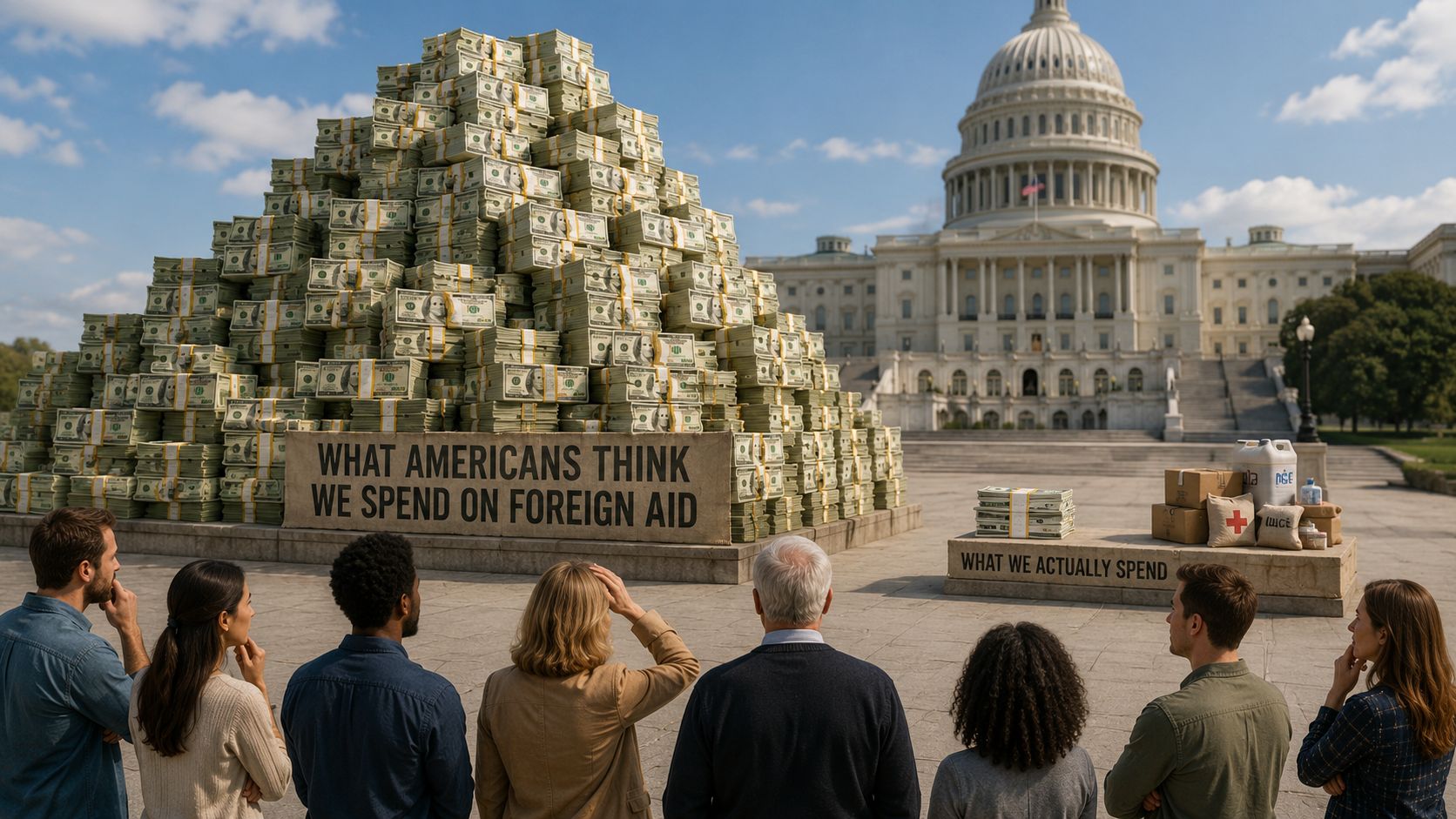
Ask the average American how much of the federal budget goes to foreign aid, and the answer will often be astonishing.
Around one quarter.
For decades, surveys have repeatedly found that Americans believe roughly 25% of the federal budget is spent helping other countries. The real number is nowhere close. Before the recent reductions in foreign assistance, the United States devoted only about 1% of the federal budget to foreign aid. Relative to the country’s economy, that amounted to roughly one quarter of one percent of GDP.
The gap between perception and reality is one of the largest misconceptions ever documented in public opinion research.
A nation that overestimates
The misconception has remained remarkably stable across multiple surveys.
When Americans are asked how much the government spends on foreign aid, the median answer is about 25% of the federal budget.
When they are asked how much the government should spend, the answer falls to roughly 10%.
Finally, when researchers reveal that the real figure is about 1%, many respondents express surprise. A substantial share then concludes that current spending is reasonable or even too low.
This tells us something important.
Many Americans are not necessarily opposed to helping poorer countries. They simply believe their government is already spending enormous sums abroad.
You could rewrite the section like this:
One percent divides opinion
Even after people learn the real figure, opinions remain divided.
Many Americans still believe 1% is too much. They argue that the federal government should focus primarily on domestic problems such as healthcare, education, infrastructure, crime, homelessness, and the national debt. In their view, American taxpayers should not bear responsibility for financing development abroad while significant challenges remain at home.
Others consider 1% entirely fair. They argue that the United States already shoulders a large share of global security responsibilities, contributes to disaster relief, funds vaccination campaigns, responds to famines, and finances development projects across the world. From this perspective, one percent strikes a reasonable balance between helping others and serving American taxpayers.
A third group reaches the opposite conclusion. They argue that one percent is simply too little for the world’s largest economy. The United States possesses extraordinary wealth, technological leadership, and unmatched global influence. If it expects to lead the international community, they argue, it should devote a larger share of its resources to reducing poverty, fighting disease, responding to humanitarian disasters, and supporting development in poorer countries.
Public opinion reflects this divide. Surveys consistently show that many Americans oppose increasing foreign aid, while others support maintaining or expanding it. However, researchers have also found that support rises significantly once people learn that foreign aid accounts for only about 1% of the federal budget rather than the 25% that many mistakenly believe.
This version also flows naturally into your next section, “A global leader should act like one.”
A global leader should act like one
The United States frequently presents itself as the leader of the free world.
Its presidents describe America as an indispensable nation. American politicians often argue that the country has a unique responsibility to defend democracy, promote human rights, respond to humanitarian disasters, and shape the international order.
Leadership, however, comes with obligations.
If a country claims exceptional influence and moral authority, many people reasonably expect it to contribute accordingly. Military power is one form of leadership. Economic assistance is another.
Foreign aid helps finance vaccination programs, emergency food deliveries, clean water projects, maternal health, education, disaster recovery, and the rebuilding of societies devastated by war or natural catastrophes. It can also reduce instability, prevent disease outbreaks from spreading across borders, and strengthen diplomatic relationships.
Critics often portray foreign aid as money simply handed to foreign governments. In reality, much of it funds specific humanitarian and development programs administered through international organizations, non-governmental organizations, or American contractors. Some assistance undoubtedly proves ineffective, while some projects fail. Yet many programs have demonstrably reduced child mortality, expanded access to medicines, and responded rapidly to humanitarian emergencies.
If the United States genuinely wishes to lead the international community, then humanitarian assistance should be regarded as part of that leadership rather than as an optional expense.
Whether that means increasing spending beyond today’s level is ultimately a political question. Reasonable people can disagree on the exact percentage.
Nevertheless, a country that describes itself as the world’s indispensable leader should expect its humanitarian contribution to be judged by the same high standards it applies to its global ambitions.
Facts matter
The debate over foreign aid illustrates a broader lesson.
Public opinion depends heavily on accurate information.
For years, millions of Americans believed their country spent around one quarter of its federal budget helping other nations. The real figure was about one twenty-fifth of that estimate.
Once people learned the actual number, support for foreign aid increased significantly in many surveys.
Whether one believes the United States should spend more, less, or exactly the same amount, the discussion should begin with the facts rather than with one of the largest misconceptions in modern public opinion.
Military spending puts foreign aid into perspective
The scale of American foreign aid becomes even clearer when compared with other categories of federal spending.
The United States spends roughly 1% of its federal budget on foreign aid. By contrast, national defense accounts for well over one tenth of the budget and, in some years, approaches one seventh depending on how it is measured. Social Security, Medicare, and Medicaid each consume far larger shares than foreign assistance.
This does not mean the military budget is excessive. The United States maintains the world’s largest armed forces, protects allies on several continents, secures international trade routes, and invests heavily in advanced military technology.
Nevertheless, the comparison shows how small foreign aid is in fiscal terms.
The image of enormous sums flowing overseas simply does not match reality.
How does the United States compare with other wealthy countries?
Measured in absolute dollars, the United States has long been the world’s largest donor of official development assistance. No other country contributes as much money overall.
However, absolute dollars tell only part of the story.
The United States also has the world’s largest economy. When aid is measured as a share of national income, America’s generosity appears much more modest.
Before the recent reductions in aid, the United States devoted roughly 0.2–0.3% of its gross national income to official development assistance. The average among OECD donor countries was considerably higher, and several European countries consistently met or exceeded the United Nations target of 0.7%.
Countries such as Norway, Sweden, Luxembourg, Denmark, and Germany have frequently contributed a larger proportion of their national income than the United States, even though their economies are far smaller.
Supporters of the American approach argue that this comparison overlooks the country’s enormous military commitments, disaster relief operations, scientific research, and security assistance, all of which benefit the international community in ways that traditional aid statistics do not fully capture.
Critics respond that humanitarian assistance should be evaluated on its own merits. They argue that military expenditures and development assistance serve different purposes and should not be treated as interchangeable.
The comparison therefore depends on the question being asked.
If the question is which country gives away the most money, the United States remains at or near the top (in absolute terms).
If the question is which wealthy countries devote the largest share of their national income to helping developing countries, the United States ranks much lower than several of its European allies.
The debate should be based on reality
Reasonable people can disagree about whether America should spend more or less on foreign aid.
Some believe one percent of the federal budget is entirely sufficient. Others argue that the world’s largest economy should contribute considerably more.
Both positions deserve to be heard.
Neither, however, should begin with the mistaken belief that one quarter of the federal budget already goes overseas.
When public debate starts from an error of that magnitude, voters are not arguing about policy. They are arguing about a country that does not exist.
A small organization, a similar mission
Freethinkers International has no government budget.
It has no taxpayers behind it. And it has no billion-dollar appropriations approved by Congress. It relies entirely on volunteers and donations.
Nevertheless, we still try to help.
Our organization publishes articles about human rights abuses, religious persecution, authoritarian regimes, corruption, scientific literacy, and humanitarian crises. We raise awareness of suffering that many people would otherwise never hear about. Whenever possible, we also support charitable causes directly, despite our extremely limited resources.
The comparison is not meant to suggest that a small non-profit can replace a superpower. It cannot.
The point is much simpler.
If a small volunteer organization with virtually no budget believes it has a moral responsibility to contribute to the world, then it is reasonable to ask whether the world’s wealthiest and most influential nation should do at least as much relative to its means.
Every society must decide how much it owes people beyond its borders.
That debate is legitimate.
It should simply be based on facts rather than myths.
Leave a Reply