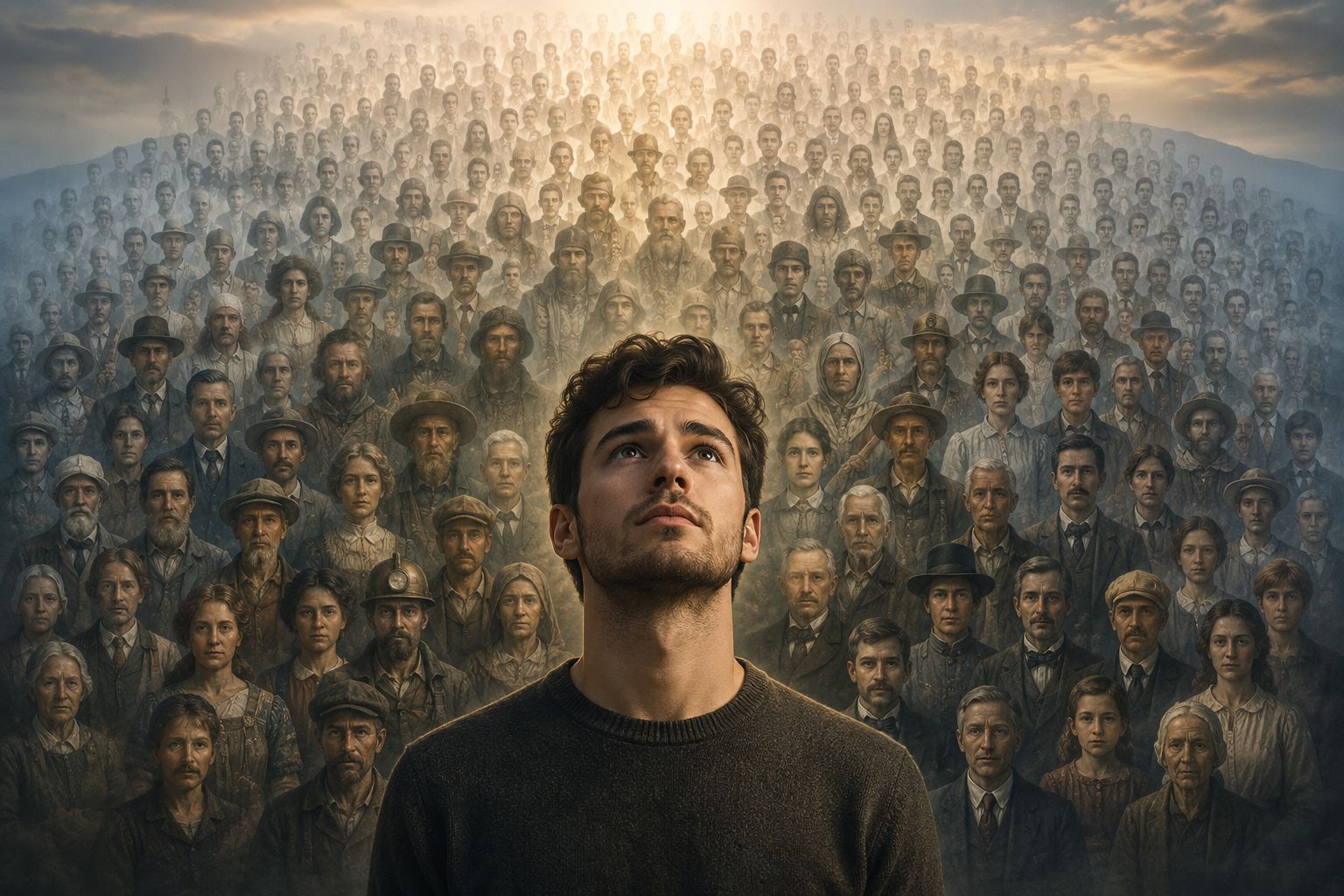
Few hobbies have experienced such explosive growth over the past two decades as genealogy. Millions of people now spend evenings searching parish records, census documents, immigration databases, and military archives in the hope of discovering who their ancestors were. Consumer DNA testing has accelerated this fascination even further. With a saliva sample and a few weeks of waiting, people can suddenly learn about distant relatives, ancient migrations, and genetic origins that would have been unimaginable only a generation ago.
The attraction is understandable. Humans naturally ask where they came from, who their ancestors were, and how they fit into history. Our brains evolved in small tribes where recognizing relatives increased survival, strengthened cooperation, and increased the chances of passing on shared genes. Family history therefore satisfies far more than simple curiosity. It provides identity, continuity, and the comforting feeling that we belong to a story much larger than ourselves.
Genealogy also gives people something increasingly rare in the modern world: roots. Many societies have become highly mobile, families often live hundreds or thousands of kilometers apart, and communities change rapidly. Looking into the past creates a sense of stability. Even if we cannot choose our ancestors, knowing who they were can make us feel connected to something permanent.
Yet genealogy contains one of the biggest misunderstandings about ancestry. Ironically, the very family line that receives the greatest attention is one of the least important biologically.
Evolution prepared us for genealogy
Our fascination with ancestors did not appear by accident. Evolution favored individuals who recognized relatives because helping family members indirectly increased the survival of shared genes. Evolutionary biologists call this principle kin selection. Long before surnames existed, humans instinctively distinguished between close relatives, distant relatives, and complete strangers.
That instinct still shapes our behavior today. Although modern genealogy websites did not exist during the Stone Age, our brains evolved to care about family relationships. Instead of remembering who shared our hunting camp, we now remember surnames, construct family trees, and compare DNA matches. The technology has changed dramatically, but the underlying psychology remains remarkably similar.
Humans also love stories. Learning that a great-grandfather fought in a war, crossed an ocean, or survived a famine transforms history into something personal. Instead of reading about anonymous populations, we suddenly imagine real individuals whose decisions ultimately led to our own existence. History becomes a family story rather than a distant collection of dates.
The obsession with the paternal line
Ask someone about their family history, and many immediately begin listing fathers.
“My father’s father came from…”
“Our surname goes back…”
“My paternal line reaches the seventeenth century.”
This emphasis feels intuitive because surnames usually follow the paternal line, while Y-chromosome DNA tests trace father-to-son inheritance. Unfortunately, it is also profoundly misleading.
Your paternal line represents only one incredibly narrow branch of your ancestry. Every generation, it follows a single father while ignoring every mother, grandmother, great-grandmother, and thousands of other ancestors who contributed just as much to your existence. It tells an interesting historical story, but biologically it is almost insignificant.
The same misunderstanding applies to family coats of arms and noble surnames. People often identify strongly with a single lineage because it has a recognizable name. However, the thousands of unnamed ancestors who never passed on a surname contributed exactly as much to creating you. Biology simply does not care which ancestor happened to transmit the family name.
Your family tree grows faster than imagination
Most people know the beginning of the calculation. You have two parents, four grandparents, eight great-grandparents, and sixteen great-great-grandparents. Few continue much further because the numbers become astonishing almost immediately.
Go back only ten generations—roughly 250 to 300 years depending on average generation length—and you already have 1,024 ancestral positions. Your celebrated paternal line consists of exactly one of those people. In other words, the lineage many families proudly preserve represents less than one tenth of one percent of your ancestors from that period.
Continue another ten generations. Around twenty generations ago, approximately six hundred years in the past, your theoretical family tree contains more than one million ancestral positions. Yet the famous paternal line still contains only one individual. Push the calculation to thirty generations—roughly 900 years—and the number exceeds one billion ancestral positions. Obviously, medieval Europe never contained anything close to a billion people. The mathematics itself reveals that genealogy is far more complicated than people imagine.
The numbers also reveal something unexpected. Every generation doubles the number of ancestral positions, but our attention usually remains fixed on a single line that never grows at all. While our ancestry expands exponentially, our imagination often follows only one branch.
The impossible family tree
The enormous numbers create an apparent paradox. If everyone had more than one billion unique ancestors thirty generations ago, the entire human population should have been vastly larger than it actually was. The explanation is known as pedigree collapse, one of the most fascinating concepts in genealogy.
The same individuals appear repeatedly throughout your family tree because distant cousins married distant cousins over many centuries. Instead of expanding forever, family trees fold back onto themselves again and again. Consequently, you do not descend from one billion different people. Rather, countless ancestral paths eventually converge on the same individuals.
This phenomenon was almost inevitable. For most of human history, people rarely traveled far from where they were born. Villages were small, transportation was slow, and marriage partners often came from neighboring communities. Over many generations, branches of the same family repeatedly reconnected. Although this may sound unusual today, it was simply the mathematical consequence of living in relatively isolated populations.
Ironically, pedigree collapse means that humanity is much more interconnected than most people realize. The further back we go, the more our family trees begin to overlap. Genealogy therefore does not separate humanity into isolated bloodlines. Instead, it gradually demonstrates that countless people share the same ancestors.
Genetic ancestry is not genealogical ancestry
Another common misunderstanding concerns the difference between having an ancestor and inheriting that person’s DNA. Most people assume the two are identical, but they are not.
Genealogy records every individual who contributed to your family tree. Genetics tells a different story. Every generation reshuffles DNA before passing it to the next. As a result, some ancestors contribute substantial portions of your genome, while others eventually contribute none at all.
Go back ten generations and you have over one thousand ancestral positions. Yet you have not inherited an equal amount of DNA from each of them. Some ancestors contributed relatively large segments of your genome. Others passed on tiny fragments. Quite a few may have contributed nothing that survived to the present day.
This surprises many people because those individuals remain your ancestors in every historical sense. They existed, they had children, and without them you would never have been born. Nevertheless, recombination gradually erased their genetic contribution. Family trees therefore grow continuously, whereas the DNA inherited from each ancestor becomes increasingly uneven.
You are made of thousands of people
People often imagine inheritance as if it were a straight line extending backward through history. Biology paints a completely different picture. Every generation reshuffles DNA through recombination, meaning that each child inherits a unique mixture from both parents rather than receiving half of every ancestor’s DNA indefinitely.
After eight to ten generations, your genome reflects contributions from hundreds of different ancestors. Continue back another few centuries, and your ancestry involves thousands of individuals who collectively shaped who you are today. Most of these people have been completely forgotten. They left no portraits, no famous surnames, and no written records. Nevertheless, they contributed just as much to your existence as the ancestor whose surname you still carry.
The irony is striking. The people whose names survive in family trees often receive nearly all the attention, while the overwhelming majority of your biological ancestors have disappeared from memory entirely. History tends to remember kings, generals, and noble families, but your existence depended just as much on unknown farmers, craftsmen, shepherds, merchants, servants, and mothers whose names have long vanished.
Every birth, marriage, illness, migration, famine, war, and chance encounter contributed to the chain of events that eventually produced you. Remove almost any one of those individuals from history, and someone genetically different would be reading this article instead.
The myth of royal blood
Many people secretly hope their family tree will reveal a famous king, queen, or medieval nobleman. Genealogy websites understand this perfectly. Stories about royal ancestry generate enormous interest because they make people feel connected to history’s most recognizable figures.
The reality is much less exclusive. Historians and population geneticists have argued that hundreds of millions of Europeans—and probably most people of European ancestry—descend from rulers such as Charlemagne and many other medieval monarchs. Once enough generations pass, descendants multiply exponentially. A person who lived a thousand years ago and left surviving descendants can easily become an ancestor of hundreds of millions of people alive today.
Finding royal ancestry is therefore not nearly as extraordinary as many imagine. In fact, for people with European ancestry, discovering that they descend from medieval nobility is often less surprising than discovering that they do not. The truly remarkable story is not that we share famous ancestors. It is that we also share millions of completely ordinary ones whose names history never recorded.
DNA tells a different story
Modern DNA testing has transformed genealogy because it reveals relationships that paper records cannot. It uncovers adoptions, previously unknown relatives, non-paternity events, and migrations hidden for centuries. At the same time, it demonstrates why simplistic ideas about ancestry are misleading.
A Y chromosome follows only one uninterrupted paternal chain. Mitochondrial DNA follows only one uninterrupted maternal chain. Both are scientifically valuable for reconstructing ancient human migrations, yet together they describe only two narrow threads within an enormous ancestral tapestry. Everything else comes from the countless recombinations that occurred across hundreds of generations.
Someone may proudly announce belonging to a particular Y-chromosome haplogroup, but that chromosome represents only about two percent of a man’s DNA. The remaining ninety-eight percent comes from all the other branches of the family tree. A Y chromosome may reveal where one distant paternal ancestor came from thousands of years ago, yet it says remarkably little about the overwhelming majority of the people who made you who you are.
The same applies to mitochondrial DNA. It follows a single maternal line while ignoring thousands of equally important ancestors. Both markers are invaluable scientific tools, but they become misleading when people mistake them for summaries of their entire ancestry.
One thousand people inside you
Imagine gathering one thousand people into a large hall. Every one of them contributed to your existence. Surprisingly, this thought experiment does not take us back to the Roman Empire or ancient Egypt. It takes us back only about ten generations, roughly 250 to 300 years depending on the average age at which people had children.
Around the beginning of the eighteenth century, your existence already depended on approximately one thousand ancestral positions. Some were wealthy, while others struggled to survive. A few may have owned land, whereas many probably worked as farmers, craftsmen, servants, laborers, or merchants. Some died young, others lived long lives, and almost all have disappeared from history without leaving more than a name in a parish register, if even that.
Now continue another ten generations. Suddenly your theoretical family tree contains more than one million ancestral positions. Extend it another three hundred years, and the number rises beyond one billion. Pedigree collapse means these are not all unique individuals, yet the message remains astonishing. You are not the product of a handful of famous ancestors. You are the cumulative result of thousands upon thousands of lives stretching across centuries.
Every language spoken by your ancestors, every migration they undertook, every epidemic they survived, every marriage they entered, and every child they raised ultimately influenced the fact that you exist today. Your own life is therefore the endpoint of an unimaginably long chain of coincidences. Had any one of countless events unfolded differently, an entirely different person would occupy your place.
Looking at yourself in a mirror is therefore rather misleading. You are not one family line preserved through time. You are the meeting point of thousands of family lines that gradually merged into a single individual.
The commercialization of ancestry
Genealogy has become a multi-billion-dollar industry. With a simple saliva sample, companies promise to reveal your ethnic origins, ancient migrations, and distant relatives. Millions of people have benefited from these tests by discovering unknown family members, confirming historical records, or satisfying their curiosity. At the same time, ancestry itself has become a commercial product.
Unlike a password or a credit card number, your DNA cannot be changed. It is the most permanent personal information you possess. Moreover, your genome reveals information not only about you but also about your parents, siblings, children, and countless relatives who never agreed to genetic testing. A single DNA test therefore reaches far beyond the individual customer.
Questions about ownership are equally important. Many people assume they own their genetic information, yet companies often retain broad rights to store and analyze it under their terms of service. Although genetic data are generally anonymized before research use, DNA itself is a unique identifier. As artificial intelligence becomes increasingly capable of analyzing enormous databases, information that seems harmless today may reveal much more in the future.
Consumer DNA testing has revolutionized genealogy and contributed enormously to science. Nevertheless, every technological advance involves trade-offs. Curiosity about our origins is entirely natural, but it should be accompanied by an understanding of what we choose to share when we mail our saliva to a laboratory.
The greatest irony of genealogy
People spend years tracing one surname, one paternal line, or one noble ancestor while overlooking nearly everyone else who made their existence possible. They hope to discover a medieval knight, a famous king, or an ancient coat of arms, even though such individuals contributed only a tiny fraction of their ancestry. The unknown farmer, shepherd, blacksmith, merchant, or peasant woman whose name has vanished from history may have contributed just as much—or even more—to the person they are today.
Genealogy remains one of humanity’s most fascinating hobbies because it connects us with the past. Yet its greatest lesson may not be that we descend from remarkable individuals. Instead, it reminds us that every human being is the product of thousands of ordinary people whose names have largely been forgotten.
Perhaps that is the real beauty of genealogy. It begins as a search for our uniqueness, but it ends by revealing our connectedness. The further back we travel through history, the more our separate family trees merge into the same human story. Our ancestors were not isolated bloodlines competing for immortality. They were millions of ordinary people whose lives intersected in countless ways, eventually producing every person alive today.
Ironically, the deeper we explore our family history, the harder it becomes to say where “our” story ends and someone else’s begins. Genealogy does not simply tell us who our ancestors were. It reminds us that, given enough generations, almost all of humanity becomes family.
Conclusion
People spend years tracing one surname, one paternal line, or one noble ancestor while overlooking nearly everyone else who made their existence possible. They hope to discover a medieval knight, a famous king, or an ancient coat of arms, even though such individuals contributed only a tiny fraction of their ancestry. The unknown farmer, shepherd, blacksmith, merchant, or peasant woman whose name has vanished from history may have contributed just as much—or even more—to the person they are today.
The irony becomes even greater when genealogy is used to support tribalism. Throughout history, countless people have claimed superiority because of their surname, dynasty, ethnicity, or “pure” bloodline. Yet genealogy teaches precisely the opposite lesson. The further back we travel, the more our family trees overlap until they become almost indistinguishable. The ancestors we proudly call “ours” are often shared by millions of other people, many of whom belong to different nations, religions, and cultures.
It is therefore rather paradoxical that some people use ancestry to divide humanity. The very science they invoke demonstrates that such divisions become increasingly meaningless over time. A family tree does not end at a national border, nor does DNA recognize languages, flags, or political identities. Long before modern countries existed, our ancestors were already mixing through migration, marriage, conquest, trade, and simple chance.
Perhaps the greatest misunderstanding is believing that one surname or one paternal line defines who we are. It is an appealing story because our brains prefer simple narratives, but reality is incomparably more complex. Every human being is the product of thousands of ordinary people whose lives intersected over centuries. Most have been forgotten, yet each played a small part in making us possible.
Genealogy therefore offers a lesson in humility rather than superiority. The deeper we explore our origins, the less unique our ancestry becomes and the more connected humanity appears. Ironically, the hobby that begins with the search for “my family” ultimately reveals that there is no clear boundary between “my ancestors” and “everyone else’s.” We are not isolated branches competing for prestige. We are countless branches of the same ancient tree.
Leave a Reply