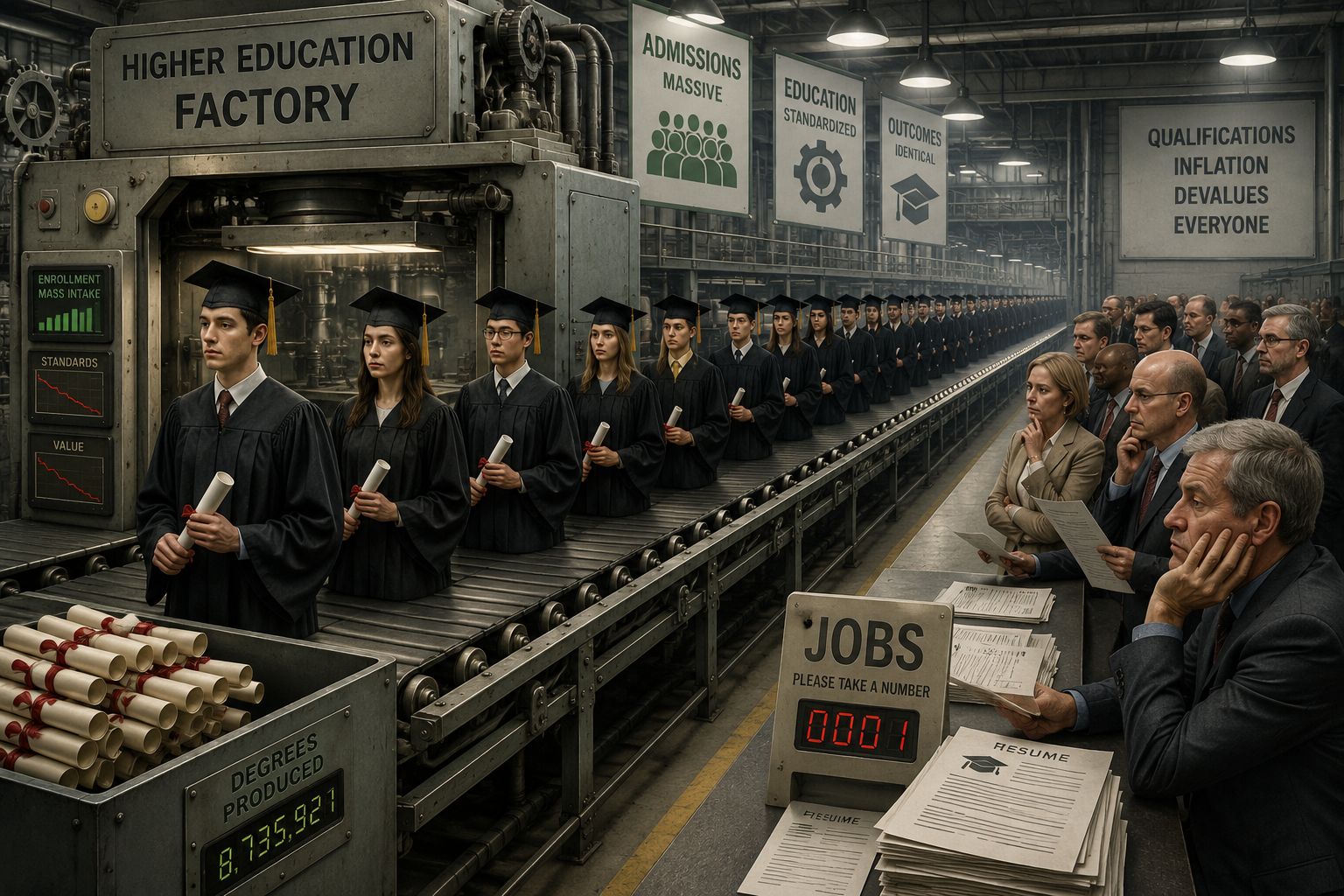
For centuries, a university education was reserved for a small intellectual elite. Universities trained future scientists, physicians, lawyers, engineers, philosophers, and public administrators. Admission was difficult, graduation even more so, and holding a university degree carried immense prestige.
Today, the situation is very different. In many developed countries, between one-third and one-half of young adults obtain a university degree. Governments celebrate rising graduation rates as evidence of social progress, while universities compete to enroll ever larger numbers of students.
But has this expansion gone too far?
The debate is uncomfortable because it touches on equality, intelligence, economic opportunity, and social status. Yet it is a debate worth having. Increasing access to higher education has undoubtedly brought enormous benefits, but mass university education has also produced unintended consequences.
A controversial statement from Miloš Zeman
Miloš Zeman remains one of the most controversial figures in modern Czech politics. The Czech lands have had many rulers, kings, presidents, and political leaders. Yet only one president became internationally known for appearing intoxicated during a public ceremony involving the Czech Crown Jewels.
For many people, that incident will remain the defining image of his presidency.
Nevertheless, political opponents can occasionally make valid observations. During one appearance at a university aula, Zeman argued that too many students were attending universities and that only a relatively small proportion of the population possessed the intellectual abilities required for demanding academic study.
His manner of presenting the argument was typically abrasive and confrontational. However, the underlying question deserves careful consideration.
Should everyone attend university?
Universities were never designed for everyone
The earliest European universities educated tiny numbers of students. Institutions such as University of Bologna, University of Oxford, and Charles University served intellectual elites rather than the general population.
For centuries, society functioned with relatively few university graduates. Skilled craftsmen, merchants, soldiers, farmers, builders, and entrepreneurs formed the backbone of the economy.
A university degree was exceptional because advanced academic work is exceptionally demanding.
There is nothing inherently wrong with this model.
Intelligence is not equally distributed
One reason mass university education encounters difficulties is that cognitive abilities vary substantially across individuals.
Research consistently shows that intelligence follows an approximately normal distribution. Some people possess extraordinary analytical abilities, while others excel through practical skills, creativity, perseverance, or interpersonal competence.
Not every occupation requires abstract academic reasoning.
Likewise, not every individual benefits from highly theoretical education.
Pretending otherwise may sound compassionate, but educational policy should be based on evidence rather than wishful thinking.
The expansion of higher education
Following the Second World War, governments dramatically expanded university systems.
Several goals motivated this expansion.
- Economic modernization.
- Greater social mobility.
- Equal educational opportunities.
- Scientific innovation.
- Increased national competitiveness.
Many of these objectives were admirable.
Millions of capable students from modest backgrounds gained access to education that previous generations could never have imagined.
Societies benefited from larger numbers of doctors, engineers, researchers, economists, and teachers.
The problem emerged when expansion became an objective in itself.
Degree inflation
As more people obtained university degrees, employers gradually raised educational requirements.
Jobs that previously required only secondary education increasingly demanded bachelor’s degrees.
Many positions did not become intellectually more difficult.
The credential simply became a filtering mechanism.
Economists refer to this phenomenon as degree inflation.
A qualification that once distinguished applicants gradually became the minimum expectation.
Credential inflation affects everyone
Ironically, degree inflation harms both graduates and non-graduates. Graduates spend additional years studying before entering the labor market. Employers receive thousands of nearly identical applications.
People without university degrees lose opportunities despite possessing perfectly adequate skills.
Meanwhile, society spends enormous sums financing education that may add little economic value.
Everyone pays the price.
Universities face conflicting incentives
Modern universities are often funded according to student numbers. This creates obvious incentives. Rejecting applicants reduces income.
Lower academic standards increase graduation rates. Higher graduation rates improve institutional statistics.
The pressure to maintain enrollment can gradually erode academic rigor.
Not every institution experiences this problem, but the incentives certainly exist.
Not all universities should be identical
This is where Zeman’s observation deserves serious consideration.
Every country should preserve a group of highly prestigious universities with exceptionally demanding admission standards and rigorous academic expectations.
These institutions should educate future researchers, leading physicians, judges, scientists, mathematicians, engineers, and other specialists whose work requires outstanding intellectual ability.
At the same time, countries may reasonably establish universities with broader access and more practical programs.
These institutions can prepare professionals for applied careers without pretending to match the academic intensity of elite universities.
The mistake is assuming that every university must provide exactly the same level of difficulty.
Educational diversity is not educational inequality.
Prestige matters
Elite universities serve an important purpose beyond education. They establish national standards of excellence. They attract international talent. They produce groundbreaking research. They compete globally for the brightest students and academics.
Diluting academic standards at these institutions would ultimately damage innovation.
Excellence requires selectivity.
Practical education deserves equal respect
An unhealthy obsession with university degrees has unintentionally devalued vocational education.
Electricians, plumbers, mechanics, programmers, machinists, laboratory technicians, nurses, and many other skilled professionals often provide greater economic value than graduates working in unrelated office positions.
Many of these professions also offer excellent salaries.
Society benefits when talented individuals pursue careers that genuinely match their abilities rather than chasing academic credentials primarily for social prestige.
Universities cannot replace aptitude
Education can improve knowledge.
It cannot eliminate natural differences in aptitude.
Excellent teaching helps students reach their potential, but it cannot transform every student into a theoretical physicist or constitutional lawyer.
Recognizing this is not elitism.
It is realism.
The goal of education should not be making everyone identical.
The goal should be helping individuals develop their own strengths.
The psychological costs of unrealistic expectations
When governments encourage nearly everyone to pursue university education, many students enter programs for which they are poorly prepared.
Some struggle academically.
Others accumulate debt before dropping out.
Many graduate but discover that their qualifications no longer guarantee attractive employment.
This creates frustration rather than opportunity.
A more honest educational system would acknowledge that success has many different forms.
International competition
Countries also compete internationally for exceptional talent.
The world’s strongest universities attract brilliant students from across the globe.
These graduates often become entrepreneurs, scientists, inventors, or innovators whose work shapes entire industries.
Maintaining globally competitive universities therefore requires protecting high academic standards rather than continuously expanding enrollment.
Quality often matters more than quantity.
Measuring success differently
Educational success should not be measured solely by the percentage of university graduates.
Other indicators may be equally important.
- Scientific productivity.
- Graduate competence.
- Employer satisfaction.
- Innovation.
- Patent production.
- Entrepreneurship.
- Labor market outcomes.
- International rankings.
A smaller number of highly capable graduates may contribute more than a much larger number with weaker preparation.
Equality does not require identical outcomes
Providing equal opportunity does not mean guaranteeing identical educational paths.
Every capable student should have the chance to attend university regardless of family income or social background.
That principle is fundamental.
However, equal opportunity differs from assuming that every individual should follow the same academic route.
Healthy societies need outstanding scientists, but they also need outstanding craftsmen, technicians, artists, entrepreneurs, and skilled workers.
All contribute to national prosperity.
A balanced approach
The solution is not reducing access to higher education indiscriminately.
Instead, countries should build diverse educational systems.
Elite research universities should remain highly selective.
Regional and teaching-focused universities can emphasize practical knowledge and professional preparation.
Vocational schools should receive greater prestige and investment.
Career guidance should help students choose paths that match their abilities rather than social expectations.
This approach benefits individuals, employers, universities, and society alike.
Conclusion
Mass higher education has transformed modern societies in many positive ways. It has expanded opportunity, reduced historical barriers, and produced millions of highly qualified professionals.
Yet expansion has limits.
Degree inflation, declining prestige, labor market distortions, and uneven academic standards suggest that simply increasing the number of university graduates is not always the right objective.
Miloš Zeman’s argument was controversial, and his delivery characteristically confrontational. Nevertheless, one need not admire the politician to recognize that he raised an important question.
The challenge is not deciding whether more people should attend university.
The challenge is ensuring that higher education remains meaningful, intellectually demanding where appropriate, and sufficiently diverse to accommodate the full range of human talents.
Leave a Reply