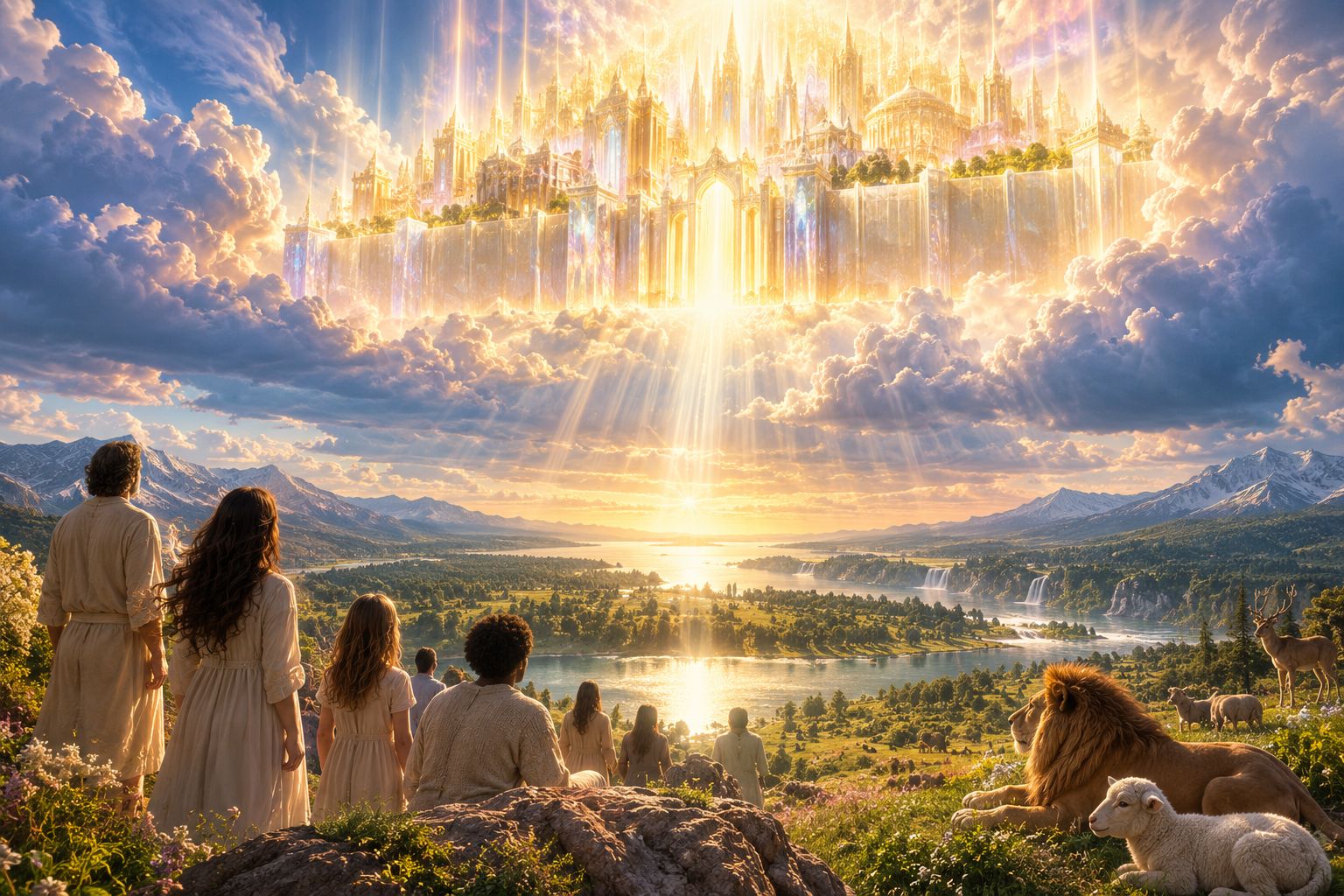
Few subjects have fascinated humanity more than heaven. Every civilization has imagined a paradise awaiting the righteous after death. Ancient Egyptians envisioned the Field of Reeds. The Vikings dreamed of Valhalla. Muslims anticipate Jannah. Christians, meanwhile, often picture clouds, angels with wings, golden gates, and elderly men playing harps.
The Bible presents a far more complex picture. Surprisingly, many of the most familiar images of heaven come not directly from Scripture but from centuries of Christian art, medieval literature, and popular culture. The biblical authors rarely describe heaven as a place where souls simply float forever in bliss. Instead, they portray it as God’s dwelling place, the center of divine authority, and ultimately the origin of a renewed creation where heaven and earth become united.
Even among Christians, there is no complete agreement about how literally biblical descriptions should be understood. Some interpret the visions in Revelation as actual architecture. Others view them primarily as symbolic language expressing truths that exceed human comprehension. Nevertheless, the Bible consistently emphasizes that heaven is not defined by streets of gold or jeweled walls. Its defining characteristic is the presence of God.
This article examines what the Bible actually says about heaven. It separates Scripture from tradition, explores both the Old and New Testaments, discusses the symbolic language of biblical prophecy, and considers how different Christian traditions interpret the biblical evidence.
What does the Bible mean by heaven?
One of the biggest sources of confusion is that the Bible uses the word “heaven” in several different ways.
In the Old Testament, the Hebrew word shamayim can refer to the sky above the earth, the realm of the stars, or God’s own dwelling place. Likewise, the New Testament Greek word ouranos carries several meanings depending on the context.
Consequently, when Scripture mentions heaven, it does not always refer to the afterlife.
For example, Genesis speaks of birds flying “across the heavens,” clearly meaning the atmosphere. Other passages describe the sun, moon, and stars as existing in the heavens. Still others speak of God’s heavenly throne, referring to a spiritual realm beyond ordinary human experience.
This distinction matters because many readers assume every mention of heaven concerns life after death, even though that is often not the case.
Heaven as God’s dwelling place
Throughout the Bible, heaven primarily represents God’s dwelling place.
Psalm 115 declares:
“The heavens are the Lord’s heavens, but the earth he has given to the children of man.”
Similarly, Isaiah describes God as sitting upon a throne above creation, while the earth serves merely as His footstool. These passages emphasize God’s transcendence rather than providing geographical information.
Unlike many ancient religions, the biblical writers rarely attempt to locate heaven physically. They simply describe it as the place from which God reigns over the universe.
For this reason, heaven functions more as a different dimension of existence than another planet hidden somewhere beyond the stars.
More than a destination
Modern Christianity often speaks about “going to heaven” as the central goal of faith. Surprisingly, this is not the Bible’s primary emphasis.
Instead, Scripture repeatedly looks forward to the resurrection of the dead and the creation of a “new heaven and new earth.” Rather than humans permanently escaping earth, God’s ultimate plan involves renewing creation itself.
This distinction appears throughout both the Old and New Testaments. The final chapters of Revelation do not depict believers leaving earth forever. Instead, they describe the New Jerusalem descending from heaven while God comes to dwell with humanity.
This reversal changes the entire perspective. Heaven is not simply where humans go. Ultimately, according to the biblical vision, heaven comes to humanity.
Why the Bible uses symbolism
Anyone expecting a straightforward travel guide quickly encounters unusual imagery.
The Bible describes crystal seas, enormous cities made of gold, gates fashioned from single pearls, rivers flowing with living water, creatures covered with eyes, fiery wheels, countless angels, and dazzling light brighter than the sun.
Modern readers sometimes wonder whether these descriptions should be interpreted literally.
The answer depends largely on one’s theological tradition. Many conservative Christians believe these visions describe real features of heaven. Many biblical scholars, however, argue that the authors employed symbolic language because ordinary human vocabulary could not adequately describe encounters with the divine.
The Book of Revelation belongs to a literary genre known as apocalyptic literature. This style uses vivid symbols, dramatic visions, and striking imagery to communicate theological truths rather than architectural blueprints.
For example, gold throughout Scripture symbolizes purity and divine glory. Light often represents God’s holiness. Precious stones signify beauty, permanence, and perfection. Rivers symbolize life and blessing.
Consequently, whether these images prove literal or symbolic, they all communicate the same central idea: heaven represents perfect communion with God.
A very different picture from popular culture
Popular culture has transformed many biblical images into clichés.
People imagine fluffy white clouds, tiny winged babies, harps, and endless leisure. Yet almost none of these ideas occupy a central place in Scripture.
The Bible never suggests that human beings become angels after death. Angels remain distinct created beings throughout both Testaments.
Likewise, Scripture never portrays eternity as endless inactivity. Instead, redeemed people worship, serve God, reign with Christ, and participate in His renewed creation.
Rather than emphasizing luxury, the biblical writers emphasize justice, peace, holiness, truth, and restored relationships.
Even the spectacular descriptions of gold and jewels point beyond material wealth. Their purpose is to express God’s incomparable glory.
The central message
If one removed every symbolic image from the Bible’s descriptions of heaven, one central message would remain unchanged.
Heaven is where God’s presence exists without separation.
Every other detail flows from this reality.
There is no death because God is present. There is no suffering because God reigns completely. There is no injustice because His judgment is perfect. There is no darkness because His glory provides light.
The biblical vision therefore differs fundamentally from many modern expectations. Heaven is not portrayed primarily as humanity’s reward. It is portrayed as the restoration of humanity’s relationship with its Creator.
In the following sections, we will examine how the Old Testament prophets described heaven, how Jesus spoke about eternal life, and why the Book of Revelation contains the Bible’s most detailed—and most misunderstood—vision of the world to come.
Heaven in the Old Testament
The Old Testament contains surprisingly few detailed descriptions of heaven. Although many people assume the concept of heaven dominates the Hebrew Scriptures, the primary focus actually lies on God’s relationship with Israel, His covenant, and His activity within history. Nevertheless, several passages offer remarkable glimpses into the heavenly realm and profoundly influenced later Jewish and Christian thought.
Unlike the New Testament, which speaks more explicitly about resurrection and eternal life, the Old Testament generally presents heaven as God’s dwelling place rather than humanity’s final destination. The prophets occasionally witness extraordinary visions of this divine realm, but these experiences serve to reveal God’s holiness and authority rather than satisfy human curiosity about the afterlife.
Heaven as God’s throne
One of the most consistent biblical images portrays heaven as the location of God’s throne.
Psalm 103 states:
“The Lord has established his throne in heaven, and his kingdom rules over all.”
Similarly, Psalm 11 declares:
“The Lord is in his holy temple; the Lord’s throne is in heaven.”
These verses do not necessarily imply that God is confined to one physical location. On the contrary, the Old Testament repeatedly insists that God fills both heaven and earth. The throne symbolizes His universal kingship, much as an earthly king’s throne symbolizes political authority.
Isaiah expresses this idea vividly:
“Heaven is my throne, and the earth is my footstool.”
Rather than describing furniture in a celestial palace, this poetic image emphasizes God’s absolute sovereignty over creation.
Isaiah’s breathtaking vision
The prophet Isaiah records one of the Bible’s most influential visions of heaven.
He writes that he saw:
“The Lord sitting upon a throne, high and lifted up; and the train of his robe filled the temple.”
Around God’s throne stood seraphim, each possessing six wings.
With two wings they covered their faces.
With two they covered their feet.
With two they flew.
The heavenly beings continually proclaimed:
“Holy, holy, holy is the Lord of hosts; the whole earth is full of his glory.”
The repeated word “holy” emphasizes God’s complete otherness and moral perfection. In Hebrew, repetition functions as a form of emphasis. Saying “holy” three times expresses absolute holiness beyond human comparison.
The vision overwhelms Isaiah. Rather than feeling honored, he becomes terrified.
He cries:
“Woe is me! For I am lost; for I am a man of unclean lips.”
His response illustrates an important biblical theme. Genuine encounters with God inspire humility rather than self-confidence.
Ezekiel’s extraordinary vision
If Isaiah’s vision seems majestic, Ezekiel’s appears almost surreal.
While living in exile, Ezekiel experiences an astonishing vision unlike anything else in Scripture.
He describes storm clouds, brilliant fire, flashing lightning, and four mysterious living creatures.
Each creature possesses four faces.
One resembles a human.
Another resembles a lion.
Another resembles an ox.
The fourth resembles an eagle.
Each creature also has four wings.
Beside them stand enormous wheels covered entirely with eyes.
The wheels move in every direction without turning.
Above everything stretches something resembling crystal.
High above this crystal expanse sits a magnificent throne.
Upon the throne appears a human-like figure surrounded by radiant light and brilliant fire.
Modern readers sometimes compare Ezekiel’s vision to science fiction. Popular books have even suggested that Ezekiel witnessed an alien spacecraft.
Biblical scholars overwhelmingly reject such interpretations.
Instead, they note that every element carries symbolic meaning. The four creatures likely represent different aspects of creation. The wheels suggest God’s ability to move everywhere. The countless eyes symbolize complete knowledge and awareness.
The message is straightforward even if the imagery is complex: Israel’s God is not confined to Jerusalem. He reigns over the entire universe.
Daniel’s Ancient of Days
Another remarkable heavenly vision appears in the Book of Daniel.
Daniel sees the “Ancient of Days” seated upon a fiery throne. His clothing appears white as snow. His hair resembles pure wool. Thousands upon thousands serve Him. Millions stand before Him.
Then the heavenly court convenes.
Books are opened.
Judgment begins.
Immediately afterward, Daniel witnesses “one like a son of man” approaching the Ancient of Days and receiving everlasting authority over all nations.
Centuries later, Jesus repeatedly refers to Himself as the “Son of Man,” a title that almost certainly alludes to Daniel’s vision.
Consequently, Daniel’s description became one of the most significant Old Testament foundations for Christian beliefs about Christ’s divine authority.
The heavenly council
Several Old Testament passages describe God surrounded by a heavenly assembly.
For example, the prophet Micaiah sees:
“The Lord sitting on his throne, and all the host of heaven standing beside him.”
Likewise, the opening chapters of Job describe heavenly beings presenting themselves before God.
These scenes resemble an ancient royal court.
God functions as king.
The heavenly beings serve as His attendants.
Importantly, these passages should not be confused with later ideas about democracy or shared divine authority. God alone exercises ultimate power. The heavenly council exists to carry out His will.
Angels in the Old Testament
Contrary to popular belief, angels occupy a relatively modest role in most of the Old Testament.
They appear occasionally as God’s messengers.
They guide Hagar.
They rescue Lot from Sodom.
They protect Daniel.
They strengthen Elijah.
However, the Old Testament never encourages people to worship angels or become fascinated with them.
Instead, angels consistently direct attention toward God.
The same pattern continues throughout the New Testament.
Did the Israelites expect to go to heaven?
One of the biggest surprises for modern readers is that early Israelites rarely spoke about going to heaven after death.
Instead, many Old Testament passages refer to Sheol, the shadowy realm of the dead.
Sheol is not identical to either heaven or hell.
Rather, it represents the common destination of the deceased before later Jewish beliefs about resurrection became more developed.
Only gradually, particularly in books such as Daniel, does the Old Testament begin expressing a clear expectation that God will one day raise the dead to everlasting life.
This development laid the foundation upon which Jesus and the New Testament writers built their teachings about resurrection, judgment, and eternal life.
From mystery to hope
The Old Testament never attempts to provide a detailed map of heaven.
Instead, it consistently emphasizes God’s holiness, sovereignty, justice, and glory.
Its prophets catch only brief glimpses behind the curtain separating heaven from earth. Even then, they struggle to describe what they see, relying on symbolism, poetry, and metaphor rather than ordinary language.
The result is both mysterious and profound. Heaven appears not as humanity’s luxurious retirement destination but as the center of divine reality itself. That perspective prepares readers for the New Testament, where Jesus begins speaking about heaven with far greater clarity while simultaneously redefining many popular expectations about God’s coming kingdom.
Jesus’ teaching about heaven
Many people assume Jesus spoke constantly about heaven as the place believers go after death. Surprisingly, this is not the case. Although He frequently mentioned heaven, His primary message centered on the “Kingdom of God” or, in Matthew’s Gospel, the “Kingdom of Heaven.” These expressions do not simply refer to a location. They describe God’s reign over creation.
This distinction changes how we understand Jesus’ teaching. Rather than inviting people merely to escape the world, Jesus proclaimed that God’s kingdom had begun breaking into history and would one day be established completely.
Consequently, heaven in Jesus’ teaching is not merely humanity’s future home. It is the source of God’s authority and the model according to which the earth will ultimately be transformed.
The Kingdom of Heaven
The Gospel of Matthew uses the phrase “Kingdom of Heaven” more than thirty times.
Many readers mistakenly conclude that Jesus was speaking about life after death. However, most biblical scholars agree that Matthew used the word “heaven” out of reverence for God’s name, following a common Jewish practice of avoiding direct references to God.
Thus, the “Kingdom of Heaven” means essentially the same thing as the “Kingdom of God” in the other Gospels.
Jesus described this kingdom through parables rather than definitions.
He compared it to:
- A mustard seed that begins almost invisibly before becoming enormous.
- Yeast working silently through dough.
- A treasure hidden in a field.
- A merchant searching for a priceless pearl.
- A fishing net gathering every kind of fish.
These images emphasize growth, transformation, value, and final judgment. They do not describe the physical appearance of heaven.
“Your kingdom come”
One of Jesus’ most famous prayers also reveals His understanding of heaven.
In the Lord’s Prayer, He teaches His followers to pray:
“Your kingdom come, your will be done, on earth as it is in heaven.”
Notice the direction.
Jesus does not tell believers to pray that people escape from earth into heaven.
Instead, He prays that heaven’s perfect order should become reality on earth.
This theme appears repeatedly throughout the New Testament. God’s ultimate purpose is not abandoning creation but restoring it.
“My Father’s house has many rooms”
Perhaps no biblical passage has shaped popular ideas of heaven more than Jesus’ words in John’s Gospel.
Before His crucifixion, He tells His disciples:
“In my Father’s house are many rooms… I go to prepare a place for you.”
Older English translations used the word “mansions,” giving rise to the popular image that every believer receives an enormous heavenly palace.
Most modern translations, however, prefer “rooms” or “dwelling places.”
The Greek word simply refers to places where people live. Jesus’ emphasis lies not on luxury but on permanence.
His disciples need not fear separation from Him because they will ultimately share His Father’s home.
Treasure in heaven
Jesus frequently encouraged people to store up “treasures in heaven.” At first glance, this expression sounds like a celestial bank account. In reality, Jesus contrasts earthly wealth with eternal values.
He warns:
“Do not store up for yourselves treasures on earth, where moth and rust destroy… But store up for yourselves treasures in heaven.”
Earthly possessions disappear. Economic crises occur. Empires collapse. Even magnificent buildings eventually crumble.
Acts of love, justice, generosity, and faithfulness, however, possess lasting significance.
The focus remains moral rather than financial.
Paradise
One of the most moving references to heaven occurs during Jesus’ crucifixion.
A criminal hanging beside Him asks:
“Jesus, remember me when you come into your kingdom.”
Jesus replies:
“Today you will be with me in Paradise.”
The word “Paradise” originally referred to a beautiful garden.
It later became a Jewish expression for the blessed state of the righteous after death.
Exactly what Jesus meant remains debated.
Some Christians understand Paradise as identical with heaven.
Others distinguish it from the final resurrection described later in Scripture.
Regardless of the interpretation, Jesus’ promise offers immediate hope rather than uncertainty.
Eternal life
Perhaps Jesus’ most important contribution to biblical teaching concerns eternal life. Modern readers often imagine eternal life simply as endless existence. Jesus presents something much richer.
In John’s Gospel He declares:
“This is eternal life: that they know you, the only true God, and Jesus Christ whom you have sent.”
Eternal life therefore begins before death. It is not merely infinite duration. It is a restored relationship with God.
Accordingly, heaven is not valuable simply because it lasts forever. It is valuable because it represents complete communion with God.
The resurrection, not disembodied existence
Some influential strands of Greek philosophy, particularly Platonic traditions, treated the body as inferior to the soul and sometimes portrayed embodied existence as something from which the soul sought liberation.
After His own resurrection, He does not appear as an invisible spirit. He eats with His disciples. People touch Him. He bears the wounds of the crucifixion.
Yet His body also possesses extraordinary qualities. He appears suddenly behind locked doors. He is no longer subject to death.
This becomes the model for Christian hope.
The goal is not permanent existence as a disembodied soul floating through heaven.
Instead, believers anticipate resurrection into transformed, imperishable bodies.
Judgment and separation
Jesus’ teaching about heaven cannot be separated from His teaching about judgment.
He repeatedly speaks of a final division between those who accept God’s kingdom and those who reject it.
Parables about sheep and goats, wise and foolish virgins, wheat and weeds, and good and bad fish all point toward a future reckoning.
Modern readers sometimes find these passages uncomfortable.
Nevertheless, they reveal an essential aspect of Jesus’ message.
Heaven is not presented as humanity’s automatic destination.
Rather, it forms part of God’s final restoration of justice.
Heaven begins with God’s presence
When all of Jesus’ teaching is considered together, one theme emerges above all others.
Heaven is not primarily about magnificent scenery.
It is about God’s presence.
Jesus rarely satisfies curiosity about architecture, geography, or material splendor.
Instead, He consistently directs attention toward reconciliation with God, love of neighbor, forgiveness, humility, and participation in God’s kingdom.
This emphasis prepares readers for the Book of Revelation. There, the Bible finally offers its most detailed visual description of heaven. Yet even Revelation ultimately reinforces the same message Jesus proclaimed throughout His ministry: the greatest promise of eternity is not golden streets or jeweled walls, but that “God himself will be with them.”
The Book of Revelation: The throne of God
If the Old Testament offers only brief glimpses of heaven and Jesus focuses primarily on God’s kingdom, the Book of Revelation provides the Bible’s most vivid and detailed descriptions of the heavenly realm. Unsurprisingly, nearly every popular image of heaven—from brilliant light and countless angels to the throne of God and streets of gold—originates from its pages. At the same time, Revelation is one of the Bible’s most misunderstood books. Written in the apocalyptic genre, it communicates through visions, symbols, numbers, and dramatic imagery. Readers therefore disagree over how literally its descriptions should be interpreted. Some Christians believe John saw heaven exactly as it is, while others argue that he used symbolic language to describe realities beyond ordinary human comprehension. Regardless of one’s approach, Revelation consistently presents heaven as a place of majesty, holiness, justice, and worship.
John’s vision begins
The apostle John explains that while exiled on the island of Patmos, he experienced a remarkable vision. He writes, “After this I looked, and there before me was a door standing open in heaven.” Immediately, he finds himself standing before God’s throne. Unlike many modern accounts of journeys through heaven, John does not attempt to satisfy human curiosity about its geography or architecture. Instead, his attention immediately focuses on God Himself. Everything else revolves around the throne, emphasizing that God’s sovereignty is the defining reality of heaven.
The throne at the center
John never attempts to describe God’s physical appearance directly. Instead, he compares what he sees to dazzling gemstones. He writes that the One seated upon the throne had the appearance of jasper and carnelian, while an emerald-like rainbow surrounded the throne. These comparisons follow an important biblical pattern. Whenever prophets encounter God, they rely on analogies rather than direct descriptions because ordinary human language proves inadequate. Consequently, readers should not imagine a literal gemstone seated upon a throne. Rather, John uses familiar objects to communicate overwhelming brilliance, purity, beauty, and glory.
The sea of glass
Before God’s throne stretches what John describes as “a sea of glass, clear as crystal.” Scholars have proposed numerous interpretations of this remarkable image. Some understand it literally as a crystal-like surface, while many others interpret it symbolically. Throughout the Old Testament, the sea frequently represents chaos, danger, and evil. In Revelation, however, the sea appears perfectly calm and transparent. If interpreted symbolically, the image suggests that all chaos has been brought under God’s complete control. Nothing threatens His authority, and perfect peace reigns throughout creation.
Four living creatures
Perhaps the most unusual beings surrounding God’s throne are the four living creatures. One resembles a lion, another an ox, the third has a human face, and the fourth resembles a flying eagle. Each possesses six wings and is covered with eyes. Day and night they proclaim, “Holy, holy, holy is the Lord God Almighty, who was, and is, and is to come.” These creatures closely resemble those seen centuries earlier by Isaiah and Ezekiel. Although scholars disagree about their precise identity, many believe they symbolize all living creation praising its Creator. The lion may represent wild animals, the ox domestic animals, the eagle the birds of the air, and the human face humanity itself. Together they express the worship of the entire created order.
Twenty-four elders
Surrounding God’s throne stand twenty-four additional thrones occupied by twenty-four elders clothed in white garments and wearing golden crowns. Their identity has long been debated. Some theologians believe they represent the twelve tribes of Israel together with the twelve apostles, symbolizing the unity of God’s people throughout history. Others consider them a special order of heavenly beings. Regardless of their identity, the elders repeatedly remove their crowns and place them before God’s throne. This act symbolizes complete submission, demonstrating that even those honored with authority recognize that all power ultimately belongs to God alone.
Countless angels
John next describes an astonishing multitude of angels. He writes, “Then I looked and heard the voice of many angels, numbering thousands upon thousands, and ten thousand times ten thousand.” The expression does not necessarily indicate a precise mathematical figure. Instead, it conveys an unimaginably vast multitude beyond human calculation. These angels praise God continuously and celebrate the victory of Christ. Interestingly, Revelation says remarkably little about their physical appearance. The emphasis remains on their worship and their role in God’s plan rather than on their outward beauty.
Worship without end
Modern readers sometimes wonder whether heaven would become monotonous if worship continued forever. The biblical concept of worship, however, differs significantly from merely singing hymns throughout eternity. In Scripture, worship encompasses complete devotion, joyful service, gratitude, obedience, and recognition of God’s greatness. Moreover, Revelation portrays heaven as dynamic rather than static. Songs arise in response to unfolding events, justice is accomplished, evil is defeated, and the redeemed participate in God’s reign. Far from suggesting boredom, the vision presents heaven as overflowing with meaning, purpose, and continual celebration.
Lightning, thunder, and fire
John’s vision also includes dramatic natural phenomena. Lightning flashes, thunder roars, and seven blazing lamps burn before God’s throne. These images deliberately recall God’s appearance at Mount Sinai during the giving of the Law, communicating divine power, holiness, and majesty. The seven lamps represent the seven spirits of God, an expression that Christians have interpreted in different ways throughout history. Many scholars understand the phrase as symbolizing the fullness and perfection of the Holy Spirit rather than seven separate divine beings.
The Lamb at the center
Perhaps the most surprising moment in Revelation occurs when John expects to see a mighty lion but instead encounters a Lamb bearing the marks of sacrifice. The Lamb approaches God’s throne, and heaven immediately erupts in worship. The symbolism is unmistakable: the Lamb represents Jesus Christ. Its appearance communicates one of Revelation’s central messages, namely that God conquers evil not merely through overwhelming force but through self-sacrificial love. This image transforms the reader’s understanding of heavenly power by presenting victory as the result of faithful obedience rather than domination.
Heaven as the control center of history
A common misconception portrays heaven as detached from earthly events, but Revelation presents the exact opposite picture. From heaven, God oversees history, judgment unfolds, justice advances, and the prayers of believers rise before His throne. Angels carry out divine purposes, while the future of humanity originates in heaven before becoming reality on earth. Heaven therefore functions not as an isolated paradise but as the true center of the universe from which God’s sovereign rule extends over all creation.
A vision of God’s glory
John’s description overwhelms the senses with brilliant light, countless voices, crystal, fire, precious stones, rainbows, lightning, thunder, and magnificent heavenly beings. Yet all these details point beyond themselves. The throne remains at the center because everything else exists only to magnify God’s glory. This emphasis continues into Revelation’s final chapters, where the greatest promise is no longer simply God’s throne in heaven. Instead, God Himself comes to dwell permanently among humanity in the New Jerusalem, the most detailed and spectacular vision of the eternal future found anywhere in the Bible.
Here is the next section in the same style.
The New Jerusalem
The climax of the Bible’s description of heaven does not occur when believers ascend into heaven. Instead, it occurs when heaven descends to earth. This is one of the most surprising aspects of Revelation, yet it fundamentally changes the Christian understanding of eternity. Rather than portraying humanity escaping the physical world forever, John describes God bringing His dwelling place to a renewed creation. Heaven and earth, once separated by human sin, become united. The final vision therefore concerns not the abandonment of creation but its complete restoration.
John introduces this dramatic scene by writing, “Then I saw a new heaven and a new earth, for the first heaven and the first earth had passed away.” Immediately afterward, he sees “the Holy City, the New Jerusalem, coming down out of heaven from God, prepared as a bride beautifully dressed for her husband.” The direction is significant. The city descends from heaven rather than believers ascending toward it. This imagery reinforces one of Revelation’s central themes: God’s ultimate purpose is to dwell permanently with humanity.
A city of enormous proportions
John describes the New Jerusalem as an immense city unlike anything ever constructed by human civilization. According to Revelation, the city measures twelve thousand stadia in length, width, and height. Modern calculations place each dimension at approximately 2,200 kilometers, or about 1,400 miles. Even more remarkable, the city forms a perfect cube.
If interpreted literally, the New Jerusalem would dwarf every modern nation. Its height would extend far beyond Earth’s atmosphere, making it physically impossible according to current scientific understanding. Consequently, many biblical scholars conclude that the dimensions are symbolic rather than architectural. The cube itself likely carries profound theological meaning because the Most Holy Place within Solomon’s Temple also formed a perfect cube. In effect, the entire city becomes the Holy of Holies, symbolizing God’s direct presence among His people.
The number twelve also appears repeatedly throughout the description. The city has twelve gates, twelve foundations, twelve kinds of fruit, and dimensions based on multiples of twelve. In biblical literature, the number commonly symbolizes God’s people, recalling both the twelve tribes of Israel and the twelve apostles. The city’s measurements therefore communicate completeness and perfection rather than simply enormous size.
Walls of jasper and streets of gold
Perhaps the best-known description of heaven concerns its extraordinary building materials. John writes that the city’s wall is made of jasper, while the city itself consists of pure gold “as pure as glass.” The image immediately captures the imagination because gold on Earth is opaque, whereas John describes a substance possessing both the brilliance of gold and the transparency of crystal.
The city’s foundations are decorated with twelve different precious stones, including jasper, sapphire, emerald, topaz, amethyst, and beryl. Throughout the ancient world, such gemstones represented wealth, permanence, and beauty. Their use here symbolizes not merely material richness but the incomparable glory of God’s renewed creation.
Likewise, each of the city’s twelve gates consists of a single pearl. This remarkable detail gave rise to the popular expression “the pearly gates.” Yet Revelation never suggests that heaven has only one entrance guarded by Saint Peter, as later tradition often portrays. Instead, the city possesses twelve gates facing every direction, emphasizing openness and universal accessibility for those who belong to God.
The River of Life
Flowing through the center of the city is one of Revelation’s most beautiful images: the River of the Water of Life. John describes it as “clear as crystal,” flowing directly from the throne of God and of the Lamb. The river recalls the Garden of Eden, where a life-giving river watered creation before humanity’s fall into sin.
Water consistently symbolizes life throughout the Bible. Jesus Himself declares that those who come to Him will receive “living water,” representing eternal life through the Holy Spirit. Consequently, the River of Life symbolizes far more than physical refreshment. It represents God’s continual provision, blessing, and sustaining presence throughout eternity.
The river also fulfills numerous Old Testament prophecies. Ezekiel envisioned a miraculous river flowing from God’s future temple, bringing life wherever it traveled. Isaiah similarly described abundant waters accompanying God’s final restoration. Revelation gathers these earlier themes into a single powerful image of eternal renewal.
The Tree of Life
Standing beside the river grows the Tree of Life, another direct connection with the opening chapters of Genesis. Humanity lost access to this tree after Adam and Eve’s disobedience, when cherubim guarded the entrance to Eden. Revelation therefore ends the biblical story where it originally began, but with an important difference. Paradise is no longer a garden occupied by two individuals. It has become a magnificent city inhabited by redeemed humanity.
John explains that the Tree of Life bears twelve crops of fruit, producing a fresh harvest every month. Its leaves exist “for the healing of the nations.” This phrase has generated considerable discussion because sickness no longer exists in the New Jerusalem. Most scholars therefore understand healing symbolically, representing complete reconciliation, restoration, and peace among all peoples. Every wound caused by sin, violence, hatred, and injustice has finally disappeared.
No temple, no sun, and no night
One of the most surprising features of the New Jerusalem is what it lacks. John explicitly states that he saw no temple within the city because “the Lord God Almighty and the Lamb are its temple.” Throughout the Old Testament, the temple represented the unique place where God’s presence dwelt among His people. In the New Jerusalem, however, God’s presence fills the entire city. A separate sanctuary is therefore unnecessary.
Equally striking is the absence of the sun and moon. John explains that “the glory of God gives it light, and the Lamb is its lamp.” This statement should not necessarily be understood as a scientific description of astronomy. Rather, it expresses the idea that God’s presence completely replaces every source of darkness. Consequently, John also writes that “there shall be no more night.” Throughout Scripture, darkness often symbolizes fear, ignorance, evil, and separation from God. Its disappearance therefore represents the complete triumph of divine goodness.
God dwells with humanity
The most important statement in Revelation’s description of the New Jerusalem appears near its beginning. A loud voice announces, “Behold, the dwelling place of God is with humanity. He will dwell with them, and they will be His people, and God Himself will be with them and be their God.”
This declaration forms the theological center of the entire vision. Gold, gemstones, crystal rivers, and magnificent architecture all serve a secondary purpose. They illustrate the glory of the city, but they are not its greatest treasure. The greatest promise is God’s immediate and permanent presence. Human beings no longer experience separation, distance, or alienation from their Creator. The relationship broken in Eden has finally been restored.
No more death or suffering
John concludes this remarkable vision with one of the Bible’s most comforting promises. God “will wipe every tear from their eyes. There will be no more death or mourning or crying or pain, for the former things have passed away.” Unlike many ancient religious visions that focused primarily on luxury or power, Revelation emphasizes the complete removal of suffering.
Death, grief, injustice, disease, violence, and fear belong to the old creation rather than the new one. The New Jerusalem therefore represents not merely an improved version of the present world but a fundamentally transformed reality in which every consequence of sin has been overcome. Whether interpreted literally or symbolically, Revelation’s final vision communicates the same central message: God’s ultimate purpose is not simply to bring people into heaven but to create a renewed world in which He lives forever with humanity.
Resurrection bodies: What will people look like?
One of the most common questions about heaven concerns the appearance of those who inhabit it. Will people remain spirits forever? Will they possess physical bodies? Will they recognize family members and friends? Will they continue to age? Although the Bible does not answer every question, it consistently teaches that the Christian hope is not the immortality of the soul alone but the resurrection of the body. This belief distinguishes Christianity from many ancient philosophical traditions and remains one of its most distinctive doctrines.
Modern culture often imagines the afterlife as a purely spiritual existence in which disembodied souls float through heaven. While the Bible acknowledges an intermediate state between death and the final resurrection, it repeatedly emphasizes that God’s ultimate plan involves restoring the whole person. Human beings were created as both physical and spiritual creatures, and God’s redemption extends to every aspect of their nature.
The resurrection of Jesus as the model
The New Testament consistently presents Jesus’ resurrection as the model for the future resurrection of believers. After His crucifixion, Jesus did not appear merely as an invisible spirit or ghost. Instead, He possessed a real body that His disciples could see and touch. He ate meals with them, invited Thomas to examine the wounds in His hands and side, and walked with His followers on the road to Emmaus.
At the same time, His resurrected body differed from His earthly one in remarkable ways. He appeared suddenly inside locked rooms, disappeared without explanation, and was not immediately recognized by some of His closest followers. The Gospels therefore describe a body that remained genuinely physical while also possessing qualities beyond ordinary human experience.
Because Jesus is described as “the firstfruits” of those who have been raised, Christians traditionally understand His resurrection as a preview of what awaits all believers. The exact nature of that transformed body remains mysterious, but the New Testament leaves little doubt that resurrection involves continuity as well as transformation.
Paul’s explanation in 1 Corinthians
The Apostle Paul provides the Bible’s most detailed discussion of the resurrection in 1 Corinthians 15. Writing to Christians who questioned whether bodily resurrection was possible, Paul argues that the resurrection of Christ guarantees the future resurrection of His followers.
To explain this transformation, Paul compares the human body to a seed planted in the ground. A seed must first die before a new plant emerges, yet the plant remains connected to the seed from which it grew. Likewise, the body buried in death is related to the body raised in glory, even though it has undergone a profound transformation.
Paul summarizes the contrast in memorable language. The body is “sown perishable” but “raised imperishable.” It is “sown in dishonor” but “raised in glory.” It is “sown in weakness” but “raised in power.” Finally, it is “sown a natural body” but “raised a spiritual body.”
The expression “spiritual body” has often been misunderstood. Paul does not mean a body made of spirit or lacking physical substance. Rather, he contrasts a body governed by ordinary earthly life with one completely empowered by God’s Spirit. The resurrected body remains a body, but it is perfectly suited for eternal life in God’s renewed creation.
Will people recognize one another?
The Bible strongly suggests that personal identity survives death. Throughout the Gospels, the disciples recognize the resurrected Jesus, even though His appearance has changed in certain respects. Likewise, Jesus’ account of the rich man and Lazarus depicts individuals retaining their memories and identities after death. During the Transfiguration, Moses and Elijah also appear as recognizable individuals despite having lived centuries earlier.
These passages have led most Christian theologians to conclude that people will know one another in the life to come. Relationships will not disappear, although they may be transformed in ways that reflect God’s perfect love and justice. Recognition therefore depends not merely on physical appearance but on the continuation of personal identity.
Will people grow old?
The Bible never directly addresses whether people will have a particular biological age in the resurrection. Consequently, every answer remains speculative. Throughout history, theologians have proposed various possibilities. Some suggested that everyone would appear as young adults because this stage of life combines maturity with physical strength. Others argued that resurrected bodies would reflect each person’s perfected identity without being subject to aging or decay.
Whatever form resurrection takes, Scripture consistently teaches that death, disease, and physical deterioration will no longer exist. The resurrected body is described as imperishable and incorruptible. It will never experience illness, disability, or the gradual decline associated with aging.
What about disabilities and injuries?
Many people wonder whether physical disabilities or injuries will remain after the resurrection. The New Testament never addresses every possible condition individually, but its overall message points toward complete restoration. Revelation promises that death, pain, mourning, and suffering will disappear, while Paul describes the resurrection body as glorious and powerful rather than weak and perishable.
Some theologians nevertheless caution against assuming that perfection means conformity to modern standards of beauty or physical ability. The resurrected Christ retained the wounds of His crucifixion, suggesting that certain marks may continue as signs of redemption rather than imperfection. Consequently, Christians have reached different conclusions regarding whether every earthly characteristic simply disappears or is transformed into something that reflects God’s purposes.
Will people become angels?
One of the most widespread misconceptions about heaven is that human beings become angels after death. Popular films, greeting cards, and children’s stories frequently depict deceased loved ones receiving wings and joining the ranks of angels. The Bible, however, never teaches this idea.
Throughout both the Old and New Testaments, angels and humans remain distinct creations. Angels serve as God’s messengers and ministers, while human beings are created in God’s image and destined for resurrection. Even Jesus distinguishes between the two. Although He says that resurrected people will be “like the angels” in the sense that they no longer marry or die, He does not suggest that they actually become angels.
The distinction is important because Christianity views humanity’s destiny as unique. Rather than becoming another order of heavenly beings, redeemed people remain fully human while sharing in God’s renewed creation.
What abilities might resurrected bodies possess?
The New Testament offers only limited clues regarding the abilities of resurrected bodies. Jesus’ own resurrection provides the primary evidence. He could eat ordinary food, engage in conversation, and allow others to touch Him. At the same time, He appeared in places unexpectedly and seemed no longer constrained by ordinary physical limitations.
Because Scripture provides so little detail, theologians have generally resisted excessive speculation. Some believe resurrected bodies may possess capabilities beyond current human experience, while others emphasize continuity with ordinary physical existence. Both perspectives acknowledge that the resurrection body belongs to a new creation operating under God’s perfect rule rather than the limitations of the present world.
The restoration of humanity
The doctrine of resurrection reveals that Christianity does not view the physical world as a mistake from which people must escape. Instead, the Bible teaches that creation itself will be renewed. Human bodies, originally declared “very good” in Genesis, are not discarded but transformed. Salvation therefore encompasses the whole person rather than only the soul.
This perspective also explains why the Bible concludes not with humanity abandoning the earth but with God creating “a new heaven and a new earth.” Resurrected people inhabit this renewed creation as complete human beings, free from death, suffering, and corruption. The Christian hope is therefore not an eternal existence as disembodied spirits but a restored humanity living forever in perfect fellowship with God.
What will people do in heaven?
One of the most common criticisms of heaven, particularly among skeptics, is that eternal life sounds unbearably monotonous. Popular culture often portrays heaven as an endless existence on clouds, where people spend eternity singing hymns, playing harps, and doing little else. Even many Christians quietly wonder whether heaven could eventually become repetitive after millions or even billions of years.
The Bible presents a very different picture. Although it says relatively little about the daily activities of resurrected humanity, the passages that do exist consistently describe heaven as dynamic rather than static. Eternal life is portrayed not as endless inactivity but as meaningful existence in perfect fellowship with God. Worship, service, learning, creativity, and relationships all appear to remain part of human life, although freed from the limitations of sin, suffering, and death.
Worship as a way of life
The Book of Revelation repeatedly depicts heaven as a place of worship. Angels, elders, and redeemed humanity continually praise God and the Lamb. To modern readers, especially those unfamiliar with biblical language, this imagery can seem repetitive. Many therefore imagine heaven as one infinitely long church service.
The biblical concept of worship, however, extends far beyond singing songs. Throughout Scripture, worship encompasses every aspect of life lived in recognition of God’s greatness. It includes gratitude, obedience, service, celebration, and joyful participation in God’s purposes. In other words, worship is not simply one activity among many. It is the attitude that transforms every activity into an expression of love and devotion.
Consequently, Revelation’s scenes of praise should not be understood as suggesting that believers will spend eternity repeating the same hymns. Rather, they communicate that every aspect of life in God’s presence will reflect perfect joy, gratitude, and communion with the Creator.
Serving God
The Bible repeatedly states that redeemed humanity will serve God. Revelation declares simply, “His servants will serve Him.” Although the statement is brief, it raises an intriguing question: what kind of service could exist in a world where suffering, injustice, and death have disappeared?
Scripture does not provide a detailed answer. Nevertheless, service in the Bible does not imply unpleasant labor or forced obedience. Before humanity’s fall, Adam and Eve were instructed to cultivate and care for the Garden of Eden. Work itself was therefore part of God’s original design rather than a consequence of sin. What changed after the fall was not the existence of work but the frustration, hardship, and conflict associated with it.
Many theologians therefore believe meaningful work will continue in the renewed creation. Whatever form it takes, it will no longer involve exploitation, exhaustion, boredom, or failure. Human abilities will instead find perfect expression in harmony with God’s purposes.
Reigning with Christ
One of the New Testament’s more surprising promises is that believers will reign with Christ. Paul writes that Christians will even “judge the world” and “judge angels,” while Revelation declares that God’s people “will reign forever and ever.”
These passages have generated considerable theological discussion because the Bible never explains precisely what such authority involves. Some scholars interpret the language literally, suggesting that resurrected humanity will participate in governing God’s renewed creation. Others understand it symbolically, emphasizing humanity’s restored dignity and partnership with God.
Regardless of the interpretation, the underlying message remains clear. Eternal life does not reduce human beings to passive spectators. Instead, they actively participate in God’s eternal kingdom.
Learning without end
The Bible never states explicitly that people will continue learning in heaven. Nevertheless, many theologians consider endless intellectual discovery a natural implication of God’s infinite nature.
If God possesses unlimited wisdom, beauty, creativity, and knowledge, finite human beings could spend eternity exploring His creation without ever exhausting its richness. Every new discovery would reveal additional aspects of God’s character rather than bringing intellectual satisfaction to an end.
This perspective has appealed to many Christian philosophers and scientists throughout history. Rather than viewing heaven as the end of curiosity, they saw it as the beginning of perfect understanding, where learning continues without error, pride, or misunderstanding.
Relationships in the life to come
Human relationships occupy a central place throughout the Bible, and there is every indication that they continue beyond death. Scripture suggests that people will recognize one another, remember their earthly lives, and enjoy perfect fellowship without jealousy, conflict, or betrayal.
Jesus nevertheless teaches that marriage, at least as an earthly institution, will not continue in the resurrection. He explains that resurrected people “neither marry nor are given in marriage, but are like the angels in heaven.” This statement has sometimes disappointed readers who hope to preserve their marriages exactly as they exist today.
Many theologians argue, however, that Jesus is not diminishing love but expanding it. Earthly marriage reflects a unique covenant designed for the present age. In the renewed creation, every relationship reaches its fullest potential because selfishness, insecurity, and separation have disappeared. Love no longer depends upon exclusive human bonds but flows perfectly toward God and all people.
Creativity and culture
Although the Bible says little about art, music, literature, or scientific discovery in heaven, many Christians believe these activities will flourish in the renewed creation. Humanity was created in the image of a Creator, suggesting that creativity belongs to human nature itself rather than merely serving practical needs.
If creation reflects God’s beauty, there seems little reason to suppose that beauty itself disappears in eternity. Music, architecture, storytelling, exploration, and artistic expression may therefore continue in ways that surpass anything currently imaginable. Such conclusions remain speculative, yet they fit naturally within the biblical picture of a restored rather than diminished humanity.
Will there be free will?
Another frequently debated question concerns free will. If heaven contains no sin, can people still choose freely?
Christian philosophers have proposed different answers. Some argue that genuine freedom includes the possibility of wrongdoing. Others maintain that true freedom consists not in the ability to sin but in the ability to choose the good without internal corruption.
The second position has become especially influential. According to this understanding, people in heaven remain fully free, but their characters have been completely transformed. Just as God cannot be tempted by evil without lacking freedom, redeemed humanity freely chooses goodness because sin no longer distorts its desires.
The Bible does not explain precisely how this transformation occurs. It simply presents heaven as a realm where evil has finally lost all power.
Will heaven become boring?
Perhaps the most common objection to eternal life is the possibility of boredom. Any finite activity, critics argue, eventually becomes repetitive. If eternity truly has no end, would even paradise lose its appeal?
The Bible never addresses this concern directly, but its overall vision suggests otherwise. Heaven is not portrayed as endless leisure detached from purpose. Instead, it is a world filled with meaningful relationships, joyful service, intellectual discovery, creativity, and direct fellowship with the infinite God. Because God Himself can never be fully exhausted or comprehended by finite minds, many theologians conclude that eternity will always contain new depths of beauty, wisdom, and joy.
This understanding shifts the discussion dramatically. The question is no longer how long heaven lasts but whom people encounter there. If eternal life consists of perfect communion with an infinite Creator, then eternity need not imply endless repetition. It may instead represent an unending journey into realities that continually surpass human imagination.
A life fulfilled rather than escaped
Taken together, the biblical evidence presents heaven not as an escape from humanity but as its fulfillment. Human capacities for love, creativity, knowledge, work, and worship are not abolished but perfected. Everything damaged by sin is restored, while everything genuinely good reaches its intended purpose.
The Bible intentionally leaves many practical questions unanswered. It does not describe daily schedules, occupations, or cultural institutions in detail. Nevertheless, its central message remains remarkably consistent. Eternal life is not defined by inactivity or boredom but by complete participation in God’s renewed creation. Heaven therefore represents not the end of meaningful existence but its true beginning.
Here is the next section.
Will animals exist in heaven?
Few questions generate as much emotional interest as the fate of animals. People naturally wonder whether pets will exist in heaven, whether extinct species will return, and whether the renewed creation will include the extraordinary diversity of life found on Earth today. The Bible does not provide definitive answers to every one of these questions. Nevertheless, it contains numerous passages suggesting that God’s plan of redemption extends beyond humanity alone. While certainty remains impossible, the biblical evidence points toward a renewed creation in which animals continue to play an important role.
The question is particularly significant because the Bible begins and ends with a world filled with animal life. The Garden of Eden contains countless living creatures, while the closing chapters of Revelation describe a restored creation rather than a purely spiritual realm. Consequently, many theologians argue that animals belong not merely to the present world but also to God’s ultimate purpose for creation.
Animals in the Garden of Eden
The opening chapters of Genesis describe animals as part of God’s original design. Before human beings appear, God creates creatures of the sea, birds of the air, livestock, wild animals, and every creeping thing upon the earth. After each stage of creation, God declares that what He has made is good.
Importantly, animals are not presented merely as resources for human use. Adam receives the responsibility of naming them, caring for creation, and exercising stewardship over the natural world. Humanity’s authority therefore carries responsibility rather than unlimited exploitation. This relationship reflects God’s intention that humans and animals coexist within a harmonious creation.
Because the original creation included abundant animal life before the entrance of sin, many theologians conclude that there is no biblical reason to assume animals disappear from God’s perfected creation.
Isaiah’s vision of peace
Some of the Bible’s most beautiful descriptions of the future include animals living together in perfect harmony.
The prophet Isaiah writes:
“The wolf shall dwell with the lamb, and the leopard shall lie down with the young goat… the calf and the lion and the fattened calf together, and a little child shall lead them.”
He continues by describing cows grazing peacefully with bears and lions eating straw like oxen. Even venomous snakes no longer threaten children.
Scholars differ over how these passages should be interpreted. Some regard them as poetic symbols representing peace among human nations. Others believe Isaiah literally envisions a restored natural world in which predation and violence have ceased.
Regardless of the interpretation, the imagery clearly portrays animals as participants in God’s future kingdom rather than absent from it.
Creation awaits redemption
Perhaps the strongest New Testament argument for the renewal of animal life appears in Romans 8. The Apostle Paul writes that “the whole creation has been groaning” while awaiting liberation from corruption.
Importantly, Paul does not limit this hope to humanity. Instead, he speaks about creation itself longing for restoration. Many biblical scholars understand “creation” to include the natural world, encompassing animals, plants, and the entire physical universe.
Paul’s language suggests that God’s work of redemption extends beyond individual human souls. Sin damaged the whole created order, and God’s final victory therefore includes its complete renewal.
This broader perspective distinguishes Christianity from philosophies that regard the physical world as something to be abandoned. Instead, the Bible repeatedly emphasizes restoration rather than escape.
Animals in Revelation
The Book of Revelation also contains numerous references to animals.
John describes the four living creatures surrounding God’s throne, each resembling a lion, an ox, a human being, and an eagle. Although these beings are symbolic heavenly creatures rather than ordinary animals, they demonstrate that animal imagery remains central even in heaven itself.
Elsewhere, Revelation depicts horses accompanying Christ and His heavenly armies. Whether these horses should be understood literally or symbolically remains debated, but their presence again suggests that animal life has not vanished from God’s eternal purposes.
The Bible therefore ends, as it begins, with a universe in which animals continue to occupy an important place within God’s creation.
What about pets?
The question most people ask, however, concerns beloved pets rather than animals in general. Will faithful dogs, affectionate cats, horses, or other companions be reunited with their owners?
The Bible never answers this question directly.
No biblical passage promises the resurrection of individual pets, nor does any passage explicitly deny it. Consequently, Christians have reached different conclusions throughout history.
Some theologians argue that because animals lack the same spiritual vocation assigned to human beings, Scripture does not teach their individual resurrection. Others respond that if God’s purpose is to restore creation completely, there is no reason to exclude the creatures that brought joy, companionship, and beauty into human lives.
The influential evangelist Billy Graham once suggested that if animals are necessary for our complete happiness in heaven, God is fully capable of providing them. While this statement represents personal theological opinion rather than biblical doctrine, it reflects a perspective shared by many Christians.
Did animals have souls?
The answer partly depends upon what one means by the word “soul.”
In modern language, the soul usually refers to the immortal aspect of a human being. The Hebrew Bible, however, often uses the word nephesh simply to describe a living creature. Both humans and animals are repeatedly called nephesh in Genesis.
This linguistic fact surprises many readers because it differs from later philosophical ideas about the soul. Nevertheless, the Bible also distinguishes humanity by declaring that people alone are created in the image of God. Consequently, while both humans and animals possess life given by God, Scripture assigns humanity a unique role and destiny within creation.
The problem of death before the Fall
One of the most debated questions concerns whether animals died before Adam and Eve sinned. Some Christians believe no death of any kind existed before the Fall, implying that all animals originally lived peacefully without predation. Others argue that the Bible specifically connects human death with sin while leaving open the possibility that animal death formed part of the natural world from the beginning.
The answer has significant implications for understanding the new creation. If predation belonged to God’s original design, the restored world may differ from Isaiah’s imagery in ways humans cannot yet comprehend. If, however, all death resulted from humanity’s fall, the renewed creation would represent a complete return to Eden’s original harmony.
Neither position commands universal agreement among biblical scholars.
Stewardship continues
Regardless of the fate of individual animals, the Bible consistently teaches that humanity bears responsibility toward the natural world. Proverbs declares that “the righteous care for the needs of their animals,” while Genesis entrusts humanity with stewardship over creation.
This perspective challenges interpretations suggesting that nature exists solely for human exploitation. Instead, the Bible presents the natural world as valuable because God created it and repeatedly declared it good.
Consequently, concern for animals and the environment need not conflict with biblical faith. Rather, many theologians view responsible stewardship as participation in God’s ongoing care for His creation.
A renewed creation filled with life
The Bible never explicitly states that every beloved pet awaits its owner in heaven. Honest scholarship therefore requires acknowledging the limits of biblical evidence. Nevertheless, Scripture consistently points toward a future in which creation itself is renewed rather than discarded. Animals appear at the beginning of the biblical story, throughout its central narrative, and within many of its visions of the future.
Whether interpreted literally or symbolically, these passages present a world overflowing with life rather than an abstract spiritual realm devoid of nature. If the renewed creation truly reflects God’s original intention, then beauty, diversity, and living creatures will almost certainly remain essential parts of eternity. The precise details remain unknown, but the Bible leaves readers with every reason to believe that God’s final creation will be richer, not poorer, than the one humanity currently inhabits.
Common misconceptions about heaven
Few subjects have accumulated as many myths and popular traditions as heaven. Over the past two thousand years, biblical teaching has blended with medieval art, literature, folklore, popular films, and cultural imagination. As a result, many ideas commonly associated with heaven have little or no direct support in Scripture. Some developed from theological speculation, while others originated in poetry, paintings, or works of fiction. Distinguishing between biblical teaching and later tradition helps readers appreciate what the Bible actually emphasizes and what later generations added.
Misconception 1: People become angels
Perhaps the most widespread misconception is that human beings become angels after death. Greeting cards, cartoons, and films frequently portray deceased loved ones receiving wings, halos, and harps before joining the ranks of angels.
The Bible never teaches this idea. Throughout both the Old and New Testaments, angels and humans remain distinct orders of creation. Angels serve as God’s messengers and ministers, while human beings are created in God’s image and destined for resurrection. Even after death and resurrection, people remain fully human.
The confusion probably arises from Jesus’ statement that resurrected people “will be like the angels in heaven.” In context, however, Jesus refers specifically to marriage and mortality. He explains that resurrected people neither marry nor die. He does not suggest that they become angels or lose their human identity.
Misconception 2: Heaven is an eternity on clouds
Artists have often depicted heaven as an endless landscape of white clouds floating high above the earth. While clouds occasionally accompany God’s appearances in Scripture, the Bible never describes heaven itself as an endless cloudscape inhabited by floating souls.
Instead, Revelation portrays a magnificent city, rivers, trees, thrones, gates, and a renewed creation. Even more importantly, the Bible consistently emphasizes relationships, worship, service, and God’s presence rather than the scenery.
The familiar cloud imagery owes far more to artistic convention than to biblical description.
Misconception 3: Saint Peter guards the gates
Another popular belief holds that Saint Peter stands at heaven’s entrance deciding who may enter. Countless jokes begin with someone arriving at the “pearly gates” only to encounter Peter serving as heavenly gatekeeper.
The Bible contains no such scene.
Jesus gives Peter the “keys of the kingdom of heaven” in Matthew’s Gospel, but the passage concerns the authority of the Church rather than Peter’s role after death. Revelation mentions twelve gates, each associated with one of Israel’s tribes, yet it never places Peter at their entrance.
The image survives largely because it became deeply embedded in Christian folklore rather than because it reflects biblical teaching.
Misconception 4: Everyone automatically goes to heaven
Modern Western culture often assumes that nearly everyone enters heaven regardless of belief or conduct. Funerals frequently describe the deceased as “looking down from heaven,” even when religion played little role in their lives.
The Bible presents a much more complex picture.
Jesus repeatedly speaks of judgment, accountability, and the necessity of responding to God’s call. His parables describe separation between the righteous and the wicked, the wise and the foolish, and those who accept or reject God’s kingdom. Different Christian traditions disagree about the precise relationship between faith, grace, works, and salvation, but virtually all agree that heaven is not portrayed as humanity’s automatic destination.
Misconception 5: Heaven is the final destination
Many Christians speak as though believers spend eternity in heaven after death. Surprisingly, the Bible’s final vision points elsewhere.
Revelation describes the New Jerusalem descending from heaven to a renewed earth. God’s dwelling comes to humanity rather than humanity permanently escaping the physical world. Consequently, many biblical scholars distinguish between the present heaven, where believers are with Christ after death, and the final state following the resurrection, when God creates a new heaven and a new earth.
This distinction fundamentally changes the Christian understanding of eternity. The ultimate hope is not abandoning creation but witnessing its complete restoration.
Misconception 6: Heaven means eternal inactivity
Critics sometimes dismiss heaven as an endless existence without challenge, purpose, or meaningful activity. Such portrayals usually imagine people sitting on clouds or singing hymns forever.
The Bible presents a far richer picture. Revelation speaks of serving God and reigning with Christ, while other passages emphasize worship, fellowship, and joyful participation in God’s kingdom. Although Scripture does not describe everyday activities in detail, it consistently portrays eternal life as purposeful rather than passive.
Meaningful work existed before humanity’s fall into sin. There is therefore little reason to assume that all meaningful activity disappears in the renewed creation.
Misconception 7: People lose their individuality
Another common assumption suggests that people merge into some kind of collective consciousness after death, losing their personalities and memories.
The Bible teaches the opposite.
Throughout Scripture, individuals remain identifiable after death. Moses, Elijah, Abraham, Lazarus, and the apostles all retain their identities. Revelation repeatedly refers to nations, peoples, kings, prophets, apostles, and martyrs as distinct individuals or communities.
The Christian hope therefore concerns the restoration rather than the destruction of personal identity. Sin disappears, but individuality remains.
Misconception 8: Marriage continues unchanged
Many people assume earthly marriage simply continues forever. Jesus explicitly challenges this expectation.
When questioned about marriage after the resurrection, He explains that people “neither marry nor are given in marriage.” His statement does not imply the disappearance of love or intimacy. Instead, it suggests that marriage belongs to the present order of creation and fulfills a specific purpose within human history.
Many theologians argue that relationships in the renewed creation become deeper rather than weaker because they are no longer limited by jealousy, insecurity, or death.
Misconception 9: Heaven exists only for human beings
Human beings naturally focus on their own destiny, yet the Bible repeatedly broadens the perspective.
Romans 8 speaks of the entire creation awaiting redemption. Isaiah envisions peaceful coexistence among animals, while Revelation describes a renewed universe rather than merely redeemed individuals. These passages suggest that God’s final purposes extend beyond humanity to encompass creation itself.
Although the Bible gives few details, it consistently presents redemption on a cosmic rather than exclusively human scale.
Misconception 10: The Bible explains everything about heaven
Perhaps the greatest misconception is that Scripture answers every question people ask about heaven.
In reality, the Bible remains remarkably selective. It says relatively little about architecture, daily routines, technology, language, culture, or countless other subjects that fascinate modern readers. Instead, it focuses upon theological truths rather than satisfying curiosity.
This silence is significant. The biblical writers seem far more interested in explaining why heaven matters than in describing every detail of what it looks like. Consequently, Christians should exercise caution whenever confident claims extend beyond what Scripture actually says.
The Bible’s consistent emphasis
When later traditions, artistic imagination, and popular culture are set aside, the Bible’s picture of heaven becomes both simpler and more profound. Rather than encouraging speculation about wings, clouds, or celestial luxury, Scripture repeatedly directs attention toward God Himself. Heaven is beautiful because God is there. The New Jerusalem shines because His glory fills it. Eternal life is joyful because death, suffering, and sin have been defeated.
Everything else, whether interpreted literally or symbolically, serves this central reality. The Bible therefore invites readers not merely to imagine a better place but to anticipate a restored relationship with the One who created both heaven and earth.
How different Christian traditions understand heaven
Although all major Christian traditions affirm the existence of heaven, they do not agree on every aspect of what happens after death or what eternal life ultimately looks like. Their differences arise from distinct interpretations of Scripture, early Christian tradition, and theological development. Nevertheless, they share several fundamental beliefs. Nearly all Christians agree that heaven involves perfect communion with God, the defeat of death, and the fulfillment of God’s plan for creation. The disagreements concern what occurs immediately after death, the nature of the intermediate state, the final resurrection, and the meaning of certain biblical passages.
Understanding these perspectives helps explain why Christians sometimes describe heaven differently while appealing to the same biblical texts.
Roman Catholic teaching
The Roman Catholic Church teaches that those who die in God’s friendship but still require purification undergo purification in Purgatory before entering heaven. According to Catholic theology, Purgatory is not a second chance for salvation but a temporary state in which believers are purified from the remaining effects of sin. Those who die completely separated from God enter hell, while those fully prepared for God’s presence immediately enter heaven.
Catholic teaching also emphasizes the Beatific Vision, the direct and perfect vision of God. According to this doctrine, the greatest joy of heaven is not its beauty or its rewards but seeing God “face to face.” Every other blessing flows from this perfect union with the Creator.
Catholics likewise affirm the future resurrection of the body. The soul may enter heaven immediately after death, but God’s final plan includes the resurrection of the body and the renewal of creation at the end of history.
Eastern Orthodox teaching
The Eastern Orthodox Church places even greater emphasis upon union with God, often using the Greek term theosis, meaning participation in the divine life. Orthodox theology teaches that salvation is not merely forgiveness of sins but the gradual transformation of human beings into the likeness of Christ.
Unlike Western Christianity, Orthodoxy generally avoids highly detailed descriptions of heaven. Many Orthodox theologians consider excessive speculation about the afterlife unhelpful because the realities of God’s kingdom ultimately surpass human understanding.
The Orthodox Church also stresses that heaven and hell should not necessarily be understood as separate physical locations. Instead, both represent different experiences of God’s presence. Those who love God experience His presence as eternal joy, while those who reject Him experience the same divine reality as suffering. Although not every Orthodox theologian expresses the doctrine in exactly the same way, this perspective has become influential within Eastern Christianity.
Protestant perspectives
Protestant churches encompass a wide range of theological traditions, making it impossible to describe a single Protestant view of heaven. Nevertheless, most Protestants reject the doctrine of Purgatory because they find insufficient biblical support for it. Instead, they generally teach that believers enter God’s presence immediately after death while awaiting the final resurrection.
Like Catholics and Orthodox Christians, Protestants affirm the resurrection of the body and the creation of a new heaven and new earth. They also emphasize that salvation depends upon God’s grace rather than human merit, although different Protestant denominations explain the relationship between faith and works in different ways.
Many Protestant theologians likewise stress that heaven should not be understood primarily as a distant location but as perfect fellowship with God. Consequently, they often focus less on physical descriptions of heaven and more on the restoration of the relationship between humanity and its Creator.
Evangelical Christianity
Evangelical Christians generally share the broader Protestant understanding but often place greater emphasis on personal salvation, assurance of eternal life, and the authority of Scripture. Many Evangelicals interpret Revelation more literally than Christians in other traditions, believing that the New Jerusalem, the resurrection, and the new creation describe actual future events rather than primarily symbolic realities.
At the same time, Evangelical theology strongly emphasizes that salvation comes through faith in Jesus Christ. Heaven is therefore understood as God’s gracious gift rather than a reward earned through human achievement.
Within Evangelicalism itself, considerable diversity exists. Some churches interpret prophecy literally, while others understand much of Revelation symbolically. Despite these differences, belief in bodily resurrection and eternal life remains central.
Seventh-day Adventists
Seventh-day Adventists hold a distinctive understanding of what happens immediately after death. They reject the idea that the soul remains consciously alive between death and the resurrection. Instead, they teach what is often called “soul sleep.” According to this view, the dead remain unconscious until Christ’s return, when believers are resurrected and receive eternal life.
Adventists therefore place particular emphasis upon the future resurrection rather than immediate entrance into heaven. They also interpret many prophetic passages differently from other Christian traditions while maintaining the central Christian hope of a renewed creation free from sin and death.
Jehovah’s Witnesses
Jehovah’s Witnesses differ significantly from mainstream Christianity in their understanding of heaven. They teach that only 144,000 faithful believers will live in heaven with Christ. The overwhelming majority of the righteous, however, will live forever on a restored paradise earth.
This belief derives primarily from their interpretation of Revelation’s reference to the 144,000. Most other Christian traditions interpret that number symbolically rather than literally or understand it differently altogether.
Jehovah’s Witnesses also reject the traditional doctrine of the immortal soul and teach that death involves complete unconsciousness until resurrection.
The Church of Jesus Christ of Latter-day Saints
The Church of Jesus Christ of Latter-day Saints teaches a more complex view of the afterlife than most other Christian traditions. According to its theology, the afterlife includes multiple degrees of heavenly glory rather than a single heaven and a single hell. Faithful believers may continue progressing eternally in God’s presence.
These teachings rely not only on the Bible but also on additional scriptures accepted by Latter-day Saints, such as the Book of Mormon and the Doctrine and Covenants. Consequently, their understanding differs substantially from that of historic Catholic, Orthodox, and Protestant Christianity.
Because these doctrines depend upon additional sacred texts, most other Christian denominations do not regard them as part of traditional Christian teaching.
Areas of agreement
Despite their differences, the major Christian traditions agree on far more than they disagree. All affirm that God ultimately defeats death and evil. All teach that eternal life consists of perfect communion with God. All expect a future resurrection of the body, although they differ concerning the intermediate state between death and resurrection. Likewise, all understand heaven as the fulfillment of God’s saving work rather than merely a pleasant destination.
These shared convictions reflect the consistent message running throughout the New Testament. Heaven is not presented primarily as a place of luxury or material reward but as the restoration of humanity’s relationship with God.
Why the differences matter
The diversity of Christian teaching reminds readers that the Bible often leaves important questions unanswered. Scripture consistently emphasizes God’s presence, resurrection, judgment, and the renewal of creation, yet it rarely explains every detail of the afterlife. Consequently, theological traditions have attempted to fill those gaps using different methods of interpretation.
Recognizing these differences encourages humility. Christians may disagree about the precise nature of heaven while remaining united on its central promise. According to every major Christian tradition, eternal life ultimately means the complete triumph of God’s goodness, the defeat of sin and death, and everlasting fellowship with the Creator.
Literal or symbolic? How should Revelation be read?
No book of the Bible has generated more debate than the Book of Revelation. For nearly two thousand years, Christians, theologians, historians, and biblical scholars have disagreed about how its extraordinary visions should be interpreted. Does Revelation describe actual future events in precise detail, or does it primarily communicate theological truths through symbolism? Should readers expect literal streets of gold, gates made from single pearls, and a cube-shaped city thousands of kilometers high, or should these images be understood as symbolic representations of realities beyond human language?
The answer depends largely on one’s approach to biblical interpretation. Although different traditions emphasize different aspects of the text, nearly all agree that Revelation belongs to a unique literary genre that requires careful reading.
What is apocalyptic literature?
Revelation belongs to a category of writing known as apocalyptic literature. This genre flourished in Jewish and early Christian communities during periods of political oppression and uncertainty. Rather than presenting history through ordinary narrative, apocalyptic works communicate through visions, symbols, dramatic imagery, mysterious numbers, and heavenly revelations.
Modern readers sometimes mistake this style for literal prediction because they approach Revelation as though it were a newspaper reporting future events. Ancient audiences, however, immediately recognized the symbolism. They understood that dragons, beasts with multiple heads, cosmic battles, and extraordinary numbers communicated theological truths rather than functioning as straightforward historical descriptions.
Other biblical books, particularly Daniel, Ezekiel, Zechariah, and parts of Isaiah, employ the same literary style. Consequently, Revelation should not be interpreted in isolation but alongside the wider tradition of biblical apocalyptic literature.
The case for a literal interpretation
Many conservative Christians believe that Revelation describes real events and real features of the future world. According to this view, John witnessed genuine heavenly realities that simply exceeded ordinary human experience. While he often used comparisons such as “like” or “as,” these readers argue that the underlying objects themselves truly exist.
Supporters of this approach point out that Scripture frequently records miraculous events that later generations accepted as historical reality. If God can create the universe, raise the dead, and transform creation, then constructing a city of extraordinary dimensions presents no theological difficulty. They therefore see no compelling reason to reinterpret Revelation’s descriptions merely because they appear physically impossible according to current scientific understanding.
Literal interpreters nevertheless recognize that some symbolism undoubtedly exists. The seven lampstands, the seven stars, and the Lamb itself are explicitly identified symbolically within Revelation. Their disagreement concerns how extensively symbolism should be applied throughout the book.
The case for a symbolic interpretation
Many biblical scholars, including numerous committed Christians, argue that Revelation should be understood primarily as symbolic literature. They note that almost every chapter draws heavily upon Old Testament imagery, often combining multiple symbols into a single vision.
For example, the New Jerusalem forms a perfect cube measuring twelve thousand stadia in every direction. Such dimensions would produce a city extending far beyond Earth’s atmosphere. Likewise, its foundations contain symbolic multiples of twelve, while its gates consist of single pearls of unimaginable size. Rather than treating these features as engineering specifications, symbolic interpreters understand them as theological statements about perfection, completeness, holiness, and God’s covenant people.
Similarly, gold “as pure as glass” combines two materials with opposite physical properties. Instead of describing a literal substance unknown to chemistry, John may simply be expressing beauty beyond ordinary human experience.
This approach does not dismiss Revelation as fictional. Rather, it takes its literary genre seriously by recognizing that symbolism often communicates profound truths more effectively than literal description.
The importance of Old Testament symbolism
One reason many scholars favor symbolic interpretation is Revelation’s extensive dependence on the Old Testament. Remarkably, the book contains very few direct quotations, yet it alludes to the Hebrew Scriptures hundreds of times.
The Tree of Life recalls Genesis. The River of Life echoes Ezekiel. The New Jerusalem fulfills Isaiah’s prophecies. The four living creatures resemble those in Ezekiel’s vision. The heavenly throne reflects Isaiah’s encounter with God. The Lamb draws upon Passover imagery and Isaiah’s suffering servant.
Because these symbols already possessed established theological meanings, Revelation’s first readers would naturally have recognized them. John therefore builds upon familiar biblical imagery rather than introducing entirely new concepts.
Numbers with symbolic meaning
Numbers play an especially important role throughout Revelation.
The number seven appears repeatedly, representing completeness or perfection. John describes seven churches, seven seals, seven trumpets, seven bowls, seven spirits, and numerous other groups of seven. The number twelve symbolizes God’s people, recalling both the twelve tribes of Israel and the twelve apostles. The number four often represents the whole created world through references to the four corners of the earth or the four winds.
Perhaps the most famous example is the number 666. Throughout history, interpreters have attempted to identify it with countless political leaders, religious figures, and public personalities. Many scholars instead argue that the number functions symbolically, representing humanity’s imperfect attempt to rival God’s perfection, symbolized by the number seven.
Whether or not individual numbers possess additional historical references, Revelation clearly employs numerical symbolism far more extensively than ordinary historical narrative.
Can both approaches be correct?
Although literal and symbolic interpretations are often presented as mutually exclusive, many theologians adopt a position combining elements of both. They argue that Revelation describes real future events while expressing them through symbolic language. According to this view, the New Jerusalem, the resurrection, and God’s final victory are genuine realities, but John’s descriptions employ imagery capable of communicating truths that ordinary language cannot adequately express.
This middle position acknowledges both the historical claims of Christianity and the literary character of apocalyptic writing. It also reflects the observation that the Bible frequently uses symbolism to describe realities that believers nevertheless regard as objectively true.
What is Revelation trying to communicate?
Regardless of one’s preferred interpretation, Revelation consistently emphasizes several central themes. God remains sovereign despite the apparent triumph of evil. Christ ultimately defeats every power opposed to Him. Justice finally prevails over oppression. Death itself is abolished. Creation is renewed rather than abandoned. Most importantly, God comes to dwell permanently with humanity.
Remarkably, these themes remain unchanged whether readers interpret the city’s dimensions literally or symbolically. The theological message therefore proves far more important than resolving every architectural detail.
Reading Revelation responsibly
The history of biblical interpretation offers an important lesson in humility. Across the centuries, many confident predictions based upon Revelation have later proved mistaken. Political leaders, popes, emperors, reformers, dictators, and technological innovations have all been identified as the fulfillment of John’s visions, only for history to move in unexpected directions.
Responsible interpretation therefore requires distinguishing between what Revelation clearly teaches and what remains uncertain. The book unquestionably proclaims God’s final victory, the resurrection of the dead, the defeat of evil, and the establishment of God’s eternal kingdom. It says much less about many of the details that have fascinated readers throughout history.
Consequently, the wisest approach combines careful scholarship with intellectual humility. The precise appearance of heaven may remain beyond human understanding, but Revelation leaves no doubt about its central message. The future belongs not to chaos, violence, or death, but to the God who declares, “Behold, I am making all things new.”
Conclusion
For thousands of years, people have imagined heaven in countless different ways. Artists painted magnificent cities floating among the clouds. Poets described eternal gardens filled with peace and beauty. Writers envisioned celestial palaces, choirs of angels, and streets paved with gold. Many of these images have become so deeply embedded in Western culture that they are often mistaken for direct biblical teaching. Yet a careful reading of Scripture reveals a picture that is both more restrained and far more profound.
The Bible never attempts to satisfy every human curiosity about the afterlife. It says remarkably little about architecture, technology, language, culture, or the countless practical questions people naturally ask. Instead, its authors consistently direct attention toward something far more important. Heaven is not defined by its buildings, its precious stones, or even its extraordinary beauty. It is defined by the presence of God.
From Genesis to Revelation
From Genesis to Revelation, the Bible tells a single, coherent story. Humanity begins in perfect fellowship with God within the Garden of Eden. Sin fractures that relationship, bringing death, suffering, and alienation into creation. Throughout the Old Testament, prophets catch only brief glimpses of God’s heavenly throne while looking forward to a future restoration. Jesus then proclaims that the Kingdom of God has entered history and promises the resurrection of the dead. Finally, Revelation concludes the biblical narrative not with humanity escaping the earth forever but with heaven descending to a renewed creation where God lives permanently among His people.
This progression fundamentally changes the way heaven should be understood. The Bible’s ultimate hope is not the abandonment of the physical universe but its complete renewal. Creation itself is redeemed. Human beings receive resurrected bodies. Death, suffering, injustice, and evil disappear forever. The relationship broken in Eden is finally restored, fulfilling God’s purpose for humanity from the very beginning.
Unanswered questions
Many questions nevertheless remain unanswered. Scripture does not clearly explain whether people continue developing new technologies, creating art, discovering scientific truths, or exploring an infinite universe. It does not reveal whether pets will be reunited with their owners, what languages people will speak, or how daily life will unfold in every detail. Such silence is not an oversight. Rather, it reminds readers that the Bible’s purpose is theological rather than speculative. Its goal is not to satisfy every curiosity but to proclaim God’s promise of redemption.
The Book of Revelation illustrates this principle especially well. Whether its descriptions are interpreted literally, symbolically, or through a combination of both approaches, the central message remains unchanged. The streets of gold, gates of pearl, crystal river, Tree of Life, and brilliant light all point toward a deeper reality. They express the perfection, holiness, beauty, and glory of God’s eternal kingdom in language that finite human beings can begin to understand. The imagery may be symbolic, but the hope it conveys is presented as entirely real.
Differences among Christian traditions likewise demonstrate that faithful readers can disagree about many details while sharing the same essential convictions. Catholics, Orthodox Christians, Protestants, Evangelicals, and numerous other denominations interpret certain passages differently. They debate the nature of the intermediate state, the symbolism of Revelation, and various aspects of the resurrection. Yet nearly all affirm the same foundational truths: God will ultimately defeat evil, raise the dead, renew creation, and dwell forever with His people.
Modern discussions
Modern discussions about heaven often focus on questions of comfort, reward, or personal happiness. The Bible adopts a broader perspective. It presents heaven as the completion of God’s work in history, the restoration of justice, the fulfillment of creation’s purpose, and the reconciliation of humanity with its Creator. Eternal life is therefore not merely endless existence after death. It is life as God originally intended it to be, free from fear, corruption, hatred, suffering, and mortality.
Perhaps the greatest surprise awaiting readers of the Bible is that its final vision concerns not humanity reaching heaven but heaven reaching humanity. The New Jerusalem descends from God. The dwelling place of God comes to earth. The Creator lives with His creation once again. The biblical story therefore ends where it began, not in a garden but in a glorious city where the separation introduced by sin has disappeared forever.
No one can know with certainty what heaven looks like in every detail. Human language remains limited, while God’s reality surpasses human imagination. Even the Apostle Paul wrote that “now we see through a glass, darkly,” recognizing that earthly understanding remains incomplete. Yet the Bible leaves readers with a promise that has inspired believers for centuries. Whatever heaven ultimately looks like, its greatest treasure will not be its golden streets, jeweled walls, or crystal rivers. Its greatest treasure will be that God Himself is there, and that nothing will ever separate humanity from His presence again.
Leave a Reply