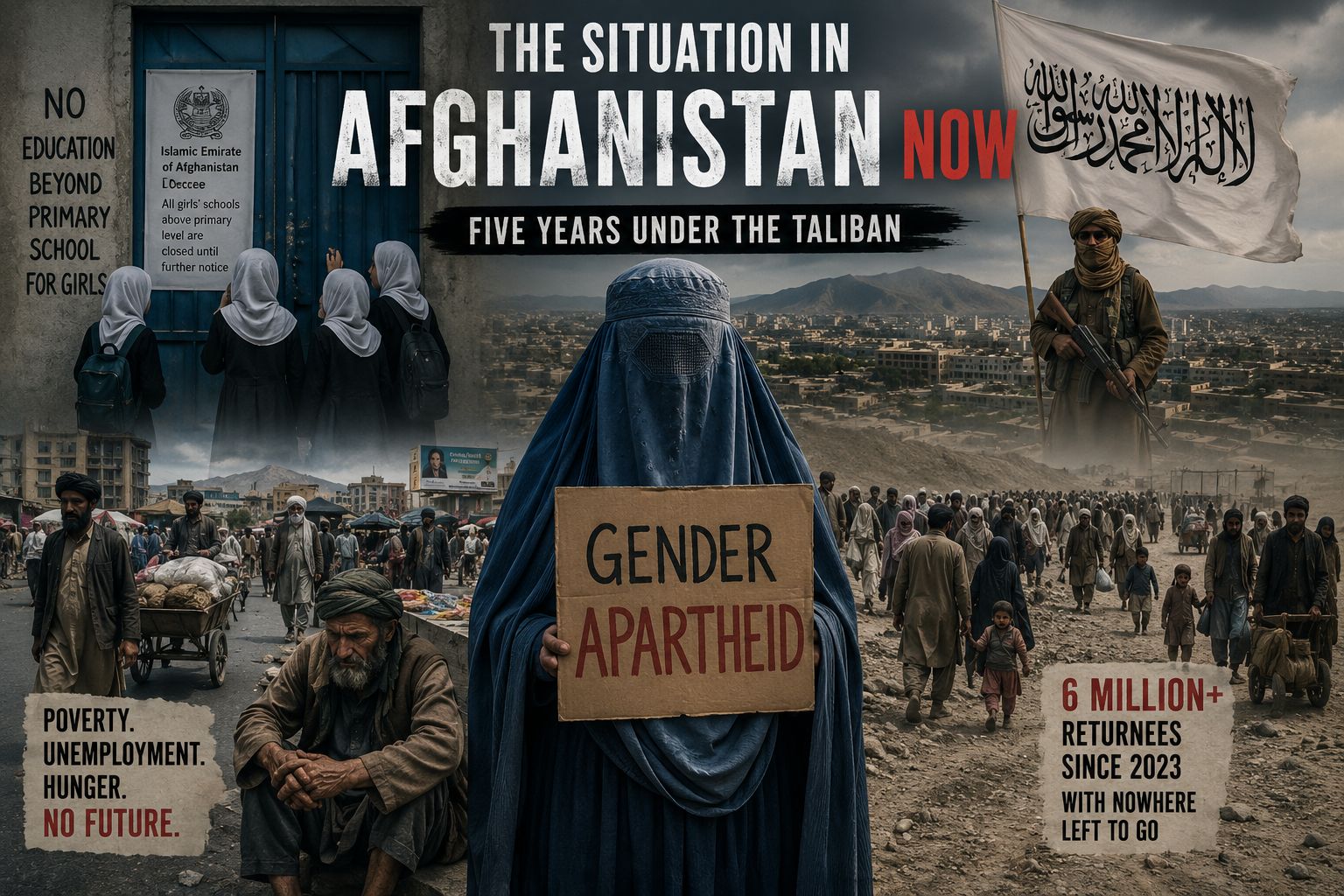
Five years ago, on August 15, 2021, Taliban fighters entered Kabul. Afghanistan’s Western-backed government collapsed with astonishing speed, President Ashraf Ghani fled the country, and two decades of American and NATO involvement ended in scenes of desperation at Kabul airport.
Five years later, the Taliban are still there.
They have not been overthrown by a popular uprising. The anti-Taliban resistance has not seriously threatened their national control. The country has not returned to the nationwide war that characterized much of the previous two decades. Russia has even formally recognized the Taliban government, becoming the first country to do so since the movement returned to power.
Yet describing Afghanistan simply as “stable” would be profoundly misleading.
The country presents a disturbing paradox. Large-scale warfare has substantially declined, and some ordinary Afghans say they feel physically safer than they did when suicide bombings, airstrikes, insurgent attacks and military operations were part of everyday life. At the same time, Afghanistan has become dramatically less free. Women and girls have been pushed out of much of public life, millions remain desperately poor, international assistance has declined, returning refugees are placing enormous pressure on an already weak economy, and tensions with Pakistan have escalated into open military confrontation.
The Taliban won their war. Five years later, the harder question is whether they can build anything resembling a successful country.
The war largely ended, and that matters
Any serious assessment of Afghanistan under Taliban rule has to begin with something that critics of the movement may find uncomfortable: security improved in an important sense after 2021.
Afghanistan before the Taliban takeover was not a peaceful liberal democracy waiting to flourish. It was a country at war. The Taliban insurgency attacked government forces and civilians, Islamic State carried out atrocities, Afghan and Western forces conducted military operations, and ordinary Afghans lived with bombings, checkpoints, kidnappings and the possibility of being caught between competing armed forces.
The Taliban’s victory removed one of the principal sides from that war because the insurgents became the government.
Associated Press reporting marking the fifth anniversary of the takeover found Kabul residents describing streets as safer than during the years of fighting. Their complaints increasingly concerned jobs, poverty and education rather than the constant physical insecurity associated with nationwide war. The United Nations has likewise acknowledged the reduction in large-scale armed conflict, even while condemning the Taliban’s human-rights record.
That improvement should not be dismissed simply because it complicates the story.
For someone who spent years wondering whether a bomb would explode in a marketplace or whether fighting would reach his village, the disappearance of much of that violence is not an abstract statistical achievement. Physical security matters enormously.
But security is not the same thing as freedom.
A dictatorship can produce safer streets. An authoritarian state can suppress armed competitors. Prison walls can be extremely orderly.
Afghanistan has therefore undergone an unusual transformation: it has become more peaceful in one sense while becoming considerably more repressive in another.
The Taliban survived when many expected them to fail
Immediately after Kabul fell, numerous predictions assumed that Taliban rule might prove temporary. Perhaps the movement would fracture, perhaps economic collapse would produce rebellion, perhaps armed resistance would grow. Perhaps international isolation would make governing impossible.
None of those developments has removed the Taliban.
Five years later, the movement controls the state apparatus, borders, security forces and most territory. Opposition groups exist, but none currently provides a nationwide alternative government. The Taliban have therefore completed a remarkable transition from insurgency to regime.
That transition also changes how they should be judged.
An insurgent movement can blame virtually everything on the government it is fighting. A government eventually owns the consequences of its policies.
The Taliban now collect taxes, regulate commerce, run ministries, control borders, appoint officials, administer courts, maintain infrastructure and conduct diplomacy. They cannot indefinitely explain Afghanistan’s economic and social failures by pointing to the previous government, foreign occupation or war; they wanted Afghanistan. They have Afghanistan.
Women have paid the greatest price
Nothing defines Taliban rule more clearly than the systematic destruction of opportunities for Afghan women and girls.
Afghanistan is now the only country in the world where girls and women are formally prohibited from education beyond primary school. UNESCO estimates that 2.4 million girls have been excluded from secondary education by 2026. Women have also been prohibited from university education since December 2022.
This is not merely a dispute over one educational policy.
UN Women says the Taliban have issued more than 100 decrees restricting women’s freedoms. Its latest research, based on thousands of interviews conducted in 2025 and 2026, found that roughly half of Afghan women leave their homes only once or twice per month. Only around 7 percent were employed, while nearly three-quarters reported feeling unsafe leaving home without a male escort.
Restrictions touch education, employment, movement, clothing, access to public places and the legal position of women within families. New decrees have continued to reinforce male authority rather than suggesting that the Taliban are gradually moving toward the more moderate system some hoped might emerge after 2021.
That matters because the Taliban initially attempted to reassure the outside world that their second period in power would differ from their first. They suggested that women would be able to study and work within an Islamic framework.
Five years provide enough evidence to judge those assurances.
Whatever tactical moderation Taliban spokesmen displayed during negotiations or immediately after their victory has not translated into a society in which women possess anything approaching equal freedom.
An entire generation of girls is being sacrificed
The education ban becomes even more disturbing when measured in human time.
A girl who was twelve when Kabul fell in 2021 is approximately seventeen today. Most of her adolescence has passed while secondary-school doors remained closed to her.
A girl who was fourteen is now approaching adulthood.
These are not children waiting for a brief emergency to end. They are becoming adults while opportunities disappear permanently.
The effects will not disappear even if the Taliban suddenly reopen schools tomorrow.
Lost years cannot simply be restored. Some girls will already have entered marriages. Some will have children. Others will be unable to return because their families can no longer afford it or because educational gaps have become too large.
The damage also spreads through the entire society.
A country that prevents women from studying eventually produces fewer female teachers, doctors, nurses and other professionals. UNESCO warns of serious future teacher shortages, while restrictions on female education are expected to worsen broader economic losses and already poor educational outcomes.
The Taliban therefore face a contradiction of their own making. In a society where conservative rules frequently limit interaction between unrelated men and women, female doctors and teachers are particularly important. Yet the government is simultaneously destroying the pipeline that produces them.
A government cannot indefinitely prohibit girls from becoming educated women and then wonder why it lacks educated women.
The consequences go far beyond education
It would be tempting to describe the Taliban’s treatment of women simply as an education crisis. That would understate the scale of what has happened.
The restrictions concern women’s presence in society itself.
Employment opportunities have contracted dramatically. Access to parks, gyms and other public spaces has been restricted. Rules concerning movement and male guardianship constrain independence. The cumulative effect is not merely that women cannot pursue particular careers but that millions have been pushed toward lives increasingly confined to the private sphere.
There are also people who continue resisting.
Afghan women operate informal education networks, pursue online learning, maintain businesses where possible and challenge restrictions despite serious personal risk. Human Rights Watch reported this week that Taliban authorities had detained six employees of an organization working on women’s and children’s rights, illustrating the risks faced by people attempting to preserve even limited civil society.
The language used to describe this system has become increasingly severe. UN officials and human-rights advocates have spoken of institutionalized discrimination and “gender apartheid,” although the latter remains a political and legal characterization rather than an internationally codified crime specifically established under that name.
Whatever terminology one prefers, the underlying reality is difficult to dispute: Afghanistan’s government deliberately assigns radically different freedoms and opportunities according to sex.
The economy survived, but Afghans are not becoming prosperous
The economic story is more complicated than the social one.
When the Taliban seized power, predictions of complete economic collapse were widespread. International aid disappeared or was dramatically reduced, foreign reserves became inaccessible, development programs stopped and thousands of educated Afghans fled.
The economy did suffer an enormous initial contraction.
Yet Afghanistan did not cease functioning. Markets continued operating, the currency avoided some of the worst scenarios, Taliban authorities improved aspects of domestic revenue collection, and economic activity eventually returned to growth.
That is the relatively positive part.
The much less positive reality is that economic growth has not translated into improving living standards for much of the population.
The World Bank estimated economic growth of 4.3 percent in 2025, but rapid population growth and the enormous influx of returning Afghans meant that GDP per person fell by 5.6 percent. Inflation, meanwhile, reached 7.6 percent by March 2026, driven particularly by food prices and supply pressures.
In other words, Afghanistan can produce more economic output while the average Afghan becomes poorer.
That distinction is crucial.
Political governments often celebrate GDP growth because it produces an impressive headline. But people do not eat national GDP. They experience wages, prices, jobs, rent and whether their children can be fed.
On those measures, Afghanistan remains desperately vulnerable.
Excluding women also damages the economy
The Taliban’s restrictions on women are therefore not merely moral or human-rights questions. They are economic policy.
Imagine trying to develop a country while intentionally preventing roughly half its adult population from participating normally in education and employment.
No sophisticated economic model is required to understand the problem.
Human capital is one of the foundations of modern prosperity. Countries become richer partly by educating people and allowing them to perform work where their abilities are most productive. Preventing millions of women from acquiring skills, entering professions or establishing careers destroys potential economic output.
The effects compound over generations.
An educated woman is more likely to contribute directly to the economy, but education also affects family income, children’s education and health outcomes. Removing women from education therefore damages not only today’s workforce but tomorrow’s.
This is one of the central contradictions of Taliban governance.
The movement says it wants a strong and independent Afghanistan while implementing policies almost perfectly designed to weaken Afghanistan’s human capital.
Poverty has replaced war as the daily emergency
For millions of Afghans, however, debates about GDP, recognition and political systems remain secondary to a much simpler problem: survival.
Food insecurity remains widespread. Families struggle with unemployment and debt. Humanitarian organizations face funding shortages precisely when enormous numbers of people continue needing assistance.
The human reality appears in individual stories.
Associated Press recently documented the life of an older Afghan woman who scavenges discarded material to support her family amid extreme poverty. Her family salvages food, fuel and anything potentially valuable. Her daughter had been detained for begging, leaving behind a breastfeeding baby who subsequently died shortly after the mother’s release.
One case cannot represent forty million people, but it illustrates something statistics easily hide.
The absence of bombs does not mean the absence of desperation.
A family that survives an insurgency only to discover that it cannot afford food has experienced an improvement in security without necessarily experiencing an improvement in life.
Afghanistan is receiving millions of people it cannot easily absorb
Then there is the refugee problem.
For decades, Afghans fled into Pakistan and Iran. Now enormous numbers are returning, many under pressure or through deportation.
UNHCR reports that more than six million Afghans have returned since 2023, including approximately 2.9 million during 2025. By July 2026, hundreds of thousands more had already returned, and UN agencies warned that millions could return by the end of the year.
These people require somewhere to live.
They require jobs.
Their children require schools.
They require healthcare.
They need food, transport and basic services.
Yet they are entering one of the poorest economies in Asia at precisely the moment when humanitarian assistance is under enormous pressure.
This creates an economic trap. Population growth increases aggregate demand and can increase GDP, but if employment, infrastructure and investment fail to expand at the same speed, output per person declines.
That is already visible in the World Bank’s figures.
Iran and Pakistan are changing Afghanistan from the outside
The mass returns also demonstrate that Afghanistan’s future cannot be understood solely by looking inside its borders.
Iran and Pakistan have hosted enormous Afghan populations for decades. Their willingness to continue doing so has declined.
Domestic politics, economic pressures and security concerns have produced tougher policies toward Afghans. Some returns are voluntary, but others involve deportation or conditions that leave refugees with little realistic choice. UNHCR has repeatedly warned that returns are occurring under adverse circumstances and are placing additional pressure on fragile Afghan communities.
The irony is striking.
For decades, Afghanistan exported instability and refugees to its neighbors. Now policies adopted by those neighbors are exporting a humanitarian challenge back into Afghanistan.
Pakistan and the Taliban have gone from partners to enemies
The relationship with Pakistan is one of the most remarkable geopolitical reversals since the Taliban takeover.
Pakistan was repeatedly accused during the twenty-year war of providing sanctuary and support to Taliban leaders and fighters. Islamabad denied many of those accusations, but the relationship between Pakistan’s security establishment and the Afghan Taliban was nevertheless viewed internationally as exceptionally close.
One might therefore have expected Pakistan to be among the greatest beneficiaries of the Taliban victory.
Instead, relations have deteriorated catastrophically.
Pakistan accuses the Taliban government of allowing Tehreek-e-Taliban Pakistan, the Pakistani Taliban or TTP, to operate from Afghan territory and conduct attacks inside Pakistan. Kabul rejects the accusation and argues that Pakistan’s militancy is fundamentally an internal Pakistani problem.
The dispute escalated beyond rhetoric.
Cross-border clashes intensified during 2025 and developed into far more serious fighting in 2026. Pakistani strikes inside Afghanistan produced Taliban retaliation, while subsequent clashes and air attacks caused deaths, border closures and serious disruption to trade. Chinese and other regional diplomatic efforts have attempted to contain the confrontation.
There is a historical lesson here.
Supporting an armed ideological movement because it seems strategically useful does not guarantee that the same movement will become a compliant government once it controls a sovereign state.
Pakistan spent decades trying to shape events in Afghanistan. It ultimately got a Taliban government—and discovered that Taliban-controlled Afghanistan was not necessarily Pakistani-controlled Afghanistan.
The Taliban now have insurgents of their own
The reversal does not end with Pakistan.
The Taliban spent twenty years presenting themselves as insurgents resisting a corrupt government and foreign occupation. They now confront militants who make similar claims against them.
The most important is Islamic State Khorasan Province, usually known as ISIS-K.
ISIS-K considers the Taliban insufficiently Islamic and has carried out devastating attacks inside Afghanistan and beyond. The Taliban have aggressively targeted the organization, making counterterrorism one area where their interests occasionally overlap with governments that otherwise oppose Taliban rule.
This produces another historical irony.
The movement that once fought the Afghan state now operates the Afghan state. The insurgents became the counterinsurgents.
ISIS-K has not displaced the Taliban from power, but its continued existence demonstrates that the end of the previous war did not eliminate militant jihadism from Afghanistan.
Nor can Afghanistan’s security problem be considered entirely domestic. ISIS-K has demonstrated ambitions and operational reach extending beyond Afghanistan, giving Russia, Central Asian states and other regional powers a reason to engage pragmatically with Kabul even when they dislike Taliban ideology.
International isolation is beginning to crack
For years after 2021, the Taliban faced an extraordinary diplomatic situation: they controlled Afghanistan but almost nobody formally recognized them as its legitimate government.
That wall finally cracked.
Russia formally recognized the Taliban government in July 2025, becoming the first country to do so since their return to power. Moscow has since sought a broader partnership with Kabul, including cooperation over trade and security.
Other states have established varying degrees of practical engagement without granting equivalent formal recognition.
The distinction matters.
Diplomatic engagement does not necessarily mean approval. Governments may conclude that they need to speak with whoever actually controls Afghanistan regardless of how objectionable that government may be.
After five years, the Taliban increasingly resemble a durable regime rather than an interim military victory waiting to collapse.
That creates an uncomfortable diplomatic question.
At what point does refusing to deal with the Taliban cease to pressure the regime and begin merely reducing the outside world’s ability to influence Afghanistan?
There is no easy answer.
Full normalization without concessions could reward systematic repression, particularly of women. Complete disengagement, however, could deepen Afghan poverty while accomplishing little politically.
Recognition gives the Taliban something they desperately want
The Taliban want more than economic assistance. They want legitimacy.
International recognition would tell Afghans and the world that the Islamic Emirate is no longer treated as a temporary regime born from military conquest but as Afghanistan’s normal government.
That is valuable domestically as well as internationally.
The outside world therefore retains some leverage.
Recognition, financial relationships, development assistance and diplomatic integration can potentially be conditioned on changes in Taliban policies. Female education is the most obvious candidate.
The problem is that five years of international pressure have produced very limited movement.
The Taliban leadership has repeatedly demonstrated that ideological priorities can outweigh enormous economic and diplomatic costs.
That should temper expectations that another round of condemnation will suddenly reopen schools.
Afghanistan is a theocracy, but that does not mean Islam equals the Taliban
Afghanistan today can reasonably be described as a theocratic authoritarian state.
Political legitimacy does not derive from competitive democratic elections. The Taliban claim religious authority and govern according to their interpretation of Islamic law. Their supreme leader occupies a position that combines political and religious power, while moral regulations influence areas of private and public behavior.
But it is important not to make the intellectual mistake of treating Taliban ideology as simply “Islam.”
Muslims disagree profoundly about theology, politics, women’s rights, democracy and the relationship between religion and the state. Afghan Muslims themselves have suffered under Taliban policies and challenged Taliban interpretations.
A Muslim woman demanding education is not rejecting Islam merely because the Taliban claim Islam requires restrictions on her.
This distinction matters whenever religion becomes state power.
The conflict is frequently not “religion versus secularism.” It is one interpretation of religion acquiring coercive authority over everybody else.
The situation of women demonstrates the difference between religion and theocracy
A religious society can remain free.
People can voluntarily pray, fast, attend mosques, dress conservatively and organize their lives according to religious rules.
The crucial word is voluntarily.
Theocracy begins when the state decides that theological conclusions are no longer matters of conscience but compulsory rules.
Taliban Afghanistan demonstrates this distinction with unusual clarity.
A woman choosing conservative Islamic dress exercises religious freedom. A woman being legally compelled to dress according to a government-approved interpretation of Islam does not.
A family voluntarily educating children within a religious tradition exercises religious freedom. A government prohibiting girls from receiving secondary education removes freedom.
The Taliban have therefore not simply made Afghanistan more religious. Afghanistan was already overwhelmingly religious.
They have concentrated the power to decide what religion legally requires.
The West failed in Afghanistan, but the failure is more complicated than the withdrawal
Any assessment of Afghanistan today eventually reaches the same question: what exactly did the United States and its allies accomplish during twenty years of war?
The final political outcome was undeniably catastrophic from the perspective of Western objectives.
A government supported for two decades collapsed within weeks. Afghan security forces that had consumed enormous resources largely disintegrated. The Taliban returned to Kabul. The democratic institutions built after 2001 vanished.
By that standard, the intervention failed.
But saying that the project ultimately failed does not mean that nothing changed during those twenty years.
Millions of children attended school. Girls entered education on a scale almost unimaginable under the first Taliban regime. Women attended universities, worked in journalism, medicine, government and civil society, and participated in political life. Cities developed, media proliferated and millions experienced opportunities that have subsequently disappeared.
Those achievements were real.
Their tragedy is that they proved institutionally fragile.
The Western-backed political order developed many of the outward structures of a modern state but failed to develop enough legitimacy, cohesion and military independence to survive when foreign support disappeared.
Blaming one American president is too easy
The final withdrawal took place under Joe Biden, and the chaotic scenes at Kabul airport became one of the defining images of his presidency.
But Afghanistan’s failure cannot seriously be reduced to one administration.
George W. Bush launched the intervention after the September 11 attacks. Barack Obama dramatically increased American forces before beginning a drawdown. Donald Trump’s administration negotiated the 2020 Doha agreement with the Taliban, establishing a path toward American withdrawal. Biden ultimately decided not to reverse that path and completed the withdrawal in 2021.
Four presidencies therefore participated in different stages of the same war.
The more important failure occurred over twenty years: foreign powers spent extraordinary resources without creating an Afghan political and security system capable of surviving independently.
The evacuation disaster lasted weeks.
That institutional failure took decades.
Staying forever was not an attractive alternative
This does not mean withdrawal was necessarily avoidable.
Criticism of the 2021 departure sometimes assumes that the alternative was simply to maintain a small foreign force indefinitely while everything else remained stable.
That cannot be known.
If the United States had abandoned the withdrawal agreement and retained troops, the Taliban could have resumed large-scale attacks against Western forces. Washington might then have faced another escalation in a war already approaching its third decade.
The available choices were therefore grim.
Continue a war with no obvious route to decisive victory, or withdraw and risk the collapse of the political order created during the occupation.
The eventual disaster was partly the product of having reached a situation where every realistic option was bad.
Humanitarian aid should not be confused with supporting the Taliban
The international community now faces another difficult distinction.
Giving money directly to Taliban institutions carries obvious political and ethical problems. But reducing humanitarian assistance to Afghan civilians because the Taliban govern Afghanistan can punish precisely the people most harmed by Taliban policies.
A malnourished child did not ban girls from school.
A widow struggling to feed her family did not negotiate the Doha agreement.
A refugee expelled from Pakistan did not design Taliban religious law.
UNHCR and UNDP warned in July that Afghanistan faces unprecedented pressure from mass returns while declining international aid threatens poverty reduction and basic services. More than six million Afghans had returned since 2023, and another large wave was expected.
The world therefore needs to maintain a distinction between helping Afghanistan and endorsing its government.
Those are not the same thing.
What does an ordinary Afghan want?
Foreign discussion of Afghanistan frequently reduces the population to ideological categories.
Taliban.
Islamists.
Democrats.
Women activists.
Former government supporters.
Refugees.
But ordinary life is rarely so theoretical.
Many Afghans want what most human beings want: physical safety, employment, affordable food, education for their children, healthcare, housing and some confidence that tomorrow will be better than today.
Recent interviews make this combination clear. Afghans can simultaneously welcome the reduction in violence, complain bitterly about unemployment and demand that schools reopen for girls.
There is nothing contradictory about those views.
A father can be grateful that his son is less likely to die in a bombing while furious that his daughter cannot attend secondary school.
A shopkeeper can appreciate security while despising economic stagnation.
A deeply religious Muslim can support Islamic values while rejecting Taliban restrictions.
Afghanistan cannot be understood if every person is forced into a Western political category.
The Taliban’s greatest success may also expose their greatest failure
The Taliban’s strongest claim to success is security.
They defeated a government backed by the world’s most powerful military alliance, ended much of the nationwide conflict and established control over the country.
But achieving order creates higher expectations.
During war, survival itself can make government performance secondary. Once fighting decreases, people begin asking different questions.
Where are the jobs? Why are prices high? Can my daughter attend school? Can my son find work? Will we have electricity? Can we afford healthcare? Why must educated people leave the country to have a future?
The more successful the Taliban become at ending war, the harder it becomes to blame war for everything else.
Afghanistan’s greatest resource is being deliberately wasted
Afghanistan possesses mineral resources, a strategically important location and a young population. But its greatest potential resource is the same one every country possesses: human beings.
Taliban policy wastes that resource on an extraordinary scale.
Millions of girls who could become doctors, engineers, teachers, entrepreneurs, scientists or administrators are prevented from completing education.
Millions of women who could contribute economically face restrictions on employment.
Young men also struggle inside an economy unable to generate enough productive work.
At the same time, educated Afghans continue seeking opportunities abroad.
The country therefore faces both a brain drain and a deliberate suppression of domestic human capital.
No amount of mineral wealth can easily compensate for that.
Countries become prosperous when people are allowed to develop their abilities.
Afghanistan is doing the opposite to half its population.
What happens next?
Predicting Afghanistan has humiliated experts for decades, so certainty would be foolish.
Several futures nevertheless appear plausible.
The first is authoritarian stabilization.
Under this scenario, the Taliban remain firmly in control. More countries gradually establish relations with them, economic activity grows slowly, major insurgent threats remain contained and the regime becomes increasingly normalized internationally. Women’s rights remain severely restricted, but foreign governments reluctantly conclude that Taliban rule is permanent.
This may currently be the most plausible trajectory.
The second possibility is limited pragmatic reform.
Economic necessity, diplomatic incentives and internal disagreements could eventually persuade Taliban leaders to relax some restrictions. Girls might return to secondary education under conditions acceptable to the leadership, and women could regain access to selected professions.
There have long been suggestions of disagreements within Taliban circles over such policies. But after five years, there is little reason to assume liberalization is imminent.
The third scenario is renewed destabilization.
Conflict with Pakistan could worsen. ISIS-K could expand. Economic problems and refugee returns could intensify dissatisfaction. Internal Taliban divisions could become more serious, while armed opposition might exploit political weakness.
Afghanistan’s history provides more than enough warnings against assuming that apparent stability is permanent.
Peace is more than the absence of gunfire
Five years after the Taliban walked into Kabul, Afghanistan is no longer the country it was during the final years of the war.
Foreign armies are gone. The Taliban have survived. Large-scale internal conflict has declined. Some Afghans genuinely feel safer walking through their cities and villages than they did before 2021.
Those facts matter.
But peace cannot be defined solely by the absence of explosions.
A girl who cannot enter secondary school is living in peace only according to the narrowest definition of the word. A woman who rarely leaves her home because the social and legal environment increasingly excludes her from public life has not gained meaningful freedom simply because fewer bombs explode. A father who cannot feed his family may appreciate security without mistaking poverty for success.
Afghanistan today is therefore neither the apocalyptic collapse predicted by some observers in 2021 nor the triumphant Islamic state portrayed by Taliban propaganda.
Something more complicated
The Taliban have demonstrated that they can conquer a country, maintain control over it and suppress much of the warfare that preceded their victory. They have shown greater administrative durability than many of their opponents expected. They are increasingly treated by neighboring powers as a government that will have to be dealt with rather than an insurgency waiting to disappear.
At the same time, they have constructed one of the world’s most restrictive systems for women, deliberately prevented millions of girls from developing their abilities, presided over persistent poverty and international isolation, and taken Afghanistan into a dangerous confrontation with the very country once widely regarded as their most important external supporter.
The distinction between winning a war and successfully governing a country could hardly be clearer.
The Taliban won Afghanistan.
Five years later, they still have to prove that they can give Afghans a future.
Leave a Reply