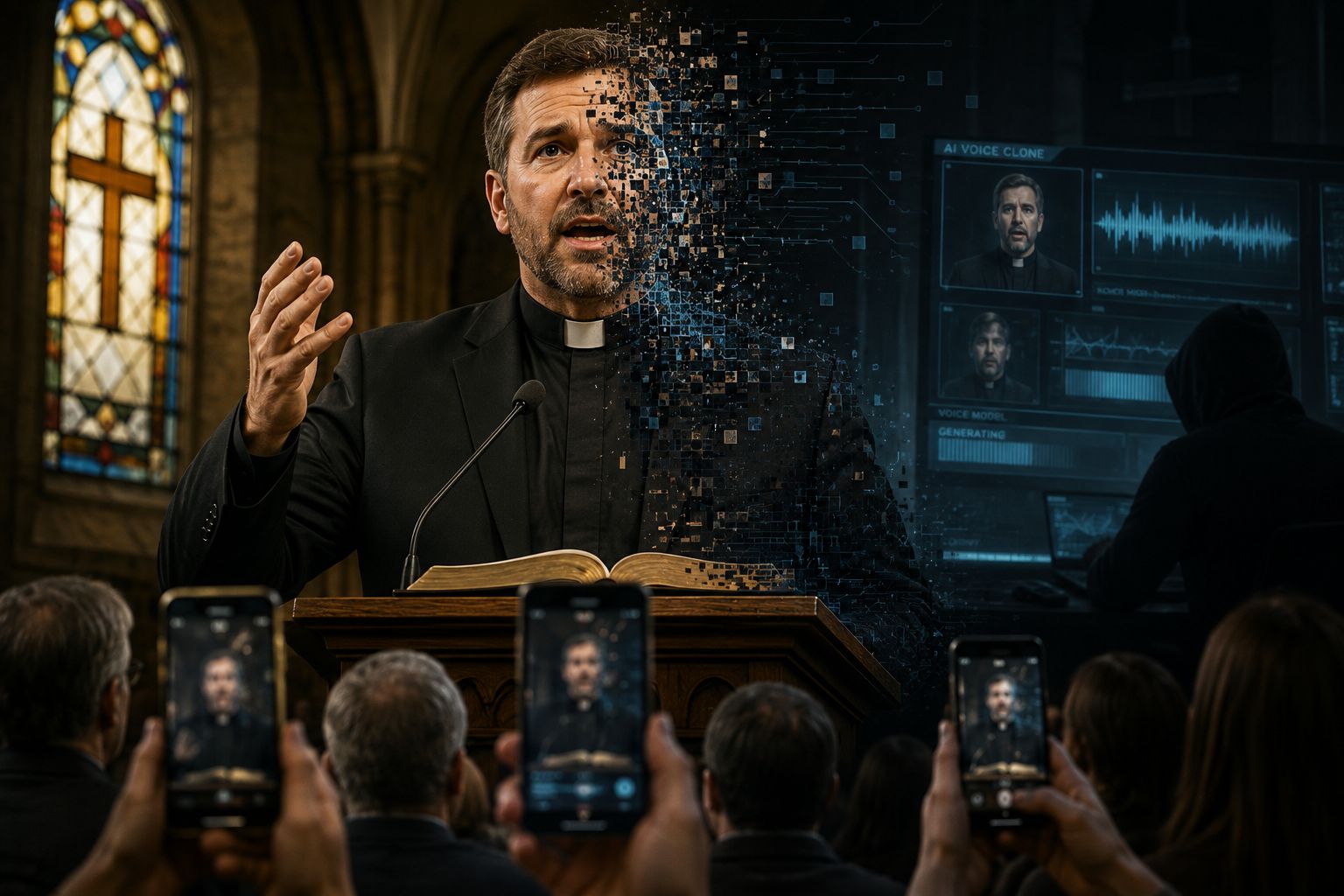
Imagine scrolling through social media one evening when your pastor appears on the screen. His face looks familiar, his voice sounds right, and he speaks with the confidence you have heard from the pulpit hundreds of times.
Then comes the message. You must see the deepfakes (here or here).
Perhaps God wants you to send money immediately. Maybe your church desperately needs financial assistance. Perhaps Christians must support a particular political candidate, oppose a particular group or prepare for some supposedly imminent catastrophe. The message might sound strange, but there he is—your own religious leader apparently saying it with his own mouth.
Except he never said anything.
The face was generated or manipulated by artificial intelligence. The voice was cloned, the message was invented, and the religious authority you trusted was turned into somebody else’s digital puppet.
This is no longer hypothetical. AI-generated impersonations of pastors and priests have already appeared online, sometimes asking believers for money and sometimes spreading inflammatory messages. In January 2026, WIRED documented impersonations involving Catholic priest and podcaster Father Mike Schmitz and warnings from religious communities across the United States and beyond.
Humanity spent thousands of years arguing about who speaks for God. Artificial intelligence has introduced a remarkable new possibility: the person supposedly speaking for God may not even exist.
When your pastor’s face no longer proves it is your pastor
For most of human history, impersonating a religious leader convincingly required considerable effort. A fraudster could forge a letter, invent a quotation or simply lie about what somebody had said, but reproducing someone’s face and voice was much harder.
Generative AI changes that calculation dramatically.
Video, photographs and audio once functioned as powerful forms of evidence precisely because fabricating them convincingly was difficult. Synthetic media increasingly weaken that assumption. A sufficiently convincing artificial voice can make someone appear to say words they never uttered, while generated or manipulated video can add the visual evidence that makes the deception considerably more persuasive.
Father Mike Schmitz encountered exactly this problem. Fake material using his likeness promoted supposed blessings and encouraged viewers to click links, while other clergy members have faced impersonations through videos, messages and calls. WIRED found more than 20 TikTok accounts posing as Schmitz at the time of its reporting, although it could not establish that every piece of material posted by those accounts was AI-generated.
South Florida pastor Jennifer LeClaire experienced another disturbing example. According to the Miami Herald, a follower became convinced that an AI-generated version of LeClaire had promised him personal counseling; the fabricated interaction eventually involved a request for money. Even when the real pastor explained that the video was fake, the victim reportedly remained difficult to convince.
The technology does not merely imitate people.
It exploits relationships.
Religious trust creates a particularly attractive target
A fake celebrity selling cryptocurrency is dangerous enough. A fake religious leader can possess something even more useful to a manipulator: moral authority.
Many believers do not regard their pastor, priest, imam, rabbi or spiritual teacher as simply another online personality. Religious leaders can counsel people through marriages, deaths, illness, moral dilemmas and crises of faith. Their words may therefore carry an authority that an ordinary influencer could never reproduce.
Scammers do not need to manufacture that trust.
The real religious leader has already spent years building it for them.
Once sermons, podcasts, interviews and livestreams are publicly available, enormous quantities of audiovisual material may also exist from which an impersonator can work. A religious leader with a huge digital following consequently presents an unusual combination: recognizable appearance, recognizable voice, established authority and an audience accustomed to receiving messages through a screen.
That makes religious communities attractive targets for digital impersonation.
The scammer does not have to persuade you to trust a stranger. The scammer merely has to persuade you that the stranger isn’t a stranger.
“God wants you to send money”
Money provides the most obvious incentive.
Religious organizations legitimately ask for donations, while clergy sometimes promote charities, fundraising campaigns or church projects. A fraudulent appeal can therefore imitate behavior that followers already expect to see.
That makes the deception more sophisticated than an obviously absurd message from an unknown account.
Imagine receiving a video apparently showing your pastor discussing a humanitarian emergency. He asks everyone to contribute through a particular link before midnight. The appeal is emotionally powerful, his voice is unmistakable, and hundreds of comments appear underneath.
Why would you distrust your own eyes?
That question is becoming increasingly dangerous.
One Catholic communications firm reported a late-2025 case in which an AI-generated imitation of a bishop appeared to ask viewers for money connected to prayer intentions at a French shrine. The video reportedly reproduced the bishop’s voice, likeness and pastoral style closely enough to appear credible at first glance.
The theological language merely makes the fraud more effective. An ordinary scammer says, “Send me money.” A religious deepfake can effectively say, “Your faith gives you a reason to send me money.”
The danger is much bigger than financial fraud
Stealing money is terrible, but the political possibilities should worry us even more.
Imagine a convincing video of a prominent pastor appearing days before an election. He tells millions of Christians that supporting one candidate is a moral obligation.
Now imagine an imam apparently telling Muslims that another religious community is preparing to attack them.
Imagine a rabbi apparently endorsing collective punishment, a Hindu leader apparently calling for retaliation against Muslims or a Christian bishop apparently describing political opponents as enemies of God.
None of them actually said it.
The video nevertheless circulates for twelve hours before somebody establishes that it is synthetic. By then, millions of people may have watched it, influencers may have reposted it, political activists may have incorporated it into their narratives, and angry responses may themselves have become news.
The correction enters a completely different information environment from the lie.
Artificial intelligence therefore creates a disturbing form of religious misinformation. It can manufacture not merely a false proposition but a false authority for that proposition.
Imagine religious deepfakes during communal violence
The danger becomes particularly obvious in societies already divided along religious lines.
Suppose violence breaks out between two communities. Fear is high, information is incomplete and people are desperately searching social media for explanations.
Then a video appears.
A prominent religious leader from one community apparently announces that the other side has declared war on them. Another synthetic video soon appears showing somebody from the opposing religion calling for revenge.
Perhaps both are fake.
It may no longer matter.
Once frightened people believe that their families are threatened, corrections arriving hours later may have little power. A technology capable of fabricating credible religious authority could therefore become particularly dangerous when combined with sectarian tension, ethnic conflict or political polarization.
The problem is not uniquely Christian, Muslim, Jewish, Hindu or Buddhist.
It is human.
Wherever religious identity carries social power, somebody has an incentive to counterfeit that power.
AI can invent the preacher too
There is an even stranger possibility.
Why bother impersonating a real pastor when you can create one?
Synthetic influencers already demonstrate that an online personality does not necessarily need a biological person behind it. Religion introduces an especially interesting variation because audiences may encounter an unfamiliar preacher while scrolling and have no reason to know whether that individual actually exists.
WIRED documented AI-generated pastor videos that appeared to show clergy delivering politically charged sermons. In one case, an account disclosed in its profile that it used AI to depict a “parallel universe,” yet individual video captions did not necessarily make their synthetic nature obvious, and commenters sometimes appeared to interpret the content as genuine.
That creates a fundamentally different problem from impersonation.
Nobody’s identity has necessarily been stolen because the preacher himself is fictional.
His congregation can be fictional too. His church can be fictional, his sermon generated, his apparent audience synthetic and his political outrage carefully optimized for engagement.
The only thing that needs to be real is the viewer.
Meet the perfect preacher
An artificial preacher could eventually possess advantages no human religious leader can match.
He never becomes tired. He never forgets his lines, asks for a vacation or suffers an embarrassing scandal unless his creators want one. His sermons can be translated instantly into dozens of languages, while his appearance and rhetorical style can be adjusted for different audiences.
More importantly, his message can be optimized.
One version tells conservative Christians what makes them angry. Another tells progressive Christians what makes them hopeful. A synthetic Muslim preacher can be adjusted for a completely different audience, while an artificial spiritual guru can tell lonely people precisely what they want to hear.
Traditional preachers address congregations.
AI can potentially address you.
A sufficiently personalized religious system could know which Bible verses you respond to, which political subjects anger you, when you are lonely, which moral anxieties trouble you and what type of language makes you most receptive.
At that point, we are no longer discussing a sermon.
We are discussing algorithmic persuasion wearing religious clothing.
But churches themselves are using AI
There is an important complication: artificial intelligence is not merely something being done to religion.
Religious organizations and clergy are adopting it themselves.
Some pastors now use generative AI to help research, organize or draft sermons. Recent reporting describes clergy experimenting with AI while debating where assistance ends and spiritual authenticity begins.
That is not automatically sinister.
A pastor using AI to reorganize notes is not fundamentally different from using a search engine, grammar checker or word processor. Religious organizations can also use AI for translation, administration, accessibility, education and countless mundane tasks.
The interesting question begins when the machine moves closer to the spiritual center.
If AI generates 10 percent of a sermon, did the pastor write it?
What about 50 percent?
What if the pastor supplies only the subject and reads whatever the machine produces?
If a congregation believes it is hearing its pastor’s spiritual reflection while most of the language originated from software, does transparency matter?
For believers who regard preaching as more than public speaking, these are theological questions as much as technological ones.
Can the Holy Spirit outsource to a chatbot?
Christian traditions differ enormously in how they understand preaching, revelation and divine guidance, but many believers regard a sermon as something more meaningful than an informational presentation.
That makes AI-generated sermons philosophically fascinating.
Suppose a pastor asks a language model:
Write me a moving sermon about forgiveness based on the Gospel of Matthew.
The resulting sermon might be beautiful. Perhaps it contains insightful interpretations, memorable metaphors and compassionate advice.
But where did the spiritual authority come from?
The pastor?
The biblical text?
The congregation?
The software?
The millions of human-written texts that influenced the model?
For an atheist, the problem may simply concern authorship and honesty. For a believer who thinks religious preaching involves genuine spiritual discernment, the problem can become much deeper.
Even the Vatican has explicitly warned about AI-generated misinformation and deepfakes. Its 2025 document Antiqua et Nova argued that synthetic media can distort people’s relationship with reality and emphasized the importance of transparency and verification.
The church has therefore arrived at an unusual moment: religious institutions can use artificial intelligence while simultaneously needing to teach believers not to trust artificial versions of religious institutions.
AI does not know whether God said anything
Another problem appears when believers themselves ask chatbots religious questions.
People increasingly use conversational AI for information, advice and interpretation, including questions concerning scripture and religious practice. A recent study examining AI systems in Islamic contexts concluded that current generative models can be useful for introductory learning but should not be treated as authoritative sources for religious rulings or scholarship without verification. The researchers identified problems involving hallucinated or incomplete citations, jurisprudential consistency and source reliability.
The underlying issue applies far beyond Islam.
Language models generate responses based on patterns in information rather than receiving supernatural revelation. They can explain what Catholics traditionally teach about purgatory, what Sunni scholars have argued about a particular question or how different Jewish traditions interpret a passage.
They cannot establish that God endorses the answer.
Yet conversational language can make uncertainty disappear psychologically. A confident response arrives instantly, written directly to the user, without the hesitations and disagreements that characterize actual religious scholarship.
The machine can sound authoritative without possessing authority.
That distinction matters.
“But I saw the video”
For decades, digital literacy taught people to be skeptical of things they merely read online.
Now we need a more disturbing lesson:
Seeing is no longer believing. Neither is hearing.
A video should increasingly be treated as a claim requiring context rather than self-authenticating evidence. Where did it originate? Does the supposed speaker’s official account contain it? Have reputable sources verified it? Is somebody asking for money, secrecy, immediate action or emotional retaliation?
Religious communities can help by establishing simple verification systems. Churches, mosques and other organizations can make their official accounts easy to identify, publish warnings about impersonators and create clear rules for donations.
Congregants also need to understand that urgency is a warning sign.
If “your pastor” suddenly tells you that God urgently needs your credit card number, God can probably wait five minutes while you verify the account.
Platforms have responsibilities too
Individual skepticism will not solve the entire problem.
Platforms hosting synthetic media know that fabricated material can reach enormous audiences before verification catches up. Labels, provenance systems, impersonation policies and rapid reporting mechanisms therefore matter.
Yet labels alone will not eliminate deception. People repost videos without context, screenshots remove warnings, synthetic content moves between platforms, and increasingly convincing generation makes casual visual inspection unreliable.
The arms race between generation and detection also makes a purely technological solution doubtful.
Society therefore needs something less exciting than another AI detector: better habits of verification.
That means slowing down precisely when a piece of content makes us most desperate to react.
Especially when it confirms what we already wanted to believe.
Religious leaders have an unusual responsibility
Clergy cannot prevent somebody from cloning their voices, but they can prepare congregations for the possibility.
A church that collects donations online should explain exactly where legitimate appeals appear. Religious organizations can repeatedly tell followers that leaders will never request money through private messages or unfamiliar payment methods if that reflects their actual policy.
Prominent clergy should also think carefully about their own use of synthetic media.
If religious institutions normalize artificial voices, generated sermons and synthetic religious personalities without clearly labeling them, they may unintentionally teach followers that authenticity does not matter very much.
Then they will have difficulty demanding skepticism when malicious actors do the same thing.
Transparency should therefore become a religious as well as technological norm.
If AI helped write the sermon, perhaps say so.
If an image is synthetic, label it.
If a religious leader never made the statement circulating online, correct it quickly and visibly.
Trust is much easier to protect before a crisis than to reconstruct afterward.
Religion has always contained an authority problem.
Who interprets scripture correctly? Which church represents genuine Christianity? Which scholar properly understands Islamic law? Which traditions should believers trust? When does a charismatic leader become a manipulator?
Artificial intelligence does not resolve any of those questions.
It adds another one:
Did the authority figure actually say the thing we are arguing about?
That may sound almost comical until we consider what religious authority can motivate people to do.
Donate money. Vote. Protest. Forgive. Condemn. Marry. Divorce. Trust. Fear. And, in the worst circumstances, hate.
A fabricated religious message can therefore have very real consequences even when every pixel in the video is artificial.
God didn’t say that
The irony is extraordinary.
For thousands of years, human beings have debated whether particular scriptures, prophets, revelations and religious experiences genuinely came from God. We developed theology, textual criticism, religious institutions and entire scholarly traditions around questions of authenticity.
Now we have created machines capable of fabricating a video of your pastor before breakfast.
The appropriate response is not panic. Artificial intelligence can be enormously useful, including for religious organizations, and most AI-generated material is not an elaborate attempt to manipulate believers.
But the old shortcut—I saw him say it—is dying.
A familiar face is no longer enough. A familiar voice is no longer enough, while a clerical collar, pulpit, mosque or religious vocabulary proves very little about who created a message.
The next time a video tells you that your pastor wants money, your imam wants retaliation or your religious leader wants your vote, ask one question before doing anything:
Did they actually say it?
Because God may not have said it.
Your pastor may not have said it either.
AI may have said it for them.
Leave a Reply