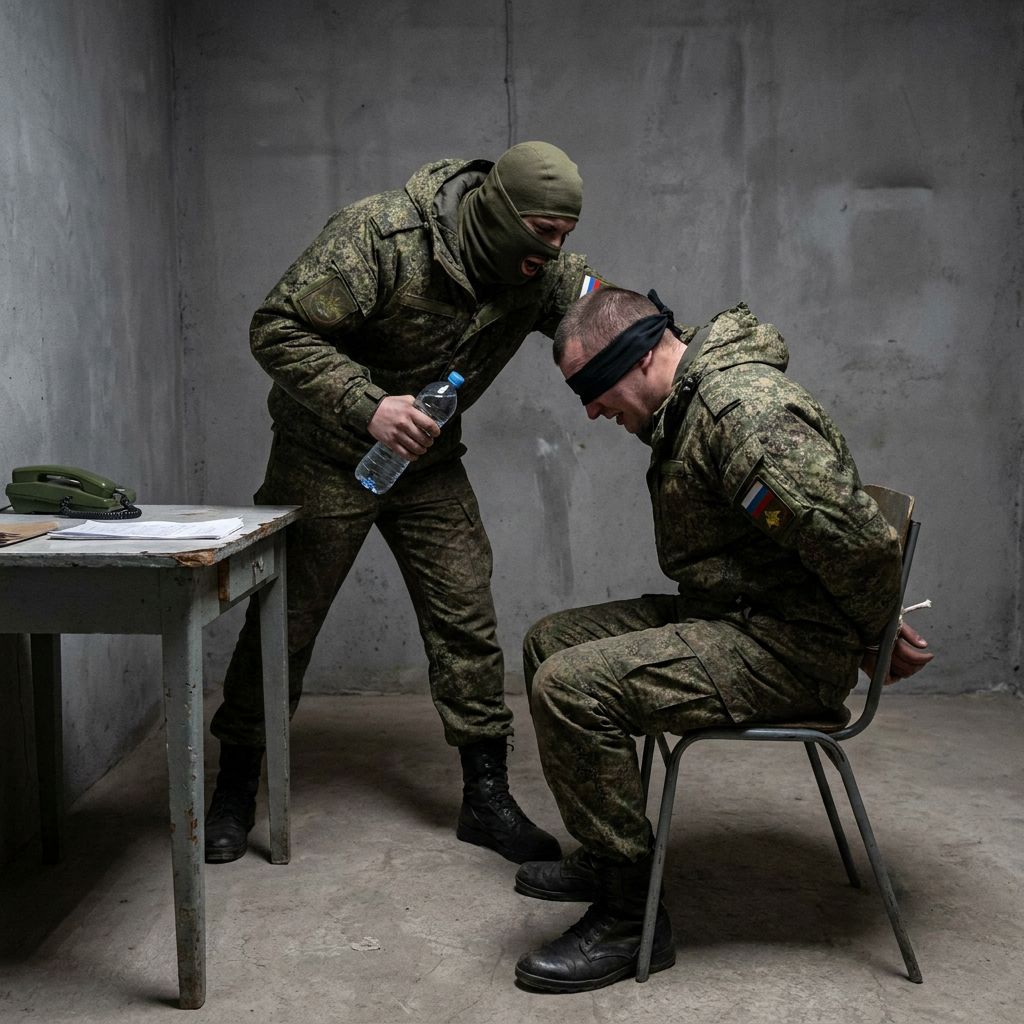
Wars are usually narrated horizontally. Russians kill Ukrainians, Ukrainians kill Russians, missiles cross borders, armies capture territory, and prisoners fall into enemy hands.
Yet violence also moves in another direction: downward, inside the armies and societies fighting the war. Russian commanders have allegedly beaten, tortured and even killed their own soldiers. Ukrainian authorities have investigated officers accused of beating and humiliating their own subordinates. One notorious case involved soldiers tying a serviceman to a wooden structure shaped like a cross.
Women serving in the military have also reported sexual harassment. Meanwhile, the wartime economy has pushed other women toward prostitution around frontline garrison towns. These stories show another face of war: people do not brutalize only the enemy.
None of this makes Russia and Ukraine equivalent. Russia launched the full-scale invasion in February 2022. Independent international monitors have repeatedly found Russian abuses against Ukrainian prisoners and civilians far more extensive. The United Nations has documented Ukrainian abuse of Russian prisoners too, but on a fundamentally different scale.
Still, acknowledging that asymmetry does not require us to pretend that everything behind Ukrainian lines is admirable. Nor should Russia’s aggression stop us from recognizing Russian soldiers as victims when their own commanders abuse them.
The Russo-Ukrainian War is not only a story about what two sides do to each other. It is also a story about what war allows people to do to those supposedly on their own side.
The Russian army can turn against its own soldiers
Some of the darkest accounts come from inside Russia’s military. Russian soldiers call one practice “zeroing out”: commanders punish or kill their own servicemen without any judicial process.
Russian independent outlet Verstka investigated the practice. In an investigation republished by Meduza in 2025, it identified 101 servicemen accused of involvement in such killings. Verstka said it obtained at least two independent confirmations for allegations against 79 of them. Almost all of those 79 were commanders.
The alleged methods are extraordinary. Commanders have reportedly thrown Russian soldiers into pits or cellars. They have deprived them of food and water and repeatedly beaten them. One serviceman told Verstka that some men died there, while commanders forced others to attack fellow soldiers.
Some commanders allegedly use the battlefield itself as punishment. They send disobedient soldiers into almost suicidal assaults without adequate weapons or protection.
These abuses complicate the simple image of the Russian soldier as a perpetrator and beneficiary of Putin’s system. A man can participate in an illegal invasion and still suffer terrible abuse from his own commander. Both things can be true.
Cutting fingers: Wagner’s version of discipline
The brutality did not begin with the latest investigations. In 2022, The Insider reported allegations from a convict whom the Wagner mercenary organization had recruited from prison.
The man described extreme punishments inside Wagner. According to evidence supplied by Gulagu.net founder Vladimir Osechkin, allegations included cutting off fingers and threats to torture servicemen. The Insider said it verified correspondence and personal details that established its source as a Wagner member. The specific allegations, however, still came from the source’s testimony.
Wagner’s recruitment model made these abuses particularly disturbing. The organization offered Russian prisoners a way out of penal colonies through military service. It therefore took people who were already vulnerable and placed them inside an organization notorious for brutal discipline.
Their choice could become grotesquely circular. Escape Russia’s prison system by going to war, then encounter another violent hierarchy at the front.
Wagner’s spectacular brutality attracted global attention. One of the most notorious cases was the filmed killing of defector Yevgeny Nuzhin with a sledgehammer in 2022. Yet later reporting suggests that abuse of Russian servicemen was never simply a Wagner peculiarity.
Russia’s regular military has produced its own allegations of pits, beatings, executions and punishment missions. Verstka reported that Russia’s Main Military Prosecutor’s Office had received more than 12,000 complaints related to killings within the ranks since the full-scale invasion began. Its figure came from a source inside the office, not from publicly released Russian statistics, so it requires that qualification.
Even so, the reporting describes much more than a few drunken officers losing control. It raises serious questions about how Russia’s military treats its own people.
Russia increasingly needs men who do not want to fight
The context matters. Russia needs enormous numbers of people to sustain a war that has consumed soldiers at a remarkable rate.
The Kremlin has avoided repeating the politically dangerous mass mobilization of September 2022. Instead, it has relied heavily on military contracts, large signing bonuses, prisoners and economically vulnerable recruits. Reports have also described intimidation, deception and pressure as officials struggle to find enough manpower.
More than 28,000 Russians have been convicted of fleeing military service, according to reporting based on court data. The true number of deserters may be considerably higher.
This creates a basic disciplinary problem. What happens when an authoritarian state needs soldiers more desperately than many of its citizens want to become soldiers?
Money provides one answer, while coercion provides another. Once a man enters the military system, commanders gain enormous power over him. They decide where he goes, what risks he takes and whether they treat his refusal as fear, cowardice, insubordination or betrayal.
At the extreme end of this hierarchy lies a terrifying possibility. The enemy in front of a soldier may not be the only person capable of killing him; the commander behind him can also become a threat.
Women prisoners were offered another escape
Russia eventually expanded prison recruitment to women. Recruiters offered female prisoners military contracts, salaries and the possibility of freedom in exchange for service.
Earlier reporting documented recruitment from women’s penal colonies. Some women agreed because military service offered a way out of incarceration and a possible route back to their children.
That arrangement created an obvious power imbalance even before sexual abuse entered the story. A free professional who chooses military medicine and a prisoner who sees military service as her route to freedom may both sign contracts. They do not have remotely equal bargaining power.
The Russo-Ukrainian War repeatedly feeds on such vulnerabilities. Poverty, incarceration, debt, immigration status and desperation become sources of military manpower.
For some Russian women, another vulnerability reportedly followed them into uniform. Women associated with Russian military service have described sexual pressure and exploitation within an overwhelmingly male hierarchy.
Sex as another form of military power
People usually discuss sexual violence in the Russo-Ukrainian War in another context: Russian violence against Ukrainians. That subject remains enormously important.
Ukrainian authorities and aid organizations have documented hundreds of reported cases involving women and girls. Survivors have described rape, sexual slavery, forced nudity and abuse in Russian detention. The true number is probably much higher because many survivors never report what happened.
International monitors have also documented sexual violence against Ukrainian prisoners. Former POWs have described rape, sexualized beatings and electric shocks to sexual organs.
Yet military sexual abuse does not necessarily respect the line between friend and enemy. A commander can control a subordinate woman’s deployment, leave, career and sometimes her safety. That gives him opportunities for coercion regardless of which flag both people wear.
War strengthens hierarchy, and sexual exploitation can follow when accountability collapses. The same military authority that organizes an army can become a weapon in the hands of an abusive commander.
Ukraine has its own internal abuse scandal
Anyone tempted to turn this into a story about uniquely Russian barbarism should look at Ukraine’s 211th Pontoon-Bridge Brigade.
In December 2024, Ukrainian journalists exposed allegations of beatings, humiliation, extortion and abuse inside the unit. Crucially, the accusations did not remain rumors on social media. Ukraine’s State Bureau of Investigation opened cases and later brought charges.
According to investigators, a senior lieutenant repeatedly used unauthorized punishment against subordinates. They alleged that in February 2024 he kicked a soldier in the face. He then ordered others to take the man inside and strip him to humiliate him before continuing the beating.
Investigators say the same officer assaulted the same soldier again near Avdiivka a month later. Then came an image almost impossible to reconcile with a modern European military.
Investigators said soldiers placed the beaten man against a wooden structure shaped like a cross and tied his hands to it. Ukrainian reporting also described allegations that officers extorted money from soldiers. Those who resisted allegedly faced threats that commanders would send them into “meat assaults.”
These were Ukrainian soldiers allegedly abusing Ukrainian soldiers while their country fought for survival. Patriotism does not make such behavior acceptable.
The difference is what happened afterward
There is, however, an important distinction. An article criticizing both sides should not erase it.
At least this Ukrainian scandal triggered investigative journalism, a criminal investigation and official action. Ukraine’s State Bureau of Investigation opened a formal case against the suspected platoon commander.
Authorities separately accused the brigade commander of knowing about systematic beatings, humiliation and torture while failing to intervene. Investigators eventually completed their pretrial investigation and sent the case against the brigade commander to court.
None of this erases the alleged abuse. It does, however, tell us something important about institutions.
Crimes occur inside militaries throughout history. The critical question is not simply whether they happen. We should also ask whether journalists can expose them, investigators can pursue them and authorities can hold commanders accountable.
Russia presents a much darker picture. Verstka reported that a source in the Main Military Prosecutor’s Office described an informal ban on investigating officers fighting in Ukraine because investigations could interfere with military operations.
If that account is accurate, impunity becomes more than an accident. It becomes part of the system.
Ukrainian women in uniform are not immune either
Ukraine’s military has also faced allegations of sexual harassment from its own female personnel. In 2024, Ukrainian investigative outlet Slidstvo.Info reported the case of a decorated female military medic who accused members of her command of sexual harassment and pressure.
She provided journalists with video evidence related to the incident. According to the outlet, more than two months passed without an official investigation inside the unit. The alleged perpetrator had meanwhile left the unit without authorization.
One case cannot tell us how common sexual harassment is throughout the Ukrainian military. It does establish something more limited but important: women serving Ukraine can face danger from people wearing the same uniform.
Supporting Ukraine against Russian aggression does not require treating the Ukrainian Armed Forces as incapable of misconduct. In fact, demanding investigations supports the democratic and legal principles that distinguish Ukraine from the authoritarian state invading it.
Then there is prostitution around the front
The sexual economy of war extends beyond women in uniform. Frontline cities in Ukraine have developed markets for commercial sex that serve soldiers.
German public broadcaster ARD reported from Izium in June 2026, where Ukrainian soldiers frequently use sex workers. One woman told reporters that she entered prostitution at 18 in May 2022 after the invasion devastated employment opportunities.
The story complicates simplistic ideas about wartime prostitution. Not every transaction constitutes rape, and calling every sex worker a passive victim would deny women agency. Some women consciously sell sexual services because soldiers provide demand and therefore an income.
But choice exists on a spectrum. War destroys jobs, displaces families and leaves entire communities struggling to survive.
When a young woman in a garrison town faces poverty on one side and prostitution on the other, calling the transaction completely voluntary ignores the economic pressure around her. She may choose, but war has radically narrowed the choices available.
Reports from Ukraine have also described violence against sex workers, including assault and rape. Because sex work remains illegal, victims may hesitate to seek help from authorities. That leaves an already vulnerable population even more exposed.
At the same time, some soldiers reportedly seek more than sex. They want conversation, intimacy and a temporary escape from the front. War eventually commodifies almost everything, including labor, bodies, safety and intimacy.
Sex, violence and hierarchy belong to the same story
At first glance, these stories appear unrelated. A Russian commander beats his soldiers, a Ukrainian officer ties a subordinate to a cross, a female soldier reports harassment, and a sex worker meets soldiers near the front.
Yet power connects them all. War creates extremely unequal relationships: commander and private, guard and prisoner, soldier and civilian, recruiter and convict, armed customer and economically vulnerable sex worker.
Most people with power do not necessarily abuse it. The danger grows when institutions make abuse easy and accountability difficult.
Russia provides particularly extreme examples. Authoritarian government, penal recruitment, enormous battlefield losses and weak independent oversight combine with an already brutal military culture.
Ukraine is different, but different does not mean immaculate. Its military has expanded enormously since 2022 and operates under the pressure of an existential war. Corruption, violence, harassment and abusive commanders do not disappear simply because the war itself is defensive.
Prisoners show the enormous asymmetry
The treatment of enemy prisoners shows why “both sides commit abuses” must never become “both sides are the same.” They are not.
UN monitoring has repeatedly found widespread and systematic torture and ill-treatment of Ukrainian POWs and civilian detainees in Russian hands. Former Ukrainian prisoners have described beatings, electric shocks, sexual violence and other forms of torture.
The UN has also documented Ukrainian mistreatment of Russian and third-country POWs. Some prisoners reported abuse during the early stages of captivity. However, international monitors have described a fundamental difference in scale, and treatment generally improved after prisoners reached established detention facilities.
That distinction matters. Human rights are not mathematics.
Finding a Ukrainian crime does not cancel Russian crimes. Likewise, evidence of systematic Russian atrocities does not make a Ukrainian crime acceptable. Every victim remains a victim, while scale, responsibility and institutional behavior still matter.
Russians can simultaneously be aggressors and victims
There is another uncomfortable conclusion. A Russian soldier can belong to an invading army and still become a victim.
He may have volunteered for money, been mobilized or come from prison. Recruiters may have pressured him into signing a contract, or he may have joined willingly and later discovered that leaving was far harder than entering.
None of that changes Ukraine’s right to defend itself while he participates in the invasion. Yet if his own commander tortures him in a pit, executes him for refusing an order or deliberately sends him to die as punishment, he is still a victim of that abuse.
Moral categories become dangerous when they force every human being into one box. Aggressor, victim, hero and monster can describe real behavior, but real people do not always remain inside a single category.
A person can participate in an unjust war and suffer injustice himself. Recognizing the second fact does not erase the first.
Ukrainians can be heroes without being saints
The same principle works in reverse. Ukrainian soldiers have defended their homes against an invasion their country did not initiate. Thousands have died protecting their country and preventing further Russian occupation.
That does not mean every Ukrainian soldier is a good person. A uniform cannot perform moral purification.
An officer who beats his subordinate abuses him whether he serves an aggressor or a defender. Sexual harassment does not become less degrading because the perpetrator belongs to the side supported by Western democracies.
Ukraine’s response to such crimes matters precisely because it claims a different political future from Russia. The rule of law means little when a country applies it only to its enemies; it becomes meaningful when authorities investigate their own people too.
War does not create every monster
It would also be too easy to blame everything on war. Militaries inherit many of the problems of the societies that create them.
Domestic violence, prison brutality, corruption, misogyny, hazing, authoritarianism and tolerance of humiliation do not suddenly appear when the first missile lands. War can, however, magnify all of them.
People receive weapons, hierarchies become steeper, and obedience becomes essential. Institutions operate under enormous pressure, while traumatized people accumulate on both sides. Military secrecy can also hide behavior that would provoke immediate intervention during peacetime.
At the same time, social disruption creates new vulnerable groups. Prisoners become recruits, impoverished women become sex workers, civilians become detainees, and young soldiers fall under commanders who may decide whether they survive the next assault.
The front therefore does more than separate two armies. It creates entire systems of power around them.
Do not look away because it is “our side”
The easiest response to wartime atrocities is tribal. When Russia commits an atrocity, Russian propaganda searches for a Ukrainian crime. When evidence of a Ukrainian crime emerges, some supporters of Ukraine fear that discussing it will strengthen Russian propaganda.
Both instincts corrupt the truth. Ukrainian officers abusing their soldiers cannot justify Russia’s invasion, while crimes committed by Ukrainian soldiers cannot make Ukraine’s defense illegitimate.
Likewise, Russia’s responsibility for starting the full-scale war does not mean Russian soldiers deserve torture from their own commanders. Morality should not change according to the flag on the perpetrator’s shoulder.
If Russian commanders torture Russian soldiers, condemn it. If Russian troops rape Ukrainian women, condemn it. If Ukrainian officers beat Ukrainian soldiers, condemn it. If Ukrainian soldiers sexually harass Ukrainian women, investigate it.
If war and poverty push women toward prostitution and expose them to violence, protect them instead of pretending they do not exist. None of this requires us to abandon the distinction between aggressor and defender.
This is not false equivalence. False equivalence erases differences in scale, responsibility and institutional behavior. Universal human rights do the opposite: they recognize those differences while refusing to declare some victims irrelevant because acknowledging them is politically inconvenient.
What Russians and Ukrainians do to their own people
The Russo-Ukrainian War began with an act of international aggression, but its violence has never remained neatly confined to Russians versus Ukrainians.
Russian soldiers can fear their own commanders. Female recruits can face sexual coercion from men supposedly serving beside them. Ukrainian soldiers can suffer beatings and humiliation at the hands of Ukrainian officers, while women in frontline towns can find their economic survival increasingly tied to the military presence around them.
Russia and Ukraine are not equivalent in this war. Russia invaded Ukraine, international monitoring has found an enormous asymmetry in detention abuses, and Russian authorities have presided over widespread and systematic torture of Ukrainians.
That should make the broader lesson clearer, not weaker. War does not simply teach people to brutalize the enemy. It can also give people opportunities to brutalize the vulnerable.
Sometimes the person holding the whip wears the same uniform as the person being whipped. Sometimes the commander threatening you speaks your language, salutes your flag and claims to fight for the same country.
The most uncomfortable question is therefore not only what Russians do to Ukrainians or what Ukrainians do to Russians. We should also ask what Russians and Ukrainians can do to their own people when war gives individuals extraordinary power, opportunity and excuses.
Leave a Reply