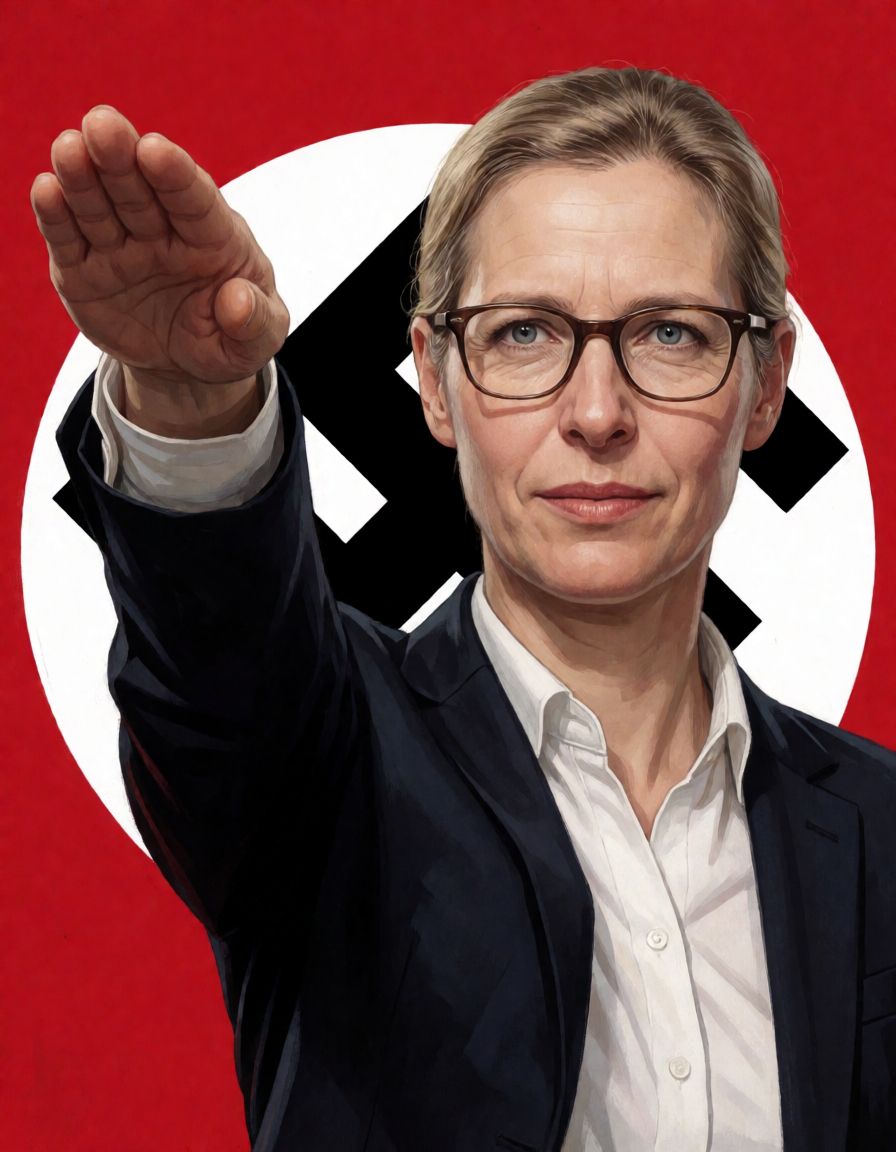
The European far right no longer lives on the political margins. In France, Marine Le Pen’s National Rally has become one of the country’s dominant political forces. In Germany, Alternative for Germany (AfD) has transformed itself from an outsider party into a major electoral force.
What happens if these movements eventually control their respective governments?
There would almost certainly be major political changes. Immigration policy would become dramatically harsher. National borders would matter more. European integration would face another enormous challenge. Relations with Russia could change substantially.
Yet there is one thing that probably would not happen overnight: dictatorship.
Not necessarily because these politicians would suddenly discover an unconditional love of liberal democracy, but because modern European states contain enormous networks of institutions, economic interests, courts, bureaucracies, international agreements, corporations, media organizations, opposition parties and civil society groups.
Powerful politicians still have to fight powerful systems.
Dictatorship is harder to build than to promise: Seek the powerful interest groups
Populist movements often create the impression that winning an election means gaining control over the state.
It does not.
France and Germany are complicated constitutional democracies. Governments operate within legal systems that distribute power among numerous institutions. Courts can challenge government decisions. Opposition parties remain in parliament. Journalists investigate politicians. Civil society organizations mobilize against government policies.
The European Union creates another layer of constraints. European law, treaties, courts, financial relationships and common institutions substantially reduce the freedom of individual governments to transform their countries however they please.
Then there is money.
Corporations, investors, financial institutions and industry groups have enormous interests in political stability, European trade and access to international markets. A government trying to dismantle too much of the existing system would therefore encounter resistance not only from liberals and human-rights activists but also from people with billions of euros at stake.
Powerful interest groups are simply too powerful for a new government to do whatever it wants.
That does not make authoritarianism impossible. It makes establishing a conventional dictatorship considerably more difficult.
Autocracy does not require abolishing elections
The more realistic danger is democratic erosion.
A government does not need to cancel elections and send tanks into the streets to weaken democracy. It can attack independent media, politicize public institutions, undermine judicial independence, intimidate NGOs and gradually change electoral rules.
Democratic institutions can remain formally alive while becoming increasingly hollow.
Hungary under Viktor Orbán provides an important European example of how this process can work. Elections continue, opposition parties exist and private businesses operate. Yet critics argue that institutional changes have created an increasingly uneven political playing field.
That model is much more plausible for twenty-first-century Western Europe than an immediate return to twentieth-century fascist dictatorship.
The danger therefore lies in accumulation. One apparently limited measure follows another until citizens discover that their democracy still exists on paper but works very differently in practice.
Anti-globalization could become their unlikely ally
Globalization itself creates constraints on nationalist governments.
Modern European economies depend on international supply chains, foreign investment, multinational companies, European markets and cross-border movement. Trying to isolate a major European economy would impose substantial economic costs.
Yet globalization is no longer moving in only one direction.
Protectionism has returned. Governments increasingly talk about strategic industries, national security, domestic manufacturing and economic sovereignty. Geopolitical rivalry is fragmenting parts of the global economy.
These anti-globalization forces could unintentionally make radical nationalism easier.
A world divided into increasingly isolated economic and political blocs would give nationalist governments more room to argue that economic independence matters more than international integration.
The paradox is obvious. Globalization could constrain the far right, while the weakening of globalization could empower it.
Immigration would become the immediate battlefield
The most visible transformation would probably concern immigration.
Both National Rally and AfD have built substantial parts of their political appeal around hostility to current immigration policies. Once in power, they would face enormous pressure from their supporters to deliver.
Expect attempts to reduce asylum, accelerate deportations, tighten citizenship requirements, strengthen border controls and make immigration significantly more difficult.
Some measures could face constitutional or European legal challenges. Others could survive.
The political rhetoric could become even uglier.
When governments repeatedly divide society between supposedly authentic members of the nation and outsiders, the distinction can extend far beyond undocumented immigration. Muslims, refugees, naturalized citizens and ethnic minorities can become convenient political targets.
Brutal anti-immigration policies can therefore become something broader: politics based on determining who really belongs.
That is where legitimate debates over immigration policy can mutate into racial hatred.
Close the borders, protect the nation
Nationalist politics offers an extremely simple explanation for complicated problems.
Your wages are stagnant? Globalization.
Housing is expensive? Immigrants.
Crime exists? Foreigners.
Your country appears weaker than it once was? Brussels.
The world feels unstable? Close the borders.
Reality is considerably more complicated, but complicated explanations rarely fit on campaign posters.
A National Rally government in France or an AfD-led government in Germany would consequently have strong incentives to emphasize sovereignty, borders and national preference.
The EU would become a permanent political enemy even without formal withdrawal from the union.
Europe might therefore experience something more subtle than another Brexit. Governments could remain inside European institutions while continuously obstructing integration from within.
And then there is Russia
Russia represents another major dividing line.
European far-right movements have historically included factions considerably more sympathetic toward Moscow than mainstream European governments. AfD politicians in particular have repeatedly faced controversy over their attitudes and connections toward Russia.
A dramatic political shift in Germany could therefore complicate European support for Ukraine, sanctions against Russia and NATO policy.
France would matter just as much.
A Europe in which Paris and Berlin simultaneously moved toward nationalist governments would look radically different. These are not peripheral EU states. France and Germany form the political and economic center of the European project.
If both turned inward at roughly the same time, European integration could enter its greatest crisis in decades.
Russia would have every reason to welcome such fragmentation.
Democracy would probably survive — but it could become weaker
None of this means that Le Pen or AfD winning an election would automatically produce fascism.
That claim would be far too simplistic.
Millions of people vote for populist parties for different reasons. Some oppose immigration. Others distrust mainstream parties. Some worry about crime, economic stagnation or cultural change. Others simply want to punish political establishments they consider incompetent.
Nevertheless, politicians should be judged not merely by whether they win elections but by what they subsequently do with power.
Democracy is more than voting every few years.
It requires independent courts, free media, political pluralism, civil liberties, minority rights and meaningful restrictions on government power.
Those safeguards matter precisely when voters choose politicians who dislike some of them.
The institutions will fight back
This is ultimately why an outright dictatorship remains unlikely.
A French or German government trying to dismantle liberal democracy would encounter courts, opposition parties, constitutional protections, European institutions, businesses, unions, NGOs, journalists and millions of hostile voters.
Some resistance would come from noble motives. Some would come from naked self-interest.
Both matter.
One of the strange advantages of a complicated modern society is that power is fragmented among groups that frequently hate one another. Corporations want profits. Judges defend judicial authority. Journalists defend press freedom. Opposition politicians want power. European institutions defend their jurisdiction.
Together, those competing interests can make absolute political control extraordinarily difficult.
The system does not need everyone to be virtuous. Sometimes it merely needs powerful people to prevent other powerful people from becoming too powerful.
A pro-traditional-family lesbian who challenges the Beneš decrees
Alice Weidel embodies some of the strangest contradictions of the modern European far right. She leads a party that presents itself as a defender of the traditional family, yet she is openly lesbian and has built a family with her female partner.
There is nothing contradictory about being gay and politically conservative. The contradiction arises when a politician personally enjoys a form of family life while her political movement promotes a substantially narrower ideal of what families should look like.
Then there is Central European history. AfD politicians have repeatedly challenged Germany’s postwar historical consensus, while Weidel has also criticized the Beneš decrees and the expulsion of ethnic Germans from Czechoslovakia after World War II.
For Czechs, that is hardly an insignificant historical dispute. The decrees remain tied to one of the most painful chapters of Czech-German history. Any German nationalist politician reopening the issue will inevitably provoke memories of the events that preceded the expulsions: the destruction of Czechoslovakia, Nazi occupation, racial persecution and mass murder.
The combination is remarkable: a lesbian politician championing traditional-family politics while leading a German nationalist party that questions parts of the postwar settlement. European nationalism has entered a genuinely strange historical phase.
Germany should know better
Germany deserves particular attention because its historical symbolism is impossible to escape.
Modern Germany is not Nazi Germany. AfD is not the Nazi Party, and treating every AfD voter as a Nazi would substitute historical analogy for serious political analysis.
Yet history still makes Germany’s political choices especially disturbing.
Germany produced Goethe, Beethoven, Kant and Einstein. It also demonstrated how quickly an educated and technologically sophisticated society could descend into barbarism when nationalism, racial politics, resentment and authoritarianism overwhelmed democratic restraints.
That history does not genetically or eternally condemn Germans. Quite the opposite: postwar Germany became one of the world’s strongest liberal democracies precisely because it learned from catastrophe.
And yet the possibility remains that the nation of Goethe will — just like in the age of Hitler — vote for the worst scum.
History does not repeat itself mechanically. It does, however, provide warnings.
The greater danger is gradual
The most plausible future is therefore neither business as usual nor an immediate dictatorship.
It is something in between.
Expect harsher borders, substantially more aggressive anti-immigration policies, growing isolationism, attacks on European integration, greater hostility toward minorities, friendlier relations with Russia and repeated conflicts with institutions that restrict executive power.
Some radical promises would fail because courts, markets, bureaucracies and international institutions would stop them.
Others would succeed.
And every successful attack on democratic restraints could make the next attack easier.
That is how modern democracies are most likely to die. Not necessarily through a spectacular coup, but through a long sequence of political decisions that individually appear survivable.
The greatest protection against that outcome may be exactly what populists complain about: too many courts, too many institutions, too many international obligations, too many independent organizations and too many competing centers of power.
In other words, the frustrating complexity of liberal democracy is also one of its greatest defenses.
Leave a Reply