Feminism has been one of the most consequential movements for human rights in modern history. Women gained political representation, greater economic independence, reproductive rights, protection against discrimination and vastly greater control over their own lives. None of this should be controversial.
But feminism is not a single doctrine, and supporting equality between women and men does not require defending everything ever written under the feminist label.
Some feminist thinkers have gone considerably further than demanding equality. At the radical fringes of the movement, men have sometimes been described collectively as predators, parasites or oppressors. A few writers have even entertained ideas that, if the sexes were reversed, would immediately be recognized as grotesque sexism.
These statements deserve criticism precisely because equality should apply to everyone.
Valerie Solanas: “Destroy the male sex”
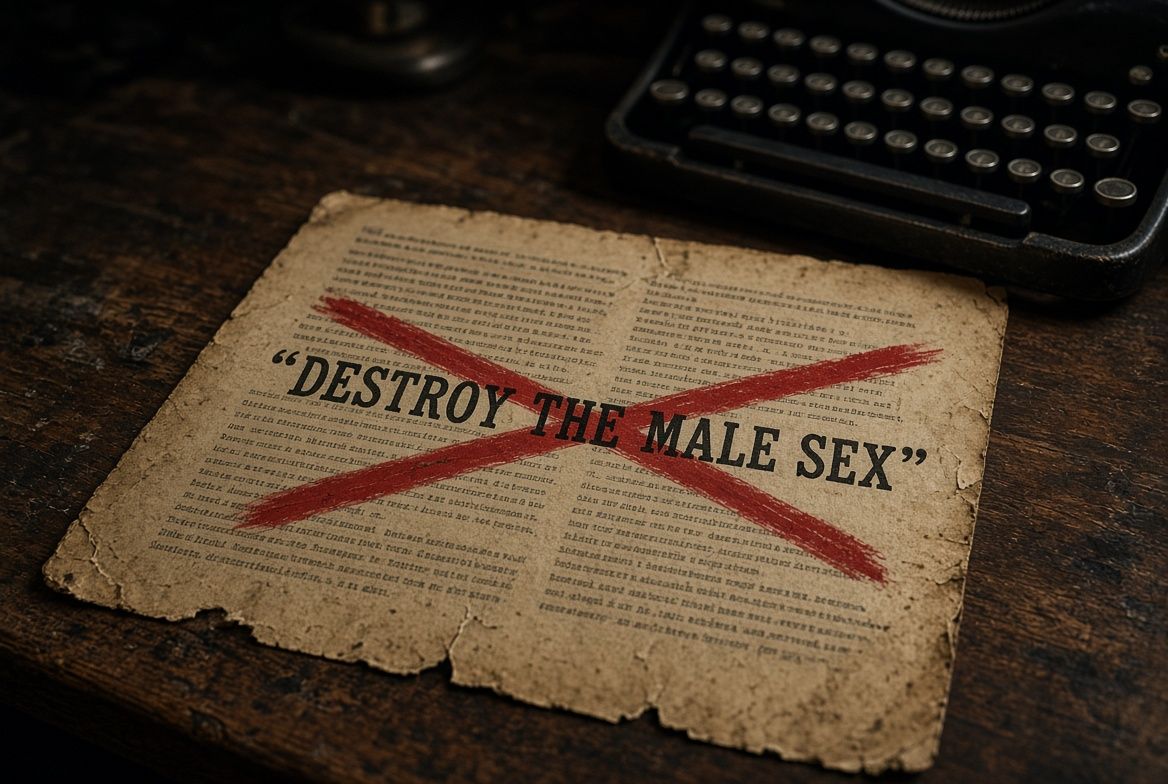
Few feminist texts are as extreme as Valerie Solanas’s 1967 SCUM Manifesto.
Its opening announces that women should overthrow the government, eliminate the monetary system, automate society and “destroy the male sex.”
Solanas portrays men not simply as beneficiaries of an unjust social system but as fundamentally defective human beings. The manifesto repeatedly treats the elimination of men as desirable.
There is an important qualification. SCUM Manifesto is an intentionally outrageous and highly idiosyncratic work, and scholars have debated how literally Solanas intended every part of it. Solanas was hardly representative of mainstream feminism.
Nevertheless, the words exist. Replacing “male” with virtually any racial, ethnic or religious category would make their disturbing character immediately apparent.
Solanas subsequently became infamous for another reason: in 1968, she shot artist Andy Warhol, seriously wounding him.
Whatever historical or literary interpretation one gives her manifesto, exterminatory rhetoric should not become acceptable simply because its target is male.
Mary Daly and a world with dramatically fewer men
Radical feminist theologian Mary Daly went somewhere similarly disturbing.
In a 1999 interview, Daly was asked about feminist Sally Miller Gearhart’s proposal that men should constitute only about 10 percent of humanity.
Daly responded:
“I think it’s not a bad idea at all.”
She went on to describe the Earth as requiring “decontamination” and predicted an evolutionary process producing a drastic reduction in the male population.
The mechanism matters. Daly was not explicitly proposing that women round up and murder 90 percent of men. Presenting the quotation as a straightforward call for genocide would therefore be inaccurate.
But the underlying sentiment remains extraordinary.
Imagine a male philosopher approving a hypothetical world in which women constituted only 10 percent of humanity and describing the process as planetary “decontamination.” Few people would hesitate to call the rhetoric misogynistic.
Calling the target male should not change the moral standard.
Andrea Dworkin and collective male guilt
Andrea Dworkin is probably the radical feminist most frequently misquoted on the internet.
She did not simply write that “all sex is rape,” despite that phrase being endlessly attributed to her.
Her actual writings, however, contain plenty of sweeping statements about men.
In Our Blood, Dworkin argued that the common erotic project of destroying women provides the foundation for male brotherhood and claimed that “all male bonding is based on it.”
That is an astonishing generalization.
Men are approximately half of humanity. They encompass billions of individuals across different societies, personalities, moral systems and relationships. Friendship between two men does not somehow require a shared desire to destroy women.
Dworkin’s work emerged from serious concerns about rape, pornography, domestic abuse and women’s historical subordination. Those subjects deserve serious treatment.
But recognizing real violence against women does not logically justify assigning a destructive sexual psychology to an entire sex.
“Intercourse is the expression of men’s contempt for women”
Dworkin went even further when discussing heterosexual intercourse.
In Intercourse, she wrote:
“Intercourse is the pure, sterile, formal expression of men’s contempt for women.”
Her argument was more sophisticated than the internet caricature that Dworkin believed every individual act of heterosexual intercourse was literally rape. She analyzed intercourse within what she regarded as a broader social system of male dominance.
That context matters.
It does not, however, make the generalization scientifically convincing.
Human sexuality encompasses affection, attachment, reproduction, pleasure, cooperation, exploitation, dominance and countless individual motivations. Reducing intercourse to an expression of male contempt transforms a complicated aspect of human behavior into an ideological absolute.
It also risks denying the agency of women who experience consensual heterosexual relationships completely differently from Dworkin’s theoretical model.
When criticism of patriarchy becomes hostility toward men
There is an important conceptual distinction between criticizing patriarchy and attacking males.
A person can argue that historical societies systematically privileged men without believing that individual men are inherently inferior, predatory or morally contaminated.
Likewise, criticizing misogyny is not hatred of men.
The problem begins when structural criticism turns into biological generalization: men are violent; men are predators; male sexuality is inherently oppressive; society would be better with dramatically fewer males.
At that point, the argument ceases to concern equal rights and begins resembling the prejudicial thinking feminism originally challenged.
Sexism does not become progressive when reversed
This is ultimately the simplest test. Take a statement about men and reverse the sexes.
Imagine someone suggesting that reducing women to 10 percent of humanity would not be a bad idea. Imagine a movement describing female sexuality as inherently contemptuous. And imagine a manifesto proposing the destruction of the female sex.
We would not spend much time searching for euphemisms. We would call it misogyny.
The same principle should apply in reverse.
Misandry is nowhere near a mirror image of historical misogyny in terms of institutional power, violence or historical consequences. Women endured legal and social disadvantages for centuries that cannot sensibly be erased from the discussion.
But historical asymmetry does not transform prejudice into virtue.
Feminism does not need misandry
None of these quotations refutes feminism.
That would commit exactly the same intellectual mistake as judging every political philosophy by its most extreme adherents. Feminism encompasses liberal feminism, socialist feminism, radical feminism, intersectional feminism and numerous other traditions whose adherents disagree profoundly with one another.
Millions of feminists simply believe that sex should not determine someone’s rights, opportunities or human worth.
That principle is entirely compatible with condemning misogyny and misandry simultaneously.
Indeed, equality requires it.
Women are not a homogeneous class of saints. Men are not a homogeneous class of predators. Both are populations of human beings displaying enormous variation in personality, intelligence, aggression, empathy, sexuality and morality.
The worst statements made in feminism’s name should therefore neither define feminism nor receive immunity from criticism because they were made by feminists.
A movement committed to equality should be particularly capable of applying its own principle universally.
Sexism remains sexism regardless of the sex of the person speaking—and regardless of the sex of the target.
Leave a Reply