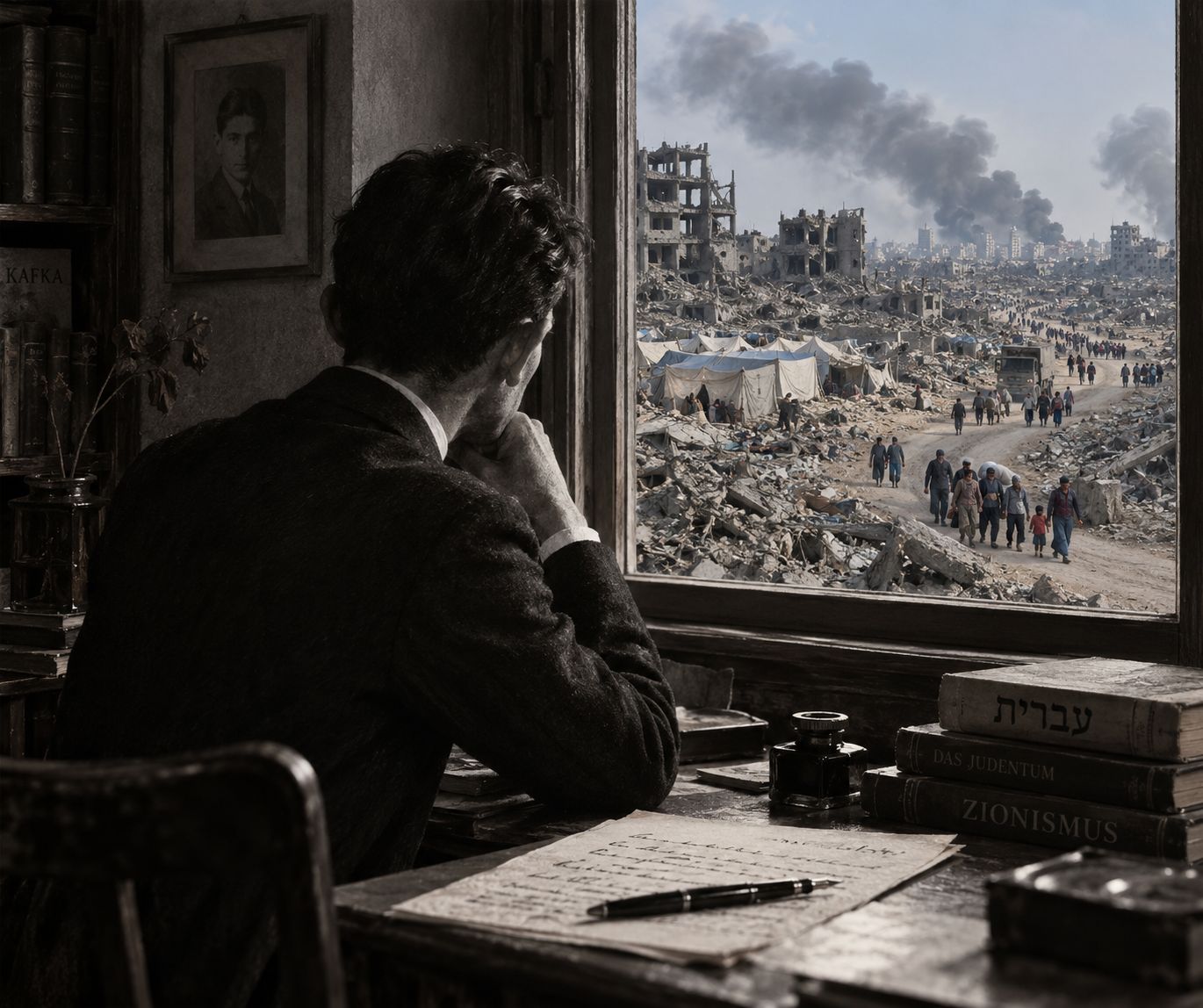
Franz Kafka died in 1924. The State of Israel did not yet exist. The Holocaust had not happened. Neither had the Arab-Israeli wars, October 7, or the destruction and enormous human suffering in Gaza.
Yet Kafka’s life, politics, Jewish identity and literature make him a fascinating figure through whom to examine Israel and Gaza. He was Jewish, became deeply interested in Jewish culture, studied Hebrew, read Zionist publications and contemplated moving to Palestine. At the same time, he had left-wing and anti-authoritarian sympathies and spent much of his literary career describing powerless individuals confronted by enormous systems of authority. His vegetarianism and extraordinary literary interest in vulnerable human and nonhuman beings add another dimension.
To understand what all of this might mean, we first have to understand Kafka himself.
Kafka was Jewish—and that matters
Any discussion of Kafka and Israel has to begin with his Jewish identity. Kafka was born into a German-speaking Jewish family in Prague in 1883. His relationship with Judaism was complicated, particularly during his younger years, but Jewish culture became increasingly important to him as he grew older.
His encounter with Yiddish theatre in Prague helped awaken a much deeper interest in Jewish identity. He studied Jewish culture and history, read Zionist publications and eventually studied Hebrew seriously. Palestine was not an abstraction to him: Kafka considered moving there, and during the final period of his life, while living with Dora Diamant, he continued studying Hebrew and entertained plans connected with Palestine. His deteriorating health made such ambitions increasingly unrealistic, and tuberculosis killed him at just 40.
Kafka’s relationship with Zionism was nevertheless complicated. He did not embrace it with the enthusiasm of his close friend Max Brod. His interest encompassed Jewish cultural renewal, Hebrew and the possibility of Jewish life in Palestine, but his position cannot simply be equated with the political ideologies that developed around the later State of Israel.
The distinction is crucial. Kafka’s interest in Palestine was genuine, but the Israel whose policies we debate today belonged to a future he never experienced.
Kafka leaned to the left
Kafka is sometimes described as a socialist or even an anarchist. Both labels require caution, although there is significant evidence of his left-wing and anti-authoritarian sympathies. His school friend Hugo Bergmann recalled political disagreements between them involving Kafka’s socialism and Bergmann’s Zionism, while other recollections associate Kafka with Czech libertarian socialist, anarchist, anti-militarist and anti-clerical circles.
Some of these accounts have been disputed by Kafka scholars, and Kafka was certainly not a political activist in the modern sense. He did not leave us a manifesto explaining precisely what economic or political system he wanted. Nevertheless, the anti-authoritarian character of much of his writing is difficult to overlook.
It is also necessary to remember what socialism meant in Kafka’s world. He lived during an era of enormous economic inequality, limited social protection and dangerous industrial working conditions. The modern European welfare state did not exist, and workers could be injured, impoverished and discarded under circumstances dramatically different from those experienced by most workers in contemporary Central Europe.
Kafka encountered this reality professionally. He worked for the Workers’ Accident Insurance Institute for the Kingdom of Bohemia, where his bureaucratic career brought him directly into contact with industrial accidents, workplace safety, compensation and the human consequences of industrialization. The writer who became famous for depicting bureaucratic machinery therefore spent much of his working life inside bureaucracy itself.
Calling Kafka a socialist today without explaining this historical environment can consequently be misleading. The capitalism he encountered was considerably harsher than the regulated capitalism of modern European welfare states. More important for understanding his writing than attaching a modern political label to him is his persistent fascination with inequalities of power.
Kafka and suffering
Kafka was also a vegetarian for much of his adult life. His diet had several motivations, including his intense concern with health, so it would be simplistic to turn his vegetarianism into proof of a particular political position. Yet animals occupy an extraordinary position in his fiction, and this forms part of a much broader pattern in his work.
Kafka repeatedly imagined existence from perspectives radically removed from conventional human power. A man becomes an insect in The Metamorphosis. An ape explains his adaptation to human civilization in A Report to an Academy. Other works place animals and strange creatures at the center of experiences involving fear, confinement, survival and alienation.
Again and again, Kafka entered the minds of beings that were vulnerable, frightened, excluded or trapped. His vegetarianism does not provide a political manifesto, but his fascination with vulnerability is difficult to dispute. Suffering, powerlessness and exclusion were among the great subjects of his imagination.
Kafka knew antisemitism
Kafka’s Jewish identity cannot be separated from the antisemitic environment in which he lived. Antisemitism was a real presence in Central European political and social life, and Kafka personally encountered hostility toward Jews. He died before European antisemitism reached its most horrifying culmination, and all three of his sisters would later be murdered during the Holocaust.
His interest in Palestine has to be understood against this European background. For Jews living amid antisemitism, the possibility of Jewish life elsewhere was not merely an abstract nationalist project. It could also represent escape, security and cultural renewal. Kafka’s attraction to Palestine therefore deserves to be taken seriously rather than treated as an inconvenient biographical detail.
The Holocaust presents an even greater historical problem. Had Kafka survived into the 1940s, the extermination of European Jews—and the murder of his own sisters—could have profoundly altered his understanding of Jewish security, nationalism and Palestine. Any modern attempt to imagine Kafka’s politics has to acknowledge this enormous event that he never lived to see.
Then came October 7
The modern question cannot be separated from October 7, 2023. Hamas-led attackers killed Israeli civilians, attacked communities and took hostages. Any discussion connecting Kafka’s Jewish identity with the modern Middle East has to include the vulnerability and suffering experienced by Israeli Jews that day.
Kafka had become increasingly interested in Jewish identity and Jewish life in Palestine during his final years. Kafka’s growing engagement with Jewish identity and the possibility of Jewish life in Palestine gives his biography a genuine connection to one of the historical currents that eventually preceded the creation of Israel, even though the political and military realities of the twenty-first century would have been completely foreign to him.
What followed October 7 created another enormous body of civilian suffering. Israel’s military campaign transformed large areas of Gaza, displaced huge numbers of people and placed Palestinian civilians at the center of a war between forces vastly more powerful than the individuals caught between them.
This is where Kafka’s literature becomes especially relevant.
Gaza and the Kafkaesque
Imagine describing contemporary Gaza without beginning with the ideological vocabulary of the conflict. People require authorization to move through borders and checkpoints. Authorities determine who can enter and leave. Families can be displaced by decisions made far above them. Human beings become identification numbers, security classifications and entries in administrative systems.
Orders are issued, evacuations announced and access granted or denied. Civilians confront institutions with vastly greater power than any individual possesses, while military and bureaucratic decisions can determine where they are permitted to go and whether they can return.
This does not mean that Gaza literally is The Trial or The Castle. Reducing literature to a direct political analogy would trivialize both Kafka and the conflict. Yet the structure is unmistakably relevant to the subjects that made Kafka one of the defining writers of modernity.
Kafka understood that modern power does not always arrive screaming. Sometimes it arrives as procedure. Nobody standing directly in front of the individual necessarily appears personally responsible: one official refers to another, one institution invokes another, and a decision has already been made somewhere beyond the individual’s reach.
The person experiencing the consequences may never meet the people who made that decision. This relationship between incomprehensible authority and individual helplessness is precisely one reason the adjective “Kafkaesque” entered our language.
The Trial and the powerless individual
In The Trial, Josef K. is arrested without being told what crime he has committed. He attempts to navigate a judicial structure that seems simultaneously everywhere and nowhere, possessing enormous authority over him while remaining almost impossible to understand.
This is one of Kafka’s great recurring themes: radical inequality between the individual and the institution. The individual experiences fear, hunger, pain and eventually death, while the institution operates through procedures, classifications and decisions. Kafka repeatedly forces the reader to experience this imbalance from below rather than from the perspective of those administering the system.
That theme has obvious resonance wherever civilians live under overwhelming military or administrative power. Kafka did not need to know the twenty-first century to understand what it meant for an individual to become almost insignificant before a system capable of determining the conditions of his existence.
The Castle and inaccessible power
The Castle presents another version of the nightmare. Authority is distant, confusing and almost impossible to reach, yet its bureaucracy penetrates everyday existence. Individuals attempt to communicate with a system they cannot properly access and whose internal logic they cannot fully comprehend.
This is not simply a criticism of one particular government or ideology. Kafka’s genius lies precisely in making the machinery universal. His bureaucracies can be read through capitalist, socialist, imperial, democratic, authoritarian or theological lenses because the underlying relationship remains recognizable: enormous impersonal power confronting the small human being beneath it.
That universality is also why appropriating Kafka exclusively for one modern political ideology misses much of what makes him important. His literature does not give governments moral legitimacy merely because their ideology is supposedly correct. It continually returns attention to what institutions actually do to individuals.
In the Penal Colony
In the Penal Colony provides an even darker example. At the center of the story is an elaborate machine designed to punish and ultimately kill a condemned person. The work explores obedience, punishment, institutional cruelty and the ability of a system to normalize suffering through procedure.
The horror comes partly from the machinery itself and partly from the intellectual framework surrounding it. Violence has acquired rules, traditions, explanations and defenders. The institution does not perceive itself simply as cruel; it possesses an elaborate justification for what it does.
This is another recurring Kafka theme with relevance far beyond any particular modern conflict. Human beings are extraordinarily capable of creating institutions that transform suffering into administration and then defending the resulting machinery as necessary, lawful or inevitable.
Kafka was difficult to fit into a tribe
Kafka himself was difficult to place neatly inside a single national category. He was Jewish, born in Prague and overwhelmingly German-speaking in his literary and intellectual life. He nevertheless understood Czech well and could speak it, although his active written Czech was much less developed than his German. Later, his linguistic interests expanded toward Yiddish and Hebrew.
He grew up in Bohemia under Austria-Hungary and spent his final years as a citizen of Czechoslovakia. His life unfolded amid competing Czech, German and Jewish identities at a time when European nationalism was extraordinarily powerful. Prague itself contained overlapping linguistic, ethnic, religious and political communities.
Kafka’s complicated position within this environment matters. His literature repeatedly deals with belonging and exclusion, inaccessible communities, uncertain identities and people who never seem completely accepted by the world around them. The outsider is one of Kafka’s natural perspectives.
His genuine interest in Zionism prevents us from simplistically describing him as an opponent of nationalism. At the same time, the complexity of his own identity makes attempts to turn him into a straightforward modern nationalist equally problematic.
Jewish and Palestinian suffering
The history behind Israel makes any discussion of the country morally complicated. Centuries of persecution culminated shortly after Kafka’s death in the attempted extermination of European Jewry. The desire for Jewish security cannot be understood without this history.
Palestinian suffering exists alongside that history. A murdered Israeli civilian does not become less human because of the actions of the Israeli government, just as a Palestinian child does not become less human because Hamas committed atrocities. Historical suffering does not mathematically cancel later suffering experienced by somebody else.
This distinction is fundamental to humanism. If human suffering matters only when the victim belongs to the correct nation, religion or political camp, it ceases to be universal humanism and becomes tribal loyalty expressed in moral language.
Kafka’s biography contains elements relevant to both sides of this moral problem. He belonged to a historically persecuted people and became increasingly interested in Jewish life in Palestine, while his literary imagination continually gravitated toward vulnerable individuals confronting overwhelming authority.
What would Kafka think about Israel and Gaza?
And only now can we return to the question in the title.
The answer is that we do not know.
Franz Kafka died in 1924. Anyone who claims with certainty that Kafka would support Israel, condemn Israel, support Zionism as it exists today, identify with the Palestinian cause or adopt any other precise twenty-first-century position is ultimately speaking for a dead man who never encountered these realities.
There are clues pointing in different directions. Kafka knew antisemitism and became increasingly engaged with Judaism. He studied Hebrew, followed Zionist ideas and contemplated Palestine. It is entirely plausible that Jewish national security would have mattered enormously to him, particularly had he survived to witness the Holocaust and the murder of his three sisters.
There are equally powerful clues in another direction. Kafka’s sympathies leaned toward the left and against authoritarian power. His professional life exposed him to injured and vulnerable workers, while his literary imagination repeatedly placed him beside the powerless rather than the powerful. The Trial, The Castle and In the Penal Colony examine systems of authority from the perspective of individuals trapped beneath them.
Kafka, the Zionist, criticizing Israel?
October 7 might therefore have confronted Kafka with something deeply personal: murdered Jews, terrified families and hostages belonging to a people whose identity he spent his later years exploring. Gaza might have confronted him with something equally central to his imagination: civilians caught beneath overwhelming military and bureaucratic power, displaced families, destroyed lives and individuals reduced to categories within systems they cannot control.
Perhaps he would have been a Zionist and a fierce critic of the Israeli government; perhaps October 7 would have pushed him strongly toward Israel; perhaps the destruction of Gaza would have pushed him in the opposite direction. Perhaps he would have rejected the entire demand that he choose between two populations of civilians. We simply cannot know.
That uncertainty should not disappoint us. It is more intellectually honest—and more interesting—than recruiting Kafka into a political camp a century after his death.
What we can say is that the modern Middle East contains many of the phenomena that obsessed him: fear, alienation, bureaucracy, inaccessible authority, punishment, exclusion, tribal identity and enormous systems exercising power over fragile individuals.
Franz Kafka never saw Israel. He never saw October 7. He never saw Gaza in ruins. We cannot know what he would have thought about any of them.
But much of what he would have seen might have looked disturbingly familiar.
Kafka never saw Gaza. Yet Gaza contains much that the word “Kafkaesque” was invented to describe.
Leave a Reply