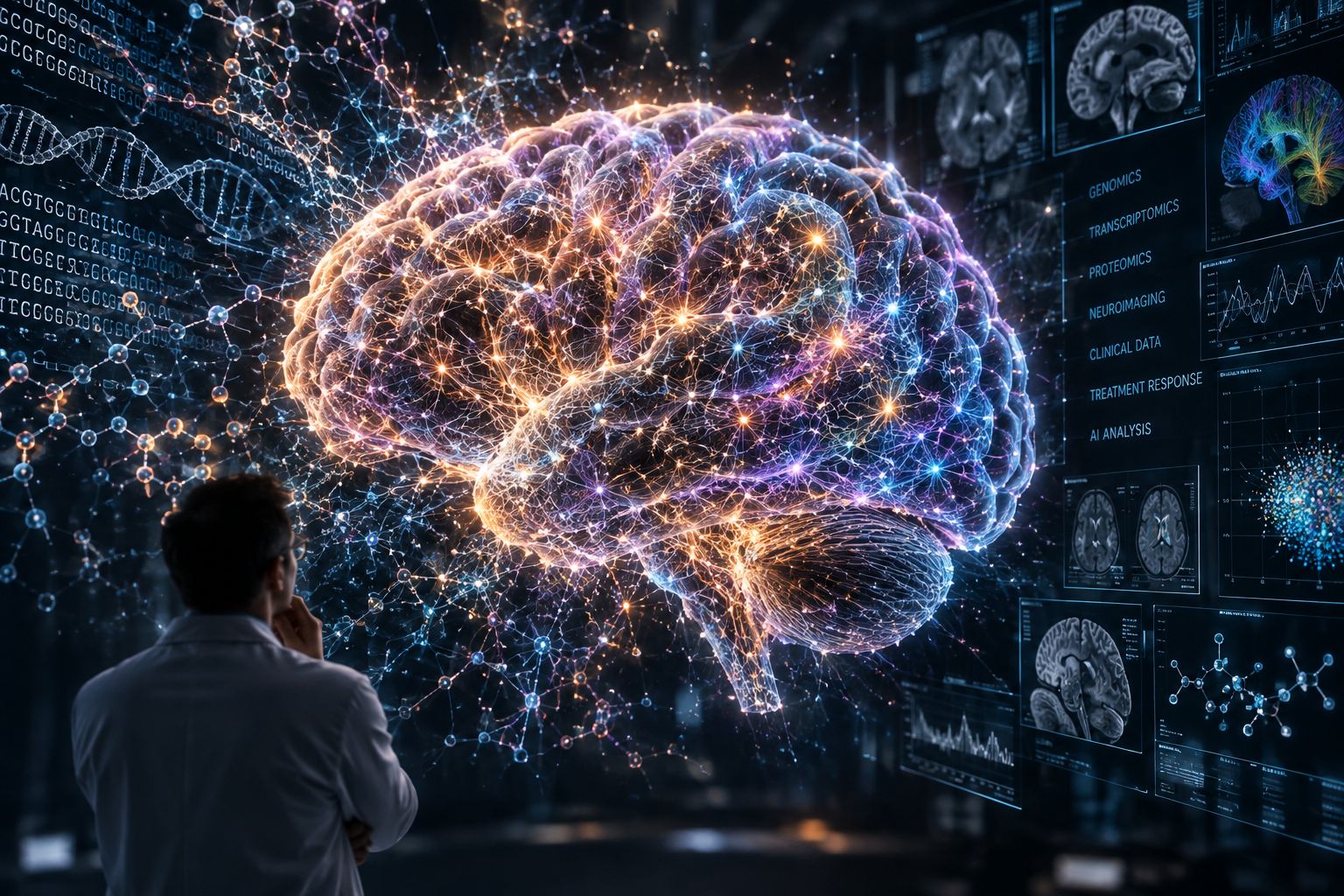
Psychiatry may be the branch of medicine that needs artificial intelligence the most.
For decades, psychiatry has faced an uncomfortable reality. We have medications that can save lives, suppress psychosis, reduce depression, stabilize mood and control anxiety. Yet our understanding of why severe psychiatric disorders actually develop remains remarkably incomplete.
Allen Frances, one of the most prominent psychiatrists of the modern era and the former chair of the DSM-IV Task Force, repeatedly warned against expecting easy breakthroughs. He argued that psychiatry had already picked much of its “low-hanging fruit.” The first generations of antipsychotics, antidepressants, lithium, benzodiazepines and electroconvulsive therapy represented enormous advances, but discovering fundamentally better treatments proved much more difficult.
Frances was largely right.
The problem was not simply a lack of money, scientists or determination. The problem was complexity.
There was no low-hanging fruit
For much of the twentieth century, medicine experienced extraordinary victories. Antibiotics transformed infectious disease. Vaccines eliminated or dramatically reduced some devastating illnesses. Modern surgery became capable of procedures that would once have appeared miraculous.
It was tempting to assume that psychiatry would follow the same trajectory.
Discover the biological abnormality behind schizophrenia, depression or bipolar disorder. Identify the responsible molecule or gene. Develop a drug that corrects it. Treat the disease.
The brain refused to cooperate with this beautifully simple model.
Schizophrenia did not turn out to be caused by a single “schizophrenia gene.” Nor did researchers discover one defective brain region or one abnormal neurotransmitter capable of explaining the entire disorder.
Instead, researchers encountered layer after layer of complexity.
Schizophrenia is highly polygenic. Thousands of genetic variants may contribute to susceptibility, usually with individually tiny effects. Rare mutations can also influence risk. Genes interact with biological development and environmental influences, while different combinations of risk factors may eventually produce clinical syndromes that psychiatrists classify under the same diagnosis.
In other words, two people diagnosed with schizophrenia may arrive at superficially similar symptoms through partly different biological pathways.
That is a nightmare for traditional medical research.
It may also be exactly the kind of problem at which sufficiently advanced AI will excel.
Frances was right about the problem
Frances wrote that psychiatry should not expect much low-hanging fruit from genetics, brain imaging or new treatments. He emphasized that the brain was extraordinarily complicated and that progress would probably come slowly.
His prediction made sense.
Traditional scientific methods require humans to simplify problems enough to study them. Researchers isolate variables, formulate hypotheses and test manageable relationships. This approach created modern science, but it becomes increasingly difficult when a disease emerges from interactions among enormous numbers of variables.
Imagine trying to understand a psychiatric disorder by simultaneously considering a person’s genome, gene expression, proteins, neurotransmitters, immune activity, brain development, neural connectivity, medication history, sleep, stress, childhood environment and countless other factors.
No human researcher can meaningfully hold millions or billions of possible interactions in his or her head.
Future AI will not have that limitation.
That is the variable Frances could not fully calculate.
AI changes the meaning of complexity
Artificial intelligence does not make the human brain simpler. It changes our ability to investigate something enormously complicated.
This distinction is crucial.
The scientific problem identified by Frances remains. If anything, modern genetics has demonstrated that psychiatric disorders are even more complicated than earlier generations imagined. But complexity ceases to be quite the same obstacle when machines can analyze patterns across datasets at a scale no human being could approach.
Future systems could simultaneously integrate genomic data, medical histories, brain imaging, blood biomarkers, electronic health records and treatment responses from millions of people.
Instead of asking whether one gene causes schizophrenia, an AI system could search for combinations of thousands of genetic and biological factors associated with particular forms of the disorder.
Instead of treating schizophrenia as one homogeneous disease, AI may help divide what we currently call schizophrenia into biologically meaningful subtypes.
Perhaps patient A’s psychosis emerges primarily from one combination of disrupted neural pathways, while patient B reaches a similar clinical state through a substantially different combination. Giving both people the same diagnostic label may eventually seem as crude as classifying every fever as the same disease.
AI could help psychiatry move beyond that limitation.
From diagnosis to mechanism
Psychiatric diagnosis today still depends heavily on symptoms and clinical observation.
A psychiatrist cannot order a routine blood test that comes back saying “schizophrenia positive.” There is no simple brain scan that establishes the diagnosis. Psychiatry therefore remains unusual within modern medicine because some of its most serious disorders are classified primarily according to patterns of thoughts, experiences and behavior rather than definitive biological mechanisms.
AI could help change this.
The revolution would not necessarily begin with an AI psychiatrist interviewing patients. That is actually one of the less interesting possibilities.
The greater transformation would happen behind the scenes.
AI could search enormous biological datasets for previously invisible relationships. It could connect particular genetic profiles with patterns of gene expression, cellular abnormalities, neural circuits, symptoms and treatment responses. It could generate hypotheses that human researchers would never think to test.
Those hypotheses could then be investigated experimentally.
AI would not replace neuroscience. It could become one of neuroscience’s most powerful instruments.
Psychiatry may be harder than cancer
AI will almost certainly transform medicine far beyond psychiatry. Cancer research is an obvious example. Machine learning can already help analyze medical images, molecular structures and enormous biological datasets.
But psychiatric disease presents an even more formidable challenge.
Cancer is extraordinarily complicated, but a tumor can be biopsied. Its cells can be sequenced and examined. Researchers can directly investigate many of the molecular abnormalities driving its growth.
You cannot casually remove pieces of a living person’s brain to determine why he hears voices.
The brain also contains tens of billions of neurons connected through an astronomical number of synapses. Those connections change with development and experience. Human thought and behavior emerge from dynamic systems operating across multiple levels of organization.
A psychiatric disorder therefore cannot necessarily be reduced to a broken molecular switch.
That is precisely why psychiatry may be among the last areas of medicine to be fundamentally transformed.
But “last” does not mean “never.”
AI could transform psychiatric drugs
The history of psychiatric medication is filled with accidental discoveries.
Some of the most important drugs were not originally created from a sophisticated understanding of the diseases they eventually treated. Researchers discovered that certain substances changed psychiatric symptoms and subsequently tried to understand why.
That is a remarkable historical fact, but it also demonstrates how primitive psychiatric drug discovery has sometimes been.
Future treatment development could work in the opposite direction.
AI could begin with massive genetic and molecular datasets, identify biological pathways involved in particular psychiatric subtypes, model potential interventions and help researchers select promising molecular targets.
Instead of testing thousands of compounds largely because they resemble existing drugs, researchers could increasingly ask which intervention is most likely to modify a particular pathological mechanism.
The result might not simply be another antipsychotic with a somewhat different side-effect profile. It could eventually mean treatments based on mechanisms that psychiatry currently does not even recognize.
The end of one-size-fits-all psychiatry
AI could also accelerate personalized psychiatry.
Two patients with the same diagnosis can respond very differently to the same medication. One may experience dramatic improvement. Another may experience little benefit and severe adverse effects.
Today, finding the right psychiatric medication can therefore involve substantial trial and error.
Imagine instead an AI system capable of analyzing a patient’s genetics, previous treatment responses, laboratory results, symptoms, cognitive profile and other biological information before treatment begins.
It might estimate that one medication has a 70 percent probability of producing a meaningful response while another has only a 20 percent probability and a much greater risk of a particular adverse effect.
That would not eliminate uncertainty. Biology is probabilistic, and humans are not machines with perfectly predictable outputs.
But even substantially reducing today’s trial-and-error process would represent an enormous improvement.
AI will not magically cure mental illness
There is an important reason to avoid technological utopianism.
AI cannot discover information that does not exist in the data. Poor studies fed into powerful computers can still produce poor conclusions. Correlation does not automatically reveal causation. Psychiatric diagnoses themselves may combine biologically different conditions, making the datasets used to train models inherently messy.
And no matter how powerful AI becomes, experimental science will remain necessary. A machine can propose a drug target, but researchers still have to establish whether manipulating it actually helps human beings without causing unacceptable harm.
The revolution will therefore involve AI working together with genetics, neuroscience, molecular biology, brain imaging, pharmacology and clinical medicine.
AI is not a replacement for those disciplines.
It is potentially the tool capable of connecting them.
The most complex object we know
The human brain has often been described as the most complicated entity in the known universe.
That observation remains one of the strongest arguments for pessimism about rapid psychiatric breakthroughs.
Paradoxically, it is also an argument for AI.
Human intelligence created psychiatry, genetics, neuroscience and modern pharmacology. Yet there may be biological problems whose complexity exceeds what unaided human cognition can realistically decipher.
For most of scientific history, that represented a hard limit.
It may not remain one.
The great psychiatric revolution may therefore come not from discovering one schizophrenia gene, one depression molecule or one universal theory of mental illness. It may come from building machines capable of navigating biological complexity that no individual human mind could ever comprehend.
Allen Frances was right that there was no low-hanging fruit.
What he could not have fully anticipated was that humanity might eventually build something capable of reaching much higher into the tree.
Leave a Reply